


Glass-Door vs Solid-Door Metal Storage Cabinets: Visibility, Privacy and Project Fit
KAYOU / B2B CABINET BUYING GUIDE
Visible storage or concealed storage?
A cabinet can have the right external dimensions and still be inconvenient for its intended users. Staff may need to see shared supplies before opening the doors, while another department wants files and reserve stock kept out of view.
That is the useful starting point for comparing a glass door metal cabinet with a solid door steel cabinet.
Choose glass-panel doors when seeing the contents supports the task. Choose solid doors when concealing the contents is the priority. Then compare the complete cabinet specification, including glazing or steel panels, shelves, hardware, installation and packing.
This guide focuses on general indoor storage for offices, schools, showrooms and commercial projects. Door material alone does not establish a security, fire-resistance or specialist-storage rating.

Product reference. Confirm the door panels, hardware and shelf configuration in the approved order.
1. Compare Door Panels Separately from Door Mechanisms
“Glass-door” and “solid-door” describe the panels. “Hinged” and “sliding” describe how the doors open. They are different purchasing decisions.
Before comparing prices, identify both. A glass-door model and a solid-door model may also differ in cabinet body, opening size, shelf layout and hardware.
KAYOU’s glass-door metal storage cabinet combines a steel body, glass-panel doors and adjustable shelving. Its glass specification and opening mechanism are confirmed for the selected configuration.
The comparison below assumes broadly comparable cabinet sizes and storage requirements.
Neither column establishes an automatic winner. The decision depends on the items, users and delivery conditions.
2. When Glass Doors Make Practical Sense
A glass-front cabinet is worth considering when users need to identify items without opening every cabinet.
Examples include:
Reference books and shared office supplies.
Teaching resources in a staff-managed storage area.
Product samples in a showroom.
Labeled parts or accessories in organized containers.
Visibility works best when the contents are arranged for it. Transparent doors will not reveal what is inside opaque cartons, behind deep stacks or below unreadable labels.
Before approving a sample, place representative items inside. Check whether users can identify them from the normal standing position and under the room’s lighting. Look for reflections, frame obstructions and shelf positions that hide labels.
Do not assume this arrangement reduces search time by a fixed percentage. If efficiency matters to the project, compare a simple representative retrieval task during sample review.
3. When Solid Doors Are the Better Fit
Solid doors suit projects where the contents should remain out of casual view.
An administration room may need an opaque front for general document storage. A commercial backroom may hold mixed supplies, spare packaging or reserve inventory that does not need to be displayed.
KAYOU’s metal storage cabinet with adjustable shelves provides a steel-body, lockable-door option for general office, garage and workshop storage.
Concealment and access control should be specified separately. A solid panel hides contents while closed; the lock and overall construction determine how access is controlled.
If the project requires a defined security or fire-resistance performance, request evidence for the exact cabinet. A metal door and a key lock do not establish those ratings by themselves.
4. Specify the Door Material Precisely
For glass-panel doors
Write the required glazing into the quotation rather than relying on the product name or photograph.
Ask the supplier to identify:
Whether the transparent panel is glass or another material.
The glass type and nominal thickness.
The panel dimensions and edge treatment.
The frame, retainers, gaskets or other mounting details.
Applicable project documentation and replacement-panel identification.
The distinction matters: some transparent-door steel cabinets use acrylic rather than glass. For example, Lyon describes Plexiglas windows on one of its visible-storage cabinet models. Lyon (1281V)
Glass itself is also a specification category, not one uniform product. Pilkington’s furniture-glass guidance discusses different treatments and products, including toughened and laminated options. Selection must reflect the intended furniture application. pilkington.com
There is no single glass thickness prescribed by this comparison for every cabinet. Confirm the proposed material and construction for the chosen model and project.
For solid steel doors
Confirm the steel grade and thickness basis, including whether the stated thickness excludes coating. Also review the formed edges, reinforcement, hinges, latch attachment and finish.
Thickness is useful information, but it does not describe the complete door. During sample review, check alignment, movement and lock operation as well as appearance.
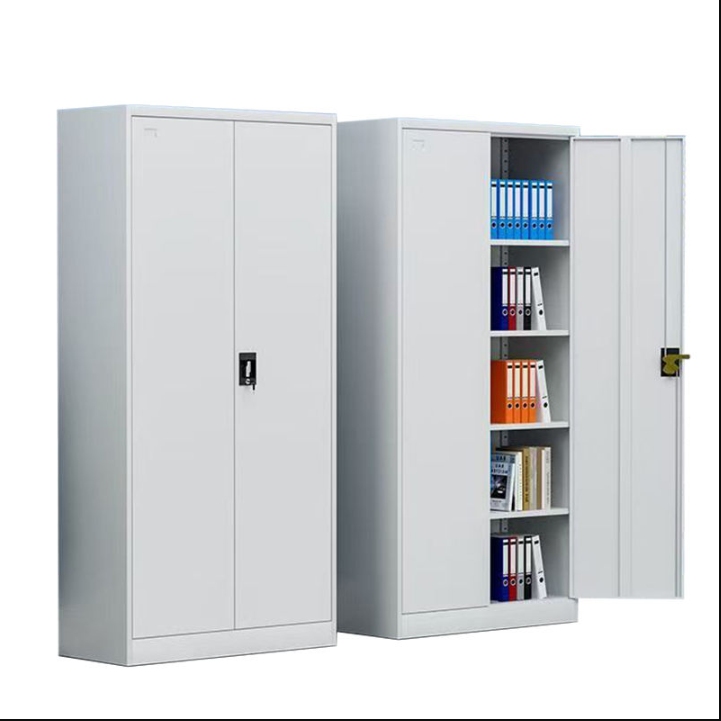
Product reference. Confirm the door panels, hardware and shelf configuration in the approved order.
5. Compare Usable Storage and Installation Requirements
Door appearance does not tell you how much usable space the cabinet provides.
Ask for the external dimensions, clear door opening and usable shelf width, depth and height. Include folder spines, container lids and handles when measuring stored items.
Specify the maximum load on each shelf, the intended load distribution and the simultaneous total cabinet load. Obtain the rating for the selected configuration rather than carrying a number across from a similar-looking cabinet.
Also confirm:
Shelf count, adjustment positions and supplied supports.
Access needed to remove the largest item.
Door-opening and handle clearance.
Lock arrangement, key quantities and any project-specific key grouping.
Installation instructions and model-specific stability or fixing requirements.
The installation review applies to both door types. A glass-versus-steel comparison should not replace it.
6. Plan Export Packing Around the Actual Delivery Route
For importers, the cabinet is only part of the purchasing decision. The packing must suit how the order will be handled after it leaves the factory.
For glass-door units, ask how the pack protects the panel edges and separates glazing from loose shelves or hardware. For solid-door units, review how broad door surfaces, corners and the coating are protected.
For either type, confirm whether the cabinet ships assembled or knock-down. If glazing or doors are installed at destination, agree the installation instructions and responsibility before ordering.
Request:
Package count and external package dimensions.
Net and gross weights.
Total packed volume, including pallets where used.
Packing drawings or photographs.
Handling and stacking instructions.
The process for identifying and ordering replacement panels or hardware.
If transport testing is required, agree the product, packaging, procedure and acceptance criteria. ISTA emphasizes understanding the actual distribution environment when selecting and interpreting packaging tests. A container shipment, warehouse transfer and individual parcel delivery should not automatically be treated as the same handling route. International Safe Transit Association
Do not describe a cabinet as “ISTA tested” unless documentation supports that specific claim.
7. Use This Checklist to Request Comparable Quotes
Send the same base requirements for both options, with differences shown explicitly.
Ask the supplier to identify any changes to the body, shelves or hardware between the glass-door and solid-door offers.
Compare the total purchase scope: cabinet supply, protective packing, transport, destination assembly and spare-part arrangements. Do not assume either door type is always cheaper once these items are included.
8. Review One Sample Against Its Intended Use
A useful sample review goes beyond approving the color.
Check the dimensions and usable openings, then place representative stored items inside. Review shelf supports, door alignment, handle clearance, locking, panel retention and visible finish condition.
For glass, compare the delivered panel with the agreed glazing specification and supporting records. For solid doors, inspect the surface and reinforcement details identified in the order.
KAYOU’s quality-control process covers production details including materials, dimensions, finish, accessories and packing. Agree the inspection scope and records applicable to your order.
Illustrative purchasing example: An office project may choose glass doors for shared reference books and solid doors for reserve stationery and general records. Both cabinet types can use a coordinated finish while following separate panel specifications.
This is a selection example, not a reported KAYOU customer project.
Frequently Asked Questions
Are all glass-door metal cabinets supplied with tempered glass?
No. The listing or photograph does not establish the glass type. State your requirement and confirm the material, thickness and supporting documents for the quoted model.
Do solid steel doors provide a higher shelf load capacity?
Door material alone does not determine shelf capacity. Compare the shelves, supports and complete cabinet configuration.
Is a glass-door cabinet dustproof?
A transparent panel does not establish a dustproof rating. Door gaps, joints, ventilation and sealing details must be reviewed if dust exclusion is important.
Can glass-door and solid-door cabinets be ordered for the same project?
Discuss both configurations in one enquiry. Confirm dimensions, finish consistency, model-specific quantities, packing and any minimum-order requirements.
Request a Cabinet Proposal from KAYOU
Tell KAYOU what you need to store, whether the contents should be visible, and where the cabinets will be installed.
Send the dimensions, shelf requirements, item weights, door mechanism, panel specification, quantity and destination. This gives the quotation a clear basis for comparing appearance, function and delivery scope.
Include your cabinet dimensions, door preference, shelf loads, quantity and delivery destination.
Technical References
Lyon — Metal Visible Storage Cabinet. Example of transparent panels specified as Plexiglas.
Pilkington — Glass Furniture. Glass products and treatments for furniture applications.
ISTA — Getting Started with Design & Testing. Distribution environments and packaging-test selection.
Final glazing, loads, installation and packing requirements should follow the approved specification for the selected cabinet.