

Industrial Pallet Racking Explained: Types, Components & Warehouse Applications
Industrial pallet racking is one of the most widely used storage solutions in modern warehouses, distribution centers and manufacturing facilities. It allows businesses to store palletized goods vertically, improve inventory organization and make better use of available warehouse space.
However, not every pallet racking system is suitable for every warehouse. Different rack structures offer different levels of storage density, pallet accessibility, loading efficiency and investment costs.
For warehouse operators, importers, distributors and project contractors, choosing the right industrial pallet racking system requires more than comparing product prices. Pallet dimensions, maximum load weight, forklift specifications, warehouse height and inventory turnover all need to be considered.
In this guide, KAYOU explains the main types of industrial pallet racking, their structural components, typical applications and the key factors buyers should evaluate before placing a bulk order.
1. What Is Industrial Pallet Racking?
Industrial pallet racking is a steel storage structure designed to hold palletized goods across multiple horizontal levels.
Unlike conventional warehouse shelving, pallet racking is generally designed for goods loaded and retrieved using forklifts or other material-handling equipment.
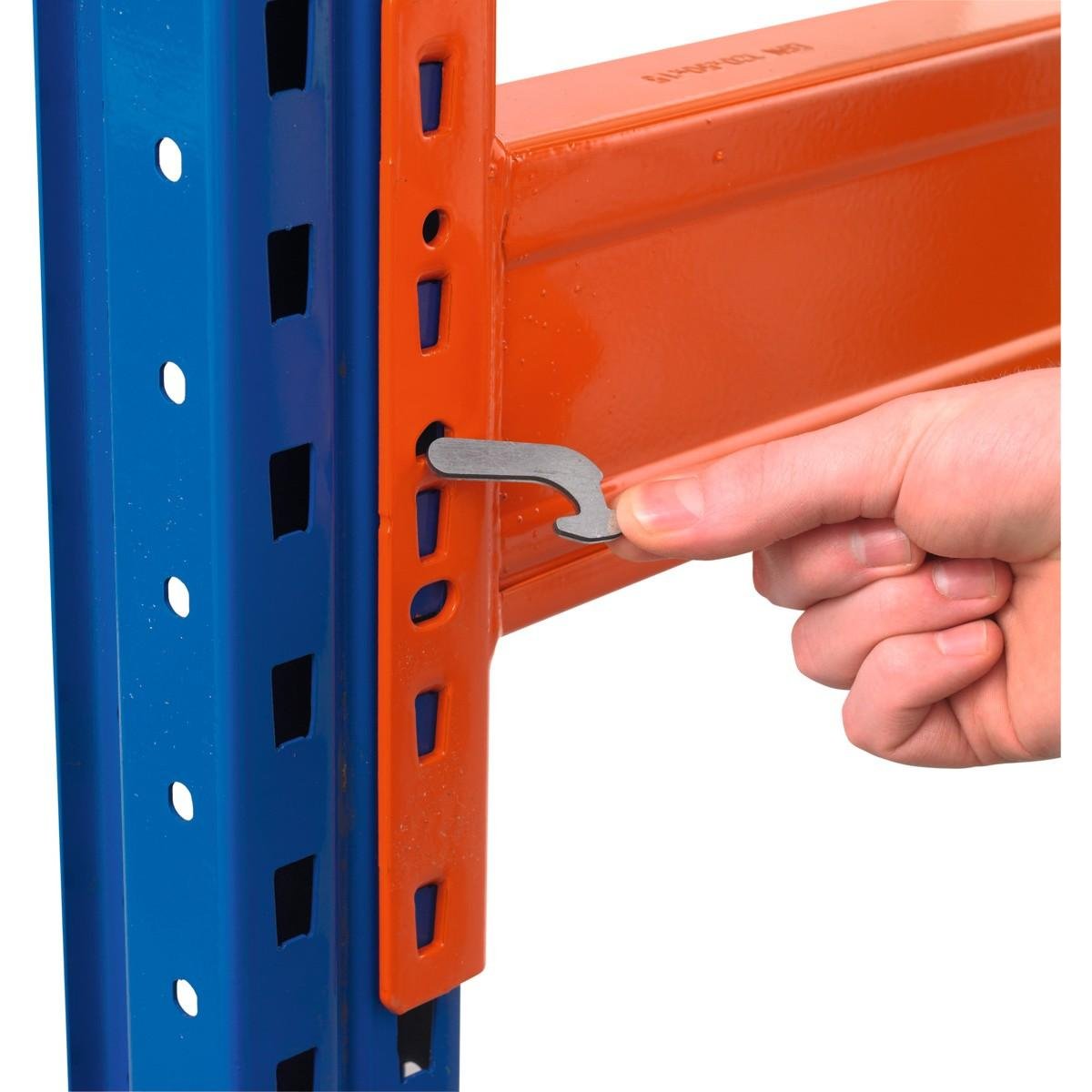
A typical pallet racking system consists of vertical upright frames, horizontal load beams, base plates, connecting components and optional safety accessories.
By using the available vertical warehouse space, businesses can:
Increase the number of pallet storage positions.
Organize inventory by SKU, batch or product category.
Improve loading and unloading efficiency.
Reduce dependence on floor stacking.
Make warehouse inventory easier to locate and manage.
Support future warehouse expansion and layout adjustments.
Industrial pallet racking is commonly used in logistics centers, manufacturing plants, wholesale distribution warehouses, e-commerce fulfillment centers and industrial storage facilities.
2. Main Components of an Industrial Pallet Racking System
Understanding the structural components is important when comparing manufacturers and evaluating product specifications.
2.1 Upright Frames
Upright frames are the vertical structural components that support the entire racking system.
Each frame normally consists of two vertical columns connected by horizontal and diagonal bracing.
Important specifications include:
Upright height and depth
Steel profile and section dimensions
Material thickness
Bracing configuration
Base plate dimensions
Connection and anchoring requirements
The frame configuration must be designed according to the number of beam levels, vertical spacing, applied loads and installation conditions.
2.2 Horizontal Beams
Beams connect the upright frames and support the pallet loads.
The beam length determines the number and arrangement of pallet positions within each bay.
When selecting beams, buyers should confirm:
Beam length and section profile
Required load per beam level
Pallet dimensions and loading arrangement
Beam-to-upright connection
Safety locking components
Beam capacity should always be confirmed for the specified span and loading configuration rather than estimated from appearance or steel thickness alone.
2.3 Base Plates and Floor Anchors
Base plates connect the upright frames to the warehouse floor and distribute structural loads.
Floor anchors help secure the rack against movement and contribute to overall stability.
The anchor type and installation requirements depend on the rack design, concrete slab condition, applied loads and applicable local requirements.
2.4 Pallet Supports and Wire Mesh Decking
Additional support components can be used when the pallet design or storage arrangement requires them.
Common options include:
Pallet support bars
Wire mesh decking
Steel decking panels
Wooden decking panels
These accessories help provide an appropriate supporting surface for specified pallet configurations. Their compatibility and load ratings must be confirmed for the actual system.
2.5 Safety Accessories
Depending on warehouse operations, a pallet racking project may also require:
Upright column protectors
End-of-row protectors
Beam safety locks
Row spacers
Load capacity labels
These components help protect the rack structure and support safer warehouse operations.
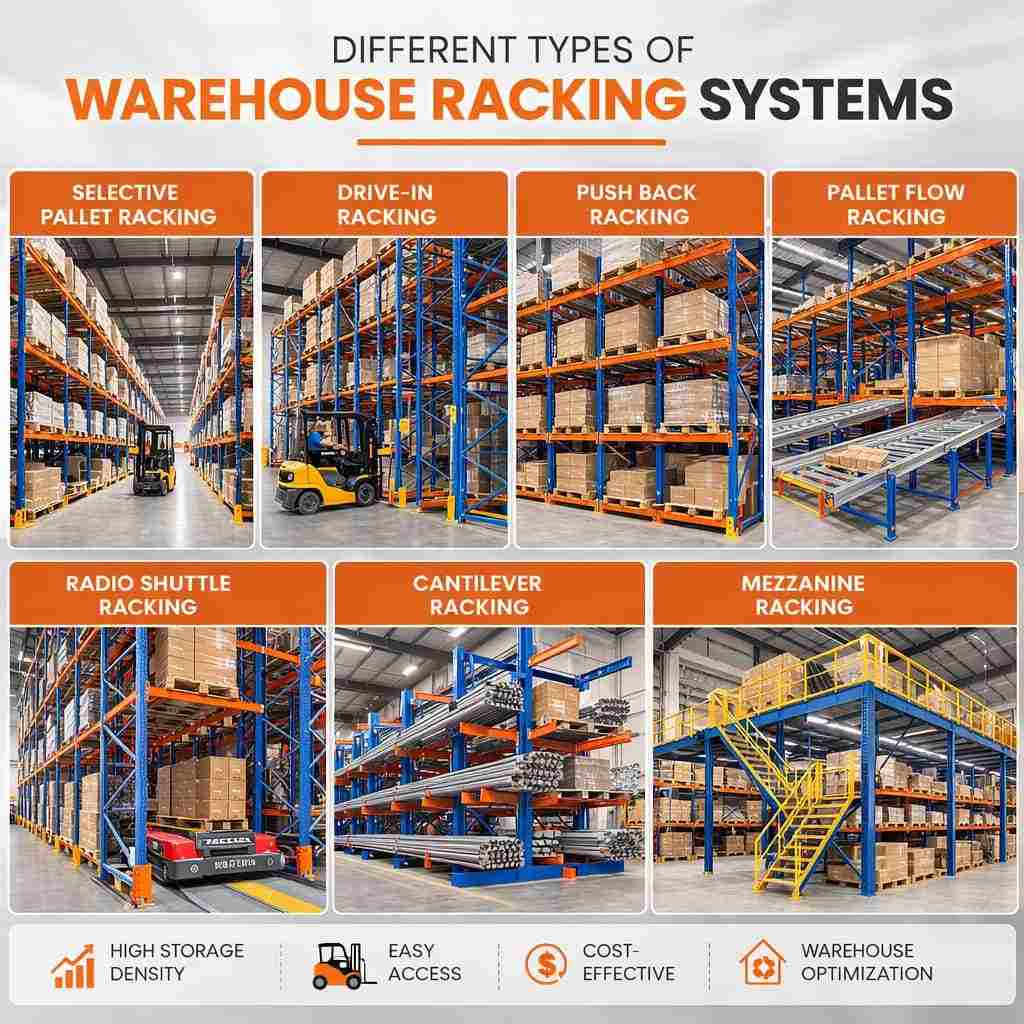
3. Common Types of Industrial Pallet Racking
Different pallet racking configurations are designed around different storage priorities. The most important considerations are storage density, direct pallet access, inventory rotation and forklift requirements.
| Racking Type | Storage Density | Pallet Accessibility | Typical Application |
|---|---|---|---|
| Selective Pallet Racking | Low to Medium | High | General warehouses |
| Double Deep Racking | Medium to High | Medium | Bulk inventory |
| Drive-In Racking | High | Low | Cold storage and homogeneous goods |
| Drive-Through Racking | High | Low | FIFO bulk storage |
| Push-Back Racking | High | Medium | Multiple-SKU storage |
| Pallet Flow Racking | Very High | Lane-based | FIFO distribution |
| Cantilever Racking | Application-dependent | High | Long and bulky materials |
3.1 Selective Pallet Racking
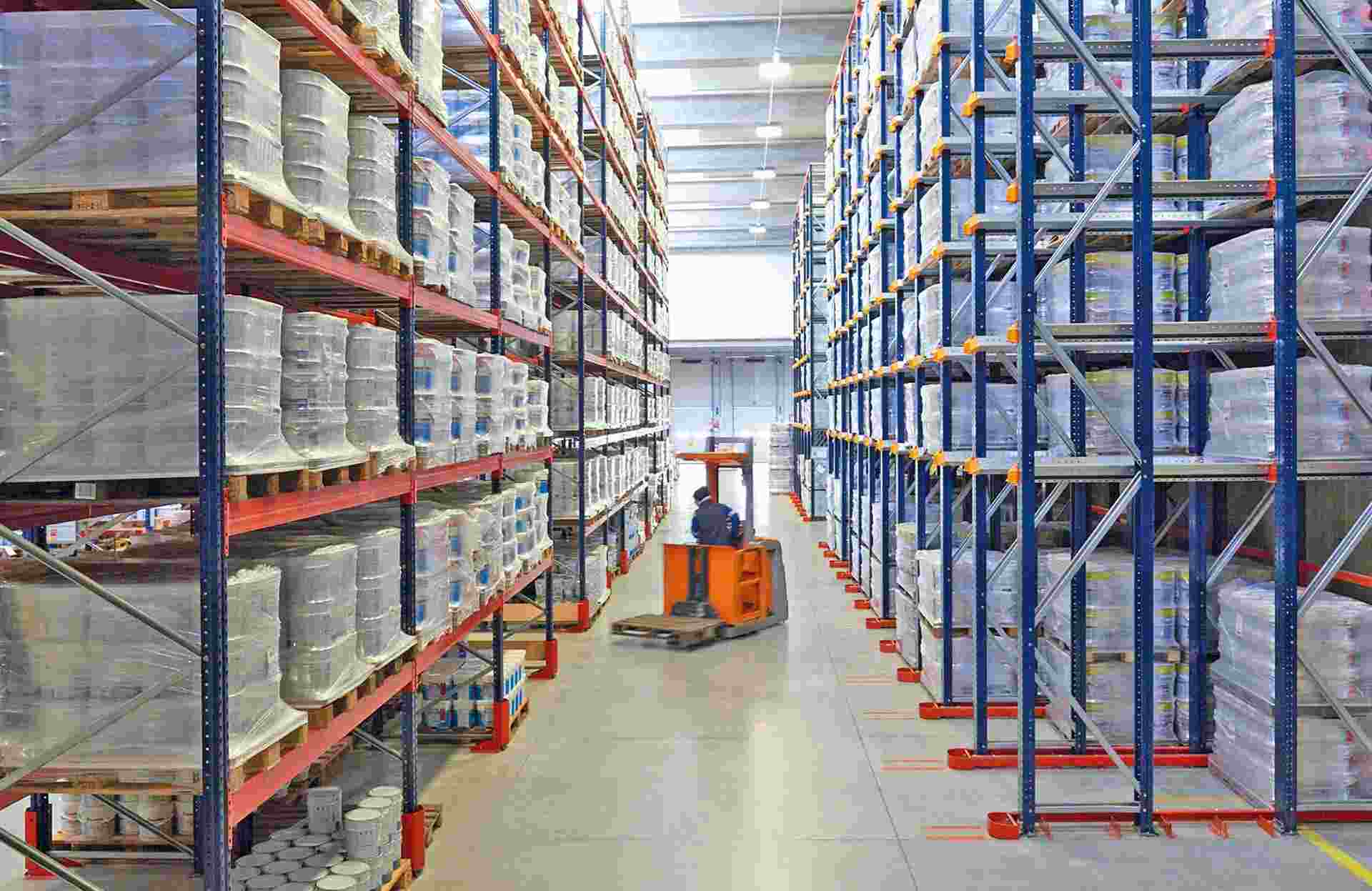
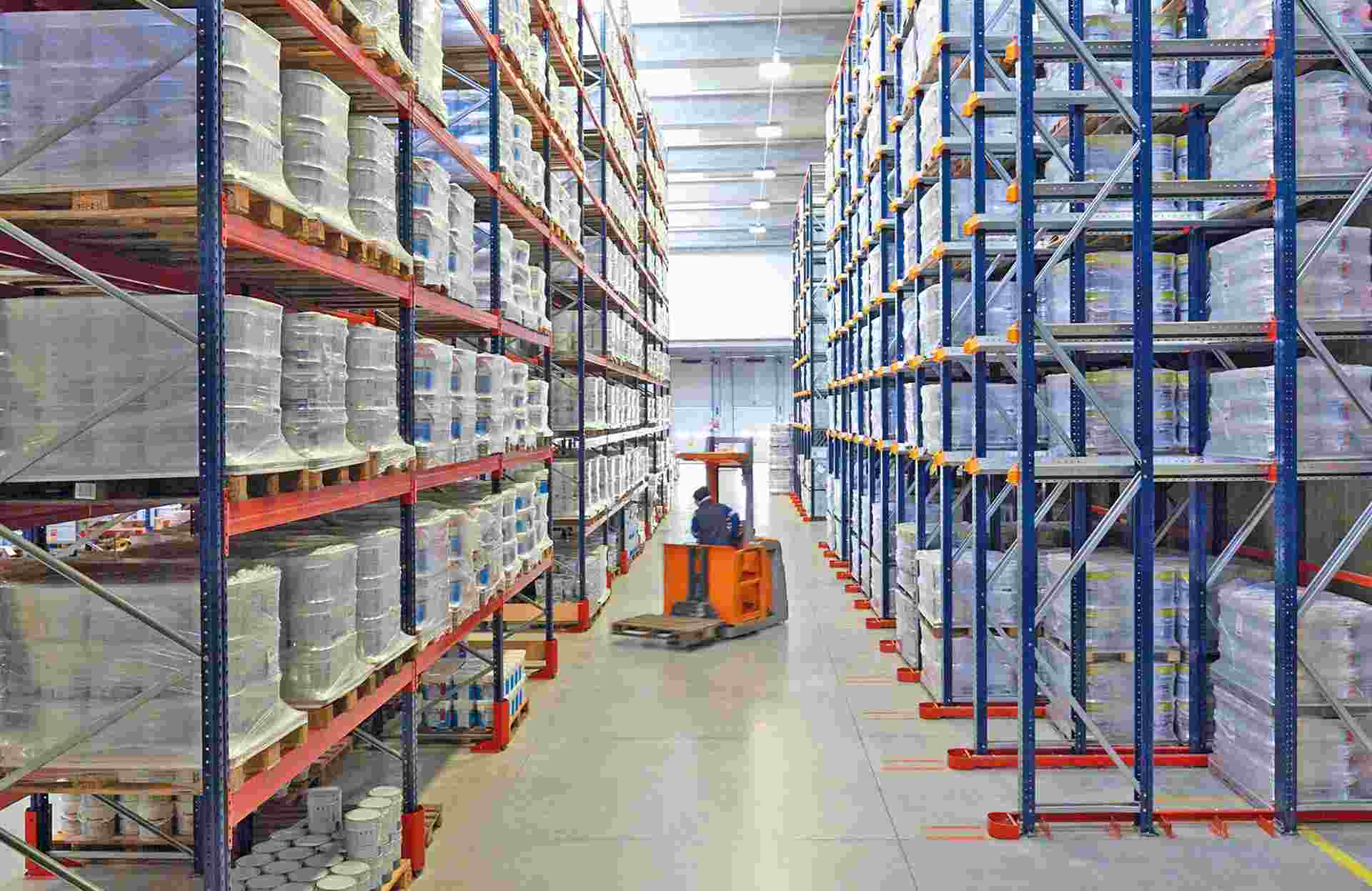
Selective pallet racking is one of the most common warehouse storage systems.
Each pallet position can be accessed directly from the operating aisle without moving other pallets.
Main advantages:
Direct access to individual pallets.
Suitable for warehouses with many SKUs.
Adjustable beam levels.
Relatively straightforward installation and expansion.
Compatible with various forklift configurations.
Typical applications:
General distribution centers
Manufacturing warehouses
Wholesale inventory storage
E-commerce fulfillment centers
Selective pallet racking is often a practical starting point for businesses that prioritize inventory accessibility and operational flexibility over maximum storage density.
3.2 Double Deep Pallet Racking
Double deep racking places two pallet positions in depth, allowing warehouses to store more pallets while reducing the number of operating aisles.
A specialized deep-reach forklift is normally required to access the rear pallet.
Main advantages:
Better floor-space utilization than conventional selective racking.
Increased pallet storage capacity within a similar warehouse footprint.
Suitable for products with multiple pallets per SKU.
Limitations:
Reduced direct access to individual pallets.
Requires compatible handling equipment.
Inventory rotation and pallet retrieval need careful planning.
This system is commonly considered for warehouses storing relatively large quantities of the same products.
3.3 Drive-In and Drive-Through Racking
Drive-in and drive-through racking are high-density storage systems designed to reduce the number of forklift aisles.
Forklifts enter dedicated storage lanes to place and retrieve pallets on supporting rails.
The main difference is the loading and unloading arrangement.
Drive-In Racking: Normally uses one operating end and follows a Last-In, First-Out (LIFO) inventory arrangement.
Drive-Through Racking: Allows access from both ends and can support First-In, First-Out (FIFO) inventory rotation.
Typical applications:
Cold storage warehouses
Food and beverage distribution
Bulk inventory storage
Warehouses handling large quantities of similar products
The main benefit is improved storage density, although pallet selectivity and forklift operating flexibility are reduced.
3.4 Push-Back Pallet Racking
Push-back racking uses nested carts or similar mechanisms on inclined rails.
When a new pallet is loaded, it pushes the existing pallets further into the storage lane. When the front pallet is removed, the remaining pallets move forward.
Main advantages:
High storage density.
Multiple SKUs can be assigned to different lanes.
Forklifts do not need to enter the rack structure.
Efficient use of available warehouse space.
Push-back systems generally operate on a LIFO basis and require compatible pallets and properly designed moving components.
3.5 Pallet Flow Racking
Pallet flow racking uses gravity rollers or wheel tracks to move pallets from the loading side toward the picking side.
Goods are loaded at one end and retrieved from the opposite end, supporting FIFO inventory management.
Typical applications:
Food and beverage warehouses
Pharmaceutical distribution
High-volume order fulfillment
Products requiring controlled stock rotation
This system can improve picking efficiency, but roller design, pallet compatibility, braking systems and maintenance requirements must be carefully evaluated.
3.6 Cantilever Racking for Long Materials
Cantilever racking is a specialized industrial storage solution for long, bulky or irregular materials that are difficult to store on conventional pallet racks.
Its open-front structure uses vertical columns and projecting support arms.
Common stored materials include:
Steel pipes and metal bars
Timber and lumber
Aluminum profiles
PVC pipes
Plywood and large panels
Long industrial components
KAYOU provides customizable single-sided and double-sided cantilever racking solutions for different material dimensions and warehouse layouts.
Explore KAYOU Cantilever Racking Systems.
4. Industrial Pallet Racking Applications by Industry
The best racking configuration depends on the type of products being stored and how frequently they need to be accessed.
Logistics and Distribution Centers
Distribution warehouses usually handle multiple SKUs and frequent inbound and outbound shipments.
Selective pallet racking is often suitable because it provides direct access to individual pallet positions.
For operations with large quantities of identical products, higher-density systems may also be considered.
Manufacturing Facilities
Manufacturing warehouses store raw materials, production components, work-in-progress inventory and finished goods.
The racking design should consider product weight, pallet dimensions, material flow and the relationship between storage and production areas. For projects that require additional storage levels, see KAYOU warehouse racking systems.
A combination of pallet racking and heavy-duty steel shelving may be appropriate when both palletized and manually handled goods need to be stored.
Cold Storage Warehouses
Cold storage facilities often face high operating costs because refrigerated space is expensive.
Drive-in racking can help increase storage density by reducing the number of operating aisles.
However, the rack finish, installation details, material handling equipment and operating environment must be considered during project planning.
E-Commerce Fulfillment Centers
E-commerce warehouses often need to manage a large number of SKUs and frequent picking activities.
Selective pallet racking can support reserve pallet storage, while industrial steel shelving can provide accessible picking locations for individual cartons and smaller products.
Combining different storage systems can create a more efficient warehouse workflow.
Building Materials and Steel Distribution
Warehouses handling long steel sections, pipes, timber and other irregular materials may benefit from cantilever racking rather than conventional pallet storage.
The support arm length, column spacing, material weight and handling equipment should all be specified before production.
5. How to Choose the Right Industrial Pallet Racking System
Before requesting a quotation, buyers should evaluate several important factors.
Step 1: Confirm Pallet Dimensions and Maximum Weight
Prepare the actual pallet specifications, including:
Pallet length and width
Total loaded height
Maximum loaded weight
Pallet base construction
Loading direction
Product overhang, if applicable
Do not use average pallet weight as the only design input. The maximum expected load should be identified.
Step 2: Check Warehouse Dimensions
Measure the available warehouse space, including:
Total warehouse length and width
Clear ceiling height
Column positions
Door and loading dock locations
Fire protection and utility installations
Available floor area
These measurements help determine the possible rack height, row arrangement and number of pallet positions.
Step 3: Match the Rack with Your Forklift
Forklift specifications directly influence warehouse layout.
Before choosing a rack configuration, confirm:
Forklift type and model
Maximum lifting height
Turning requirements
Manufacturer-specified operating aisle
Pallet handling direction
A narrow aisle does not automatically mean a more efficient warehouse if the forklift cannot operate safely within it.
Step 4: Define the Required Storage Density
Consider whether your warehouse prioritizes:
Direct access to every pallet
Maximum pallet positions
FIFO or LIFO inventory rotation
Fast picking and replenishment
Future warehouse expansion
The most space-efficient system is not always the most operationally efficient one.
Step 5: Confirm the Complete Load Specification
A professional quotation should clearly distinguish between:
Load per pallet position
Load per beam level
Total load per bay
Upright frame capacity
These ratings are not interchangeable.
The final structural capacity depends on the complete configuration, including beam span, upright dimensions, beam spacing, bracing, connections, floor conditions and anchoring.
For a more detailed discussion, read our Warehouse Rack Systems: Practical Buyer's Guide to Types, Loads, Layout and Cost.
6. Pallet Racking Safety: What Buyers Should Consider
Safety should be considered from the initial design stage rather than after installation. For more detail, read our guide to floor fixing and wall restraint for steel storage systems.
Important considerations include:
Load limits: Never exceed the approved load ratings. Capacity information should be clearly displayed and communicated to warehouse operators.
Floor anchoring: Confirm the floor condition and anchor requirements before installation.
Forklift protection: Consider upright guards and end-of-row protection in areas exposed to forklift movement.
Pallet condition: Damaged or unsuitable pallets can create unstable loading conditions.
Regular inspection: Check upright frames, beams, connections, locking components, anchors and protective accessories.
Unauthorized modifications: Do not cut, weld, replace or reposition structural components without an appropriate technical review.
Any rack damage should be reported and assessed by a competent person before the affected area returns to service.
Warehouse operators should also follow applicable local regulations, manufacturer instructions and relevant storage-racking safety requirements.
7. What Information Should You Prepare Before Buying Pallet Racking?
For importers, wholesalers, contractors and warehouse project buyers, providing complete specifications helps manufacturers prepare more accurate quotations.
Use the following checklist:
| Information | Details to Provide |
|---|---|
| Warehouse dimensions | Length, width and clear height |
| Pallet size | Length × width × loaded height |
| Maximum pallet weight | Maximum loaded weight per pallet |
| Required capacity | Total pallet positions |
| Rack configuration | Number of levels and bays |
| Forklift information | Type, model and lifting height |
| Warehouse layout | CAD drawing, PDF or floor plan |
| Surface treatment | Powder coating or galvanized finish |
| Accessories | Guards, safety pins, supports and decking |
| Order requirements | Quantity, destination and trade terms |
If you do not have a complete technical drawing, a warehouse sketch, product photographs and pallet information can be useful starting points.
8. Why Choose KAYOU for Industrial Pallet Racking?
KAYOU is a professional steel storage solution supplier providing customized warehouse racking and industrial storage products for global B2B customers.
Our warehouse racking range includes:
Selective pallet racking
Heavy-duty warehouse racking
Drive-in racking
Cantilever racking
Mezzanine racking systems
For wholesalers, importers, distributors and project contractors, KAYOU supports customization according to different project requirements.
Available customization options include:
Rack height, depth and beam length
Upright and beam specifications
Load capacity and storage levels
Steel material and thickness
Powder coating and color selection
Safety accessories and decking options
OEM/ODM branding and export packaging
We can also review warehouse dimensions, pallet specifications and storage requirements to help identify a suitable racking configuration.
Whether you are sourcing pallet racking for a new distribution center, expanding an existing warehouse or developing a bulk import program, KAYOU can support your project with customized product specifications and quotation services.
Explore our Warehouse Racking Systems to learn more.
Frequently Asked Questions About Industrial Pallet Racking
1. What is the most common type of industrial pallet racking?
Selective pallet racking is one of the most widely used systems because it provides direct access to individual pallets and accommodates a wide range of SKUs.
2. Which pallet racking system provides the highest storage density?
Drive-in and pallet flow systems can provide high storage density, depending on the warehouse layout and operating requirements. However, higher density may reduce direct pallet accessibility.
3. What is the difference between pallet racking and heavy-duty shelving?
Pallet racking is designed primarily for palletized goods handled by forklifts. Heavy-duty shelving is generally designed for non-palletized products such as cartons, tools, spare parts and industrial components that are accessed manually.
Read our guide: Medium Duty vs Heavy Duty Shelving vs Pallet Racking.
4. How much weight can industrial pallet racking hold?
Load capacity depends on the complete rack configuration, including beam dimensions, upright profiles, beam spacing, pallet arrangement and structural design.
Always request the approved load specifications rather than relying on a general capacity claim.
5. Can pallet racking be customized?
Yes. Industrial pallet racking can be customized according to warehouse dimensions, pallet sizes, load requirements, rack height, beam levels, colors and accessories.
6. Does pallet racking need to be anchored to the floor?
Floor anchoring is commonly required for industrial pallet racking, but the exact fixing arrangement must follow the approved design, site conditions and applicable local regulations.
7. What is the difference between FIFO and LIFO racking?
FIFO means First-In, First-Out, where the first stored goods are retrieved first. LIFO means Last-In, First-Out, where the most recently stored goods are retrieved first.
Drive-through and pallet flow systems can support FIFO arrangements, while drive-in and push-back systems typically operate on a LIFO basis.
8. What should I send to a manufacturer for a pallet racking quotation?
Provide your warehouse dimensions, pallet size, maximum loaded weight, required pallet positions, forklift specifications, preferred rack levels and delivery destination.
A warehouse layout drawing is especially helpful for project-based quotations.
Get a Customized Industrial Pallet Racking Solution from KAYOU
Looking for a reliable industrial pallet racking manufacturer for your warehouse project or wholesale business?
Send KAYOU your warehouse dimensions, pallet specifications and storage requirements.
Our team can help review your requirements and provide a suitable warehouse racking proposal and quotation.
Get a free storage solution quote within 12 hours.
WhatsApp: +86 158 3799 8881
Website: https://www.kayoushelf.com/