

Stainless Steel Shelves for Commercial Kitchens
KAYOU · BUYER GUIDE
By KAYOU
Imagine choosing a 900 mm wide rack for two lidded ingredient bins. The quote gives the rack’s outside width, but the posts take up some of the space the bins need. During a busy shift, staff also need room to grip the bins and lift them past the shelf above.
Start with four checks when buying stainless steel shelves for a commercial kitchen. Measure the largest loaded container, choose a shelf surface that suits what you store, check the grade against your cleaning routine, and confirm the load rating for the exact configuration. This guide covers freestanding racks for kitchen teams, equipment dealers, and project buyers.
ILLUSTRATIVE FIT CHECK
810 mm
Usable shelf width
380 mm
Bin 1 20 mm
gap 380 mm
Bin 2
Bin 1 20 mm
gap 380 mm
Bin 2
Includes 15 mm clearance at each end.
Measure the space your staff can actually use
Measure the biggest items with their lids, handles, and feet in place. On the rack drawing, ask for clear width between the posts, usable depth to the rear stop or wall, and clear height to the underside of the shelf above. Overall dimensions help you check the room layout. Clear dimensions tell you whether staff can load and retrieve the items.
For example, two bins that measure 380 mm across the handles need 760 mm side by side. If your team wants 20 mm between the bins and 15 mm at each end, ask for 810 mm of usable width. Those allowances are illustrative. Try the fit with the actual bins and the gloves your staff wear, especially if they carry a bin with both hands.
Check depth and height the same way. A rear lip can keep a container from sitting flat, and a beam under the next shelf can reduce the space available for lifting. If you plan to add another shelf later, ask what clear opening will remain and where the supports can be positioned.
Mark the rack footprint on the floor before approving the layout. Open nearby refrigerator and cabinet doors, then run a cart through the normal route. Measure the delivery route too, including the tightest doorway and corner. Ask for the largest packed component if the rack will arrive disassembled.
Match the shelf surface to the goods and the cleaning routine
Start with the items that are hardest to store. A small spice tub needs a stable base. A wide tray needs enough flat support. A damp utensil basket may benefit from openings, provided the location and the items below can accommodate drips.
| Shelf style | A good starting point for | What to check on the sample |
|---|---|---|
| Solid | Small containers, cartons, and items with narrow feet | Containers sit flat. Staff can reach the edges and underside for cleaning. The lip, if supplied, allows a loaded bin to slide out. |
| Perforated | Containers or trays that need a flat surface with some airflow or drainage | The hole size and pattern support the smallest item. Check how the underside is cleaned and where water goes. |
| Wire | Larger bins and baskets where an open deck is useful | Narrow feet stay supported and the container sits level. Check wire spacing, cleaning access at intersections, and the effect of drips on lower levels. |
If a single unit will hold mixed goods, ask the supplier to identify each deck type and its rating on the drawing. In a zone where items can drip, show what will be stored below before you choose an open deck. Agree on where any drip tray goes and how staff remove it for cleaning. KAYOU offers flat, perforated, and wire shelf options for its configurable stainless steel rack. KAYOU stainless steel rack configurations
Compare 201, 304, and 316 against actual exposure
Write down where the shelves will sit and what reaches them during an ordinary shift. Record condensation, sink splash, brine or salt residue, and the cleaners or sanitizers used in that zone. Share the product names, in-use concentrations, and contact times with the supplier. A dry storeroom and the area beside a wash station can call for different specifications within the same building.
| Grade | Where to begin the discussion | What to confirm |
|---|---|---|
| 201 | A dry indoor store with limited moisture and chemical exposure | Verify how the space is cleaned and whether the goods or the project call for a different grade. |
| 304 | Many indoor commercial kitchen and back-of-house storage areas | Confirm the cleaning products, splash exposure, and routine for removing residue. |
| 316 | Locations with recurring salt exposure or more demanding corrosion conditions | Review the specific exposure, including concentrated cleaners and areas that stay wet. |
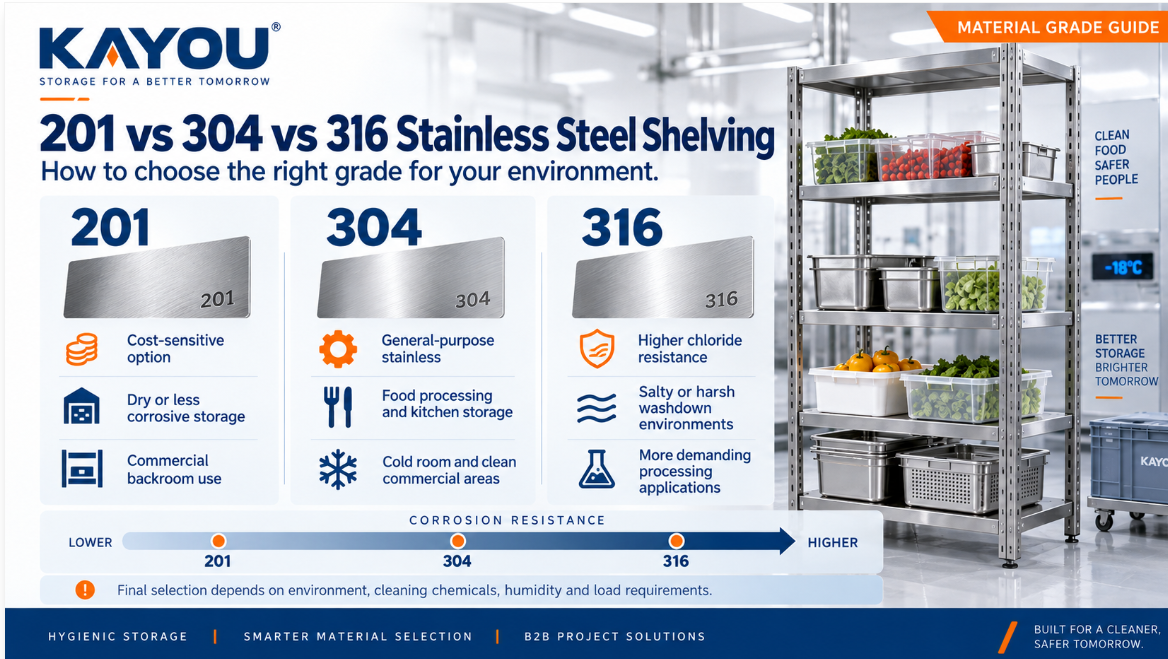
The molybdenum in 316 generally gives it greater resistance to chloride-related pitting than 304. Grade selection still depends on the exposure, and the approved cleaner matters for either grade. Ask the supplier to confirm the grade by component, including the decks, frames, supports, and any hardware for which you have a material requirement. Agree on the material records you need before production. Outokumpu Core stainless steel datasheet · Outokumpu Supra stainless steel range
For routine care, confirm that the shelf maker’s instructions work with your kitchen’s sanitation procedure. Give the cleaning team access to the seams, undersides, and feet. Follow the chemical label and the site procedure for dilution, contact time, and any required rinsing. worldstainless guidance on commercial food equipment
How much weight can stainless steel shelves hold?
Use the ratings for the exact shelf span, deck, supports, and assembled unit. A uniformly distributed load (UDL) is spread across the shelf. A compact appliance on feet or a stack of dense containers concentrates weight in a smaller area. Give the supplier the weight, footprint, contact points, and intended position so it can assess that loading pattern.
Return to the two-bin example. If each filled bin weighs 24 kg, their combined load is 48 kg per occupied level. Three levels with that same pair total 144 kg of stored goods. Those figures describe what the kitchen wants to store. The supplier still needs to confirm the load for the bin footprints and the total allowed for the assembled rack.
Ask for a written rating that identifies these details:
Per-level capacity for the quoted clear span, deck type, and support arrangement.
Total capacity for the unit when the planned levels are loaded together.
Placement conditions, including how the load must be distributed and any limits for concentrated loads.
Assembly conditions that affect the rating, such as the required support beams, feet, bracing, or fixing details.
Have the supplier put the ratings and their conditions on the same drawing or specification revision as the order. If the kitchen later changes the layout, moves a heavy item onto the rack, or removes a support to make room, ask the supplier to check the revised configuration before using it.
Check cleaning access, installation, and documentation
Look at the floor around the feet, the gap behind the rack, and the clearance under the lowest level. Decide how staff will reach those areas during cleaning. Show the installer the floor condition, walls, and any coving or drainage slope. Ask the supplier to confirm the leveling range and specify any required restraints or fixings for the proposed installation.
For a U.S. foodservice project, identify the rules that the local authority applies before fixing the bottom shelf height. Section 3-305.11 of the FDA’s model Food Code generally calls for food to be stored at least 6 inches (15 cm) above the floor, with exceptions for specified situations. Confirm whether the applicable rules cover your goods and location. FDA Food Code and adoption context · FDA Food Code, section 3-305.11
If the project specifies NSF/ANSI 2 certification, request the exact model or component identifiers and check the listing and its conditions of use. Some shelving listings are limited to dry storage. Record any required listing against the quoted configuration, especially when the quote allows changes to the deck or supports. NSF food equipment standards · NSF certified shelving listings
Approve a representative rack before a rollout
For a rollout across multiple locations, agree which first unit will represent the production order. Use its drawing, parts list, and assembly instructions together. The KAYOU diagram below shows the shelf panels, support beams, side frames, and feet as separate parts. Ask the supplier to identify those parts on the drawing so your receiving team can check the delivered configuration.

Check fit. Measure the clear shelf opening and place the intended containers on the approved sample within its stated load limits. Open lids and lift the containers out the way staff will during service.
Check access. Walk through the approved cleaning procedure with the team. Look for corners that are hard to reach, sharp edges, and places where water remains after cleaning.
Check the build. Compare the decks, support beams, and feet with the parts list. Record the finish, dimensions, and any issues against the drawing revision.
Close changes in writing. If you change the depth, support layout, or deck type, ask the supplier to update the drawing and relevant ratings. Keep the sample record with the purchase order for repeat orders.
Agree on the inspection records you expect to receive and when you need them. KAYOU describes its material, production, and final checks on its quality-control page. Ask which records are available for the configuration you are buying. KAYOU quality-control process
Copy this stainless steel shelving RFQ checklist
Send one brief per rack configuration. Put an open question such as the grade choice in a separate field, then ask the supplier to state the assumptions behind its proposal.
| Include in your brief | What to send |
|---|---|
| Location and cleaning | Kitchen zone, moisture or salt exposure, cleaner names, and the cleaning routine. |
| Goods and fit | Largest container dimensions including handles and lids, clear shelf width and depth, vertical opening, and the space available in the room. |
| Load | Filled weight and count per level, footprint of heavy items, and which levels will be loaded at the same time. |
| Rack configuration | Number of levels, shelf style by level, grade by component if specified, finish, feet, and required installation details. |
| Evidence and delivery | Required material or certification records, inspection scope, order quantity, destination, and packing or labeling instructions. |
Ask for a dimensioned drawing, ratings for the proposed build, and a quote that lists any substitutions separately. For larger orders that mix kitchen racks with general warehouse shelving, use the warehouse RFQ template for the additional configurations. KAYOU warehouse shelving RFQ template
Discuss your shelving project with KAYOU
Have a floor sketch or an existing shelf that needs replacing? Send KAYOU the sketch, the largest container dimensions, and your expected quantity. Include a photo of the installation area if the room has pipework, drains, or other restrictions.
Request a KAYOU shelving quotationFrequently asked questions
Can 304 stainless steel shelves go in a walk-in cooler?
Grade 304 can suit many walk-in coolers. Check persistent condensation, salt exposure, and the cleaning procedure before approving it. Ask the cooler supplier about clearances around equipment and airflow when you lay out the racks. KAYOU shelving guide for cold rooms and food processing
Can a magnet tell 304 and 316 stainless steel apart?
A magnet alone cannot reliably identify the grade. Forming or drawing the steel can change its magnetic response. Use traceable material documents and agree on an appropriate grade verification method with the supplier when the project requires one. ASSDA technical guide to grade confirmation
Can I put casters on an existing stainless steel rack?
Use casters only if the rack supplier approves a mobile configuration for that frame. Ask for the assembled unit’s mobile load rating, the specified casters and brakes, and any limits on moving the rack while loaded.
Can I add more shelf levels after installation?
Check with the supplier using the original rack model and drawing revision. Confirm the compatible deck and supports, the minimum clear spacing needed for your goods, and the unit’s total rating with the added level in place.
What should I record if I need replacement panels later?
Keep the shelf part code, overall dimensions, support type, grade, finish, and drawing revision. Send those details with a photo of the connection or support when ordering replacements. A matching outside width can still leave the new panel with the wrong support or fit.