
Global Certifications Matter: How KAYOU Builds Steel Shelving for International Markets
For international warehouse projects, choosing a shelving supplier is no longer simply a matter of comparing dimensions, load capacity and price.
Professional importers, distributors, contractors and warehouse operators increasingly ask another question:
Can the manufacturer provide verifiable evidence that its products, materials and manufacturing processes meet the standards required for my market?
At KAYOU, we believe product quality should be supported by more than a sales claim.
A reliable steel shelving and warehouse racking system should be supported by technical documentation, material traceability, manufacturing controls, product testing and appropriate compliance documents.
This becomes particularly important when supplying warehouse storage systems to customers in Europe, North America, Australia, the Middle East, Asia and other international markets.
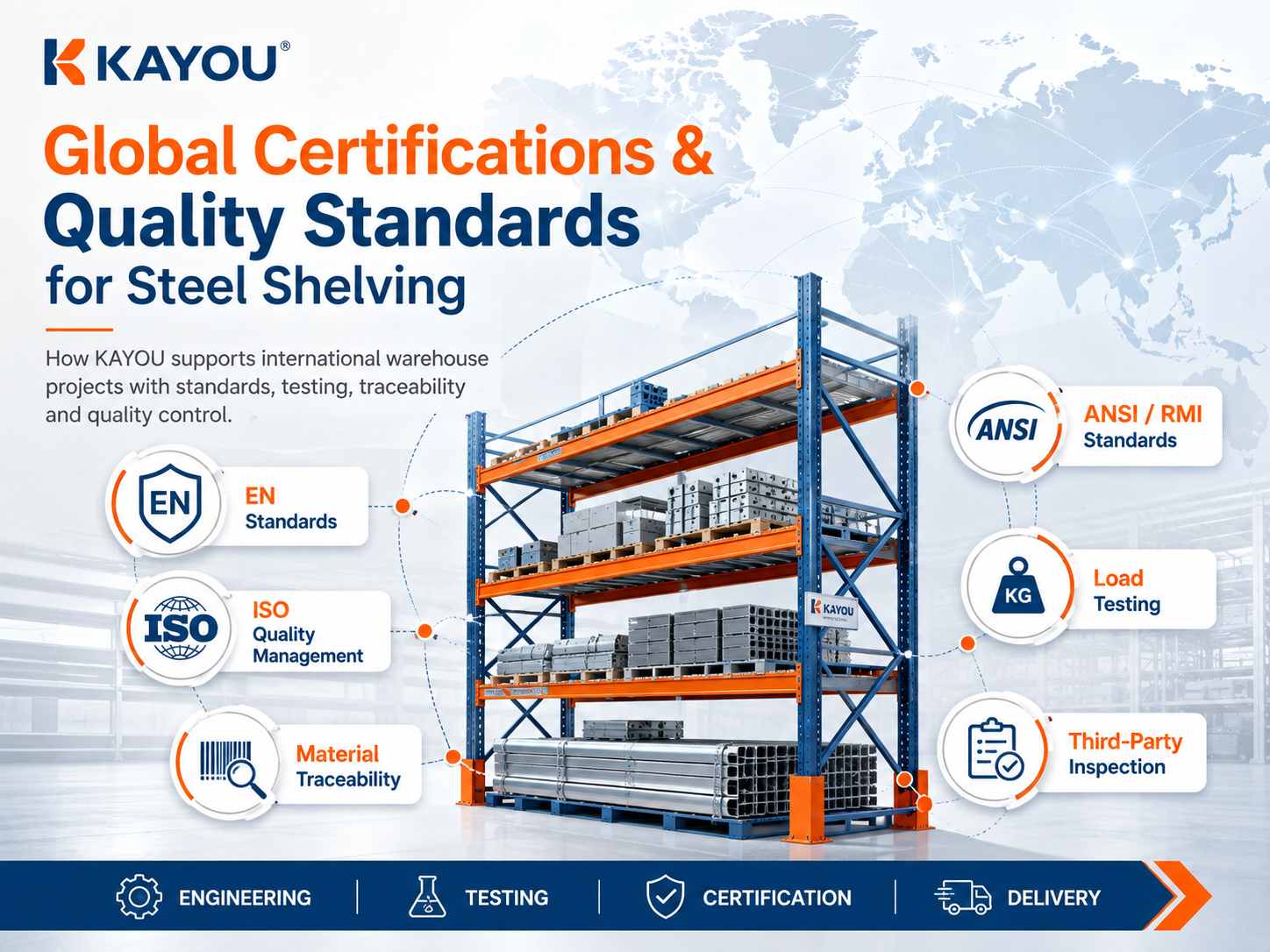
Why Are Certifications Important for Warehouse Racking?
Warehouse shelving carries real loads every day.
A rack may store cartons weighing only a few kilograms, while an industrial pallet racking system may support several tons across multiple beam levels.
Failures can affect:
Stored products
Warehouse equipment
Employees
Buildings
Production continuity
Insurance and project approval
This is why professional warehouse buyers should not evaluate racking only by appearance.
The engineering behind the structure matters.
Important factors include:
Steel grade + steel thickness + upright profile + beam design + connection structure + welding quality + load distribution + anchoring + installation + operating conditions.
International standards provide a common technical framework for evaluating these factors.
Different Markets Use Different Racking Standards
There is no single certificate that automatically makes a warehouse rack suitable for every country.
Different markets and product categories may reference different standards.
That is why KAYOU approaches international projects according to the destination market, rack type, loading conditions and project requirements.
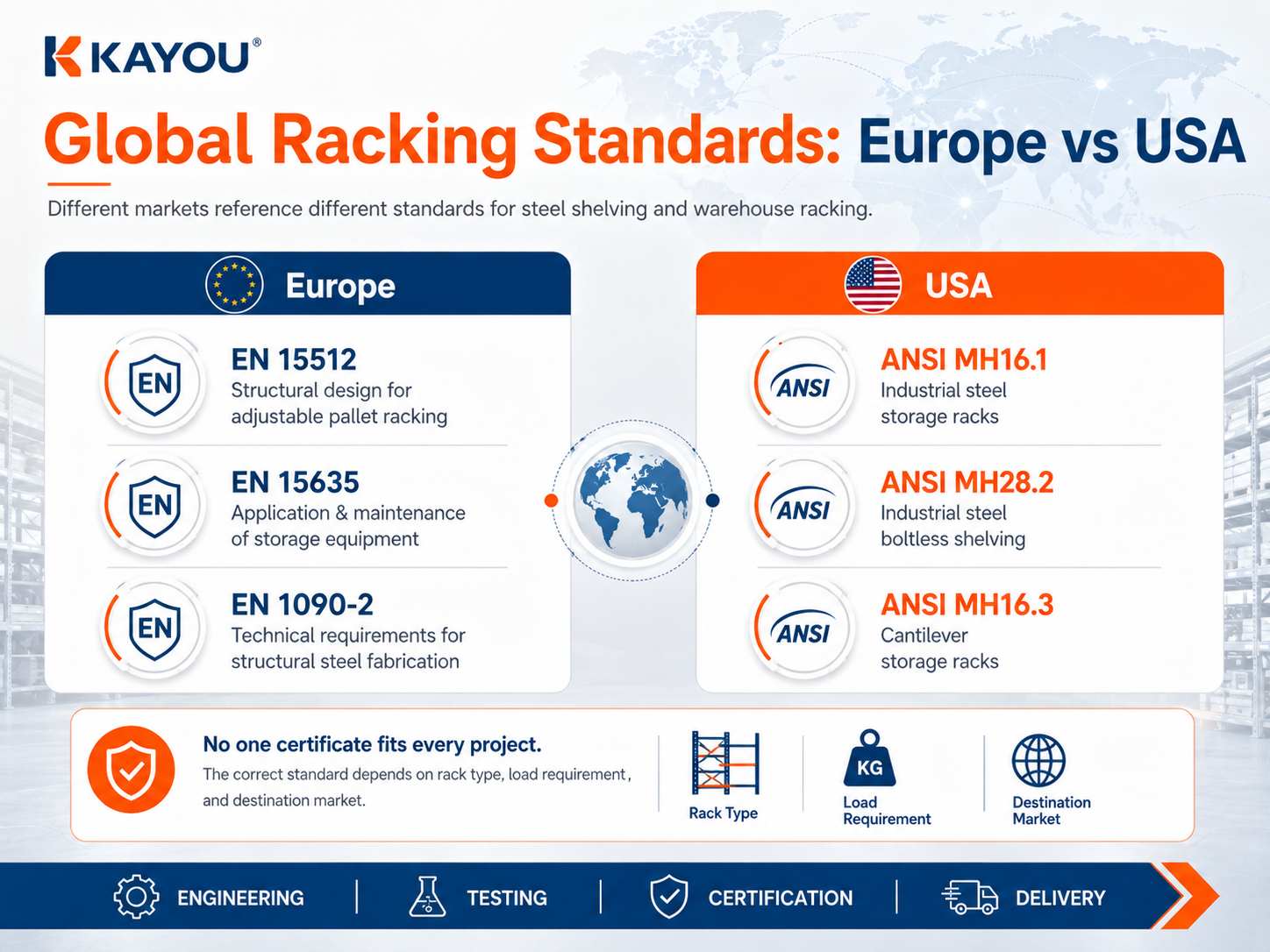
European Market
For adjustable pallet racking, EN 15512 establishes structural design requirements for steel adjustable beam pallet rack systems. The current BS implementation is BS EN 15512:2020+A1:2022.
Another important European reference is EN 15635, which addresses the application and maintenance of steel static storage systems and focuses on maintaining structural safety during use.
For projects involving structural steel fabrication, EN 1090-2:2018+A1:2024 specifies technical requirements covering areas such as materials, fabrication, welding, geometrical tolerances, inspection and testing.
For KAYOU, these standards provide an important technical reference when preparing suitable solutions for European warehouse and structural-storage projects.
North American Racking Standards
The United States and other North American projects frequently reference standards developed through ANSI and the Rack Manufacturers Institute.
For industrial steel storage racks, ANSI MH16.1-2023 specifies minimum requirements for structural design, testing and utilization of industrial steel storage racks.
Different storage products may require different standards.
For example:
Industrial steel boltless shelving:
ANSI MH28.2-2022
This standard covers industrial steel boltless shelving, including certain multi-level and mobile configurations.
Cantilever racking:
ANSI MH16.3-2025
The current standard specifies minimum requirements for the design, testing and utilization of industrial steel cantilevered storage racks.
This demonstrates an important point:
Professional racking compliance should be product-specific rather than based on one generic certificate.
KAYOU's Global Quality Documentation System
For international B2B buyers, certification is only one part of quality assurance.
KAYOU focuses on building a more complete chain of evidence covering the entire product process.
1. Quality Management
A professional quality management system helps control every stage from raw-material purchasing through production and final inspection.
Important control points include:
Incoming steel inspection
Material specifications
Steel thickness
Cutting and punching dimensions
Welding quality
Surface preparation
Powder coating
Component dimensions
Assembly compatibility
Packaging inspection
For international projects, relevant quality-management documentation can be supplied according to the product and contractual requirements.
ISO explains that a quality management system is intended to help organizations consistently provide products that meet customer and applicable regulatory requirements.
For buyers, this is far more meaningful than simply checking the appearance of a finished rack.
2. Raw Material Traceability
A strong shelving system begins with qualified steel.
For this reason, raw-material documentation is an important part of KAYOU's quality-control process.
Depending on project requirements, buyers can request documentation relating to:
Steel grade
Steel mill information
Material thickness
Chemical composition
Mechanical properties
Material certificates
Batch identification
Incoming material inspection
For large warehouse projects, this allows the project team to trace critical structural components back to the material used during manufacturing.
Why does this matter?
Consider two upright posts that look almost identical after powder coating.
One may use the specified steel thickness.
The other may use thinner material.
From appearance alone, the difference may be difficult to identify.
That is why KAYOU places emphasis on measurable specifications instead of visual assumptions.
3. Steel Thickness Verification
Steel thickness is one of the most frequently discussed topics when international buyers compare shelving suppliers.
For example, a quotation may state:
1.0 mm upright
But what does that actually mean after the product arrives?
A professional supplier should be able to verify it.
KAYOU can perform steel thickness inspection using precision measuring equipment and provide measurement records when required.
For important projects, customers may also arrange independent third-party inspection before shipment.
This provides buyers with another layer of verification rather than relying only on the quotation.
4. Structural Design and Engineering Calculations
Load capacity cannot be determined simply by increasing steel thickness.
A warehouse rack is a structural system.
Its performance depends on how different components work together.
For a typical pallet or industrial shelving system, engineering considerations may include:
Upright section
Beam section
Steel grade
Beam span
Shelf depth
Number of levels
Bracing configuration
Beam-to-upright connection
Base plate
Anchoring
Horizontal forces
Vertical loads
Seismic requirements where applicable
This is why KAYOU first asks customers for their actual application rather than simply recommending the thickest rack.
For customized projects, information such as warehouse layout, pallet dimensions, load per level, number of levels and building conditions allows engineers to develop a more appropriate solution.
5. Load Testing: A Certificate Should Be Supported by Real Performance
One of the most important parts of rack qualification is load performance.
A label saying:
“500 kg per shelf”
does not tell the whole story.
Professional testing should also consider:
How is the load distributed?
What is the beam span?
What is the allowable deflection?
How does the connection behave under load?
Is the rack permanently deformed after unloading?
These questions are particularly important for:
Heavy-duty shelving
Pallet racking
Long-span shelving
Cantilever racks
Mezzanine structures
Mobile shelving
High-density storage systems
KAYOU can conduct product and load verification according to project requirements and can cooperate with third-party inspection organizations where independent verification is required.
A Load Rating Is Not Just a Number
Suppose two suppliers both advertise:
300 kg per shelf
This does not necessarily mean both racks provide the same structural performance.
Supplier A may use:
Different upright geometry
Thinner steel
Smaller beams
Fewer support bars
Different connection structures
Supplier B may optimize the entire structure.
Therefore:
Load Capacity ≠ Steel Thickness Alone
A more meaningful comparison is:
Material + Profile + Beam + Connection + Support + Testing + Safety Factor
This is why technical documentation is especially important for professional procurement.
6. Welding and Fabrication Quality
For welded shelving, mezzanine floors and structural storage products, welding quality can significantly influence structural performance.
Quality control may include inspection of:
Weld position
Weld length
Penetration
Weld continuity
Visible defects
Component alignment
Dimensional tolerance
For structural-steel projects where EN 1090 requirements apply, the standard specifically addresses areas including manufacturing, welding, tolerances, inspection and testing.
For KAYOU, controlled manufacturing is particularly important for customized products where structures cannot simply be evaluated as standard commodity shelving.
7. Powder Coating and Surface Quality
Structural strength is essential, but durability also matters.
Steel shelving may operate in:
Warehouses
Workshops
Distribution centers
Retail stockrooms
Industrial facilities
Cold-storage environments
Spare-parts centers
KAYOU therefore controls the surface-treatment process according to the project requirements.
Typical stages may include:
Surface preparation → cleaning → powder coating → curing → appearance inspection → coating inspection
Customers with special environmental requirements can also specify coating or corrosion-resistance requirements during project development.
8. Environmental and Workplace Management
International procurement teams increasingly consider not only the product but also how it is manufactured.
Environmental management standards such as ISO 14001 provide organizations with a framework for systematically managing environmental responsibilities and improving environmental performance. ISO published the latest ISO 14001:2026 edition in April 2026.
Occupational health and safety can also be managed through standards such as ISO 45001:2018, which provides a framework for managing workplace health and safety risks.
For global supply chains, this broader management perspective is becoming increasingly relevant alongside traditional product quality.
9. Third-Party Inspection Is Welcome
One of the strongest indicators of supplier confidence is whether the manufacturer allows customers to verify its claims.
For KAYOU projects, buyers can arrange third-party inspections according to order requirements.
Inspection may include:
Product dimensions
Steel thickness
Quantity
Color
Surface quality
Welding
Accessories
Packaging
Loading condition
Product labeling
Functional assembly
Depending on the project, testing agencies or customer-appointed inspection companies can also participate before shipment.
This creates a much stronger level of transparency for international procurement.
10. Documentation Before Shipment
A professional warehouse project should not end when production is finished.
Before shipment, buyers may require a documentation package.
Depending on the product and project scope, KAYOU can prepare relevant documents such as:
Product specification sheets
Technical drawings
Material documentation
Inspection records
Thickness measurements
Load information
Packing lists
Installation instructions
Quality documents
Project photographs
Container loading information
Third-party inspection documentation when arranged
This is particularly valuable for distributors and project contractors who need to submit documentation to their own customers.
Certification Is Not a Logo Collection
This is one of the most important differences between professional industrial procurement and consumer purchasing.
A website may display many certification logos.
But international buyers should ask:
Is the certificate valid?
Who issued it?
What product does it cover?
What standard was used?
Is the manufacturer's name correct?
Is the certificate within its validity period?
Can the supplier provide the original document?
Does the tested specification match the product being purchased?
KAYOU encourages customers to evaluate certificates this way.
Because the objective is not to have the largest number of logos.
The objective is to provide verifiable evidence for the actual product being purchased.
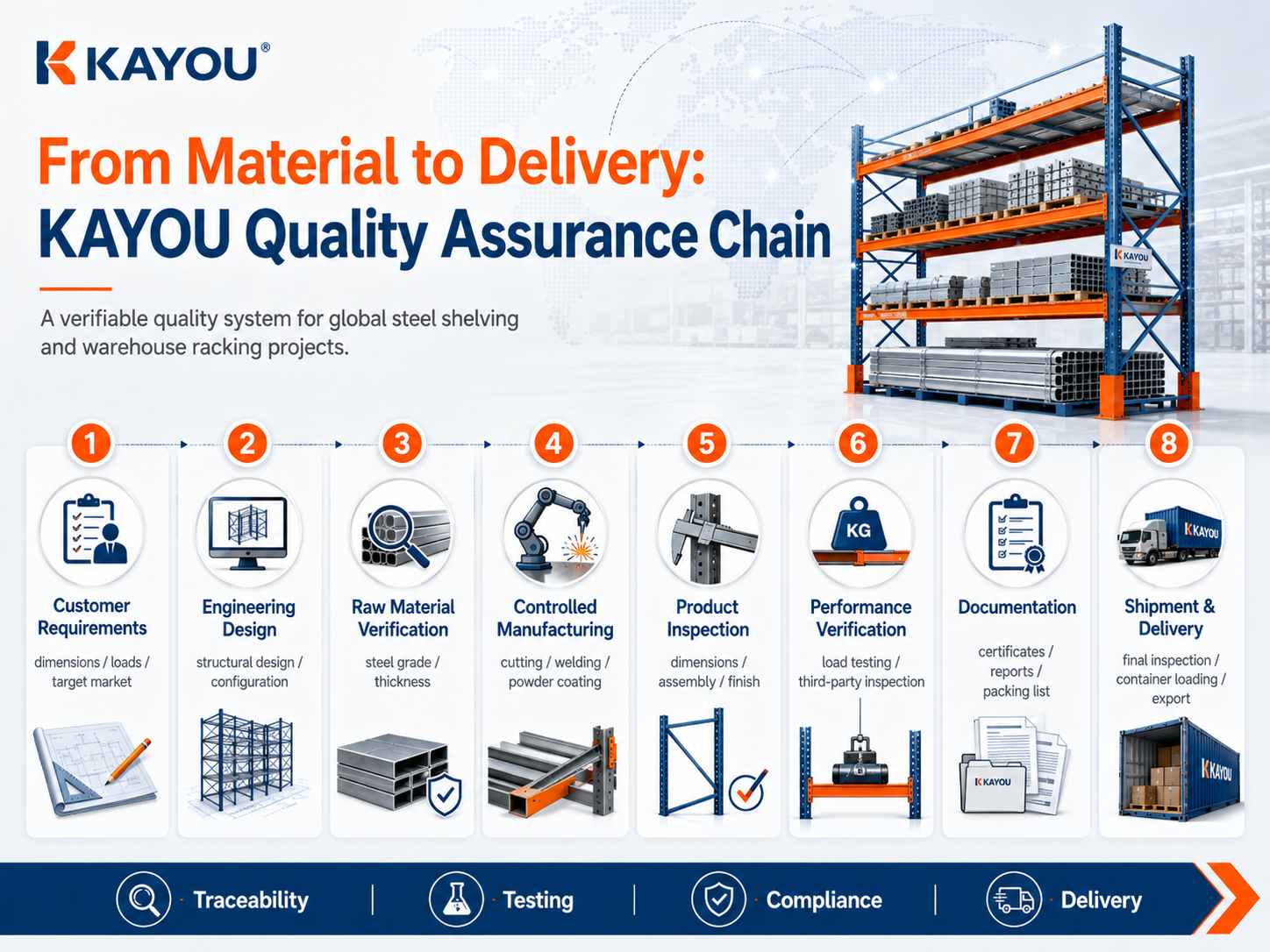
From Certificate to Finished Rack: KAYOU's Quality Chain
A useful way to understand KAYOU's approach is:
01 — Customer Requirement
Warehouse dimensions
Product type
Load requirement
Target market
↓
02 — Engineering Design
Rack structure
Material selection
Load calculation
Configuration
↓
03 — Raw Material Verification
Steel grade
Steel thickness
Material documentation
↓
04 — Controlled Manufacturing
Cutting
Punching
Forming
Welding
Powder coating
↓
05 — Product Inspection
Dimensions
Structure
Surface quality
Assembly
↓
06 — Performance Verification
Load checks
Project testing
Third-party inspection where required
↓
07 — Documentation
Technical data
Inspection records
Certificates
Packing documents
↓
08 — Shipment
Final inspection
Container loading
Export documentation
This provides buyers with a much clearer quality chain than simply saying:
“Our rack is high quality.”
Global Standards, Local Project Requirements
One of the challenges of exporting warehouse racking globally is that every project can be different.
A European customer may focus on EN requirements.
A US customer may request ANSI/RMI references.
A distributor may require ISO documentation.
A contractor may request engineering drawings and load calculations.
Another buyer may primarily need:
Material certificates
Third-party inspection
Thickness reports
Loading tests
Therefore, KAYOU does not treat international compliance as a one-size-fits-all package.
Instead, the goal is to understand:
Where will the rack be installed?
What will it store?
How much load will it carry?
Which standard does the project require?
Which documents does the buyer need?
Then the appropriate technical and documentation package can be prepared.
What Should You Ask a Steel Shelving Manufacturer Before Ordering?
When comparing warehouse shelving suppliers, ask for more than a price.
A professional RFQ should confirm:
Rack dimensions
Load capacity per shelf or pallet position
Steel thickness
Steel grade
Upright and beam profiles
Applicable design standard
Load-test information
Relevant certificates
Material documentation
Inspection procedure
Third-party inspection availability
Warranty and after-sales support
This allows buyers to compare products on an equivalent technical basis.
Why Global Buyers Choose KAYOU
For international warehouse projects, the value of a supplier is not only the ability to manufacture steel racks.
It is the ability to provide a complete storage solution that combines:
Engineering
Correct structural configuration for the application.
Manufacturing
Controlled production from raw steel through the finished product.
Quality Verification
Thickness, dimensions, welding, assembly and loading can be checked.
Documentation
Relevant technical and compliance documents can be prepared according to project requirements.
Customization
Dimensions, load capacities, levels, colors, structures and accessories can be customized.
Export Experience
Product design, packaging and container utilization can be considered together to reduce total procurement cost.
This is how KAYOU approaches global B2B storage projects.
Frequently Asked Questions
What certifications should warehouse racking have?
There is no universal certification for every type of warehouse rack. The relevant requirement depends on the rack type, destination market and project. European pallet racking projects may reference EN 15512, while US industrial storage racks commonly reference ANSI MH16.1.
What standard applies to pallet racking in Europe?
EN 15512 provides structural design requirements for adjustable steel pallet racking systems.
What standard applies to industrial storage racks in the United States?
ANSI MH16.1-2023 specifies minimum requirements for the structural design, testing and utilization of industrial steel storage racks.
Is there a separate standard for boltless shelving?
Yes. ANSI MH28.2-2022 applies to industrial steel boltless shelving and certain related systems.
Can KAYOU provide material certificates?
Material and inspection documentation can be prepared according to the project and order requirements. Buyers should confirm required documents before production.
Can customers arrange third-party inspection?
Yes. For projects requiring independent verification, inspection requirements can be incorporated into the order and production plan.
Can KAYOU customize racks for different countries?
Yes. Rack dimensions, load capacity, structure, materials and documentation requirements can be discussed according to the destination market and individual warehouse project.
More Than Certifications — Build a Verifiable Storage System
For professional warehouse buyers, global qualification is not about displaying certificates on a website.
It is about creating a verifiable chain from:
Material → Engineering → Manufacturing → Testing → Inspection → Documentation → Delivery
That is the quality philosophy behind KAYOU's international steel shelving and warehouse racking projects.
Whether you are sourcing:
Steel Shelving
Boltless Shelving
Long Span Shelving
Pallet Racking
Cantilever Racking
Mobile Shelving
Mezzanine Systems
Customized Warehouse Storage Systems
KAYOU can work with your team to identify the technical requirements, documentation and product configuration needed for your project.
Need Certification Documents or a Custom Racking Solution?
Send KAYOU your:
Country / destination market
Rack type
Dimensions
Load capacity
Quantity
Required standards or certifications
Our team can review the requirements before quotation and recommend a suitable solution.
Contact KAYOU for your next warehouse storage project.
GLOBAL STORAGE SOLUTIONS
Need Certification Documents or a Custom Racking Solution?
Send us your destination market, rack type, dimensions, load capacity, quantity and required standards. KAYOU will help review the project requirements before quotation.