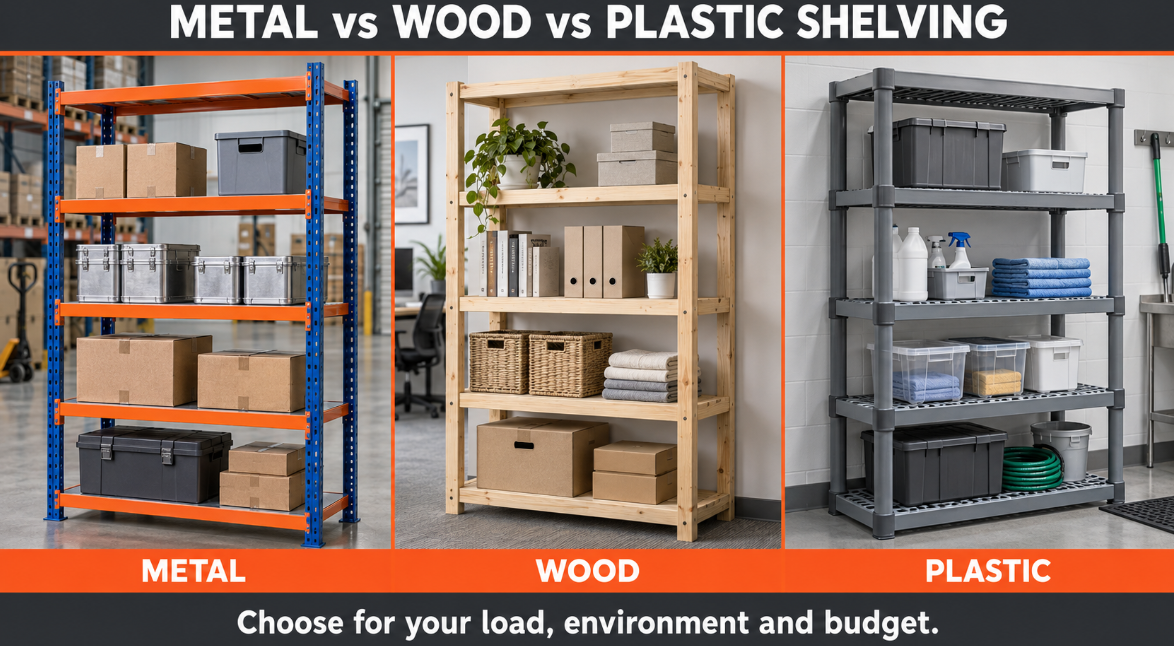

Choosing shelving often starts with a simple question: should you buy metal, wood or plastic? The answer affects more than appearance. It influences how you store goods, clean the area, rearrange shelf levels and manage replacement costs.
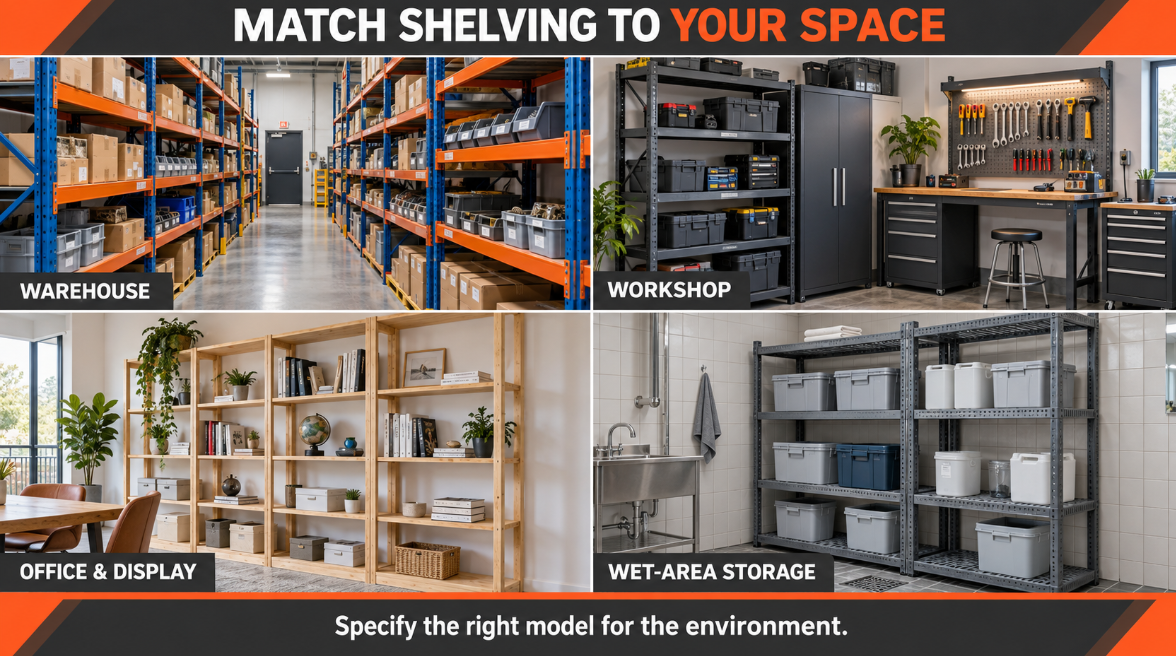
For a warehouse holding cartons and industrial parts, configurable steel shelving is a practical starting point. For decorative indoor storage, wood can provide the appearance you want. For wet areas, an appropriately specified commercial polymer system may be a strong candidate.
The best choice depends on the complete shelving system, the stored goods and the environment. Here is how to compare your options before ordering.
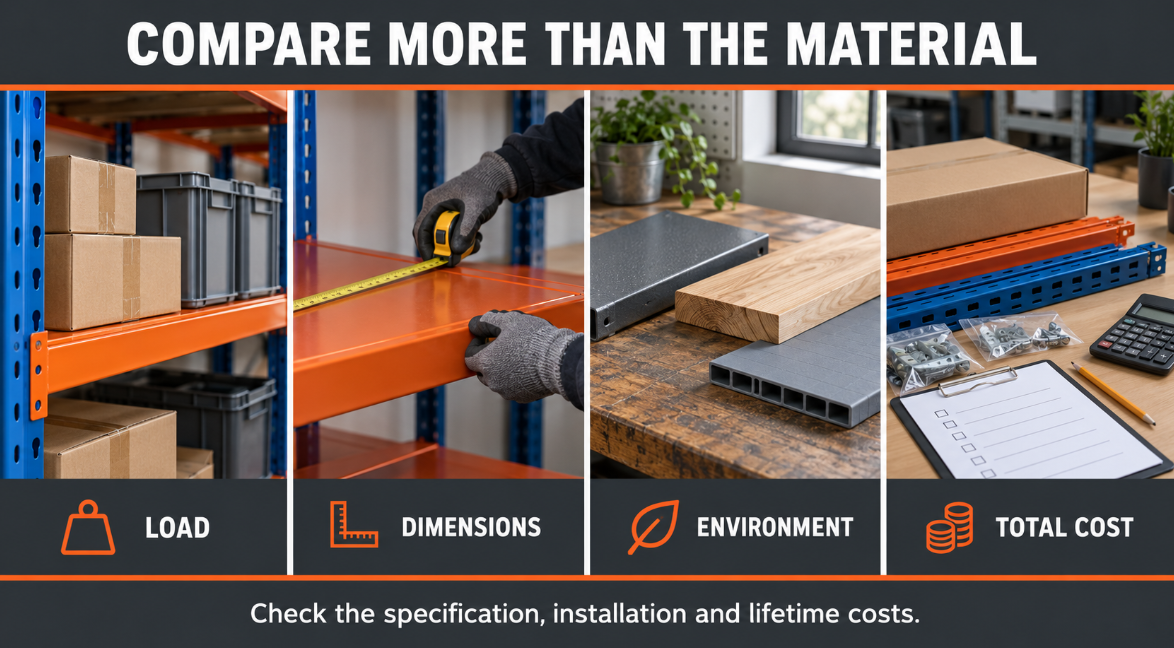
Quick Answer: Which Shelving Material Is Best?
Choose metal shelving when you need adjustable storage for warehouses, workshops, stockrooms or garages, with documented capacity for your loads.
Choose wood shelving when appearance and a solid display surface matter, particularly in dry indoor spaces.
Choose commercial plastic or polymer shelving when corrosion resistance and regular cleaning are priorities, subject to the model’s load, temperature and chemical limits.
There is no universal capacity or lifespan for any of these categories. A commercial polymer unit may outperform a basic steel shelf, while a properly supported wood panel may be suitable for substantial loads. Compare actual specifications rather than material names alone.
Metal vs Wood vs Plastic Shelving at a Glance
| Buying factor | Metal shelving | Wood shelving | Plastic or polymer shelving |
|---|---|---|---|
| Typical applications | Warehouses, workshops, stockrooms and garages | Homes, offices, retail displays and dry storage | Household storage or commercial wet-area storage, depending on model |
| Load selection | Wide range of rated systems; verify shelf and bay limits | Depends on panel grade, thickness, span and supports | Household and engineered commercial products differ substantially |
| Moisture considerations | Steel grade and protective finish matter | Panel type, sealing and exposure matter | Polymer parts do not rust; check any metal components |
| Cleaning | Depends on finish, joints and shelf surface | Surface finish and exposed edges affect cleaning options | Removable mats are available on some commercial systems |
| Adjustment | Adjustable beam or shelf levels are available on many systems | Depends on brackets, cabinet construction or supporting frame | Depends on post and shelf design |
| Appearance | Industrial, commercial or decorative finishes | Natural or laminated furniture-style surfaces | Usually functional, with model-specific colors and textures |
| Price comparison | Compare equivalent dimensions, finish and load ratings | Include panel quality, supports and finishing | Basic plastic may be inexpensive; commercial polymer can cost more |
This table is a selection guide, not a performance rating for an individual product.
First, Separate the Frame from the Shelf Surface
Many shelving units combine materials. A product described as “wood shelving” may have a steel frame with particleboard shelves. A polymer shelving system may include metal reinforcement or posts.
Ask the supplier to identify the uprights, beams, shelf panels, connectors and feet or casters separately. The frame supports the system, while the shelf surface must suit the shape and contact points of the stored goods.
For example, cartons may need a different surface from small loose components. A smooth panel can prevent tiny items from falling through openings, but its unsupported span and load rating still need checking.
1. Metal Shelving: A Practical Option for Working Storage
Metal shelving includes powder-coated steel, galvanized steel, stainless steel and other constructions. These should not be treated as one identical material specification.
Steel systems offer useful configuration choices for warehouses and stockrooms: different heights, widths, depths, shelf levels and panel arrangements. Adjustable levels can help match available space to cartons, bins and tools.
KAYOU’s medium-duty steel shelving provides a starting point for discussing warehouse, garage and industrial storage requirements. Confirm the dimensions and approved loading arrangement for the selected configuration.
What buyers should check
Ask for the material specification, shelf construction, connection details and rated load per level and per complete bay. The word “heavy-duty” alone is not a technical specification.
For humid locations, confirm the finish and exposure conditions. Powder coating protects the steel surface, but damaged coating, condensation or aggressive cleaning chemicals can affect performance. Stainless steel selection also requires the appropriate grade and cleaning method.
Metal shelving can be a good choice for a working storage area, provided the finish, structure and installation match the job.
2. Wood Shelving: Useful for Appearance and Solid Surfaces
“Wood” may mean solid timber, plywood, MDF or particleboard. Their properties differ, and the surface finish does not tell you everything about the panel underneath.
Wood and wood-based panels can provide an attractive display surface for offices, shops and homes. A solid panel can also be practical for dry carton storage when it is properly supported by a suitable frame.
What buyers should check
Identify the panel type, grade, thickness, support spacing and edge treatment. Ask whether the load rating applies to the exact panel size and supporting arrangement offered.
Moisture exposure needs particular attention. Standard panels and moisture-resistant grades are not interchangeable. Manufacturer guidance explains that moisture-resistant MDF is intended to better tolerate humid interiors; it should not be assumed suitable for prolonged water exposure. Kronospan: Understanding Moisture-Resistant MDF
For a dry office display, appearance may justify a wood finish. For a frequently washed stockroom, panel selection and maintenance requirements deserve closer scrutiny.
3. Plastic Shelving: Distinguish Household from Commercial Systems
Basic household plastic shelving and engineered commercial polymer shelving are very different products. Comparing both under one “plastic” label can lead to the wrong conclusion about capacity, durability or cost.
Commercial polymer systems can be suitable for damp storage and cleaning-intensive environments. Some provide removable shelf mats and configurations designed for coolers or freezers. These features are specific to the product, rather than promises that apply to every plastic shelf. Metro: Polymer Shelving
What buyers should check
Confirm the rated shelf and unit loads, operating temperature, cleaning chemicals and whether the structure includes metal parts. If foodservice suitability or another certification is required, request documentation for the exact model.
Do not assume that a lightweight household unit can replace a rated commercial system. Equally, do not dismiss all polymer shelving as unsuitable for demanding storage applications.
How to Compare Load Capacity Fairly
A headline such as “200 kg capacity” is incomplete unless you know what it describes.
Before comparing metal, wood and plastic shelving, confirm:
Whether the rating is per shelf or per complete unit.
The shelf width, depth and support spacing.
Whether the rating assumes a uniformly distributed load.
The stored item’s footprint and contact points.
The number and positions of shelf levels.
Whether the system is stationary or mounted on casters.
A box spread across a shelf and a machine resting on four small feet create different loading conditions. Similarly, adding up individual shelf ratings does not automatically establish the allowable load of the complete unit.
For further explanation, read KAYOU’s shelving safe working load guide.
Which Material Fits Your Storage Space?
Warehouse or e-commerce stockroom
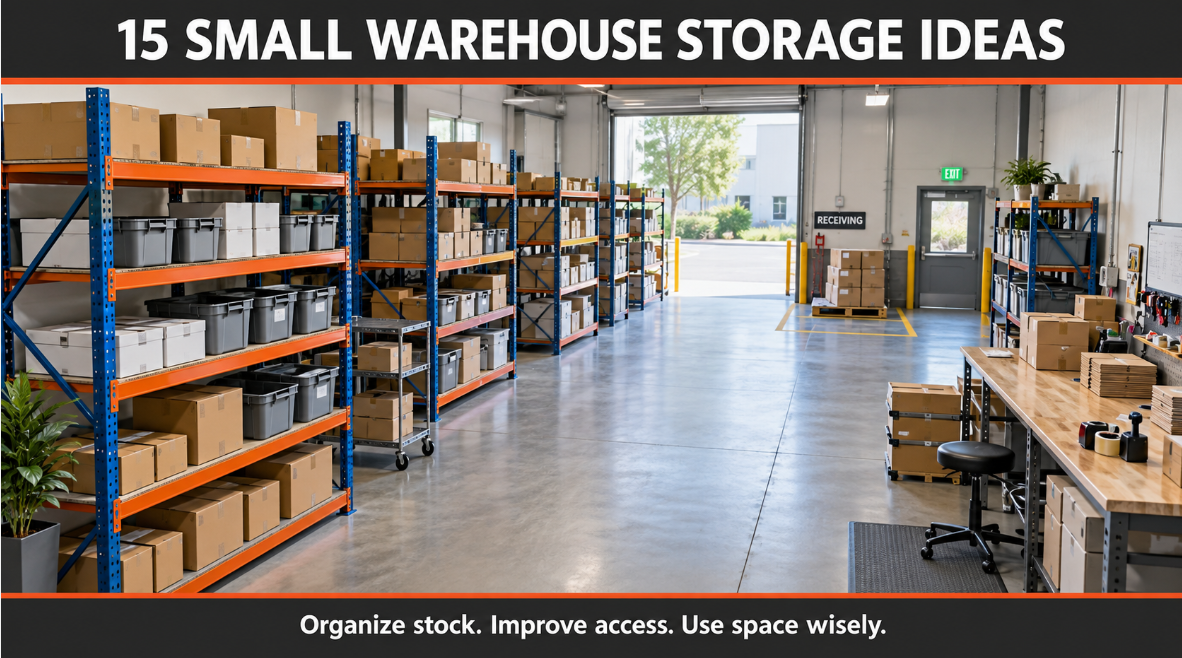
Start with carton dimensions, SKU quantities, stock weight and picking frequency. Adjustable steel shelving is worth evaluating for this application. Choose the shelf surface around the goods and keep aisles suitable for the handling method.
Garage or workshop
Separate bulky bins, hand tools, tires and heavier equipment. A combination of shelving and enclosed tool storage may work better than one oversized shelf. Check actual item weights and the installation requirements.
Office or retail display
Wood or wood-finished shelving can suit customer-facing interiors. Steel may suit utility rooms or an industrial display style. Decide whether appearance, reconfiguration or cleaning is the main priority.
Damp storage or regularly cleaned areas
Compare suitably specified stainless steel, protected steel and commercial polymer systems. Provide the supplier with information about condensation, cleaning chemicals and temperature before selecting a material. Metro’s commercial shelving guide similarly distinguishes dry-storage finishes from wet-environment options. Metro: Commercial Shelving Buying Guide
Which Shelving Costs Less Over Time?
Compare quotations for the same usable dimensions, loading arrangement and quantity. An inexpensive unit can become costly if it needs early replacement or does not provide enough usable space.
Include the following in your comparison:
Purchase price and included accessories
Packing dimensions and transport costs
Assembly and installation requirements
Cleaning and maintenance
Replacement panels, connectors or other available parts
Future changes to the storage layout
There is no reliable rule that plastic is always cheapest or steel always offers the lowest lifetime cost. Product specification, local conditions and the intended service determine the result.
Five Mistakes to Avoid
Buying by material name alone. Compare the complete structure and supporting documentation.
Ignoring moisture at the floor. Tell the supplier about washing, leaks or condensation near the lowest shelf.
Selecting only by total weight. Include item dimensions and contact points, especially for machinery or concentrated loads.
Assuming any finish permits outdoor use. Confirm the whole system’s suitability for the intended exposure.
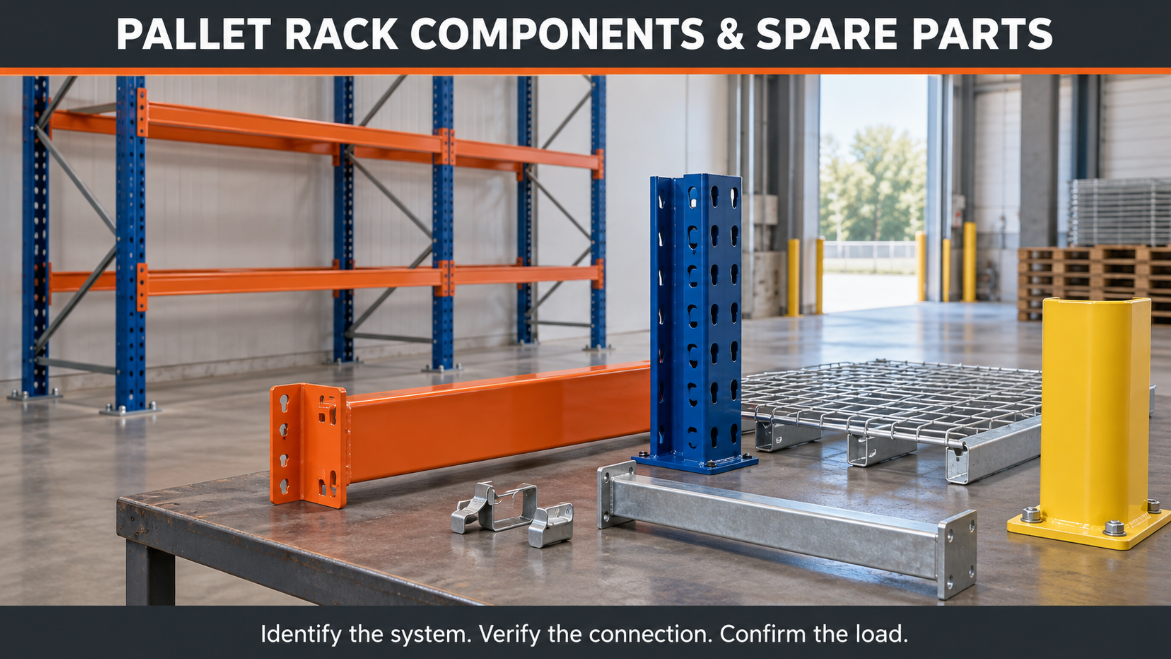
Treating every shelf as pallet racking. This guide focuses on shelving for manually handled goods. Forklift-loaded pallets require a system specifically designed for that operation.
Frequently Asked Questions
Is metal shelving stronger than wood shelving?
Not automatically. A system’s capacity depends on its dimensions, materials, supports and connections. Compare documented ratings for equivalent configurations and loading conditions.
Can plastic shelving hold heavy items?
Some engineered commercial polymer systems can. Check the exact shelf and unit ratings, temperature limits and load distribution. Household plastic shelving should not be assumed to offer the same performance.
Is wood shelving suitable for a garage?
It can be suitable in a dry garage when the panel and supports match the load. Where condensation, leaks or frequent washing occur, review the panel grade and exposure limitations first.
Does metal shelving rust?
Carbon steel can rust if exposed to moisture and its protection is inadequate or damaged. Specify a finish suitable for the environment and maintain it according to the supplier’s instructions.
Can I use wood panels on a steel shelving frame?
Yes, when that combination is designed and approved for the intended load. Confirm panel thickness, support spacing, fit and retention. Replacing the original deck with a different panel may change the usable rating.
Find the Right Shelving for Your Business with KAYOU
The right shelving starts with your goods and storage environment. Metal, wood and plastic each have useful applications; the best purchase is the configuration that matches your actual needs.
For warehouse, garage, workshop or stockroom projects, explore KAYOU’s steel shelving options and send us:
Required width, depth and height
Number of levels and quantity of units
Maximum load per level and stored item dimensions
Indoor conditions, moisture and cleaning requirements
Preferred configuration, color and delivery destination
KAYOU can review your requirements and discuss a suitable steel shelving configuration for your project or wholesale order.