
Mobile Shelving System: A Smarter High-Density Storage Solution for Modern Warehouses
Warehouse space is becoming increasingly valuable.
For distributors, manufacturers, spare-parts warehouses, archives and fulfillment facilities, one of the biggest challenges is no longer simply how to add more shelves.
The bigger question is:
How can you store more products without constantly expanding the warehouse?
This is where a mobile shelving system can make a major difference.
Instead of leaving a permanent aisle between every row of shelving, mobile shelving places multiple storage units onto movable bases running along floor tracks. Users open only the aisle they need, allowing more of the available floor area to be used for actual storage.
For businesses focused on warehouse space optimization and high-density storage, this makes mobile shelving an increasingly practical alternative to conventional static shelving.
What Is a Mobile Shelving System?
A mobile shelving system, also called mobile storage shelving, compact shelving, movable shelving or high-density mobile shelving, is a storage system in which shelving units are mounted on mobile carriages.
These carriages move horizontally along rails installed on or into the floor.
Instead of providing a fixed aisle between every shelving row, several shelving units are placed close together.
When access is required, the operator moves the relevant shelving units apart to create a working aisle.
In simple terms:
Static shelving:
Shelf → Aisle → Shelf → Aisle → Shelf → Aisle → Shelf
Mobile shelving:
Shelf → Shelf → Shelf → One movable aisle → Shelf
This simple change can significantly improve the usable storage density of a room.
Industry suppliers commonly describe mobile shelving as a way to substantially reduce the floor area occupied by permanent aisles, although the actual capacity improvement depends on shelving dimensions, room layout, load requirements and the number of access aisles required.
Why High-Density Storage Matters in 2026
Warehouse design is changing.
Businesses are increasingly looking for ways to improve:
storage density
inventory accessibility
warehouse footprint utilization
operating efficiency
flexibility
cost control
At the same time, warehouse automation, AI-supported inventory management and smarter facility layouts continue to be important themes in 2026 logistics planning.
But not every warehouse needs a fully automated robotic system.
For many B2B storage projects, improving the physical layout itself can generate substantial benefits.
A high-density mobile shelving system is one relatively straightforward way to convert unused aisle space into additional storage positions.
How Does a Mobile Shelving System Work?
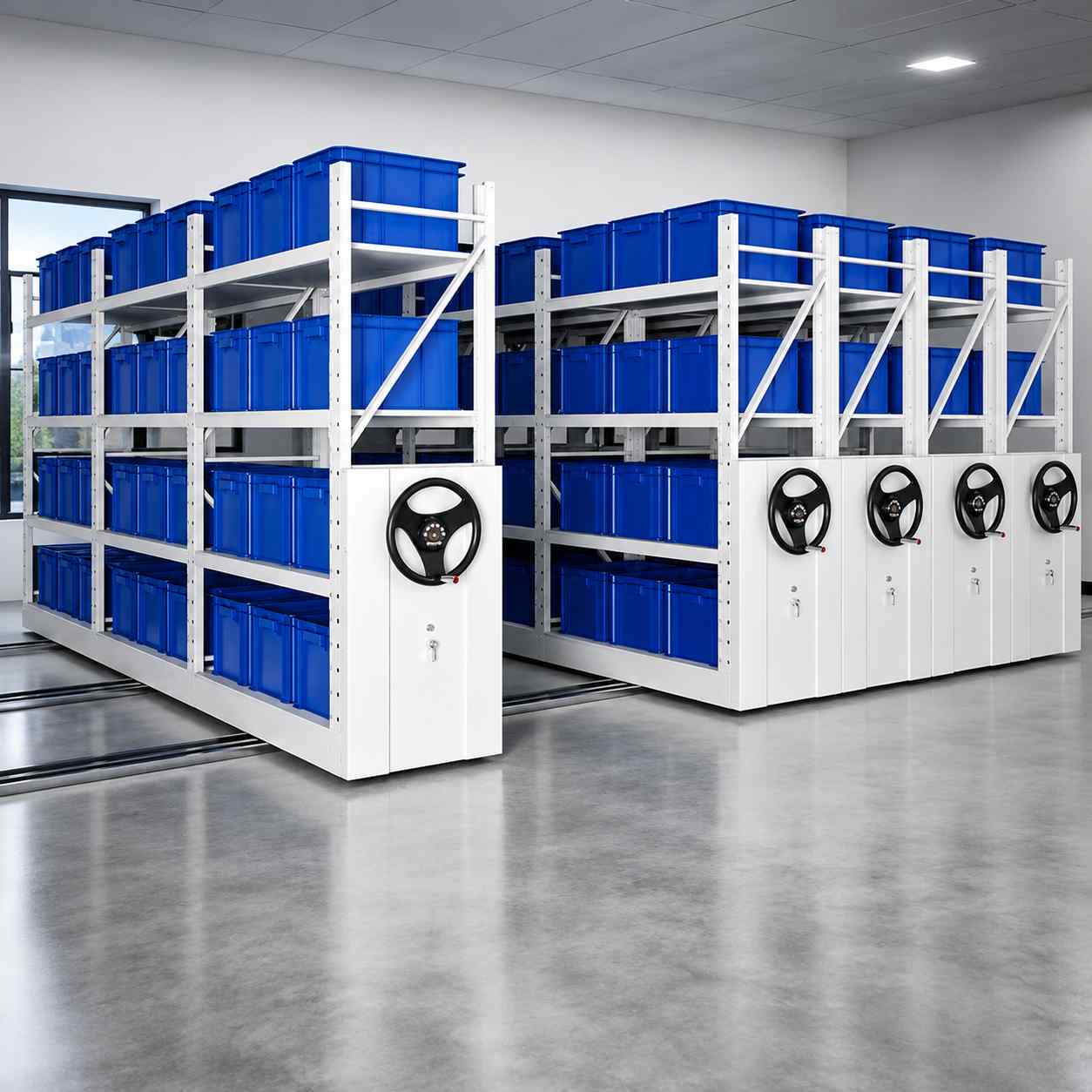
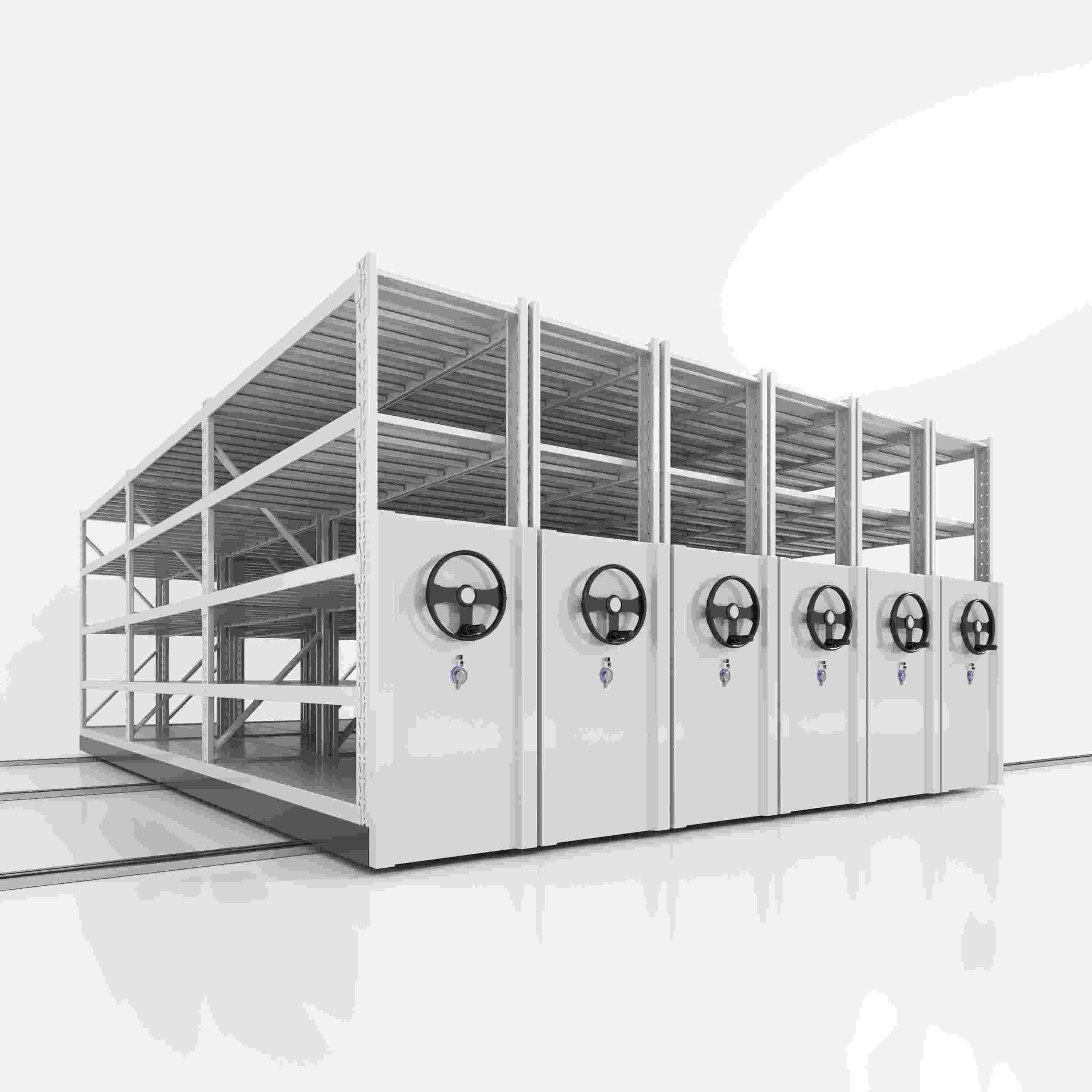
The mobile shelving system shown above uses a hand-crank mechanical drive system.
Each shelving block is installed on a steel mobile base.
The base runs along parallel floor rails.
When an operator turns the handwheel, the mechanical transmission system moves the shelving row along the track.
Once the desired aisle is opened, the operator can access the stored goods.
This type of system usually consists of several key components.
1. Steel Shelving
The upper structure provides the actual storage positions.
Shelf height, width, depth and number of levels can be customized according to the stored products.
Plastic bins, cartons, spare parts, documents, tools and other materials can all be organized on the shelves.
2. Mobile Base
The shelving is mounted onto a reinforced steel carriage.
The carriage transfers the shelving load to the wheels and rail system.
3. Floor Rails
Rails guide the mobile units and help maintain stable linear movement.
The rail layout should be designed according to the room dimensions, floor condition and total system load.
4. Handwheel Drive
For mechanical mobile shelving, the operator turns an external hand crank or handwheel.
A transmission mechanism transfers this motion to the mobile carriage.
Mechanical handwheel systems can make heavier shelving blocks easier to move than simple push-pull configurations.
5. Locking and Safety Components
Depending on the project, mobile shelving can incorporate:
aisle locks
unit locks
anti-tilt devices
end stops
safety brakes
mechanical locking systems
These components should be selected according to the intended application and local project requirements.
Mobile Shelving vs. Static Shelving
One of the most common questions buyers ask is:
Is mobile shelving better than conventional shelving?
The answer depends on how the warehouse operates.
| Feature | Static Shelving | Mobile Shelving |
|---|---|---|
| Permanent aisles | Multiple | Usually fewer |
| Storage density | Standard | High |
| Space utilization | Moderate | High |
| Initial investment | Lower | Higher |
| Access | All aisles simultaneously | Selected aisle |
| Layout flexibility | Good | Very good |
| Best application | Fast-access general storage | High-density storage |
| Expansion space required | Higher | Potentially lower |
Static shelving remains an excellent choice when workers need simultaneous access to many aisles.
However, when storage density is more important than having every aisle open at the same time, mobile shelving becomes particularly attractive.
6 Key Benefits of a Mobile Shelving System
1. Maximize Warehouse Space
The main advantage is simple:
reduce unnecessary permanent aisle space.
A traditional shelving layout may require an aisle between every row.
Mobile shelving allows multiple shelving blocks to share a smaller number of access aisles.
This allows warehouse designers to dedicate a greater percentage of available floor space to inventory.
2. Increase Storage Capacity Without Expanding the Building
Warehouse expansion can involve:
higher rent
construction costs
relocation expenses
additional utilities
longer internal transport routes
Before expanding a facility, it can therefore be worth evaluating whether the existing space is being used efficiently.
A properly designed compact shelving system may allow businesses to increase capacity inside an existing room.
3. Improve Inventory Organization
Mobile storage shelving can be configured according to SKU type.
For example:
Zone A: spare parts
Zone B: tools
Zone C: cartons
Zone D: plastic storage bins
Zone E: documents or technical materials
Labels, dividers and bins can further improve picking accuracy.
The blue storage bins shown in this project are a good example of how mobile shelving can support systematic small-parts storage.
4. Flexible Shelf Configuration
Different industries store very different products.
That is why a professional mobile shelving system should not be treated as a one-size-fits-all product.
Important customizable dimensions include:
shelving height
shelving width
shelving depth
shelf spacing
number of shelves
bay quantity
carriage length
aisle width
rail length
loading capacity
This allows the system to be adapted to both the building and the inventory.
5. Suitable for High-Density Storage Areas
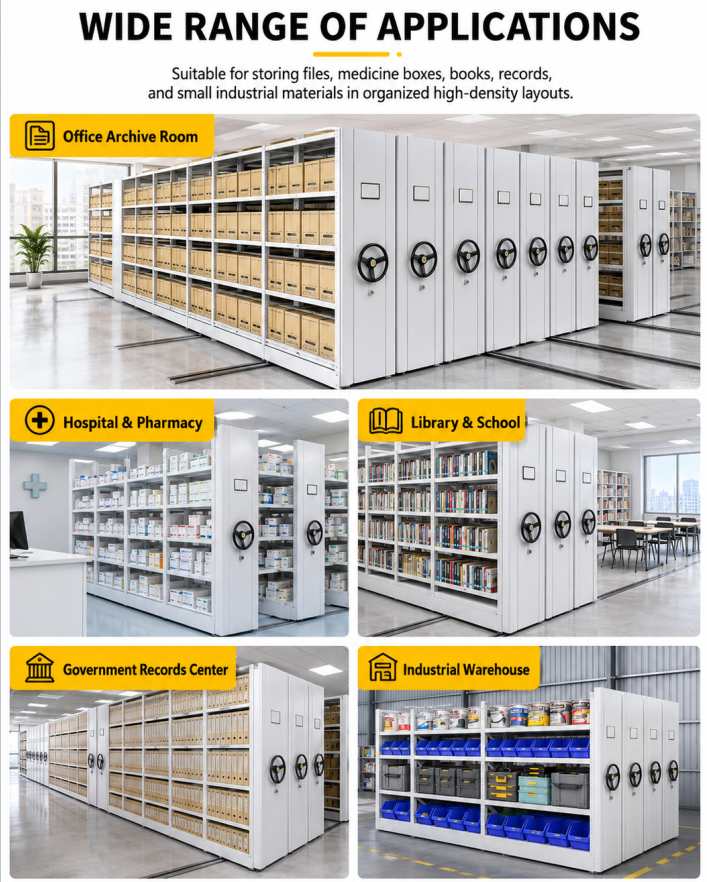
Mobile shelving can be particularly useful where storage space is limited but inventory density is high.
Typical projects include:
Spare Parts Warehouses
Ideal for organizing automotive, machinery and maintenance components.
Industrial Storage Rooms
Suitable for tools, consumables and production materials.
Archives
Mobile shelving is widely used for high-density document and record storage.
Libraries
Books and reference materials can be stored in compact layouts.
Hospitals and Laboratories
Shelving can organize records, supplies and selected equipment according to project requirements.
Government and Office Records
High-volume document storage can often benefit from compact shelving layouts.
6. Scalable for Custom Warehouse Projects
For B2B buyers, the real value is not just the shelving itself.
It is the complete storage layout.
Before production, factors such as:
room dimensions → product size → loading requirement → aisle width → rail layout → shelving configuration
should be considered together.
This is particularly important for larger mobile shelving projects.
Manual, Mechanical or Electric Mobile Shelving?
Mobile shelving systems can generally be divided into several operating types.
Manual Mobile Shelving
The shelving is pushed or pulled manually.
It is typically suited to smaller and lighter configurations.
Mechanical Hand-Crank Mobile Shelving
This is the configuration shown in the product image.
A handwheel drives the mobile base through a mechanical transmission system.
It combines relatively simple operation with higher-density storage and does not require the same electrical control infrastructure as powered systems.
Electric Mobile Shelving
Electric motors move the shelving units.
Depending on the system design, electric versions can include additional controls, sensors and safety features.
They are often considered for larger or more frequently accessed installations.
What Should Buyers Check Before Purchasing Mobile Shelving?
This is one of the most important parts of any mobile shelving project.
Price should not be the only consideration.
A reliable supplier should first understand the application.
1. Floor Loading Capacity
The complete system weight includes:
steel structure + mobile bases + shelving + stored goods
Because the load is concentrated through the mobile carriage and rail structure, floor conditions should be evaluated during project planning.
2. Shelf Load Requirement
Do not simply tell the supplier:
“We need heavy-duty shelving.”
Provide an approximate weight instead.
For example:
150 kg per shelf
250 kg per shelf
350 kg per shelf
The correct steel thickness and structural configuration depend on the actual load.
3. Product Dimensions
Provide:
Length × Width × Height + Weight
for the stored cartons, bins or equipment whenever possible.
This helps engineers calculate shelf spacing more accurately.
4. Available Room Dimensions
For custom mobile shelving, provide:
Room Length × Width × Clear Height
Also identify:
doors
columns
fire exits
electrical cabinets
windows
ventilation equipment
sprinkler locations
restricted areas
A floor plan is even better.
5. Required Aisle Width
The required aisle depends on how workers access the products.
A person retrieving archive boxes requires a different aisle from someone handling larger industrial components.
6. Safety Requirements
Depending on the application and destination market, buyers should discuss:
locking requirements
anti-tilt protection
aisle safety
track installation
floor transitions
emergency access
load signage
These details should be confirmed before manufacturing.
Why Steel Is Commonly Used for Mobile Shelving
Steel remains one of the most practical materials for industrial storage systems because it combines:
structural strength
dimensional consistency
long service life
manufacturability
adjustable configurations
recyclable material characteristics
A properly prepared surface can also receive powder coating to improve appearance and corrosion resistance for indoor storage applications.
For B2B projects, steel shelving also makes it easier to customize components such as uprights, beams, shelves, side panels and mobile bases.
Why Choose a Custom Mobile Shelving System?
Warehouse dimensions are rarely identical.
Neither are the products being stored.
That is why purchasing a completely standard shelving specification without checking the actual facility can result in wasted space.
A customized layout allows the supplier to optimize:
Storage Capacity
Determine how many bays and shelving rows can reasonably fit.
Shelf Spacing
Match shelf levels to the height of the stored products.
Access
Provide practical aisle widths.
Load Distribution
Configure the shelving and carriage according to project loading requirements.
Future Expansion
Reserve space or modular connections where future expansion is expected.
KAYOU Mobile Shelving Systems for B2B Storage Projects
KAYOU focuses on steel storage solutions for commercial and industrial applications.
For mobile shelving system projects, configurations can be developed according to the customer's:
warehouse dimensions
storage product dimensions
required load capacity
shelving quantity
aisle requirements
operating method
surface finish
color requirements
packing requirements
Instead of choosing shelving only from a standard catalog, B2B buyers can provide their project information and request a customized layout.
This is particularly useful for distributors, warehouse operators, contractors and project buyers who require a complete storage solution rather than individual shelving units.
Information to Send Us for a Mobile Shelving Quotation
To receive a more accurate quotation, prepare the following information:
1. Room size
Length × Width × Height
2. Required shelving size
Length × Depth × Height
3. Number of shelf levels
4. Load per shelf
5. Stored product dimensions
6. Required quantity
7. Manual, mechanical or electric operation
8. Destination country or port
If available, also send us your warehouse drawing.
Our team can then evaluate the layout and recommend a more suitable mobile storage configuration.
Frequently Asked Questions About Mobile Shelving Systems
What is a mobile shelving system?
A mobile shelving system places shelving units onto movable carriages running along floor rails. The shelving rows move to create an access aisle only where required, allowing more floor space to be dedicated to storage.
What is another name for mobile shelving?
Common terms include:
high-density mobile shelving, compact shelving, mobile storage shelving, movable shelving, rolling shelving and mobile storage racks.
Terminology varies between countries and industries.
Does mobile shelving save warehouse space?
Yes, its main purpose is to reduce the number of permanently open aisles required between shelving rows. The actual space improvement depends on the room layout, number of shelving rows and required aisle dimensions.
Is mobile shelving suitable for warehouses?
Yes.
Industrial mobile shelving can be used for spare parts, cartons, tools, plastic bins, production materials and other products when high storage density is required.
Is manual or electric mobile shelving better?
Neither is universally better.
Manual or mechanical systems can be simpler and more economical, while powered systems may be more suitable for larger installations or applications requiring frequent movement.
The correct choice depends on load, system size, access frequency and budget.
Can mobile shelving dimensions be customized?
Yes.
Professional mobile shelving manufacturers can customize dimensions, shelf spacing, shelving levels, carriage length, aisle width, load capacity and surface finish according to the project.
What information is needed for a mobile shelving quotation?
At minimum, provide:
room dimensions + shelving dimensions + load per shelf + number of levels + stored product dimensions + quantity + destination.
Providing a CAD drawing or warehouse layout can improve quotation accuracy.
Build More Storage Capacity Into the Space You Already Have
Adding warehouse capacity does not always mean adding more building space.
Sometimes the better solution is to use the existing space more efficiently.
A properly designed mobile shelving system can reduce wasted aisle space, improve storage density and create a cleaner, more organized inventory environment.
Whether you are planning a:
warehouse, spare-parts room, archive, office storage area, industrial facility or distribution center,
KAYOU can help develop a customized high-density mobile storage shelving solution based on your available space and loading requirements.
Need a Mobile Shelving Layout or Quotation?
Send us your:
warehouse dimensions + required load capacity + storage product size + quantity
and our team can help evaluate a suitable configuration for your project.
Contact KAYOU for a customized mobile shelving system solution.
Need a Mobile Shelving Layout or Quotation?
Send us your warehouse dimensions, required load capacity, storage product size and quantity. Our team can help evaluate a suitable mobile shelving configuration for your project.