


Bolted vs Welded Steel Shelving Uprights: How KAYOU Reduces CBM and Shipping Costs
When sourcing steel shelving from overseas, buyers usually compare load capacity, dimensions, material thickness and price.
However, there is another factor that can significantly affect the final landed cost:
Packaging CBM.
For international shipments, especially container orders, a shelving system with a more compact packing structure can sometimes save more money than simply negotiating a lower unit price.
At KAYOU, we therefore consider not only the strength and stability of the shelving system, but also how the structure can be optimized for packing, container loading and transportation.
One important design choice is:
Bolted upright structure vs welded upright structure.
So what is the difference?
1. What Is a Bolted Steel Shelving Upright?
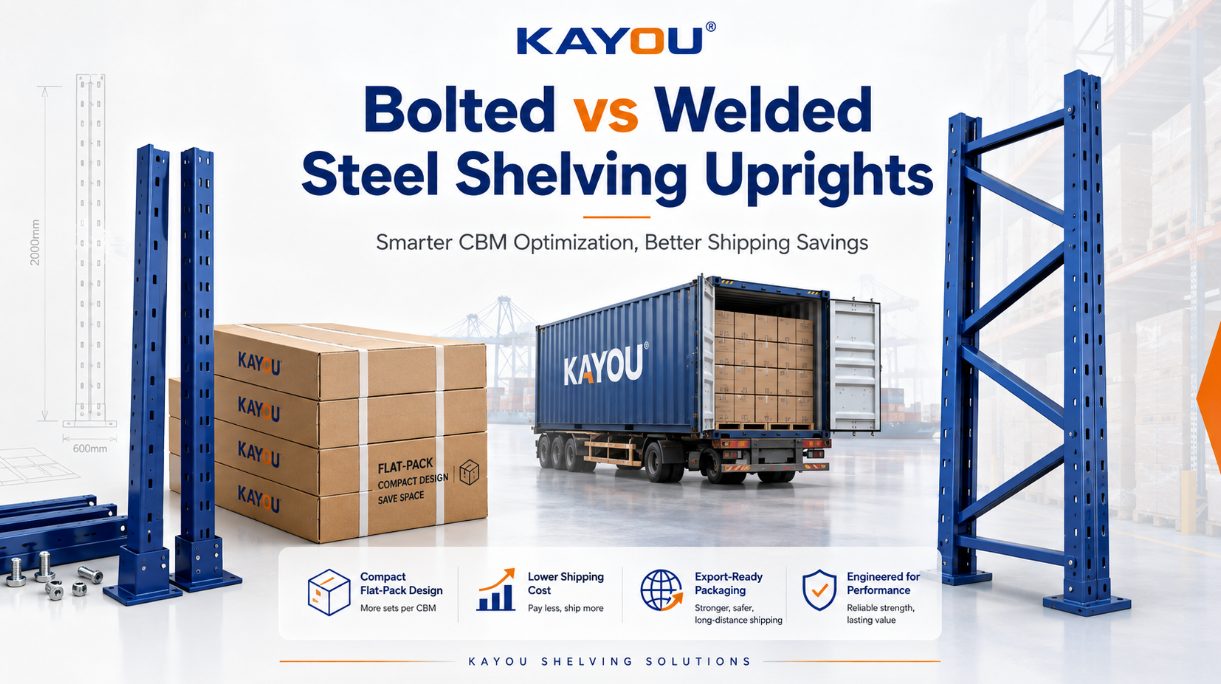
A bolted upright uses separate steel components that are connected with bolts and screws during installation.
Instead of shipping the entire upright frame as one large welded component, the upright posts and related structural parts can be packed separately.
This creates a more compact, knock-down packaging solution.
Main advantages of bolted uprights
Upright components can be disassembled
Smaller packing volume
Better container space utilization
Easier stacking during transportation
Lower storage space requirements
Individual components can be replaced more easily
Suitable for international container shipments
For distributors, wholesalers and project contractors importing large quantities of shelving, these advantages can have a direct impact on logistics costs.
2. What Is a Welded Upright Frame?
A welded shelving upright is manufactured as a complete frame.
The vertical posts and horizontal or diagonal braces are welded together before shipment.
This means less assembly work is required after the shelving arrives at the customer's warehouse.
Main advantages of welded uprights
Pre-assembled frame structure
Faster installation on site
Fewer bolts and connection components
Stable integrated structure
Convenient for projects where installation speed is important
The main disadvantage is transportation volume.
Because the frame cannot normally be dismantled, welded uprights occupy significantly more space during packing and container loading.
Bolted vs Welded Shelving: Key Differences
| Feature | Bolted Upright | Welded Upright |
|---|---|---|
| Structure | Knock-down | Pre-welded |
| Installation | Requires bolting | Faster installation |
| Packing Size | More compact | Larger |
| Shipping CBM | Lower | Higher |
| Container Utilization | Better | Lower |
| Component Replacement | Easier | More difficult |
| Best For | Export & container orders | Fast local installation |
| Logistics Cost | Usually more economical | Usually higher |
There is therefore no universally “better” structure.
The correct choice depends on your project, installation requirements and logistics strategy.
3. Why CBM Matters When Importing Steel Shelving
CBM (cubic meter) represents the volume occupied by cargo.
For ocean freight, container space is extremely valuable.
Consider a shelving system with an assembled size of approximately:
2000 × 600 × 2000 mm
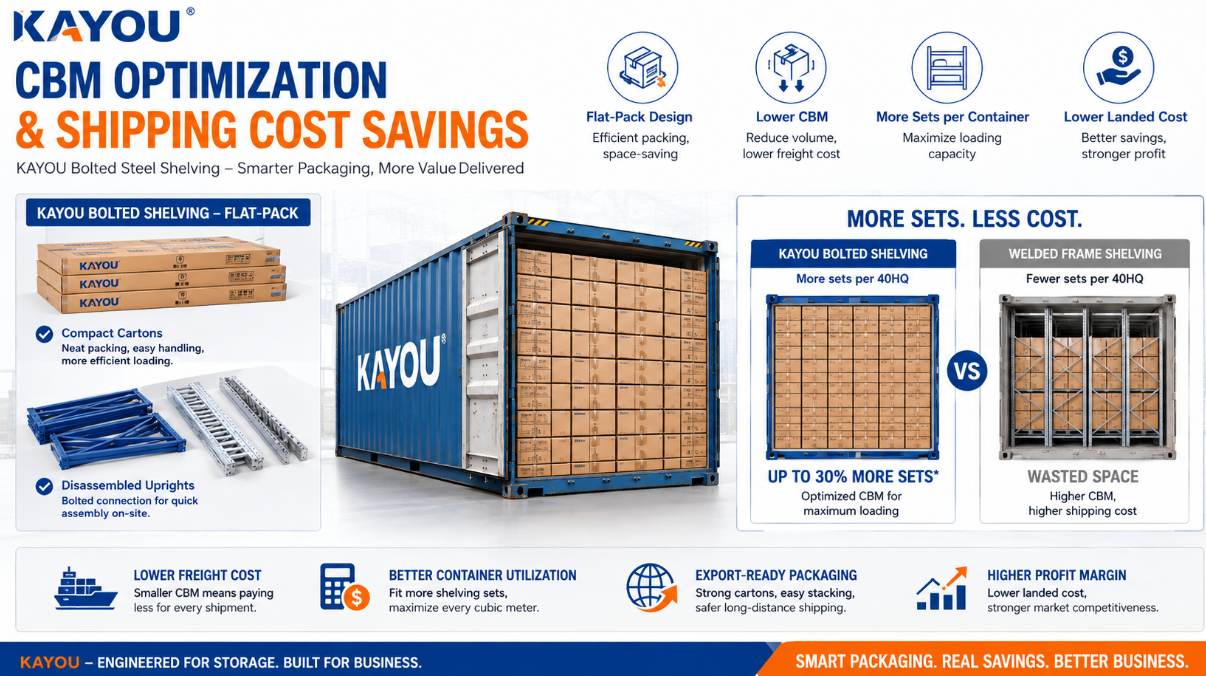
In the packaging example shown above, the two structural solutions can result in approximately:
Bolted structure:
≈ 0.2 CBM/set
Welded structure:
≈ 0.4 CBM/set
That means the knock-down bolted design can reduce packing volume by approximately:
50%
The exact CBM depends on the shelving dimensions, number of shelves, steel profiles, accessories and packing method, but the principle is important:
Smaller package volume = more shelving systems per container.
4. Saving CBM Can Be More Valuable Than Saving Product Cost
Imagine two suppliers offer similar shelving systems.
Supplier A may offer a slightly lower product price but uses bulky welded packaging.
Supplier B optimizes the shelving structure and packaging so that significantly more units can be loaded into one container.
For an international buyer, Supplier B may actually provide the lower landed cost per unit.
This is why KAYOU evaluates more than the EXW product price.
We also consider:
Product Cost + Packaging + CBM + Container Quantity + Freight Cost
This gives buyers a much more realistic understanding of the total purchasing cost.
How KAYOU Optimizes Steel Shelving CBM
At KAYOU, packaging optimization starts during the product design stage.
Instead of treating packaging as something that happens after production, we consider transportation requirements when determining the shelving structure.
1. Knock-Down Upright Design
When the project allows it, uprights can be designed with bolted connections so that long structural components can be packed more efficiently.
2. Compact Component Arrangement
Posts, beams, shelves and accessories are arranged to minimize unused space inside each package.
3. Container Loading Calculation
Before mass production, we can estimate:
Packing dimensions
Gross and net weight
CBM per package
Sets per container
Approximate 20GP / 40GP / 40HQ loading quantity
This allows customers to evaluate logistics costs before placing the order.
4. Balance Between Strength and Shipping Efficiency
Reducing CBM should never mean sacrificing structural performance.
The shelving configuration still needs to consider:
Required load capacity
Upright profile
Steel thickness
Shelf reinforcement
Connection method
Stability
Installation conditions
The objective is not simply to make the package smaller.
The objective is to achieve:
Reliable shelving performance with a more efficient logistics solution.
When Should You Choose Bolted Shelving?
A bolted or knock-down structure is particularly suitable if you are:
Importing shelving by container
Purchasing large quantities
Supplying retail or wholesale markets
Distributing shelving to multiple locations
Trying to maximize 40HQ loading quantity
Looking for lower freight cost per shelving unit
For many overseas distributors, shipping efficiency is one of the biggest reasons to select bolted upright structures.
When Should You Choose Welded Shelving?
A welded upright frame can be a good choice when:
Installation speed is the priority
Transportation distance is relatively short
Freight volume is less important
Customers prefer pre-assembled frames
The project requires minimal on-site assembly
For some local warehouse projects, welded frames can offer a convenient installation experience.
KAYOU Focuses on Total Cost, Not Just Shelf Price
For B2B shelving procurement, the cheapest quotation is not always the lowest-cost solution.
Professional buyers should compare:
Unit Price
Packing CBM
Container Loading Quantity
Ocean Freight
Installation Cost
= Total Landed Cost
This is especially important for steel shelving because the products are relatively large compared with their value.
A small improvement in packaging efficiency multiplied across hundreds of shelving units can create meaningful logistics savings.
That is why KAYOU continuously optimizes steel shelving structure, knock-down packaging and container loading solutions for international customers.
FAQ: Bolted vs Welded Steel Shelving
Is bolted shelving weaker than welded shelving?
Not necessarily.
Load capacity depends on the complete structural design, including upright profile, steel thickness, connection points, beams, shelves and reinforcement.
A properly engineered bolted system can provide reliable performance for warehouse and commercial storage applications.
Which shelving type is better for export?
For many container shipments, bolted or knock-down shelving offers an advantage because of its smaller packaging volume.
It can help increase the number of shelving units loaded into each container.
Can KAYOU calculate CBM before ordering?
Yes. Based on the confirmed shelving configuration, packaging method and quantity, the packing dimensions and estimated CBM can be calculated before shipment planning.
Can I customize the shelving structure?
Yes. Dimensions, load capacity, shelf quantity, upright design, steel thickness, surface finish and other specifications can be configured according to the project requirements.
Reduce Shipping Costs Before Your Shelving Is Produced
When purchasing steel shelving internationally, don't compare product prices alone.
Ask your supplier:
How many sets can actually fit into one 40HQ container?
A well-designed shelving system should not only provide reliable storage capacity—it should also help reduce unnecessary logistics costs.
KAYOU provides customized steel shelving and warehouse storage solutions, with attention to both structural performance and shipping efficiency.
Need a CBM and container loading calculation for your shelving project?
Send us your:
Length × Depth × Height + Load Capacity + Quantity
and KAYOU can recommend a suitable shelving structure and packing solution.
KAYOU — Smart Shelving Design. Better Container Utilization. Lower Total Cost.
Contact KAYOU
Get a customized steel shelving solution, CBM calculation and container loading recommendation for your project.
<!--!doctype-->