
A replacement pallet rack beam may look identical to the original and still be unsuitable for the installation. The connector might engage, but the steel section, locking device or tested connection performance may differ.
For warehouse operators, distributors and project buyers, this makes spare-parts sourcing more demanding than matching a photograph. Physical fit is only one part of compatibility. The replacement must also suit the rack’s structural design, loading configuration and operating environment.
This guide focuses on conventional selective pallet racking. Drive-in, shuttle, mobile and automated systems need additional checks specific to their designs.
What Are the Main Pallet Rack Components?
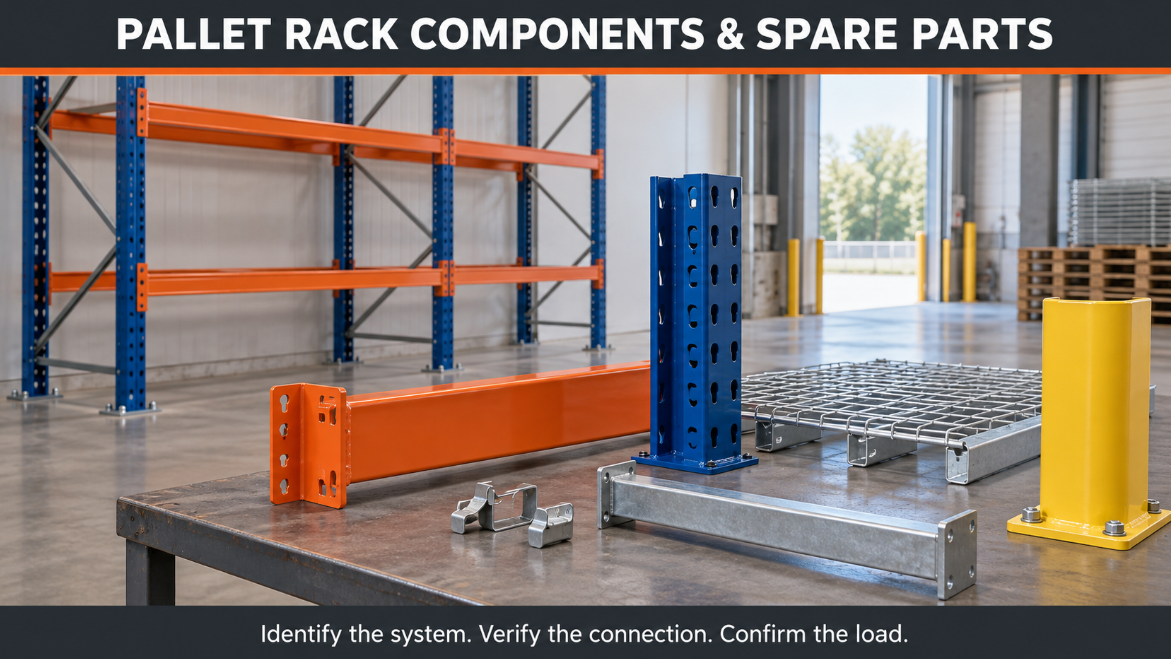
A typical selective pallet rack includes upright frames, load beams, beam locking devices, baseplates and floor anchors. Depending on the project, it may also include pallet supports, wire decking, row spacers, back mesh and protective guards.
Each part has a different function. A pallet support transfers load; a safety pin helps retain a beam connection; a column guard helps protect an upright. They are not interchangeable solutions.
| Component | Main Function | What Buyers Should Verify |
|---|---|---|
| Upright frame | Supports beam levels and transfers loads toward the floor | Manufacturer, profile, steel thickness, frame depth, bracing and approved configuration |
| Load beam | Carries pallet loads between uprights | Clear span, section, connector, load rating and loading pattern |
| Beam connector | Joins the beam to the upright | Hook or bolt geometry, engagement, plate thickness and connection performance |
| Safety pin or locking clip | Helps prevent accidental beam disengagement | Exact compatible design, retention and correct installation |
| Frame bracing | Contributes to frame stability | Member section, length, connection arrangement and fasteners |
| Baseplate and shim | Transfer column reactions and support alignment | Dimensions, bearing arrangement and approved installation detail |
| Floor anchor | Secures the rack to the slab | Specified anchor system, substrate, embedment and installation requirements |
| Pallet support bar | Supports the intended pallet or load arrangement | Beam interface, support position and rated application |
| Wire mesh deck | Supports specified stored loads | Deck size, support channels, beam seating and loading basis |
| Row spacer | Maintains the designed relationship between adjacent rows | Row separation, attachment points and approved fixing detail |
| Column guard or barrier | Provides impact protection | Clearance, mounting method and compatibility with rack operation |
Explore KAYOU warehouse pallet racking for an overview of system configurations and accessories.
Are Pallet Rack Parts Universal?
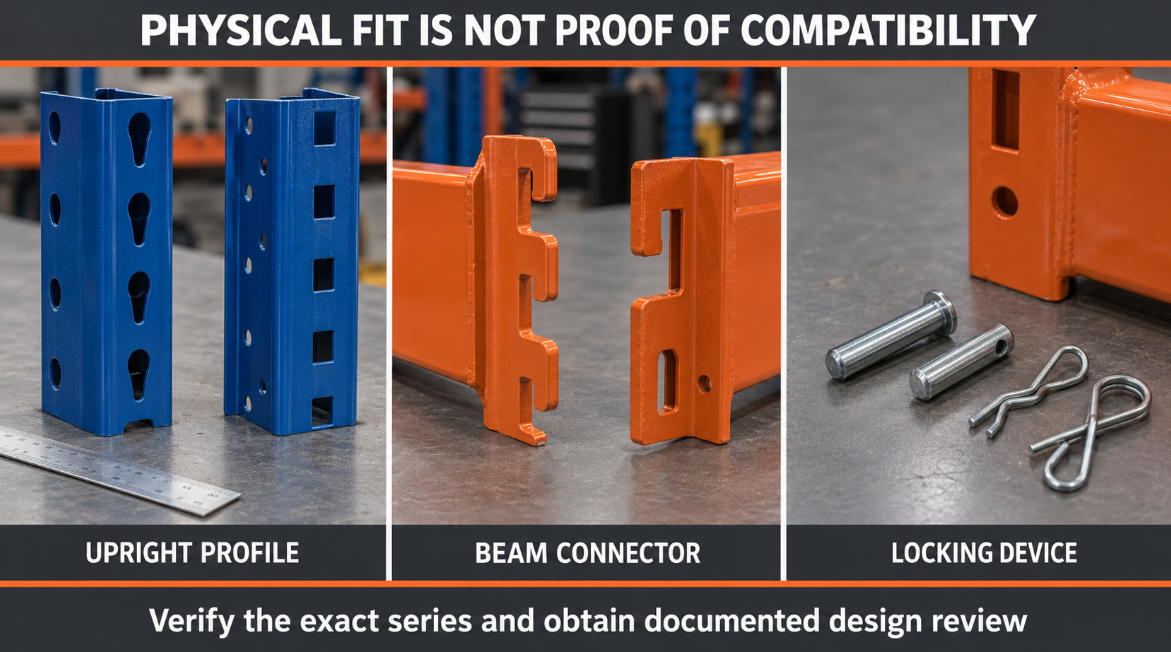
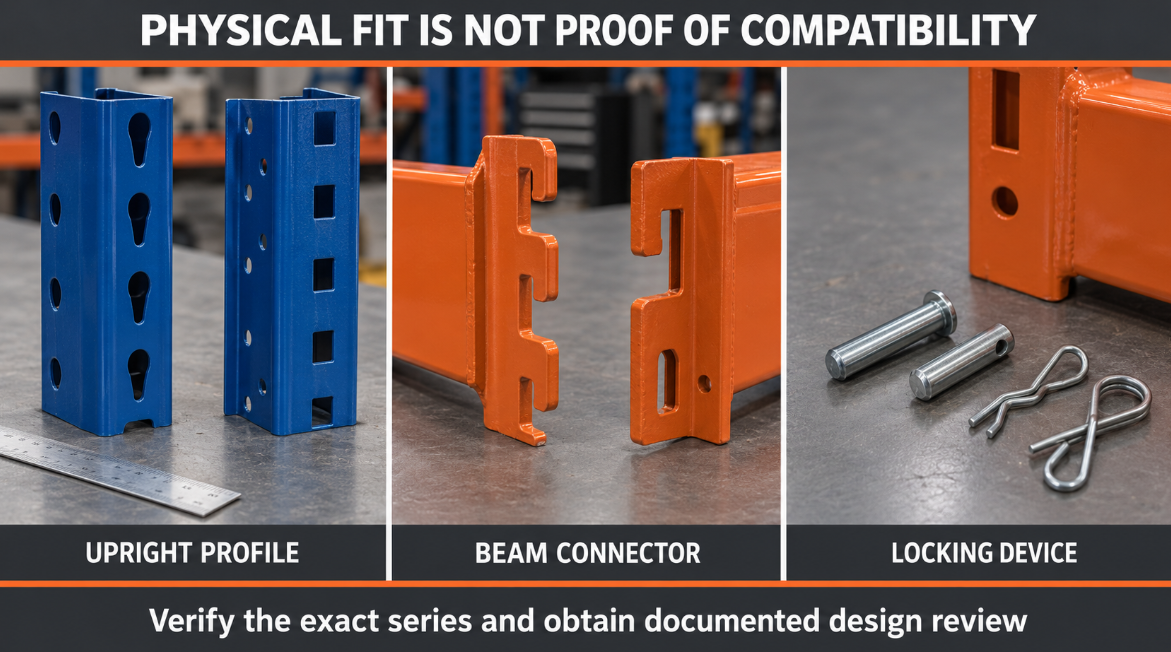
No. Similar hole patterns, beam colors or nominal dimensions do not establish interchangeability.
Manufacturers can use different column profiles, connector geometries, materials and production methods. Even a familiar description such as “teardrop pallet rack” identifies a connection style rather than proving that every beam and upright combination has been assessed together.
RMI explains that manufacturers test their components as systems. Those results cannot simply be transferred to a combination assembled from unrelated manufacturers’ parts. RMI: Why Mixing Rack Components Is a Bad Idea
Start with the original manufacturer and exact product series. Where an alternative is proposed, obtain documented review from the responsible rack designer or qualified engineer before procurement and use. A photograph, sales assurance or unloaded trial fit is not structural approval.
1. Identify the Existing Rack Before Ordering
Build a simple identification record before requesting replacement parts:
Manufacturer name, product series and installation date, if known
Original quotation, drawings, bill of materials and order reference
Component labels, stamped markings and part numbers
Current load plaques and actual beam-level positions
Clear photographs of the complete bay and relevant connections
Check whether previous repairs or extensions have introduced different components. One warehouse may contain several rack systems that look similar from the aisle.
If the manufacturer cannot be identified, describe the rack as unidentified. Do not assign a brand or capacity based on paint color or hole shape. An on-site assessment may be necessary before a replacement can be specified.
2. Check Upright Profiles and Hole Patterns
For replacement frames or proposed beam connections, record the upright’s front width, side depth, profile shape, hole dimensions and vertical hole pitch. Include front and side views with a ruler visible.
Also record frame depth, bracing arrangement and connection details. Steel thickness should come from reliable drawings or appropriate measurement; a reading over paint or zinc is not automatically the bare steel thickness.
Two uprights can share the same outside dimensions while having different sectional properties and capacities. Similarly, replacing individual braces requires more than matching their approximate length.
These measurements help identify a candidate component. They do not establish that the frame can carry the intended loads.
3. Match Replacement Beams and Connectors Together
A replacement beam specification should identify:
Clear span between uprights and the drawing’s length convention
Beam section height, width, steel thickness and profile
Step or support ledge geometry, where present
Connector plate dimensions and attachment to the beam
Hook quantity, spacing and geometry, or the specified bolted connection
Locking-device arrangement
Rated loading condition for the proposed installation
For example, two beams with the same nominal length and section height may use different connector plates or steel thicknesses. Ordering only by those two dimensions leaves essential questions unanswered.
Confirm whether the quoted capacity applies to one beam, a beam pair or a complete level. Also distinguish uniformly distributed loads from pallet reactions or concentrated loads. A beam-pair rating does not by itself establish upright-frame or whole-bay capacity.
If replacing only one beam, ask the responsible designer whether that replacement is permitted with the retained beam. Do not assume the level retains its previous rating.
4. Treat Safety Pins and Locking Clips as Specified Parts
Small locking devices are easy to overlook, particularly when buying used beams or loose spare parts. However, they perform an essential retention function at the beam-to-column connection.
RMI describes clips, pins and bolts as measures intended to reduce accidental disengagement caused by upward contact from lift-truck forks or a load. RMI: Load Beam Locking Devices
Request the correct locking device for the identified beam and upright combination. Confirm its dimensions, retaining mechanism, required quantity and installation instructions.
Do not substitute wire, nails or an arbitrary bolt because it passes through a hole. An unsuitable substitute may not provide the intended retention or may interfere with proper seating.
5. Verify Wire Decking and Pallet Supports Separately
Wire decking compatibility involves more than panel width and depth. The reinforcing channels must seat correctly on the intended beam profile, and the deck must be rated for the actual load arrangement.
Ask whether the deck is designed for step beams, box beams or another interface. Check channel-end geometry, bearing, waterfall edges where applicable and any specified restraints.
A container on four small feet is different from cartons distributed over the deck. RMI highlights that concentrated loads require appropriate decking design rather than reliance on a general uniformly distributed load rating. RMI: How to Pick Industrial Storage Rack Decking
For pallet support bars, confirm pallet orientation, runner locations, support spacing and the intended load path. Neither adding a deck nor adding support bars automatically increases the approved beam-level capacity.
6. Review Anchors, Shims, Spacers and Guards
These accessories interact with the installation and should be identified in the approved drawings.
Anchors: Match the specified anchor system and slab conditions. Diameter alone is insufficient. Do not assume an existing hole or previously installed anchor can be reused.
Shims: Use the approved material, bearing arrangement and installation detail. Improvised packing can affect baseplate support and anchorage.
Row spacers: Confirm separation distance and connection points. A spacer should not be treated as an improvised means of straightening a damaged frame.
Guards and back mesh: Check mounting, clearances and intended protective function. A rack-mounted guard changes how impact forces enter the rack, while a floor-mounted guard has its own anchorage requirements. Standard back mesh is not automatically rated to arrest a falling pallet.
7. Consider Finish and Operating Conditions
Replacement parts should suit the installation environment as well as the connection geometry. Ask about humidity, condensation, salt exposure, cleaning chemicals and operating temperature.
Powder-coated and galvanized components can require different finish specifications and attention to connector clearances. Coating selection does not prove structural compatibility, and matching paint does not prove matching material.
Tell the supplier if parts are intended for a freezer, coastal building or frequently washed area. Confirm that both the component and finish are suitable for that service.
What to Send with a Spare-Parts RFQ
For a useful quotation, send one organized package rather than several disconnected photographs.
Existing manufacturer, series and order reference, if available
Part name, identification number and required quantity
Complete-bay photograph and close-ups of both mating components
Dimensioned sketch with clearly stated measurement points
Steel specification or available material records
Current rack height, frame depth and beam-level positions
Pallet dimensions, orientation and maximum loaded weight
Number of pallets per level and other loading conditions
Original drawings and current load plaques
Reason for replacement, including any damage or corrosion
Site environment, destination and required delivery date
Required engineering confirmation and inspection documents
Mark uncertain information as “to be confirmed.” Do not estimate missing structural dimensions merely to obtain a faster price.
Receiving, Installation and Spare-Parts Control
On delivery, check labels and part numbers against the approved order, inspect transportation damage and verify critical dimensions before the installation team starts work.
Any trial assembly should follow an approved procedure in a safe, unloaded condition. Check seating and lock operation, but do not treat the trial as a load test. Do not grind hooks, enlarge holes, bend connectors or weld parts to make an unapproved combination fit.
If damage prompted replacement, have the affected area assessed and controlled, including safe unloading where required. Installing a new component without examining adjacent parts may leave other damage unresolved. RMI recommends assessment when deciding between rack repair and replacement. RMI: Considerations Before Repairing Damaged Rack
Keep spare parts labeled by manufacturer, series and part number. Record approved substitutions and update drawings or load notices when the responsible designer requires it. Avoid combining unidentified clips or connectors in a shared maintenance bin.
How KAYOU Supports Component Enquiries
KAYOU supplies configurable warehouse racking systems with project-specific dimensions, loading and accessories.
For an existing KAYOU installation, include the original order reference and drawings so the proposed replacement can be checked against the supplied configuration. For another manufacturer’s system, send the identification and technical records first. Availability and compatibility must be reviewed before any replacement is confirmed; custom manufacturing is not a promise of universal interchangeability.
Where a suitable replacement cannot be verified, discuss an assessed replacement section or separate new system rather than forcing unrelated components into the existing structure.
Frequently Asked Questions
Can I mix pallet rack beams from different brands?
Do not assume this is acceptable. Similar appearance or successful engagement does not establish structural compatibility. Seek an approved replacement and documented review of any proposed alternative.
Are all teardrop pallet rack parts interchangeable?
No. The description alone does not confirm connector dimensions, locking arrangements, materials or tested performance. Identify the exact series and component combination.
Can a higher-capacity beam increase my rack capacity?
Not automatically. Uprights, connections, bracing, anchorage and the full configuration still govern the system. A revised rating requires the responsible designer’s assessment.
Can KAYOU identify a spare part from photographs?
Photographs can support preliminary identification. Dimensioned drawings, part numbers and original records may still be needed, and photographs alone cannot confirm safe working capacity.
What should I do if the original rack is discontinued?
Ask about documented replacement options and whether the original design information remains available. If compatibility cannot be demonstrated, obtain professional advice on replacing the affected section or system.
Need Pallet Rack Components or Replacement Parts?
Send KAYOU your rack photographs, manufacturer or order reference, component dimensions, required quantity, loading information and destination. Our team can review the available information and discuss suitable supply options and the confirmations needed for your project.