For an international buyer, two steel shelving quotations may look almost identical.
Both suppliers may offer the same shelving dimensions, the same number of levels and even the same stated load capacity. However, the actual steel thickness, upright size, beam profile, shelf reinforcement and material weight may be very different.
This is why comparing steel shelving only by price can be risky.
A quotation may specify a 0.6 mm component, while the delivered product uses thinner material. Another supplier may advertise a “200 kg load capacity” without clearly explaining whether this means per shelf, per unit or under uniformly distributed loading conditions.
These differences may not be obvious in a catalog photo. They usually become visible only after the buyer measures the finished components, compares the product weight or performs a proper inspection.
At KAYOU, we believe steel thickness and structural dimensions should be clearly confirmed before production and openly verified before shipment.
What Is Steel Thickness Substitution?
Steel thickness substitution happens when the material used in production is thinner than the specification confirmed in the quotation, drawing, sample or purchase contract.
For example, a supplier may quote:
0.6 mm upright steel
0.6 mm beam steel
0.4 mm shelf panels
But the delivered product may contain thinner components in one or more locations.
The difference may appear small on paper, but for a large order containing hundreds or thousands of shelving components, even a small reduction in steel thickness can significantly reduce material consumption and production cost.
This creates an unfair price advantage for an under-specified quotation and makes it difficult for buyers to compare suppliers accurately.
Why Steel Thickness Matters
Steel thickness affects how a shelving component responds to bending, deformation, impact and repeated daily loading.
However, thickness should never be evaluated alone.
The performance of a steel shelving system also depends on:
Upright profile and cross-sectional dimensions
Beam height and width
Shelf span
Reinforcement design
Steel grade
Connection structure
Number of shelves
Load position
Overall rack dimensions
Anchoring and installation conditions
The Rack Manufacturers Institute defines rated rack capacity as the maximum allowable product load after accounting for design safety factors, material properties, geometric properties, fabrication tolerances and installation uncertainties. This means a credible capacity claim must be based on the complete system rather than one isolated thickness value.
Current industrial storage rack standards also address structural design, testing and utilization—not simply the thickness of an individual steel part.
Common Ways Buyers Can Be Misled
1. The Quotation Does Not Identify Each Component
Some quotations use only a general description such as:
Material thickness: 0.6 mm
This does not explain whether 0.6 mm applies to the upright, beam, shelf panel, bracing or every component.
A professional quotation should list the main components separately.
| Component | Information that should be confirmed |
|---|---|
| Upright | Profile size, steel thickness and hole type |
| Beam | Height, width, steel thickness and connection type |
| Shelf panel | Thickness, panel width and reinforcement |
| Bracing | Profile size, thickness and arrangement |
| Support bars | Quantity, profile and thickness |
| Surface finish | Powder coating or other treatment |
Without a component-level specification, the supplier may use different thicknesses while still claiming that the general product matches the quotation.
2. Only the Outer Dimensions Are Shown
A large upright does not automatically mean that thick steel has been used.
For example, two upright profiles may have similar external dimensions, while their actual base material thickness is different. The same problem can occur with beams and shelf panels.
Buyers should verify both:
Section dimensions, such as 80 × 35 mm
Steel thickness, such as 0.6 mm
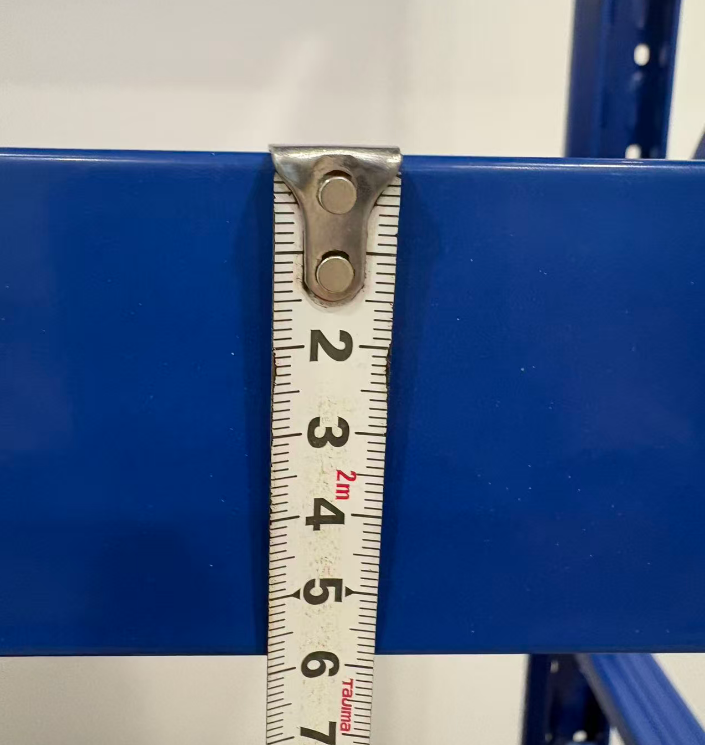
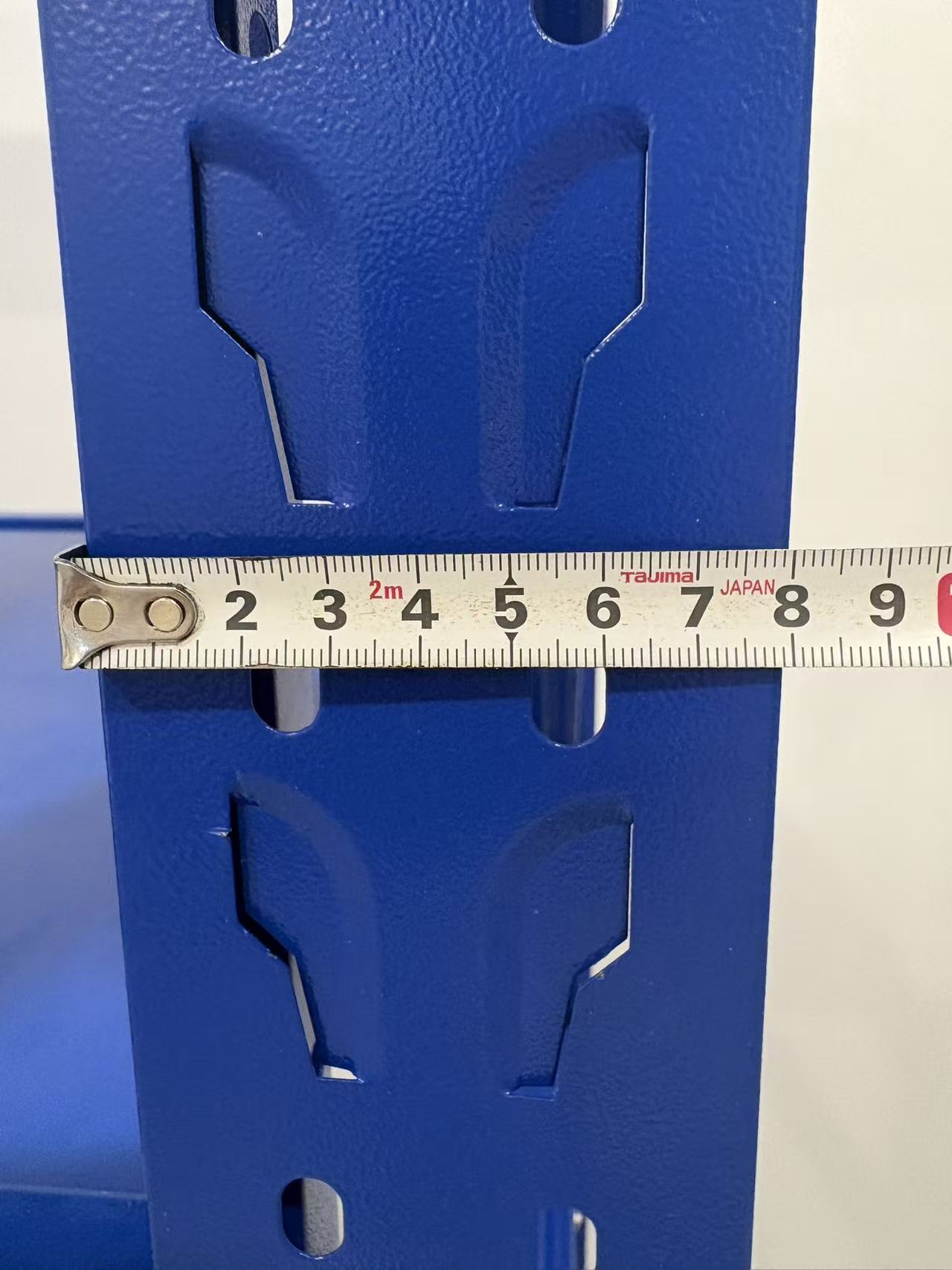
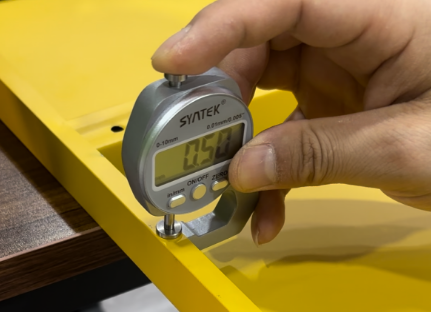
The images from KAYOU demonstrate these two separate checks. A measuring tape is used to verify the upright and beam dimensions, while a dedicated thickness instrument is used to check the steel material.
3. The Supplier Provides Only One Measurement Photo
A single photo can show one carefully selected component, but it does not necessarily represent the complete order.
For a bulk order, thickness should be sampled from:
Different product components
Different shelving units
Different production batches
Different packing cartons
Multiple positions on the same component
A continuous inspection video is generally more useful than several disconnected photographs because it can show the measuring instrument, zero position, selected component, measuring point and final reading in one sequence.
4. The Load Capacity Is Not Clearly Defined
A statement such as “load capacity: 200 kg” is incomplete unless the loading conditions are explained.
The buyer should confirm:
Is the capacity 200 kg per shelf or per shelving unit?
Is the load uniformly distributed?
What is the shelf length and depth?
How many reinforcement bars are installed?
Does the rating include the weight of the shelf panel?
Is the rack freestanding or anchored?
Was the capacity calculated or physically tested?
What safety factor or design standard was applied?
Industrial shelving should be selected according to the real size, weight and handling method of the stored goods.
OSHA requires stored materials to remain stable and secure against sliding or collapse and requires aisles and passageways to remain clear of hazards. Therefore, an unclear or exaggerated capacity claim can become more than a product-quality issue; it may also affect warehouse safety.
Does Powder Coating Affect the Thickness Reading?
Finished shelving components normally have a powder-coated surface.
When an external thickness gauge measures a finished coated component, the reading may include both the steel base material and the coating layers. For this reason, the buyer and supplier should agree on what the quoted thickness represents.
The specification should clarify whether the value means:
Nominal base steel thickness before coating
Finished component thickness after coating
Minimum acceptable measured thickness
Thickness according to an agreed material tolerance
The most reliable approach is to combine physical measurement with production records and raw-material documentation.
How B2B Buyers Can Verify Steel Shelving Thickness
Step 1: Request a Detailed Specification Sheet
Before paying a deposit, ask the supplier to provide a written specification for every major component.
A useful specification should include:
Overall rack dimensions
Upright profile and thickness
Beam profile and thickness
Shelf-panel thickness
Reinforcement quantity
Load capacity per shelf
Loading condition
Steel material
Surface treatment
Product weight
Packaging dimensions
Do not rely only on WhatsApp messages or a catalog description. The confirmed specifications should appear in the quotation, proforma invoice, drawing or purchase contract.
Step 2: Confirm the Measurement Method
Ask the supplier which instrument will be used and how the measurement will be performed.
For section dimensions, suitable tools may include:
Steel tape
Digital caliper
Vernier caliper
For steel thickness, the supplier should use a suitable thickness gauge or micrometer rather than attempting to estimate the thickness visually.
The inspection record should show:
The measuring instrument
The instrument returning to zero
The component being measured
The exact measuring location
The final reading
Repeated measurements where necessary
Step 3: Verify Dimensions and Thickness Separately
External dimensions and material thickness are not the same measurement.
For example, a buyer may confirm:
Upright: 80 × 35 × 0.6 mm
Beam: 40 × 60 × 0.6 mm
Shelf panel: 0.4 mm
The first two numbers describe the section dimensions. The final number describes the material thickness.
Each value should be checked separately.
Step 4: Request Measurements Before Mass Production
When ordering a customized product, approve the structural specification or physical sample before the complete order enters production.
This allows both parties to confirm:
Upright dimensions
Beam dimensions
Shelf-panel construction
Hole pattern
Connection method
Steel thickness
Powder-coating color
Assembly performance
An approved sample can later serve as the comparison standard for the finished order.
Step 5: Request In-Process Inspection Evidence
Do not wait until the goods are completely packed.
During production, the supplier can provide:
Raw-material photos
Steel-coil or sheet identification
Component measurement videos
Production-line photos
Sample assembly photos
Product-weight records
Powder-coating inspection
Finished-product measurements
Finding a specification problem before coating and packaging is much easier than resolving it after container loading.
Step 6: Inspect Random Finished Components
The inspection samples should not be selected only from a demonstration unit prepared by the supplier.
Random components can be taken from different production and packing areas. Buyers may also appoint a representative or independent inspection company to select the samples.
Step 7: Keep All Confirmed Specifications in Writing
A complete order file may include:
Approved quotation
Technical drawing
Component specification table
Signed sample confirmation
Product photos
Measurement videos
Inspection report
Packing list
Written quality guarantee
These documents reduce misunderstandings and make the acceptance requirements clearer for both parties.
Thickness Alone Does Not Prove Load Capacity
A thicker shelf is not automatically a better shelf.
Two shelf panels with the same steel thickness may perform differently because of:
Different panel widths
Different folded-edge structures
Different reinforcement quantities
Different reinforcement profiles
Different shelf spans
Different steel grades
Different connection methods
Similarly, a large upright profile may still be unsuitable when the perforation pattern, bracing arrangement, base plate or beam connection has not been properly designed.
Industrial storage rack standards cover the design, testing and utilization of the structural system because the components work together to support the stored load.
A trustworthy supplier should therefore provide both:
Material specifications, including profile and thickness
Structural information, including configuration and rated load conditions
Warning Signs When Comparing Steel Shelving Quotations
Buyers should investigate further when they see the following situations.
The Price Is Much Lower but the Specification Appears Identical
A significant price difference may come from:
Thinner steel
Smaller profiles
Fewer reinforcement bars
Lower product weight
Simpler packaging
Lower-quality surface treatment
Different steel grades
Reduced inspection requirements
A low price does not automatically mean poor quality, but the supplier should be able to explain how the price was calculated.
Every Shelf Size Has the Same Load Capacity
A 900 mm shelf and a 2,000 mm shelf do not have identical structural conditions.
When the span, depth or load arrangement changes, the required beam, panel and reinforcement configuration may also change.
The Supplier Refuses to Provide Product Weight
Product weight is not a complete quality standard, but it is a useful cross-check.
When two products have the same dimensions and structure but significantly different weights, buyers should examine the profile sizes, component quantities and steel thickness more carefully.
The Supplier Avoids Continuous Measurement Video
A responsible manufacturer should be able to demonstrate the measurement process clearly.
Photos alone may not show whether:
The instrument was correctly zeroed
The same sample was used throughout
The measuring location was suitable
Multiple parts were checked
The displayed component belongs to the actual order
The Capacity Claim Has No Conditions
Claims such as “heavy duty,” “500 kg capacity” or “industrial grade” have limited value unless the quotation explains the shelf size, load distribution and structural configuration.
How KAYOU Controls Steel Shelving Specifications
At KAYOU, quality verification begins before mass production.
Specification Confirmation
We confirm the dimensions, load requirements and major component specifications according to the customer’s storage application.
Physical Dimension Measurement
Upright and beam profiles can be physically measured to confirm that the finished component matches the agreed dimensions.
Steel Thickness Inspection
Steel thickness can be checked with a dedicated measuring instrument. The inspection process can be recorded in a continuous video showing the instrument and measurement result.
Multiple Production Checks
Measurements can be taken during raw-material preparation, component production and final-product inspection rather than relying on only one finished sample.
Sample and Drawing Approval
For customized projects, KAYOU can prepare technical drawings or samples for customer approval before mass production.
Third-Party Inspection Support
Customers may inspect the products personally or appoint an independent inspection company before shipment.
Written Quality Commitment
The confirmed steel thickness, structure and product requirements can be included in the order documents and written quality guarantee.
A Practical Pre-Order Checklist
Before confirming a steel shelving supplier, ask these questions:
What is the upright profile and steel thickness?
What is the beam profile and steel thickness?
What is the shelf-panel thickness?
How many reinforcements are installed under each shelf?
What does the stated capacity mean?
Is the load uniformly distributed?
What is the total product weight?
Can the supplier provide an assembly drawing?
Can the supplier provide a continuous measurement video?
Can random finished products be inspected?
Is third-party inspection accepted?
Will the specifications be included in the contract?
A professional supplier should answer these questions clearly and consistently.
Frequently Asked Questions
Is thicker steel always better for shelving?
Not necessarily.
Steel thickness is important, but structural performance also depends on the profile, reinforcement, span, steel grade and connection design. The correct goal is not simply to use the thickest material, but to provide a verified structure suitable for the required load.
How should steel shelving thickness be measured?
A suitable thickness gauge or micrometer should be used. The instrument, zeroing process, component, measuring location and final reading should be clearly shown.
Can a tape measure verify steel thickness?
No.
A tape measure can verify the external width or height of an upright and beam, but it cannot accurately verify thin sheet-steel thickness. A suitable precision instrument should be used for thickness inspection.
What does 200 kg per shelf mean?
It should normally identify the permitted load on one shelf level under specified conditions. The supplier should also state the shelf dimensions, loading method and whether the load must be uniformly distributed.
Why can two 0.6 mm shelving systems have different capacities?
They may use different upright profiles, beam heights, shelf spans, reinforcements, steel grades, connectors or overall configurations. Thickness is only one factor in the complete system.
Should buyers arrange third-party inspection?
Third-party inspection is useful for large orders, customized projects or situations where the buyer requires independent confirmation. Inspection requirements and acceptance criteria should be agreed before production.
Buy Specifications, Not Just a Low Price
Steel shelving is a long-term warehouse asset. The real purchasing cost is not only the amount shown on the invoice.
An under-specified product may lead to premature deformation, replacement costs, operational disruption, customer disputes and warehouse safety concerns.
A reliable quotation should clearly identify what material will be used, how the capacity is defined and how the finished product can be verified.
KAYOU provides customized steel shelving and warehouse storage solutions for importers, wholesalers, distributors, manufacturers and project buyers.
Send us your required shelving dimensions, load per shelf, quantity and application. Our team can recommend a suitable structure and provide technical specifications, measurement evidence and export packaging support.
Need a Verified Steel Shelving Solution?
Send us your required dimensions, load per shelf, quantity and application. Our team will recommend a suitable structure and provide a detailed quotation.