

Can You Mix Different Brands of Boltless Shelving? A Buyer’s Compatibility Checklist
KAYOU / SHELVING PARTS & EXPANSION GUIDE
Identify the system before ordering parts.
An existing shelving row needs another bay. A damaged beam needs replacing. A supplier offers parts that look almost identical to the ones already installed.
Can you buy them and keep using the original load rating?
Do not assume that boltless shelving parts from different brands are interchangeable. Use identified original-series replacements or alternatives supported by configuration-specific technical confirmation. Matching color, nominal dimensions or hole spacing is not enough.
This guide helps warehouse operators, importers and distributors identify existing shelving, prepare a useful parts enquiry and choose between an approved replacement and a separate new system. It covers manually loaded boltless steel shelving, not forklift-loaded pallet racking.

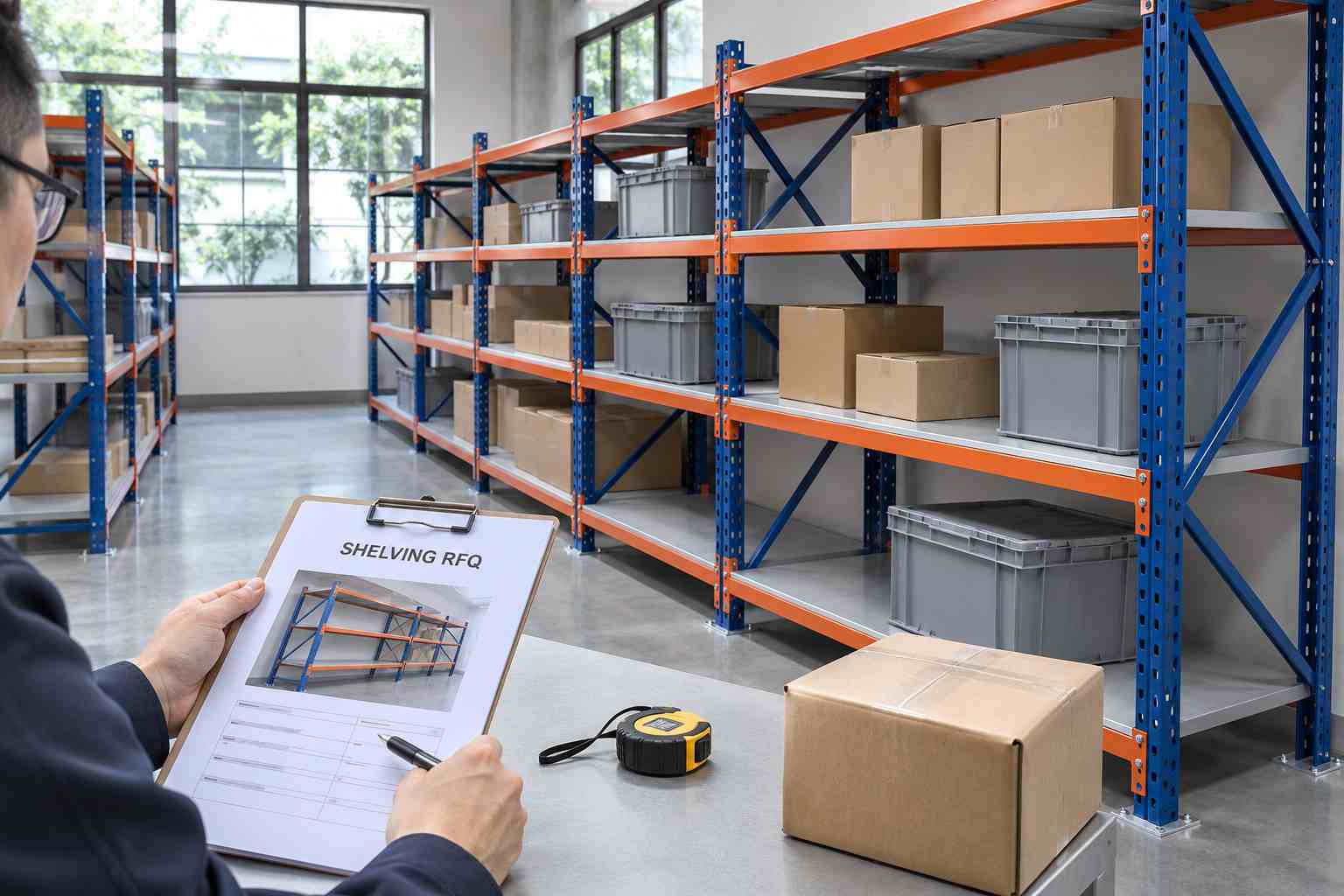
AI-generated illustration: component identification before selecting replacement parts.
1. “Boltless” Describes a Connection Method
Boltless shelving may use rivets, tabs, hooks or other interlocking connections. The term does not identify one universal component interface.
Two systems can both be sold as “heavy-duty boltless shelving” while using different upright profiles, hole openings, connectors, beams and deck supports.
Our boltless versus longspan shelving guide explains why product names alone are insufficient for selecting a system.
For replacement parts, distinguish three questions:
Identification: What manufacturer, series, revision and part number do you have?
Connection: Do the proposed components engage as intended, with the specified supports and locking features?
Performance: What evidence establishes the allowable loads and installation requirements for the resulting configuration?
A visual match addresses only part of the first question. An unloaded trial fit does not answer the third.
2. Check More Than the Upright Hole Pitch
Hole pitch is the repeated distance between corresponding points on adjacent openings. It is useful identification information, but it does not describe the complete connection.
Use this checklist when asking a supplier to identify or assess parts. It is an information-gathering tool, not a pass/fail engineering specification.
Ask the supplier to mark measurement locations on a sketch. A description such as “2,000 mm beam” is ambiguous unless both parties use the same reference points.
Photograph accessible features without disturbing a loaded installation. Arrange any dismantling or component removal according to the system instructions and the condition of the shelving.
3. Even Same-Brand Parts Need a Revision Check
A genuine manufacturer part may still require particular companion components.
For example, Lyon’s official rivet-rack update identifies compatibility between certain new and previous posts and beams, while specifying additional conditions. It requires corresponding front and rear T-post replacement in the stated situation and distinguishes which center supports belong with old or new beams. [1]
This is a manufacturer-specific example, not a rule for every shelving system. It shows why a general statement such as “compatible with older models” should be checked against the actual component instructions.
Ask for:
The applicable part-number cross-reference.
Any requirement to replace components together.
The installation instructions for the resulting combination.
For distributors, retain these records alongside the quotation so future repeat orders use the same approved specification.
4. Confirm Capacity for the Complete Arrangement
A replacement beam labeled “300 kg” does not automatically give an existing shelf or bay a 300 kg rating.
The review needs to address the connected components, span, decking, supports, shelf positions and loading conditions. Distinguish the permitted load on one complete shelf level from the permitted total bay load.
The Storage Manufacturers Association advises that shelving reconfiguration should be checked against the original load application and configuration drawings. If the proposed arrangement is outside those documents, the manufacturer or a qualified design professional should review and approve it. [2]
For procurement, request confirmation that identifies:
The exact original and replacement parts.
The configuration covered, including shelf positions and required supports.
The permitted loads and loading conditions.
The supporting assessment or test information and its limitations.
The installation instructions and any revised load information.
A seller’s statement that a component “fits most brands” does not provide this detail. Nor does reducing the intended load by an arbitrary percentage establish an acceptable mixed configuration.
If making parts fit requires drilling, grinding, bending or welding, stop treating the proposal as a direct replacement. Request a documented solution before installation.

AI-generated illustration: reviewing system information before a replacement or expansion order.
5. Send a Useful Shelving Replacement-Parts Enquiry
Start with identification rather than asking only for a price per beam.
A useful photo package includes:
A complete bay and the full connected row.
Manufacturer labels, load notices and component markings.
The upright openings with a scale visible.
Beam-end connections and any locking features.
The beam cross-section and shelf-support arrangement.
Deck undersides, bracing, bases and the location requiring replacement.
Use a consistent unit system and label measurements. Record missing, bent, corroded or previously modified components separately.
Copyable enquiry template
Subject: Boltless Shelving Parts Identification and Replacement Enquiry
Existing manufacturer / series / revision: [known details or unknown]
Original order or part numbers: [details]
Bay size and installed row arrangement: [dimensions and sketch]
Components required: [description, quantity and location]
Current shelf levels and positions: [details]
Stored goods: [dimensions, maximum weight and base contact pattern]
Existing load information: [attach labels or documents]
Available evidence: [photos, drawings, instructions or samples]
Delivery destination and required date: [details]Please identify the proposed parts, state any companion replacements, and explain what technical confirmation is available for the resulting configuration. List information still required and quote alternatives separately.
If the brand is unknown, state that clearly. Photographs and measurements help identification; they do not certify compatibility.
6. Choose the Replacement or Expansion Route
An independent unit and an add-on bay are different purchasing options. An add-on relies on the adjacent structure; it is not simply another shelf placed nearby. Read our starter bay and add-on bay guide before preparing an extension order.
Illustrative example: A warehouse wants two extra bays beside an unidentified shelving row. A proposed beam has the same nominal length and hole pitch. Those observations alone leave the connector geometry, upright identity and allowable connected loads unresolved. The buyer should obtain the missing technical confirmation or compare a separate, fully specified two-bay system.
This is a purchasing example, not a reported KAYOU project.
7. Compare the Full Replacement Cost
A low component price can exclude work needed to make the order usable.
Compare part identification, technical assessment, required companion components, packing, transport, unloading and installation. Include any planned interruption to warehouse operations.
For repeat supply, retain a component schedule with part numbers, drawing revisions and approved alternatives. Label spare parts by system rather than grouping visually similar beams or supports together.
That record gives importers and distributors a clearer basis for future replacement quotations.
Frequently Asked Questions
If the hole spacing matches, will the beam fit?
Not necessarily. The opening, connector geometry, upright profile and engagement arrangement also need checking. Matching pitch alone does not establish connection suitability or capacity.
Can I mix brands if I store only lightweight goods?
A lower intended load does not resolve an unidentified connection or missing system information. Request confirmation for the proposed arrangement.
Are shelf panels easier to substitute than beams?
Panels still need the correct dimensions, support, retention and load information. A panel that drops into the opening is not automatically a suitable replacement.
Can new shelving stand beside an older brand?
A separate unit can be considered without sharing structural components. Confirm its own installation requirements and the available access space. Connecting units or sharing supports introduces a different assessment.
Discuss Your Shelving Requirement with KAYOU
KAYOU supplies steel storage shelving for warehouse, workshop and commercial applications, with configurable dimensions and storage arrangements.
For a replacement or expansion enquiry, send the identification details, connection photographs, dimensions, load information, required quantities and destination. KAYOU can discuss supply options once the requirement is clear.
Compatibility with a third-party system must be established for the specific configuration; photographs or a quotation alone are not approval. Where that cannot be established, discuss a separate new shelving solution.
Technical References
Lyon — Rivet Rack Update. Manufacturer-specific new/old component compatibility and companion-part instructions.
MHI — Storage Manufacturers Association FAQs. Guidance on shelving reconfiguration and applicable load information.
This guide supports purchasing and component identification. It does not approve a mixed-brand installation or establish a load rating.