
KAYOU Apparel Storage Guide
How Double-Tier Garment Racks Improve Apparel Picking and Hanging Storage
A practical B2B guide to hanging capacity, SKU zoning, rail configuration and apparel warehouse workflow.
Apparel inventory creates a different storage challenge from cartons, tools or industrial components. Many garments must remain hanging to protect their shape, reduce creasing and keep colors, sizes and styles visible during picking.
A conventional single-rail clothes hanging rack may work for long coats or dresses, but it can leave a large amount of unused vertical space when storing shirts, jackets, uniforms and other short or medium-length garments.
A double-tier steel garment rack addresses this problem by arranging two hanging levels vertically within one frame. When garment length and rail clearance are planned correctly, the system can create more usable hanging positions without expanding the storage area.
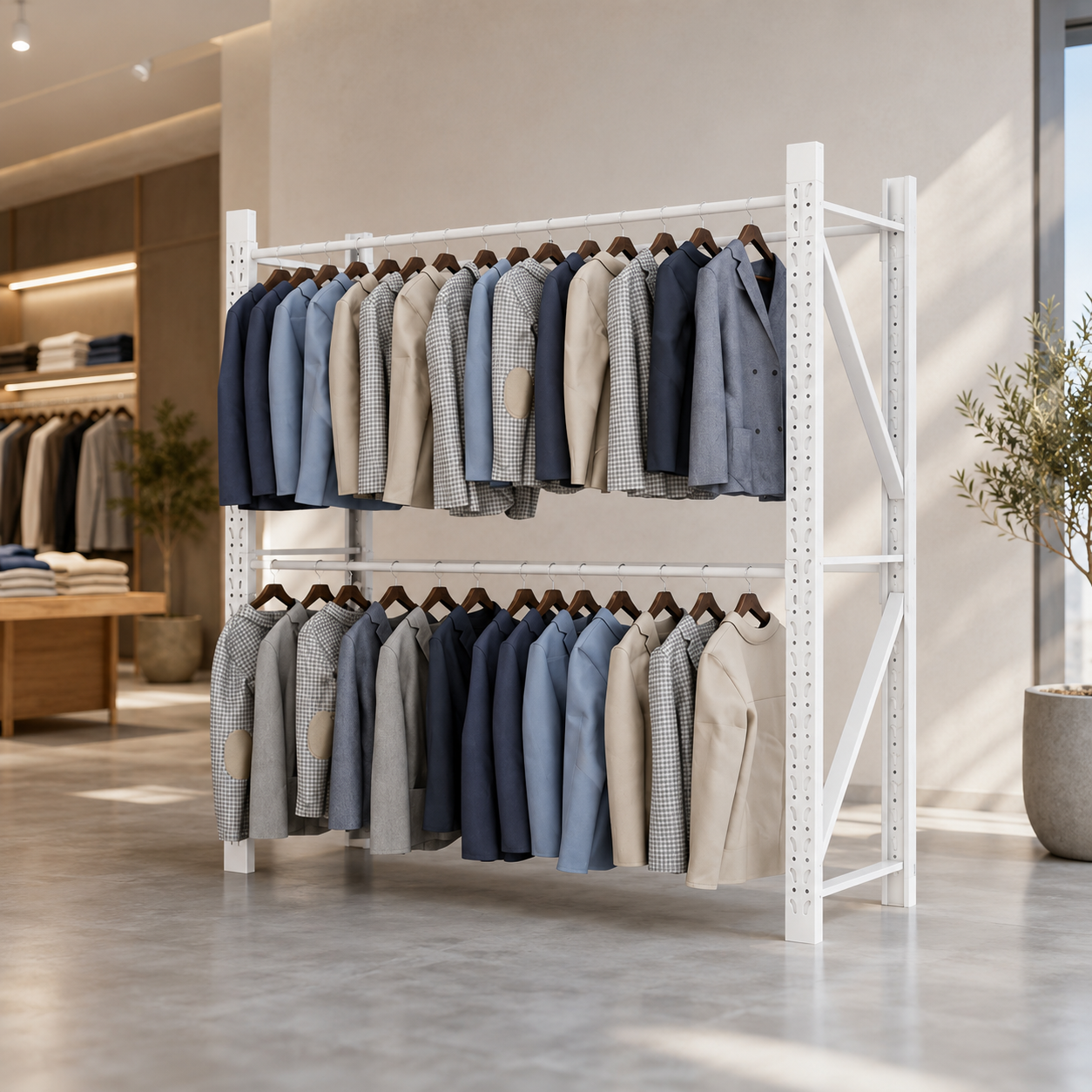
The KAYOU product shown here uses a white powder-coated steel structure, four perforated uprights, two vertically arranged hanging rails and reinforced side frames. It can support apparel warehouses, retail stockrooms, clothing showrooms, uniform storage rooms and e-commerce fulfillment operations.
Double-Tier and Double-Rail Do Not Always Mean the Same Thing
Buyers frequently search for a double rail garment rack, but this term can describe two different structures.
A double-tier garment rack has one hanging rail above another and uses vertical space. A parallel double-rail rack places two rails at approximately the same height, usually one behind the other, and increases hanging depth.
Because both may be advertised as double rail clothing racks, a written description alone is not enough for a B2B order. Confirm the rail position, overall height, usable hanging width, distance between levels, frame depth, picking direction and number of accessible sides.
Why Hanging Inventory Needs a Dedicated Storage Plan
A warehouse clothing rack should not be planned in the same way as ordinary steel storage shelving. Shelf capacity is usually calculated by shelf area, carton positions or volume. Hanging apparel capacity depends on:
Usable rail length and average hanger spacing
Garment thickness and garment drop length
Weight per item and approved rail load
Upper and lower rail height
Picking frequency and replenishment method
Clearance required to separate and remove garments
A rail that appears full may still be inefficient if employees cannot read labels or remove one item without disturbing adjacent garments. For apparel operations, practical capacity matters more than the greatest number of hangers that can physically fit.
How to Estimate Hanging Capacity
Use the following formulas for a preliminary layout estimate:
Usable rail length / Average hanger pitch
Positions per rail x Rails x Bays
Average hanger pitch should include the real garment thickness and operating clearance needed for picking. Thick winter jackets, suits and workwear require more rail length than light shirts or packaged uniforms.
Use this calculation for planning, not as a guaranteed capacity. Before confirming a commercial garment rack order, test a representative group of the thickest garments and largest hangers on the proposed rail length.
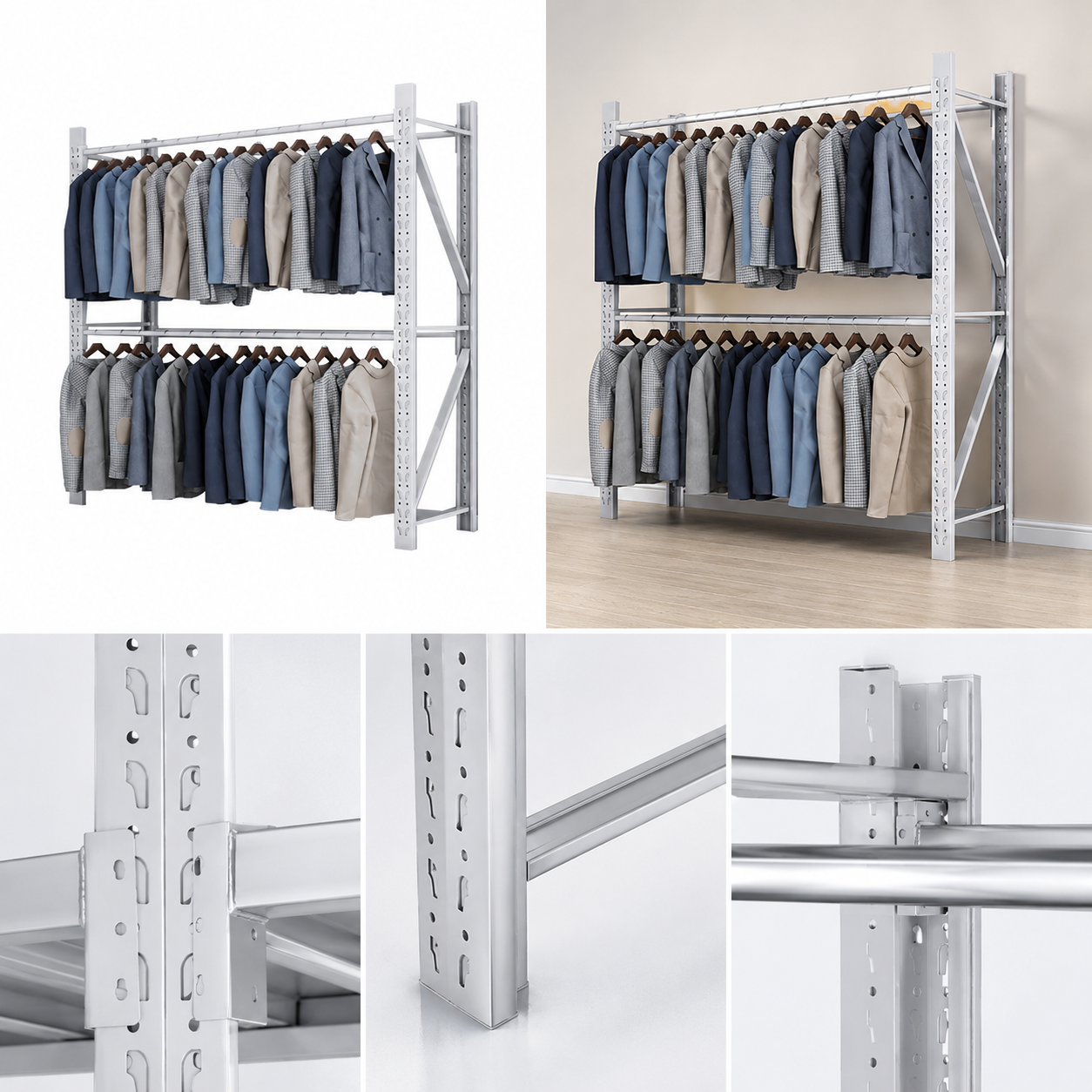
What the Product Details Show
Perforated Steel Uprights
Repeated slots allow horizontal components to be installed at selected positions. Confirm the exact adjustment pitch instead of assuming that every rail can be placed at any height.
Two Vertical Hanging Levels
Upper and lower rails can separate sizes, styles, order status or inventory priority. One level may hold reserve stock while the other supports active picking.
Reinforced Side Frames
Horizontal members and diagonal bracing help maintain frame geometry. The complete frame, not only the hanging tube, affects rack stability.
Fixed Slot-Based Structure
The modular connectors support assembly and reconfiguration. The pictured product is floor-standing and does not include caster wheels.
Match the Rail Layout to the Garment Type
Double-tier storage works best when products fit within the available vertical clearances.
| Garment Type | Recommended Planning Approach |
|---|---|
| Shirts and blouses | Well suited to two hanging levels |
| Short jackets | Usually suitable after checking garment drop |
| School or work uniforms | Useful for size and department zoning |
| Suits | Confirm jacket length, hanger width and spacing |
| Heavy winter coats | Allow greater hanger pitch and verify rail load |
| Long dresses | May require a full-height single hanging section |
| Trousers on clip hangers | Can suit double-tier storage with correct clearance |
| Mixed apparel | Combine single-tier and double-tier bays |
A garment should not touch the floor, lower rail or clothing stored below it. For mixed inventory, combine full-height hanging bays for long clothing with double-tier bays for shirts, jackets and folded-over trousers.
Use the Rack to Support the Apparel Workflow
A garment storage rack becomes more valuable when its locations follow the inventory process.
Receiving
Unload and identify incoming garments.
Inspection
Check quality, quantity, size and color.
Put-Away
Assign locations by style, color and size.
Active Picking
Place current SKUs on accessible rails.
Reserve Storage
Hold replenishment inventory separately.
Consolidation
Group completed orders before packing.
Dispatch
Move checked orders to packing and shipping.
Rack labels should follow the same logic as the warehouse management system or inventory spreadsheet. A code can identify the aisle, bay and hanging level:
A03-B05-L2This may represent aisle 3, bay 5 and level 2. Clear coding reduces searching and makes it easier to replenish a lower pick rail from reserve inventory.
Fixed Garment Rack or Rolling Garment Rack?
A fixed steel garment rack is normally more suitable for permanent warehouse rows, organized SKU locations and higher-volume hanging storage. A rolling rack may be useful for temporary movement between receiving, inspection, production, photography or packing areas.
| Requirement | Fixed Double-Tier Rack | Rolling Garment Rack |
|---|---|---|
| Permanent SKU locations | Strong choice | Less suitable |
| Frequent movement | Not intended for movement | Strong choice |
| Long connected rows | More practical | Usually individual units |
| Floor planning | Requires fixed rack positions | Requires movement space |
| Stability | Depends on frame and installation | Also depends on caster quality |
| Apparel picking zones | Suitable | Better for temporary transfer |
The product in the images is fixed and should not be promoted as a garment rack with wheels unless casters are separately designed and confirmed.
Common Garment Storage Planning Mistakes
Using two levels for garments that are too long
Calculating capacity without considering garment thickness
Confusing load per rail with load per complete bay
Leaving too little clearance above the hanger hook
Installing the lower rail too close to the floor
Mixing fast and slow SKUs without location rules
Overfilling rails until labels become difficult to read
Ordering a home closet rack for commercial workload
Requesting wheels without reviewing stability
Ignoring connection, anchoring or floor-fixing requirements
What B2B Buyers Should Confirm Before Ordering
A reliable quotation should describe the complete rack, not only its overall dimensions.
Overall height, width and depth
Usable hanging length per rail
Number and position of rails
Vertical clearance between levels
Upright profile and steel thickness
Hanging rail profile and thickness
Rated load per rail and per bay
Main and add-on bay configuration
Side bracing and connection method
Locking or safety accessories
Floor-fixing requirements
Powder-coating specification
Standard and custom colors
Knock-down packaging dimensions
Assembly instructions
Spare component availability
Inspection and load documents
Check whether quoted dimensions refer to the outside of the frame or the usable hanging area. Two racks with the same overall width may provide different usable rail lengths.
Suitable B2B Applications
Manufacturing and Wholesale
Garment factories, wholesale clothing markets, sample rooms and work-in-process storage.
Warehouse and Fulfillment
Apparel distribution warehouses, e-commerce picking and uniform distribution centers.
Retail and Showrooms
Retail stockrooms, boutiques, fashion showrooms and seasonal inventory areas.
Institutional Storage
Hotels, events, costume departments, schools and workwear suppliers.
The final structure should always follow the stored garments, operating method and approved loading requirement. For projects combining hanging storage with cartons or folded products, KAYOU can also review other warehouse storage systems.
Frequently Asked Questions
Is it suitable for long coats?
Usually not on both levels. Long coats and dresses often require a full-height hanging section. A mixed layout can combine full-height and double-tier bays.
How many garments fit on one rail?
Quantity depends on usable rail length, hanger spacing, garment thickness and approved rail load. Test representative garments instead of using a universal number.
Can the rail height be adjusted?
The perforated uprights support configurable positions, but the exact adjustment pitch and approved rail locations must be confirmed.
Is this a rolling garment rack?
No. The pictured configuration is fixed and has no wheels. Rolling versions require suitable casters and a separate stability review.
Can the color be customized?
Yes. Powder-coated racks can be produced in white, black or other confirmed colors for distributors, retailers and projects.
Can several bays be connected?
A modular system may use main and add-on bays. Connection details, quantities and overall stability should be confirmed in the approved drawing.
Related KAYOU Storage Solutions
Build a Garment Storage System Around Your Inventory
Send KAYOU your garment length, required rail capacity, available space, quantity and preferred color. Our team will prepare a customized double-tier garment rack proposal for your warehouse or retail project.