
KAYOU Warehouse Planning Guide
Tire Storage Rack Sizing: How to Plan Capacity for Mixed Tire SKUs
Turn tire diameter, section width, unit weight and picking frequency into a practical rack layout before requesting a quotation.
Ordering a tire storage rack by its external height and width alone can create costly problems. Two racks with similar outside dimensions may hold very different quantities when tire section width, outside diameter, weight and handling clearance are considered.
This is especially important for tire distributors, automotive service centers and seasonal tire warehouses. Passenger car tires, SUV tires, light truck tires and mounted wheel assemblies cannot always share the same bay configuration efficiently.
This guide explains how to convert your tire inventory data into practical rack dimensions before requesting a quotation.
Tire Storage Rack Warehouse Tire Rack Heavy Duty Tire Rack Adjustable Tire Rack Commercial Tire Shelving
Start with Tire Data, Not Rack Dimensions
Before selecting a heavy duty tire rack, prepare a list of the products that will actually be stored. For every SKU, record the following information:
Passenger car, SUV, crossover, light truck or another vehicle type.
Outside diameter and maximum section width for every product family.
Unit weight plus whether products are mounted or unmounted.
Current quantity, peak-season quantity and picking frequency.
The maximum tire diameter determines the required clear height between levels. Section width affects how many tires fit along each beam, while unit weight determines the load placed on every level.
Using average dimensions may work for uniform inventory, but it can underestimate the space needed for mixed-SKU operations.
A Simple Tire Rack Capacity Formula
For tires stored upright in a row, an initial quantity estimate can be calculated as follows:
Always round the result down to a whole tire. Do not calculate capacity from the rack's total outside width. Uprights, connectors and end clearance occupy part of that dimension. The usable measurement is the clear beam length between frames.
Handling allowance should account for:
Space for workers to grip and remove a tire
Barcode or product labels
Small dimensional differences within the same SKU
Separation between customer orders or tire families
Four Dimensions That Control Rack Performance
A longer beam may provide more tire positions, but it also changes the structural requirement. Specify both the preferred bay width and the number of tires expected per level.
Base vertical clearance on the largest outside diameter assigned to that level. Adjustable beam positions can reduce unused height in a mixed inventory.
The open support bars should suit the intended tire diameter without allowing the tire to sit too deeply, become difficult to remove or pass through the opening.
Calculate the expected working load with the heaviest tire assigned to the level. Do not confuse a per-level rating with total bay capacity.
A longer span affects the required beam profile, steel thickness and connection design. Mounted wheel-and-tire assemblies can also be substantially heavier than unmounted tires and must be declared separately.
Final load capacity depends on the complete rack dimensions, material specifications, beam structure and connections. It should be confirmed by the manufacturer before production and loading.
Configure the Rack Around Your SKU Mix
Similar dimensions make repeated, high-density positions possible. Matching level spacing can simplify replenishment and location management.
Wider and larger-diameter products reduce positions per beam and require more vertical clearance. Dedicated levels or bays are easier to control.
Do not assume a rack for unmounted tires is automatically suitable. Provide complete assembly weight, dimensions and intended orientation.
Divide SKUs into dimension families and configure separate clear heights for compact, performance, SUV and light-truck products.
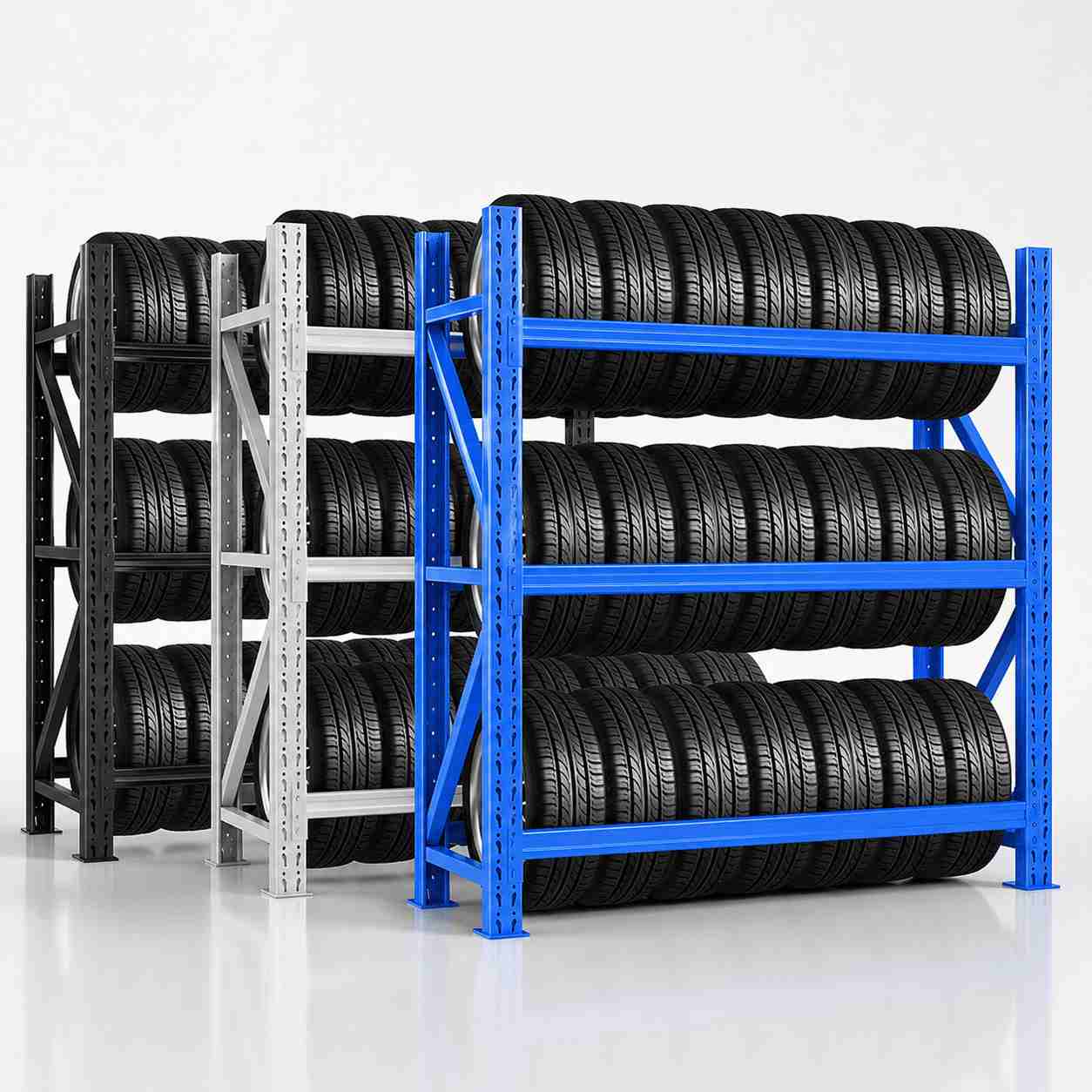
An adjustable automotive tire storage rack can use different clear heights for each tire family, reducing unused space while keeping locations easy to identify.
Use Color as Part of Warehouse Zoning
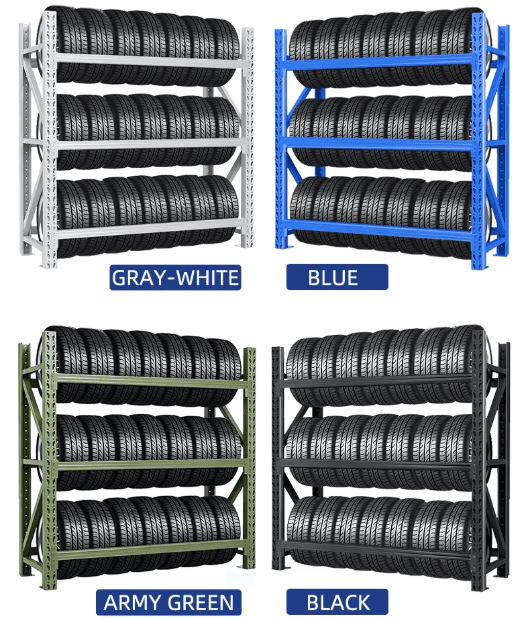
The product images show gray-white, blue, army green and black steel tire rack options. Color can support visual zoning in larger warehouses.
Different colors may identify passenger, SUV and light truck inventory; seasonal categories; customer-owned tires; fast-moving stock; reserve inventory; or separate warehouse areas.
Improve Slotting and Picking Efficiency
A properly sized warehouse tire rack should reflect how often each SKU moves. High-turnover tires are usually best placed at comfortable handling levels and close to receiving, installation or dispatch areas. Slow-moving and seasonal reserve stock can be assigned to less accessible positions.
Avoid spreading one popular SKU across many distant bays. Consolidated locations make replenishment and stock counting easier. Clear bay, level and position codes also help workers find the correct tire without relying only on tread appearance.
A practical location code can follow this structure:
Zone – Bay – Level – PositionFor example, B-12-02-05 can identify one exact position inside the blue storage zone.
Common Tire Rack Quotation Mistakes
Many quotations become inaccurate because the supplier receives only a general request such as “three levels for car tires.” Avoid these common mistakes:
Providing outside rack dimensions instead of usable dimensions
Giving rim size without outside diameter and section width
Omitting the maximum tire or wheel-assembly weight
Mixing mounted and unmounted products in one capacity figure
Using average stock instead of peak-season inventory
Requesting a quantity per rack without tire dimensions
Confusing per-level load with total rack load
Ignoring aisle width and manual handling requirements
Setting every level around one sample tire
Failing to identify local anchoring or installation requirements
The more accurate the input data, the more reliable the proposed capacity, configuration and quotation will be.
Information to Send with Your RFQ
For a faster custom tire shelving proposal, prepare the following information:
Available warehouse length, width and clear height
Tire SKU list with outside diameter and section width
Maximum unit weight for each tire category
Mounted or unmounted storage condition
Normal and peak inventory quantities
Required number of storage levels
Preferred bay length and rack depth
Single-sided or double-sided access
Manual or equipment-assisted handling method
Required color, logo and packaging
Project destination and order quantity
Local installation or safety requirements
KAYOU can use this information to recommend a suitable rack structure, level arrangement and estimated storage quantity. For broader warehouse projects, explore our industrial storage shelving and warehouse racking systems.
Tire Storage Environment Still Matters
Rack design is only one part of correct tire storage. Tires should be kept in a clean, cool, dry and moderately ventilated indoor area, away from direct sunlight, heat sources, oils, fuels and harmful chemicals.
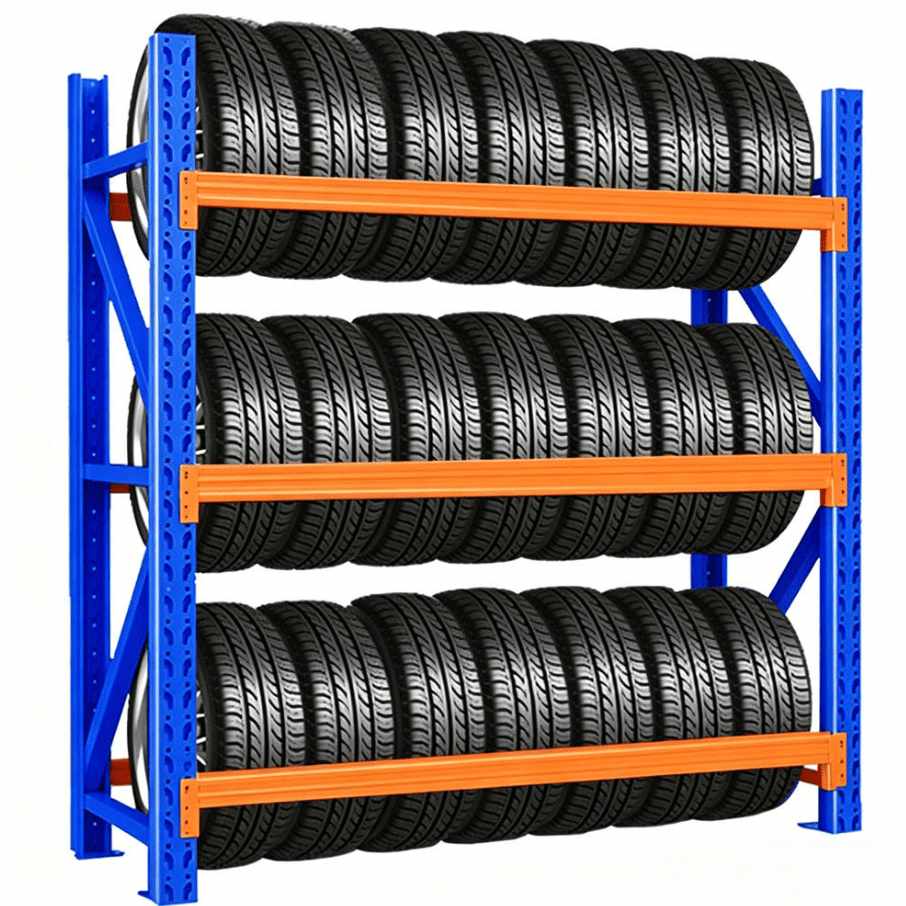
Unmounted tires are generally suitable for upright storage, as shown in the images. Storage practices for mounted assemblies may differ, so the rack configuration should match the actual product condition.
Frequently Asked Questions
How many tires fit on one tire storage rack?
Capacity depends on clear beam length, tire section width, handling clearance, number of levels and approved load capacity. There is no accurate universal quantity without tire dimensions.
Can one rack store both passenger and SUV tires?
Yes, when beam positions, vertical clearance, support-bar spacing and level loads are designed for both groups. Separate levels or bays are usually easier to manage.
Is a three-tier tire rack suitable for mixed inventory?
A three-tier configuration can divide inventory by tire size, season, brand or turnover rate. The usable height of each level should be adjusted to its assigned SKU family.
Can KAYOU customize the rack color and dimensions?
Yes. KAYOU supports customized dimensions, levels, load requirements, colors, logos and packaging for B2B projects. View the KAYOU Heavy Duty Tire Storage Rack for product information.
Plan Your Tire Rack from Real Inventory Data
The most efficient tire storage system starts with accurate SKU dimensions—not a standard rack size copied from another warehouse.
Send KAYOU your tire list, peak inventory, available space and handling requirements. Our team can help configure a steel tire rack that matches your passenger car, SUV or light truck inventory.