

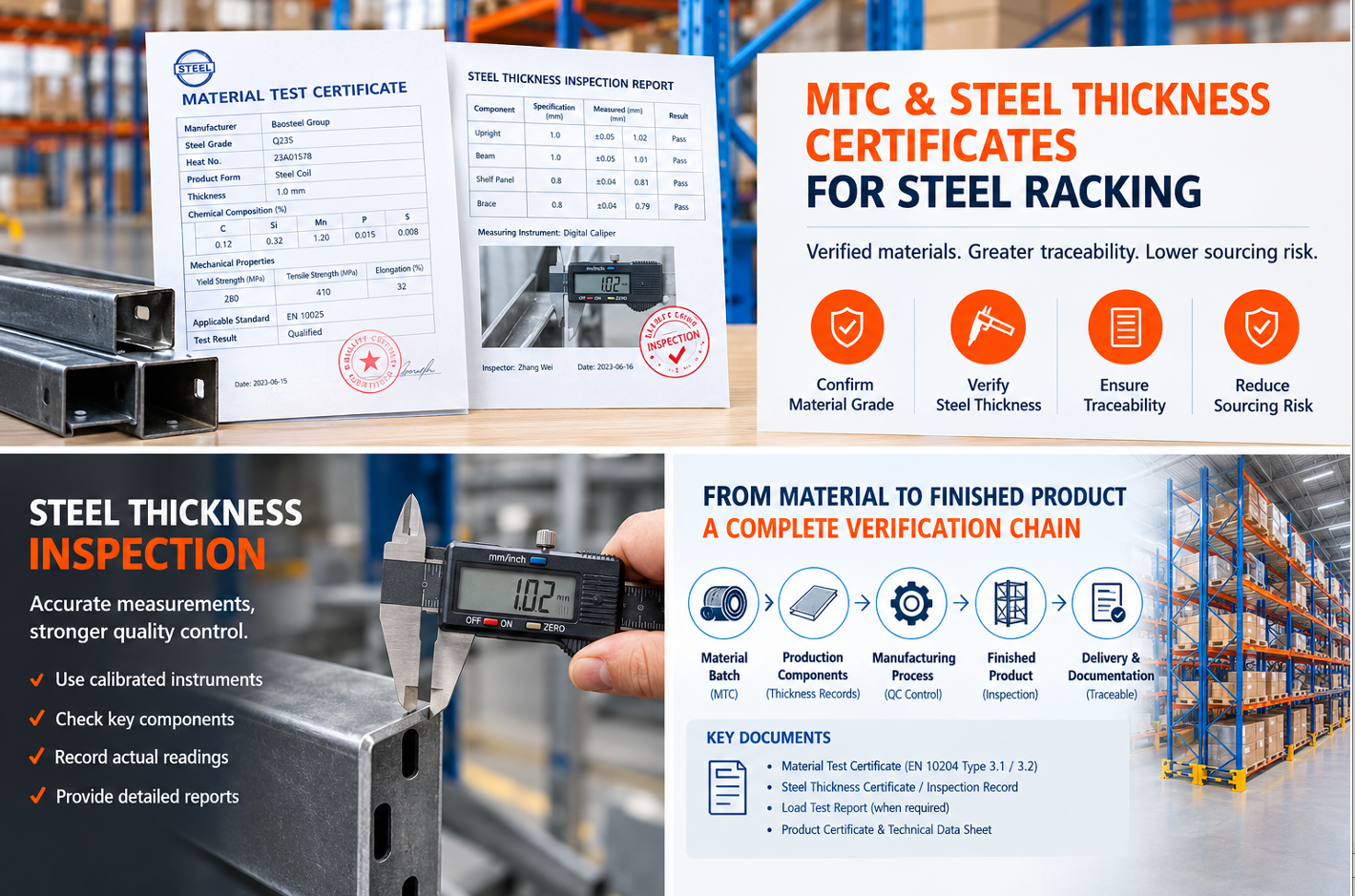
How MTC and Steel Thickness Certificates Reduce Sourcing Risk
When sourcing steel shelving or warehouse racking internationally, two products can look almost identical in photographs while differing significantly in material grade, steel thickness, structure and manufacturing consistency.
A quotation may state “Q235 steel” or “1.0 mm thickness,” but professional buyers need more than a line on a specification sheet. They need evidence connecting the confirmed specification to the steel received by the factory and the components produced for their order.
A Material Test Certificate (MTC) and properly documented steel-thickness inspections can help provide this evidence. However, buyers must understand what these documents prove—and what they do not prove.
In This Guide
What Is a Material Test Certificate? Understanding EN 10204 Inspection Documents What Is a Steel Thickness Certificate? Why Steel Thickness Matters for Racking How These Documents Reduce Sourcing Risk How to Check Whether an MTC Is Reliable MTC vs. Load Test Report vs. Product Certificate KAYOU’s Material Verification Approach Frequently Asked Questions
What Is a Material Test Certificate?
A Material Test Certificate, sometimes called a Mill Test Certificate or Mill Test Report, is a document associated with a batch or heat of steel. It normally records information provided by the steel producer, such as:
Manufacturer or mill name
Steel grade
Heat or batch number
Product form and dimensions
Chemical composition
Mechanical properties
Applicable material standard
Test results
Date and document authorization
ISO 10474:2013 defines different types of inspection documents supplied to purchasers for steel products according to the requirements of the order. It is intended to be used with standards governing the relevant technical delivery conditions.
For a warehouse-racking buyer, an MTC can help answer an important question: Does the incoming steel correspond to the material grade and properties specified in the purchase agreement?
Understanding EN 10204 Inspection Documents
EN 10204 is commonly referenced for inspection documents covering metallic products such as steel sheet, plate, bar and structural sections. The inspection-document type should be agreed before production.
EN 10204 Type 3.1
A Type 3.1 certificate contains specific inspection results and is validated by the manufacturer’s authorized inspection representative who is independent of the production department. It is commonly requested when buyers require batch-level material traceability without an external inspector validating the certificate.
EN 10204 Type 3.2
A Type 3.2 certificate involves validation by the manufacturer’s independent inspection representative and either the purchaser’s authorized representative or an officially designated inspection representative. It generally involves additional coordination and cost, so it should be specified at the inquiry or contract stage.
Important: An MTC should not be treated as a generic marketing certificate. Its usefulness depends on whether the document is authentic, applicable to the correct material and traceable to the purchased goods.
What Is a Steel Thickness Certificate?
“Steel thickness certificate” is usually a commercial term rather than one universal standardized document. Depending on the supplier and purchase contract, it may refer to:
A signed thickness guarantee
Incoming-material inspection records
Coil or sheet thickness measurements
Finished-component inspection results
A third-party thickness inspection report
A table comparing specified and measured thicknesses
A useful thickness record should identify:
Purchase order or project number
Product model and component name
Required nominal thickness
Applicable tolerance or acceptance rule
Measuring instrument
Measurement locations
Actual readings
Inspection date and inspector
Pass or fail result
A statement saying only “the thickness is guaranteed” provides much less assurance than a measurement record connected to identifiable components.
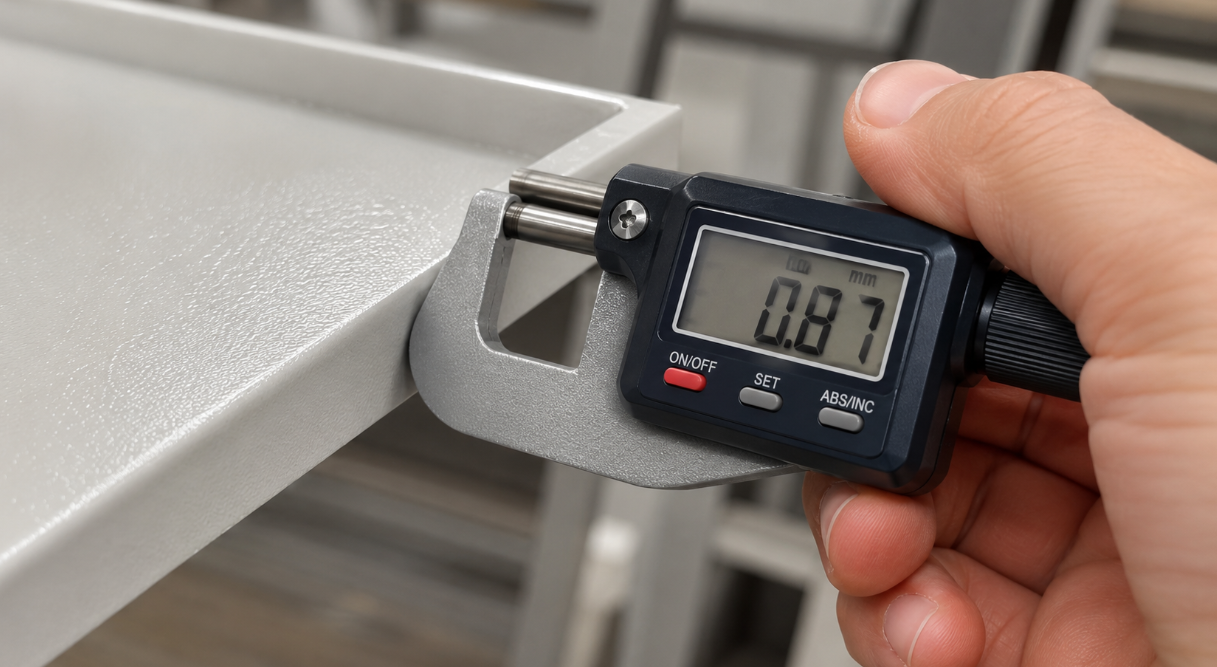
Why Steel Thickness Matters for Racking
Steel thickness can influence component stiffness, weight, forming quality, connection performance and manufacturing cost. In warehouse racking and steel shelving, it can affect:
Upright posts
Beams
Shelf panels
Bracing members
Base plates
Mobile-shelving bases
Cabinet bodies and doors
However, thickness alone does not determine load capacity. Performance also depends on steel grade and mechanical properties, profile geometry, bends and reinforcing ribs, upright perforations, beam connectors, bracing arrangement, weld quality, fasteners and anchors, overall system configuration and load distribution.
A well-designed 0.8 mm profiled component may perform differently from a poorly designed flat component made from thicker steel. Buyers should therefore avoid evaluating a racking system using thickness alone.
For a better comparison, request the material grade, actual component profile, rated uniformly distributed load, drawings and relevant test or calculation evidence. For complete warehouse projects, see KAYOU’s warehouse racking systems.
How These Documents Reduce Sourcing Risk
1. They Reduce Material Substitution Risk
Material substitution can occur when the steel used in production differs from the approved specification. An MTC provides information about the steel batch, while incoming thickness records help confirm whether dimensions match the order. Used together, they create a stronger verification chain than either document alone.
2. They Make Supplier Quotations Easier to Compare
One supplier may quote a low price based on lighter material, while another may include heavier profiles, reinforcement and stronger packaging. Requesting consistent documentation helps buyers compare equivalent specifications instead of comparing price alone.
A useful comparison should include:
Steel grade
Nominal thickness and permitted tolerance
Component profile
Product weight
Load per level
Surface treatment
Packaging method
3. They Improve Batch Traceability
Purchase Order → Approved Drawing → Material Batch → Production Components → Finished Product → Inspection Record
If a quality issue is discovered, batch information can help determine which materials and products require investigation. Without this connection, an MTC may be genuine but unrelated to the customer’s order.
4. They Support Pre-Shipment Inspection
Thickness records give third-party inspectors a clear inspection basis. Buyers should define in advance the components to be measured, sample quantity, measurement positions, whether coating is included, applicable tolerance and required reporting format.
5. They Help Prevent Disputes
Many sourcing disputes result from unclear terminology. For example, “1.0 mm steel” may be interpreted as nominal raw-material thickness, minimum thickness, finished thickness or coated thickness. These are not automatically the same.
The purchase contract should clearly state the measurement basis and acceptance criteria. Supporting inspection records then provide objective evidence if a disagreement occurs.
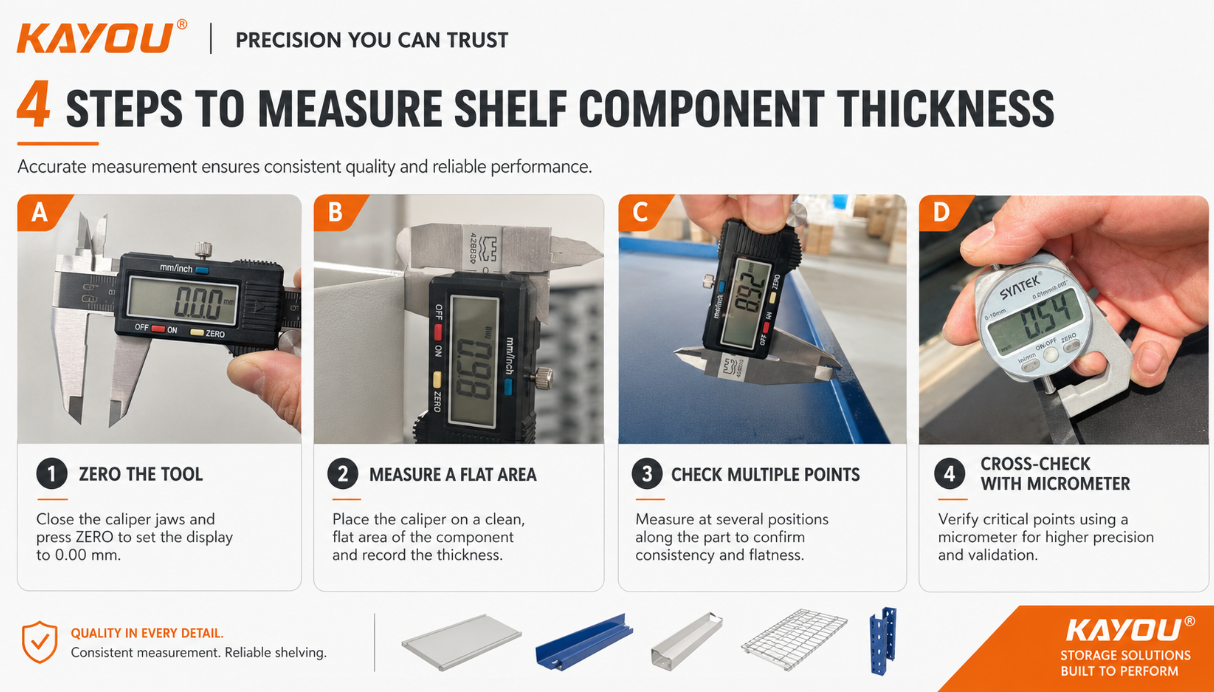
How to Check Whether an MTC Is Reliable
Receiving a PDF titled “MTC” is not sufficient. Buyers should review whether the document matches the transaction.
Does the manufacturer or steel mill name appear?
Is the steel grade clearly identified?
Is there a heat, coil or batch number?
Are chemical and mechanical results included where required?
Is the applicable material standard stated?
Does the material description match the ordered steel?
Can the supplier connect the certificate to receiving and production records?
Is the certificate type required by the purchase order clearly identified?
Are altered, incomplete or inconsistent fields visible?
Can the issuing organization or inspection party be verified when necessary?
A professional supplier should be able to explain how the document relates to the actual order, not simply forward an unrelated certificate.
Common Red Flags
Buyers should investigate further when:
Every order receives the same MTC
Batch or heat numbers are missing
The document does not identify the material standard
The grade differs from the approved specification
Thickness is confirmed only verbally
Measurement records do not identify components
The supplier refuses an agreed third-party inspection
Product weight is inconsistent with the quoted structure
MTC data cannot be linked to incoming material
A material certificate is presented as proof of rack load capacity
Remember: an MTC confirms characteristics of the raw material. It does not certify the structural capacity of the completed racking system.
MTC vs. Load Test Report vs. Product Certificate
These documents serve different purposes:
| Document | Primary Purpose | What It Does Not Prove Alone |
|---|---|---|
| Material Test Certificate | Verifies specified properties of a steel batch | Complete rack load capacity |
| Thickness Inspection Record | Records measured material or component thickness | Steel chemistry or complete system safety |
| Load Test Report | Records product performance under stated test conditions | Material traceability for every order |
| Structural Calculation | Evaluates a defined configuration and load case | Manufacturing consistency |
| Product Certificate | Demonstrates conformity within its stated scope | Every unspecified custom configuration |
For higher-risk projects, buyers may need several of these documents rather than relying on only one.
When Should Buyers Request Documentation?
Documentation requirements should be included in the RFQ or purchase order before production begins. Specify:
Required steel grade
Nominal thickness and tolerance
Required MTC or inspection-document type
Components subject to measurement
Sampling quantity
Third-party inspection requirements
Load-test or calculation requirements
Document-submission deadline
Actions required if results do not comply
Late requests can increase costs or make correct batch traceability difficult.
KAYOU’s Material Verification Approach
KAYOU supplies customizable steel shelving, warehouse racking systems, mobile shelving and steel furniture for international B2B projects.
Depending on the order and agreed requirements, KAYOU can support buyers with:
Material Test Certificates
Steel thickness confirmation
Incoming-material inspection
Component measurement records
Technical data sheets
Product drawings
Load-related documentation
Pre-shipment inspection
Third-party inspection coordination
Our quality-control process checks the approved requirements before production and verifies relevant incoming steel before it enters cutting, punching, forming, welding and coating. See the KAYOU quality-control process for more information.
For a practical example of thickness verification, read How KAYOU Measures Steel Thickness Before Production. Buyers comparing steel consumption and quotation differences can also review What Does Steel Shelving Really Cost?.
Frequently Asked Questions
Does an MTC prove that a rack can carry the stated load?
No. It provides information about the steel material. Rack capacity also depends on profile design, connections, bracing, manufacturing quality and the complete configuration.
Is thicker steel always better?
Not automatically. Thickness is important, but it must be evaluated together with steel grade, profile geometry, reinforcement and structural design.
Can buyers request third-party thickness inspection?
Yes. The scope, sampling method, tolerance and measuring procedure should be agreed before inspection.
Should every project require an EN 10204 Type 3.2 certificate?
Not necessarily. The appropriate document depends on the contract, applicable standard, project risk and customer requirements. Type 3.2 should be specified early because it may require external involvement.
What information should buyers provide when requesting a quotation?
Provide the required dimensions, load per level, shelf quantity, steel or certification requirements, order quantity, application and destination. This allows the supplier to prepare a more accurate technical and commercial proposal.
Conclusion
MTCs and steel-thickness certificates reduce sourcing risk by making material claims more traceable and measurable. They help buyers compare suppliers, verify incoming steel, support inspections and resolve specification disputes.
However, these documents must be connected to the correct batch, order and component. They should also be used alongside drawings, load information, production controls and finished-product inspection.
The safest purchasing process is based on a clearly defined specification supported by relevant, traceable evidence—not on a quotation number alone.
Need Documented Steel Shelving or Warehouse Racking?
Send KAYOU your product dimensions, required load, quantity, destination and documentation requirements. Our team can review the project and prepare a customized technical and commercial proposal.
For B2B projects, please include dimensions, load per level, quantity, destination and any required inspection or certification documents.