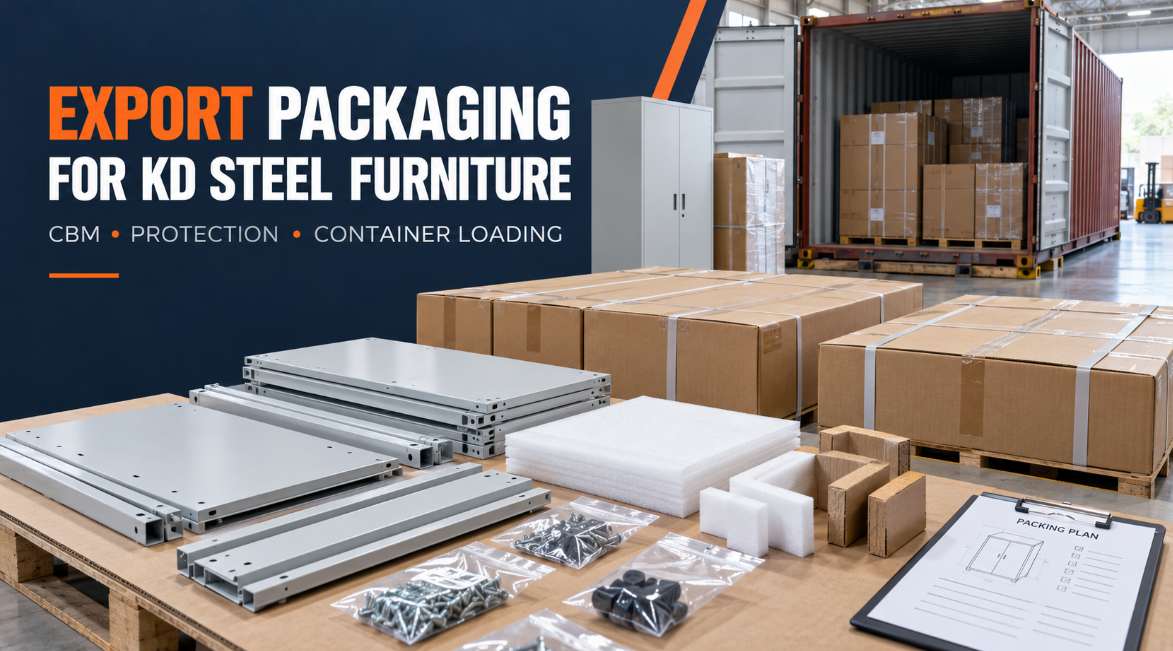


Export packaging affects much more than the appearance of steel furniture on arrival. It influences freight estimates, container utilization, unloading efficiency, assembly accuracy and the risk of transit damage.
For importers purchasing flat-pack filing cabinets, lockers, wardrobes or tool cabinets, the right packaging plan should answer four questions:
What are the final packed dimensions and gross weight?
How are painted panels, edges and hardware protected?
How will the cartons be arranged and secured inside the container?
What evidence will be available if damage is discovered?
This guide explains how B2B buyers can evaluate knock-down steel furniture packaging without relying on unrealistic container quantities or general claims such as “standard export packing.”
Quick Answer
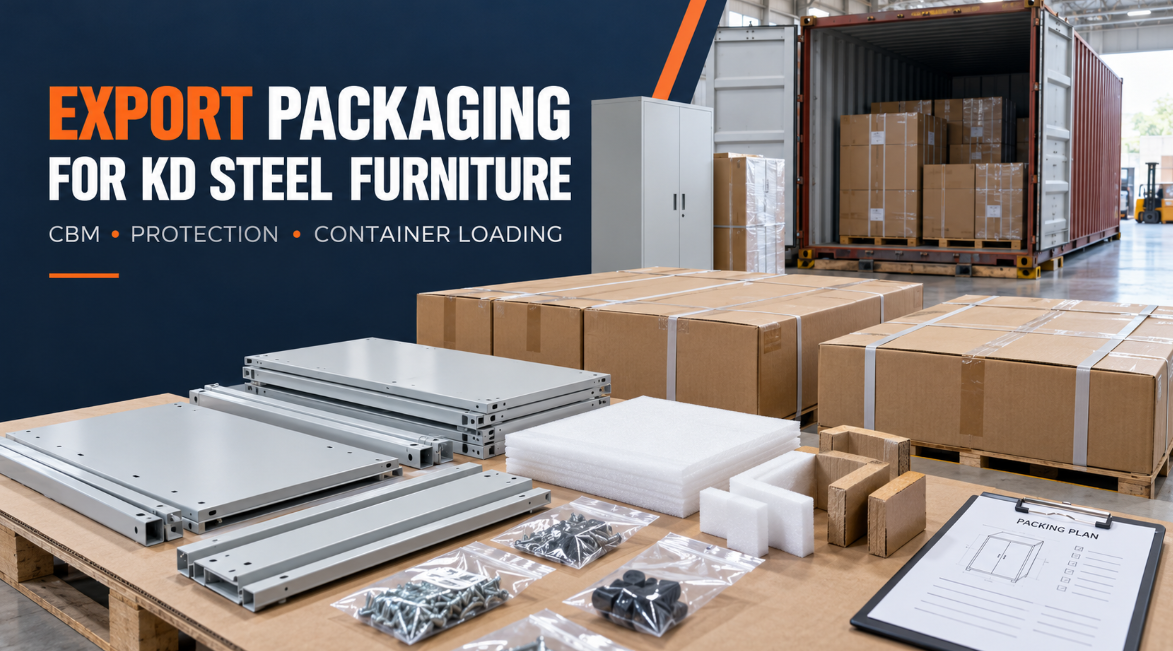
Knock-down, or KD, steel furniture is shipped as separate panels and components rather than as a fully assembled cabinet. This can reduce packed volume, but the actual benefit depends on the product design, carton dimensions, protection materials and container loading plan.
Buyers should request:
Packed carton dimensions and gross weight;
A packing diagram or sample packing photos;
A complete parts and hardware list;
Surface, edge and corner protection details;
Carton marking requirements;
Preliminary container-loading calculations;
Loading photos and final packing list.
Do not confirm a container quantity from product dimensions alone. Always calculate it from the final packed cartons.
What Is Knock-Down Steel Furniture?
Knock-down steel furniture is designed so that cabinet panels, doors, shelves and accessories can be packed flat and assembled at the destination.
Common KD products include:
Metal filing cabinets;
Steel lockers;
Sliding- and hinged-door cabinets;
Metal wardrobes;
Tool cabinets;
Bookshelves and storage cupboards.
You can explore the complete KAYOU steel furniture range for typical office, school, factory and project applications.
A good KD design must balance shipping efficiency with assembly reliability. Reducing a carton’s size is not helpful if panels become overloaded, hardware is lost or the product is difficult to assemble correctly.
KD vs Assembled Packaging
| Factor | Knock-Down Furniture | Assembled Furniture |
|---|---|---|
| Packed volume | Usually lower | Usually higher |
| Destination work | Assembly required | Limited assembly |
| Panel protection | Each component must be separated | Complete cabinet must be protected |
| Transit risk | Scratching, bending or missing hardware | Cabinet deformation or door misalignment |
| Container planning | More cartons and orientations | Fewer but larger units |
| Best suited for | Distributors, project orders and cost-sensitive shipping | Projects requiring rapid placement |
KD packaging does not automatically guarantee lower landed cost. Buyers should include destination assembly labor, installation tools, rejected units and spare parts when comparing the two options.
How to Calculate Steel Furniture CBM
CBM means cubic meter and represents the external volume of the packed cargo.
CBM per carton = Packed length × Packed width × Packed height
All dimensions must be converted to meters.
For example, if one KD cabinet carton measures:
Length: 1.85 m
Width: 0.55 m
Height: 0.14 m
The carton volume is:
1.85 × 0.55 × 0.14 = 0.14245 m³
For 100 cartons:
0.14245 × 100 = 14.245 m³
This is a preliminary cargo-volume calculation—not proof that the cartons will fit within a particular container.
The actual loading quantity can be affected by:
Container internal and door dimensions;
Allowable payload;
Carton orientation;
Whether cartons can be stacked;
Mixed product models;
Pallets or wooden frames;
Moisture-control materials;
Void-filling and cargo-securing space;
Container condition and carrier restrictions.
Ask the supplier for both the theoretical CBM and a loading plan based on the final production packaging.
Start Packaging Design with the Product Structure
Packaging should be considered before mass production, not after the cabinets have been completed.
For each model, confirm:
Which panels can be packed flat;
Which components require additional reinforcement;
Whether doors, drawers or glass panels need separate packaging;
Where hardware bags and assembly instructions will be placed;
How users can remove parts without scratching them;
Whether the carton can withstand the proposed stacking arrangement.
For example, a flat steel side panel and a drawer slide should not be allowed to move directly against each other. A hard component can damage a powder-coated surface even when the outer carton remains intact.
Protecting Powder-Coated Panels
Most transit damage to flat-pack steel furniture begins with contact between components or excessive pressure on an unsupported edge.
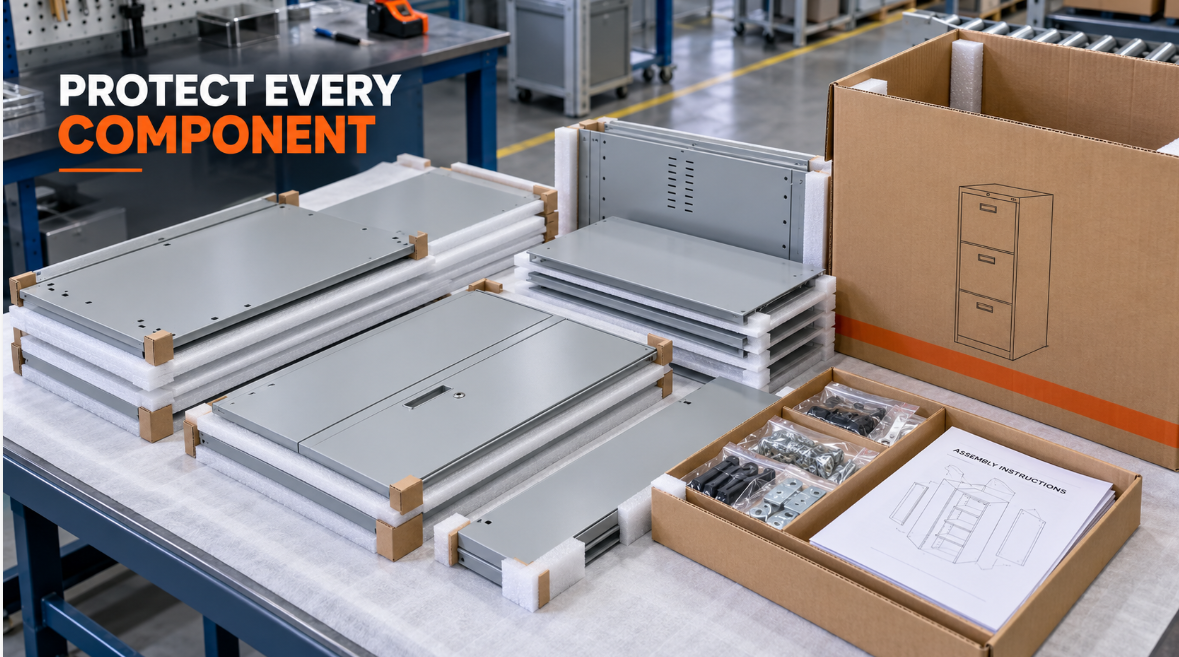
A practical protection system may include:
1. Surface Separation
Use clean, non-abrasive sheets, foam or other suitable interleaving materials between painted panels. The protection material should cover likely contact points and remain in position during handling.
2. Edge and Corner Protection
Doors, side panels and worktops can be vulnerable at folded edges and corners. Reinforced corner protectors help distribute localized pressure inside the carton.
3. Component Restraint
Shelves, locks, handles and drawer slides should not move freely inside the package. Loose metal parts can scratch panels or puncture the carton.
4. Hardware Management
Place fasteners in sealed, clearly identified bags. The bag should correspond with the assembly instructions and packing list. Consider spare fasteners for large projects, with the quantity agreed before production.
5. Moisture Risk Control
Container condensation risk varies by route, season, temperature change, transit time and packaging system. Desiccants, liners or moisture barriers should therefore be selected for the actual shipment—not added using an unverified universal quantity.
Carton, Pallet and Wooden Packaging Requirements
Carton strength should be selected according to packed weight, carton size, handling method, stacking arrangement and transport route. “Five-layer carton” alone does not establish whether the package is suitable.
When pallets are used:
Avoid carton overhang;
Confirm pallet dimensions and forklift access;
Prevent straps from pressing directly against painted panels;
Stabilize the load without crushing the lower cartons;
Confirm whether the destination accepts the proposed pallet material.
Raw-wood pallets, crates and dunnage used in international trade may fall within ISPM 15 requirements. The official International Plant Protection Convention standard covers wood packaging made from raw wood, including dunnage, while excluding wood processed so that it is free from pests, such as plywood. Buyers must still verify the destination country’s current import rules before shipment. See the official IPPC ISPM 15 publication.

What Should Appear on the Carton?
Carton markings should help the warehouse identify, count and assemble the products.
Depending on the order, useful information includes:
Product model;
Purchase order number;
Product color;
Carton number, such as “1 of 2”;
Quantity;
Net and gross weight;
Packed dimensions;
Destination or consignee reference;
Handling orientation;
Assembly instruction identification;
Barcode or customer label, if required.
Marking requirements should be confirmed in the purchase specification. Do not assume that one label design is suitable for every destination or customer.
Container Inspection Before Loading
Before loading begins, the container should be checked for conditions that could damage the cargo.
The inspection should consider:
Visible holes or light penetration;
Water, dampness or staining;
Strong odors or contamination;
Damaged floor areas;
Protruding nails or sharp edges;
Door operation and sealing surfaces;
Lashing points and internal condition;
Container identification and seal information.
The 2014 IMO/ILO/UNECE CTU Code provides global, non-mandatory guidance for packing and securing cargo transport units throughout sea and land transport. It emphasizes safe stowage and cargo securing across the intermodal journey. Buyers and packers can consult the official IMO CTU Code information page.
How to Load KD Steel Furniture Safely
A container-loading plan should account for both weight and carton strength.
Recommended planning principles include:
Distribute cargo weight instead of concentrating it in one area.
Place heavier or stronger packages below lighter packages.
Do not stack cartons above their approved capability.
Avoid unsupported gaps that allow cartons to collapse.
Fill or block significant voids to reduce movement.
Protect cargo from direct contact with sharp surfaces.
Keep mixed models identifiable during unloading.
Secure the final rows near the doors.
Record the loading sequence with photographs.
Verify the final package count against the packing list.
A high container utilization rate is not successful if cartons cannot be unloaded safely or arrive crushed. Loading density, cargo stability and destination handling must be evaluated together.
Pre-Shipment Packaging Inspection
Before mass loading, buyers should consider approving one complete packed sample.
The inspection can verify:
Correct product and color;
Packed dimensions and weight;
Carton construction;
Inner protection arrangement;
Panel and edge separation;
Parts and hardware count;
Assembly instructions;
Carton labels;
Closure and strapping method;
Product condition after unpacking.
Drop, vibration or compression testing should only be specified using an agreed procedure and acceptance criteria. A supplier should not claim that packaging “passed a test” without identifying the test method, sample and result.
KAYOU’s published quality-control process includes checking accessories, cartons, pallets, export packaging and loading safety. Model-specific inspection requirements should still be written into the quotation or purchase agreement.
Arrival Inspection and Damage Evidence
Inspect the shipment before discarding cartons or unloading evidence.
Record:
Container number and seal;
Exterior and interior container condition;
Position of the cargo when the doors are opened;
Wet, crushed or displaced cartons;
Carton labels and quantities;
Product condition during unpacking;
Missing or damaged components.
Photographs and continuous unpacking videos can help distinguish manufacturing defects from handling or transport damage. Preserve affected packaging, labels and parts until the claim is reviewed.
RFQ Checklist for KD Steel Furniture Packaging
Send suppliers the following information:
Product model, dimensions and quantity;
KD or assembled delivery preference;
Required carton or pallet restrictions;
Destination country and port;
Warehouse handling method;
Customer label and barcode requirements;
Acceptable package weight;
Mixed-model loading requirements;
Required inspection or testing;
Required spare parts;
Trade term and delivery schedule.
Ask the supplier to return:
Carton dimensions;
Net and gross weight;
CBM per unit;
Packing materials and arrangement;
Units per carton;
Preliminary container quantity;
Loading method;
Assembly documentation;
Inspection records.
Frequently Asked Questions
Does KD packaging always reduce freight cost?
It often reduces packed volume compared with assembled furniture, but the actual savings depend on final carton dimensions, freight terms, loading efficiency, destination labor and damage rates.
How many steel cabinets fit in a 40HQ container?
There is no reliable universal quantity. The supplier needs final packed dimensions, gross weight, carton orientation, stacking limits and the complete loading plan.
Can plywood pallets avoid ISPM 15 requirements?
ISPM 15 excludes wood packaging processed so that it is free from pests, with plywood given as an example. However, pallet construction and destination-country rules must be verified before shipment.
Should every container use desiccants?
Not automatically. Moisture protection should be selected according to route, climate, transit time, container condition and packaging design.
What is the most important document for comparing suppliers?
Request a packing specification showing the packed dimensions, weight, inner protection, carton structure, labels and loading assumptions for the exact product being quoted.
Plan Your Steel Furniture Shipment with KAYOU
KAYOU supplies customizable metal filing cabinets, steel lockers and metal tool cabinets for distributors and project buyers. Send your selected model, quantity, destination and packaging requirements for a model-specific review.
Technical note: This article provides general purchasing and packaging guidance. Final packaging, container loading, import compliance and cargo-securing requirements must be confirmed for the specific product, route, destination and contracted transport service.