
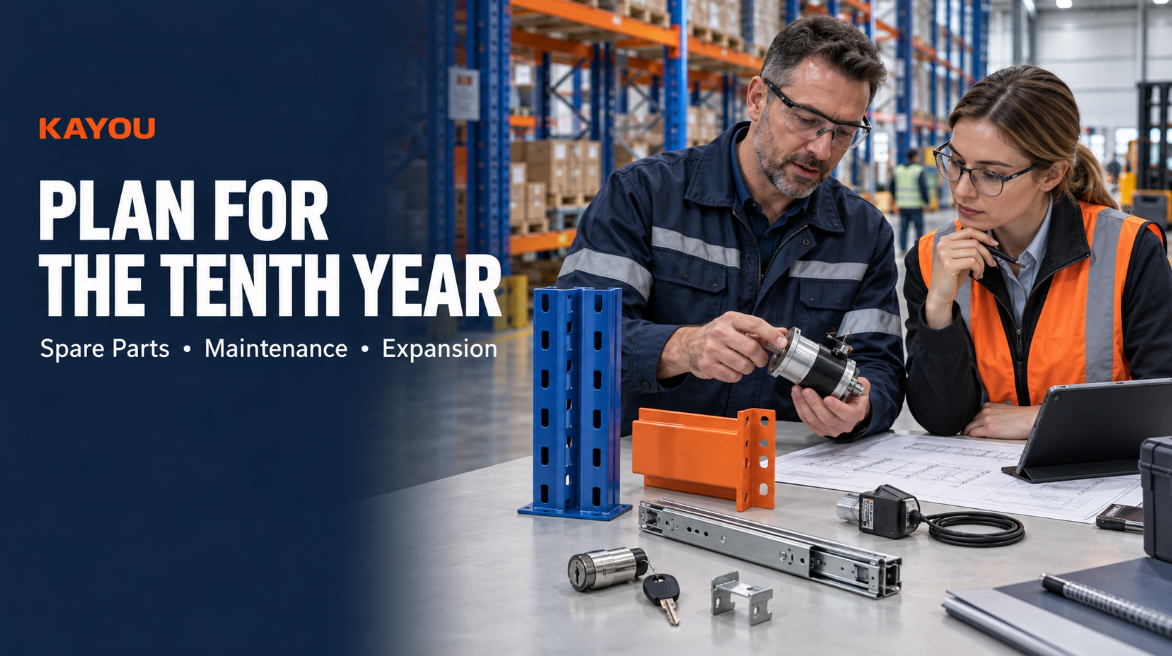
A storage system may operate for ten years or longer, but the first delivery is only the beginning of its cost.
Uprights can be struck by forklifts. Beams and locking clips may need replacement. Mobile shelving can require switches, sensors, control components or drive parts. Steel cabinets may need new locks, handles or drawer slides. A growing warehouse may also need new bays that connect to an existing installation.
This creates a question every project buyer should ask before placing an order:
Will the supplier support compatible spare parts and future expansion five to ten years from now?
There is no honest universal answer. Availability depends on the product series, production tooling, electrical platform, order records, supplier policy and whether the proposed component remains technically compatible. Buyers should therefore request a written support plan instead of relying on a general promise that “parts will always be available.”
Why Spare-Parts Support Belongs in the Original RFQ
Many quotations compare dimensions, capacity, finish, price and delivery time. Fewer compare the cost of keeping the equipment operational.
Poor spare-parts planning can lead to:
longer shutdowns while an unidentified component is measured;
an unsafe attempt to install a part that merely looks similar;
replacement of an entire rack section or cabinet because one component is unavailable;
incompatible locks, slides or controllers across one facility;
delayed expansion because original drawings cannot be found; and
higher urgent freight and technician costs.
This is why warehouse racking spare parts and lifecycle support should be evaluated before the purchase order—not after damage occurs.
Google Trends reports relative interest rather than absolute keyword volume. This guide therefore covers related buyer intents—including pallet rack replacement parts, rack beam replacement, mobile shelving spare parts and steel cabinet replacement locks—without presenting trend data as a sales forecast.
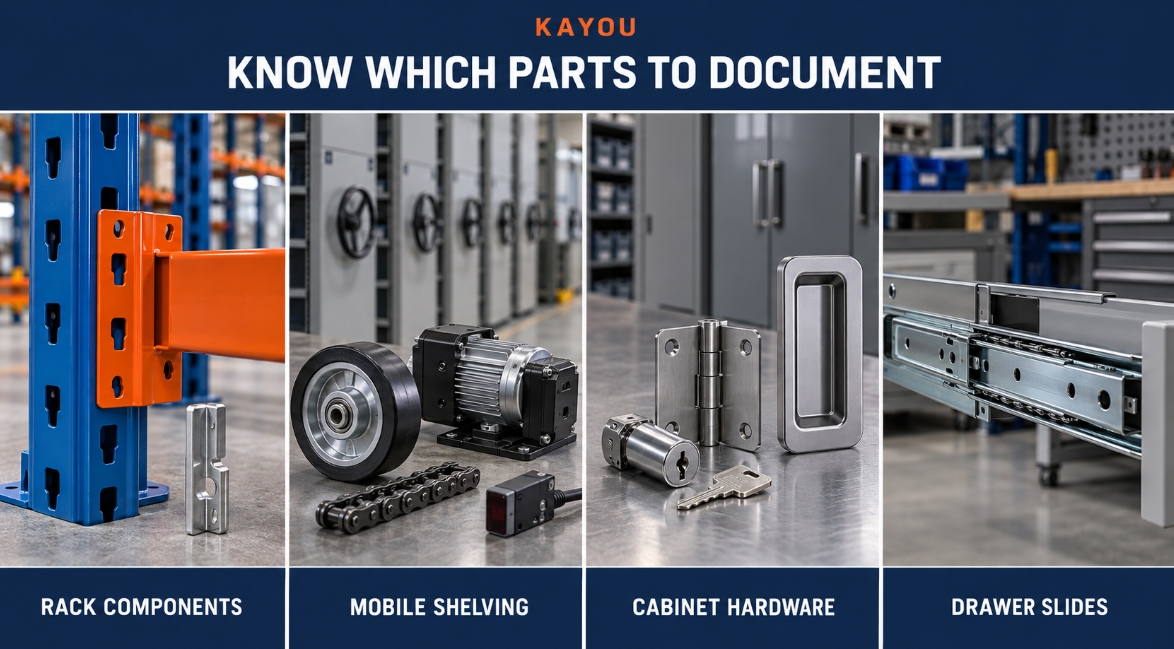
Which Spare Parts Should a Buyer Discuss?
The list depends on the system.
| Equipment | Typical components to discuss | Critical information to retain |
|---|---|---|
| Selective pallet racking | Upright frames, beams, locking clips, bracing, anchors, row spacers, pallet supports and decking | Rack series, profiles, connector geometry, beam span, loading and approved configuration |
| Mobile shelving | Rails, wheels, bearings, chains, handwheels, locks, motors, sensors, switches, controllers and cables | Mechanical drawings, wiring diagrams, voltage, controller model, software/parameter records and serial numbers |
| Steel filing cabinets and lockers | Locks, keys, handles, hinges, shelves, door guides and glass retainers | Cabinet model, door construction, lock cut-out, key plan and finish color |
| Drawer and tool cabinets | Drawer slides, stops, handles, locks, casters and dividers | Slide length, extension, mounting pattern, load class and drawer dimensions |
| Mezzanine or platform systems | Bolts, guard components, flooring panels and approved structural members | Approved drawings, material specification, loading plan and connection details |
Small components deserve attention. A locking clip or cabinet lock may cost little, but the wrong version can prevent safe use or create access-control problems.
For pallet racking, use KAYOU’s Pallet Rack Components and Spare Parts Compatibility Guide to identify the information needed for uprights, beams, connectors, decking and anchors.
Are Pallet Rack Replacement Parts Universal?
No. Color, nominal size and successful physical engagement do not establish structural compatibility.
The Rack Manufacturers Institute (RMI) warns against mixing rack components from different manufacturers because columns and beams that look alike can have different materials, connection details and tested system performance. See RMI’s guidance on mixing rack components.
Before approving a rack beam replacement or new frame, confirm:
Original manufacturer and exact rack series.
Upright profile, hole pattern and vertical pitch.
Beam section, clear span and connector geometry.
Locking-device type and correct engagement.
Steel specification and available production records.
Pallet size, orientation, quantity and maximum loaded weight.
Beam elevations and the complete bay configuration.
Applicable drawings, load plaques and engineering requirements.
A replacement beam with a higher advertised capacity does not automatically increase the capacity of the bay. Uprights, connections, bracing, anchorage and configuration still matter.
If rack damage triggered the enquiry, isolate and assess the affected area rather than treating the purchase as a simple parts order. KAYOU’s guide on damaged pallet rack repair, replacement and isolation explains this decision process.
Mobile Shelving Requires Both Mechanical and Electrical Planning
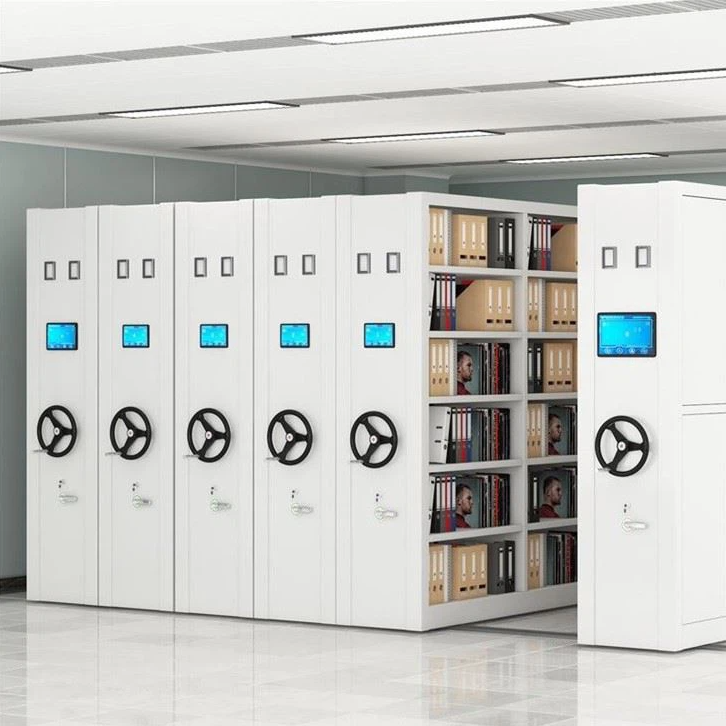
Manual mobile shelving commonly relies on rails, wheels, chains, bearings, handwheels and mechanical locks. Electric mobile shelving adds motors, limit switches, aisle sensors, emergency-stop devices, controllers, cables and user interfaces.
Electrical parts can become obsolete faster than steel members. A controller may be discontinued even when the shelving frames remain serviceable. Procurement teams should therefore ask:
Which electrical components are standard commercial parts and which are proprietary?
Are model numbers shown in the operation and maintenance manual?
Can parameters, wiring diagrams and software backups be supplied?
What happens if the original controller or sensor is discontinued?
Can the system operate in a safe manual or recovery mode during a fault?
Does replacement require a supplier technician, local electrician or software authorization?
Which parts should be purchased as commissioning spares?
Explore KAYOU’s mobile shelving systems when comparing manual and electric configurations. The final spare-parts list should match the approved project specification rather than a generic catalogue.
Locks, Drawer Slides and Cabinet Hardware Also Need Identification
For steel furniture, buyers often assume locks and slides are interchangeable. In practice, mounting holes, backset, rod arrangement, cylinder diameter, slide length, travel and fixing method can differ.
For multi-site office, school, hospital or workshop projects, decide whether locks should be keyed alike, keyed differently, controlled by a master key or replaceable by cylinder.
For drawer slides, record the manufacturer or approved specification, nominal length, closed length, extension type, mounting pattern and stated loading basis. A slide that fits physically may not provide the same travel, stability or load performance.
Standardising hardware can reduce the number of spare parts a facility must stock. Review KAYOU’s steel furniture range when preparing the specification.
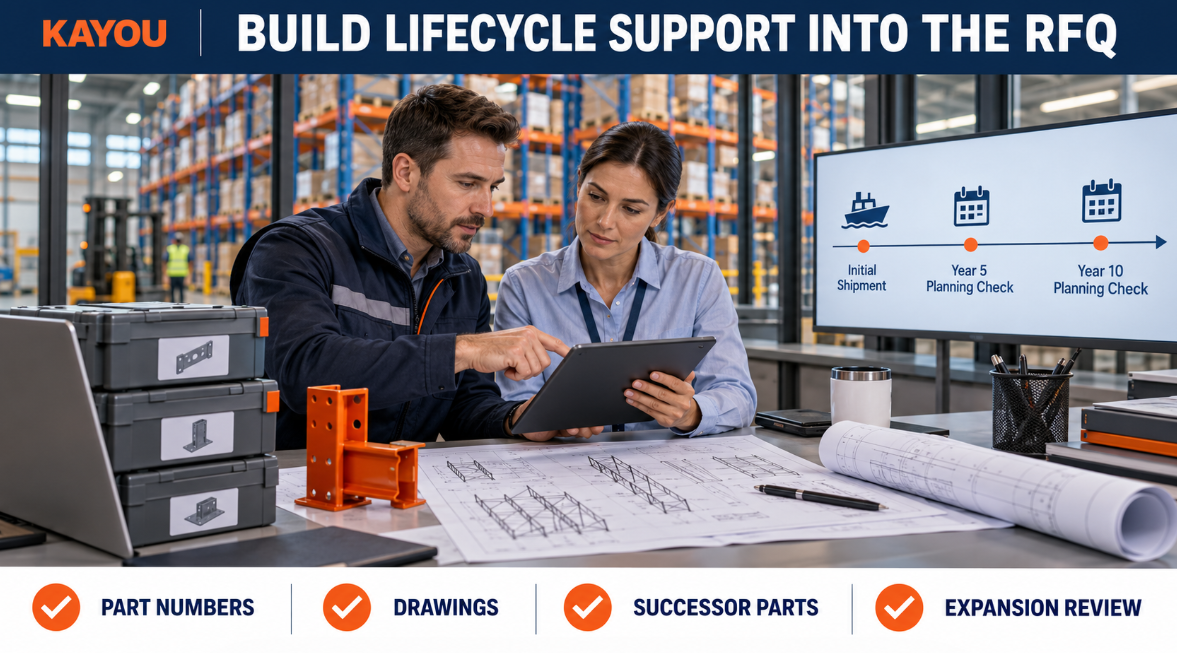
What Does a Credible “5–10 Year Support” Commitment Look Like?
A credible commitment should distinguish four promises:
State the support period, exclusions, documentation and responsibility for technical review. Avoid “lifetime spare parts” unless the term and obligations are defined.
1. Stocked Spare Parts
Regular inventory with an indicative lead time and minimum order quantity.
2. Make-to-Order Parts
Components reproduced from retained drawings or tooling, subject to minimums, material availability and technical review.
3. Approved Successor Parts
A current component offered after discontinuation, with its interchangeability or required modification documented.
4. Best-Effort Technical Support
The supplier reviews records and options without guaranteeing indefinite reproduction of every obsolete part.
Build a Spare-Parts Schedule Before Shipment
For an important project, create a spare-parts schedule linked to the bill of materials.
| Priority | Recommended approach |
|---|---|
| Safety-critical, low-cost parts | Consider purchasing a small approved quantity with the original shipment |
| Common wear parts | Record part number, replacement method and normal lead time |
| Large structural components | Preserve drawings and manufacturing identification; order only after condition and compatibility review |
| Proprietary electrical parts | Confirm lifecycle status, backup method, replacement route and programming requirements |
| Cosmetic parts | Record color reference, finish and visible variation tolerance |
The correct quantity depends on system size, operating intensity, local service access and failure consequences. A supplier should not prescribe a universal percentage without understanding the project.
Documentation Is the Foundation of Future Compatibility
Ten years later, a clear project file may be more valuable than a box of unidentified hardware. Retain the approved specification, final drawings, bill of materials, part numbers, load information, manuals, wiring diagrams, controller settings, inspection records, finish references, original order number and every approved modification.
RMI explains the importance of Load Application and Rack Configuration drawings for identifying permitted rack configurations and loads. When a rack is expanded or reconfigured, the approved documentation should be reviewed and updated as required.
KAYOU’s quality-control process outlines the checkpoints buyers can discuss for materials, dimensions, welding, surface finish, accessories and final inspection.
Seven Questions to Put in Your RFQ
Before choosing a supplier, ask:
Which mechanical, structural and electrical spare parts are available for this exact model?
Which parts are stocked, made to order or proprietary?
What support period can be stated in writing, and what are the exclusions?
How will discontinued components and successor parts be handled?
What drawings, part numbers, manuals and electrical records will be delivered?
Who confirms compatibility for replacement, repair or future expansion?
What information must the buyer provide when ordering parts years later?
Also request indicative spare-parts pricing and lead times, but treat them as current commercial information—not fixed prices for the next decade.
How to Plan a Future Racking-System Expansion
Expansion is not simply buying more bays in the same color. Confirm whether the new section connects structurally to the old rack or forms an independent row, whether beam elevations and loads change, and whether current building, seismic or fire requirements apply. Keep the latest layout, pallet data and handling-equipment information. Review KAYOU warehouse racking systems before assuming the original storage method is still best.
How KAYOU Can Support a Spare-Parts Enquiry
For an existing KAYOU installation, provide the original order number, project drawings, component photographs, dimensions, required quantity and reason for replacement. This gives the team a better basis for checking the supplied configuration and current availability.
For another manufacturer’s system, photographs support preliminary identification but do not prove compatibility or capacity. Send the manufacturer, model, profiles, connections, loading and drawings. If compatibility cannot be verified, an assessed replacement section or separate system may be safer than forcing an unrelated part to fit.
Availability, lead time and compatibility should always be confirmed for the specific enquiry. Custom manufacturing is not a promise that every third-party component can be reproduced safely.
Frequently Asked Questions
How long should a racking supplier keep spare parts?
There is no universal period for every market or system. Buyers can request a project-specific support commitment—often evaluated over a 5–10 year planning horizon—but the written terms should distinguish stocked parts, make-to-order parts, successor parts and exclusions.
Should we buy spare beams and uprights with the original order?
It may help remote or critical sites, but storage and identification matter. Structural parts should still be installed only after the affected rack and replacement compatibility are reviewed.
Can a local workshop copy a damaged rack component?
Physical duplication does not establish structural equivalence. Obtain system-specific approval before using a reproduced or alternative component.
What should we do if an electrical controller is discontinued?
Ask about an approved successor, interface changes, programming, safety validation and documentation updates. Matching voltage alone is insufficient.
Can new bays be connected to a ten-year-old rack?
Possibly, but not automatically. Identify the original system, condition, configuration and loading, then obtain a documented compatibility and design review. A separate independent installation may sometimes be the clearer solution.
What information speeds up a spare-parts quotation?
Provide the order number, manufacturer and series, full-bay and close-up photos, part numbers, dimensions, loading, drawings, quantity, destination and reason for replacement.
Plan for the Tenth Year Before the First Shipment
The strongest storage-equipment procurement plan covers more than initial price and delivery. It also defines how the system will be identified, maintained, repaired and expanded.
Send KAYOU your equipment type, drawings, component photos, required parts, loading information, quantity and destination. Our team can review the available records and discuss the supply options and technical confirmations required for your project.