
How to Get an Accurate Pallet Racking Quote: 10 Things Buyers Should Prepare
Requesting a pallet racking quote may look simple, but an accurate quotation requires more than just the number of racks you want to buy.
A professional pallet racking system is designed around the warehouse, pallets, stored goods, forklift operation, required storage capacity and local project conditions. If important information is missing, suppliers may have to make assumptions about beam length, rack height, load capacity, aisle width or material specifications — making quotations difficult to compare and potentially inaccurate.
Quick Answer
To get an accurate pallet racking quotation, prepare these 10 key details:
Warehouse dimensions and layout
Pallet dimensions
Maximum loaded pallet weight
Loaded pallet height
Required pallet positions
SKU quantity and inventory flow
Forklift type and operating aisle
Available warehouse clear height
Floor and project safety requirements
Project location, quantity and delivery requirements
Providing this information allows a racking supplier to develop a more accurate layout, determine appropriate structural specifications, calculate storage positions and prepare a quotation based on the actual project instead of assumptions.
Planning a heavy-duty pallet storage project? Explore KAYOU Heavy-Duty Pallet Racking to review the product solution and discuss a configuration based on your warehouse layout, pallet size and load requirements.
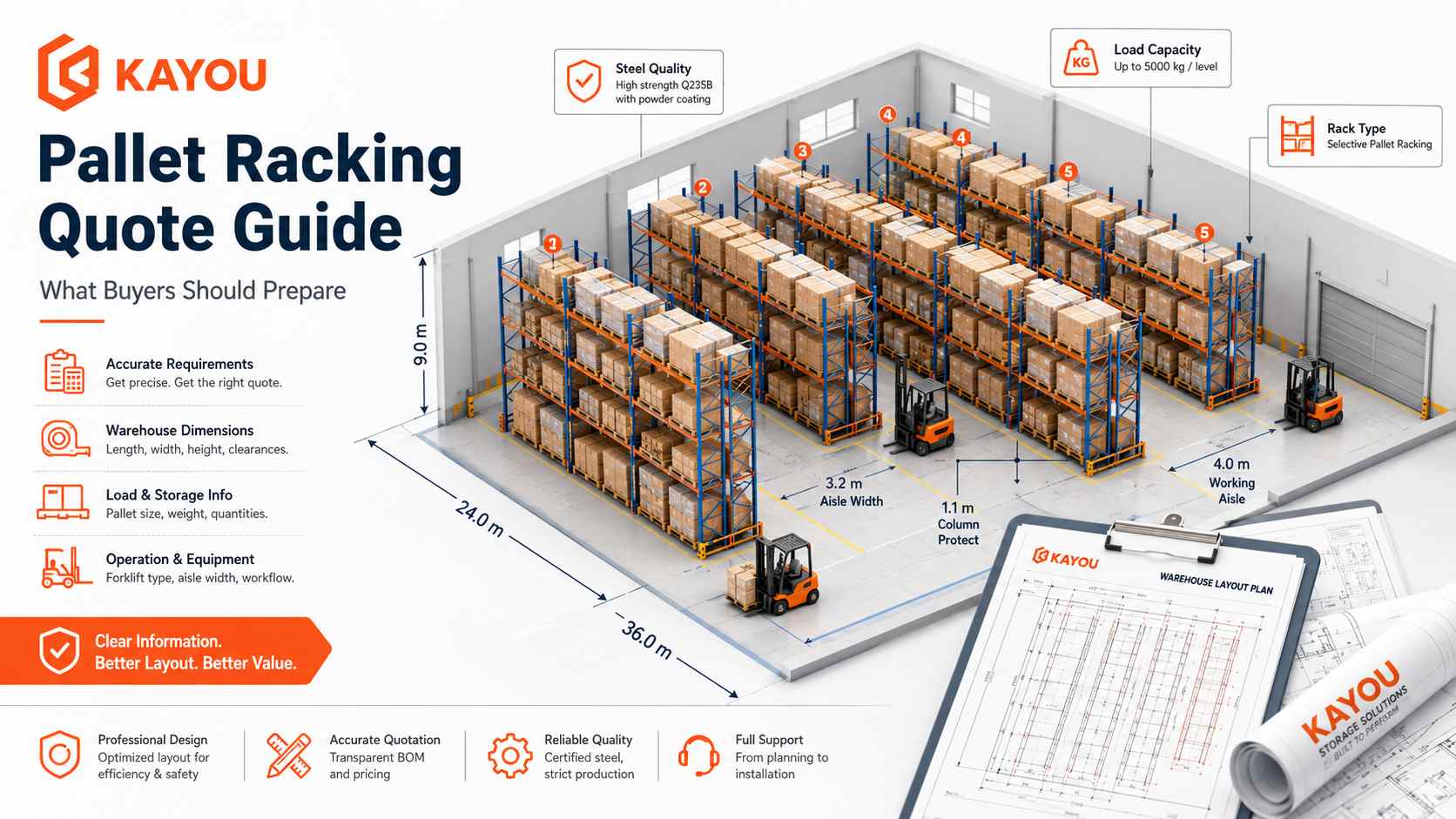
 Recommended visual:
A professional KAYOU 3D pallet racking warehouse layout with dimension markings.
Suggested ALT:
pallet racking quote and warehouse layout design by KAYOU
Why Is Detailed Information Important for a Pallet Racking Quote?
Two warehouses requesting “100 bays of pallet racking” may require completely different systems.
For example, one warehouse may store 500 kg Euro pallets using a reach truck, while another stores 1,500 kg industrial pallets using a counterbalance forklift.
Even if both projects require a similar number of pallet positions, differences in load, pallet dimensions, beam levels, aisle width and rack height may change:
Upright specifications
Beam profiles
Frame depth
Bracing configuration
Number of rack levels
Anchoring requirements
Safety accessories
Total steel consumption
Warehouse storage capacity
Container loading quantity
Project cost
This is why comparing quotations only by rack quantity or price per bay can be misleading.
A useful quotation should clearly correspond to the same technical requirements and project scope.
Not sure which storage system is suitable for your warehouse? Compare KAYOU Warehouse Racking Systems to explore selective, high-density and customized storage options before finalizing the layout.
1. Provide Your Warehouse Dimensions and Floor Plan
The warehouse layout is usually the best starting point.
For a basic quotation, provide the overall:
Length
Width
Clear usable height
For a more accurate warehouse racking design, also identify:
Building columns
Doors
Loading areas
Emergency exits
Fire equipment
Electrical cabinets
Stairs
Elevators
Walls
Office areas
Production areas
Existing equipment
Restricted zones
Other permanent obstructions
A CAD drawing is ideal, but it is not always required at the beginning.
Buyers can also provide:
PDF drawings
Dimensioned warehouse sketches
Architectural plans
Clearly marked photographs
The key requirement is that the dimensions must be understandable.
Buyer Tip
Do not send only the total warehouse area, such as:
“Our warehouse is 2,000 m².”
The total area alone does not show column locations, usable rack zones or forklift routes.
A warehouse measuring 40 × 50 meters can produce very different rack layouts depending on doors, columns and operating areas.
Have a Warehouse Drawing?
Send your CAD, PDF or dimensioned warehouse sketch to KAYOU. Our team can review your storage requirements and help prepare a customized racking layout and quotation.
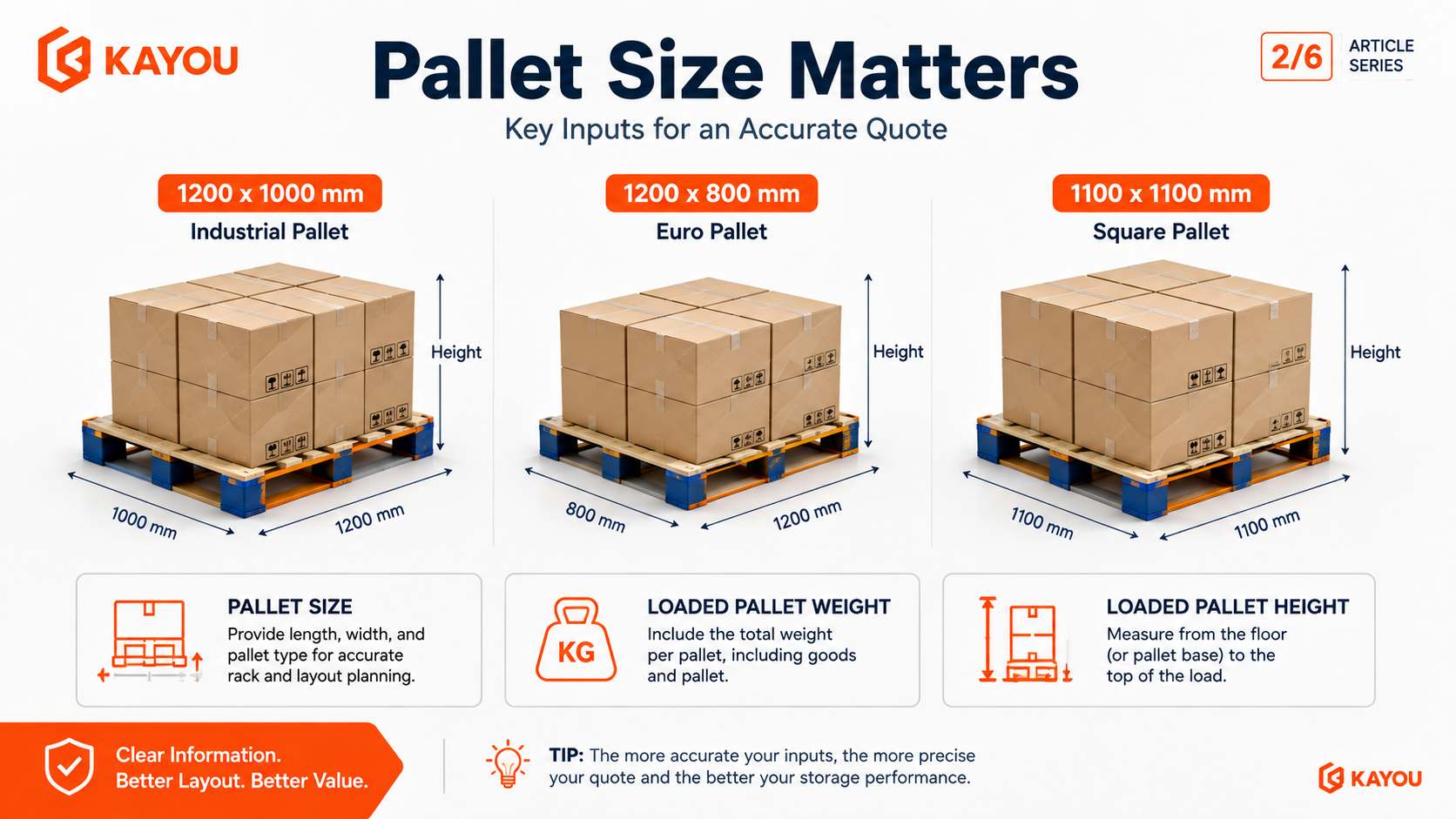
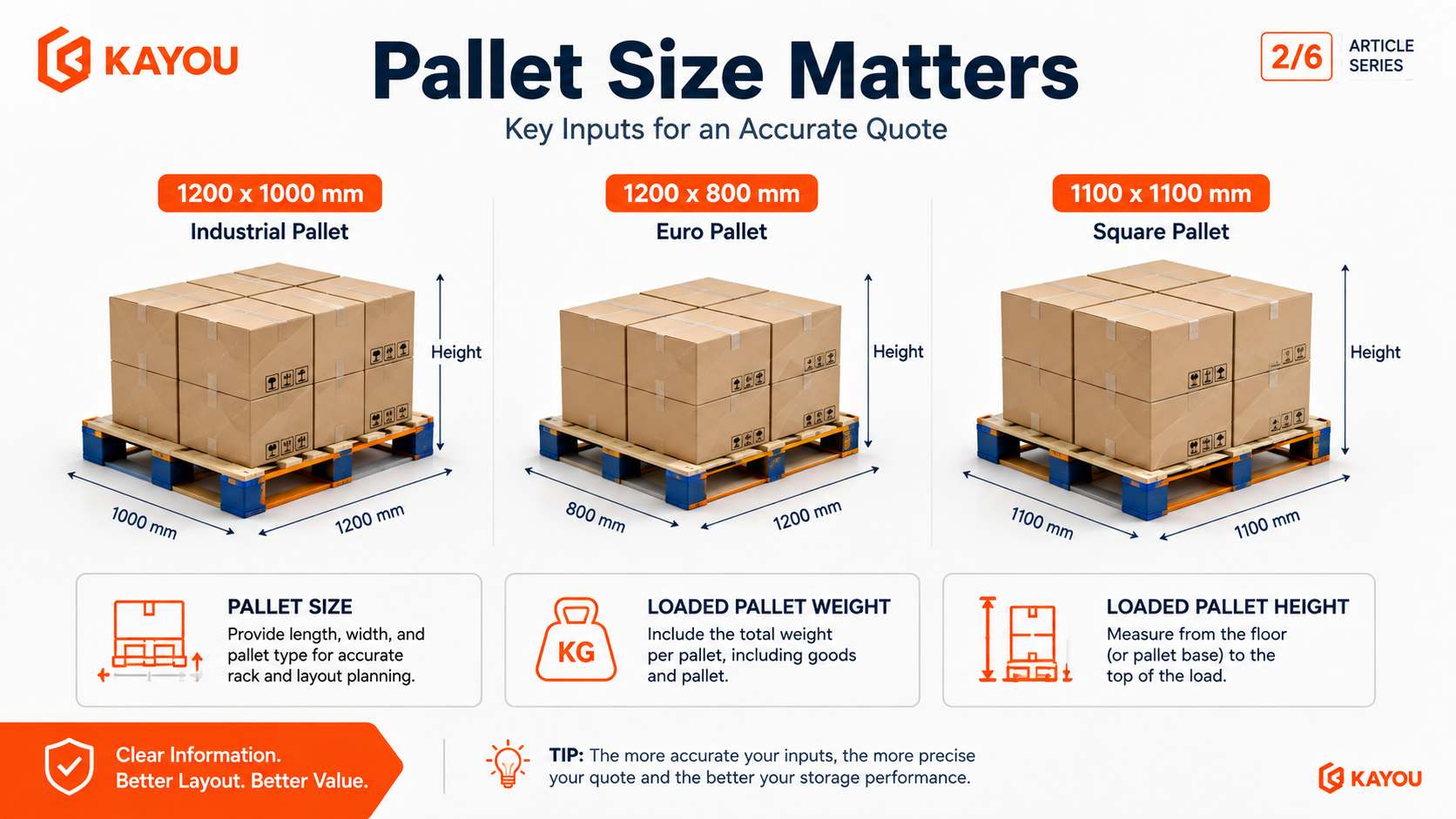
2. Confirm the Pallet Size
Pallet dimensions directly affect rack dimensions.
Typical pallet formats may include:
1200 × 1000 mm
1200 × 800 mm
1100 × 1100 mm
Custom industrial pallets
However, buyers should provide their actual pallet dimensions rather than relying only on a pallet standard.
Your supplier may need to know:
Pallet width
Pallet depth
Pallet base construction
Fork entry direction
Any product overhang beyond the pallet
These details help determine:
Beam length
Frame depth
Pallet support arrangement
Clear space between loads
Number of pallets per beam level
Example
If a customer stores:
Pallet size: 1200 × 1000 mm
Pallet quantity per beam level: 2 pallets
the beam configuration must be designed around both pallet dimensions and the required operational clearance.
Simply asking for a “2-pallet rack” is not enough to determine the final beam specification.
3. Provide the Maximum Loaded Pallet Weight
One of the most important pieces of information in any pallet racking quotation is the maximum loaded pallet weight.
Do not provide only the weight of the empty pallet.
Do not provide only the average load if some pallets are significantly heavier.
The supplier needs to understand the maximum expected operating load.
For example:
| Item | Example |
|---|---|
| Pallet Size | 1200 × 1000 mm |
| Empty Pallet Weight | 25 kg |
| Goods Weight | 975 kg |
| Maximum Loaded Pallet Weight | 1,000 kg |
Why does this matter?
The pallet weight can influence:
Beam section
Beam thickness
Upright section
Upright thickness
Frame bracing
Total bay capacity
Structural configuration
If there are two pallets weighing 1,000 kg each on one beam level, the rack level must be designed for the required loading condition — not simply described as “heavy duty.”
Need a rack configuration based on real pallet loads? View KAYOU Heavy-Duty Pallet Racking Solutions and send us your pallet weight, beam levels and warehouse dimensions for a project-based recommendation.
Important
A load rating should always relate to the actual rack configuration.
Changing the beam span, rack height, number of beam levels or load distribution can change structural requirements.
For project purchasing, buyers should therefore compare technical specifications and design assumptions, not only advertised maximum load figures.
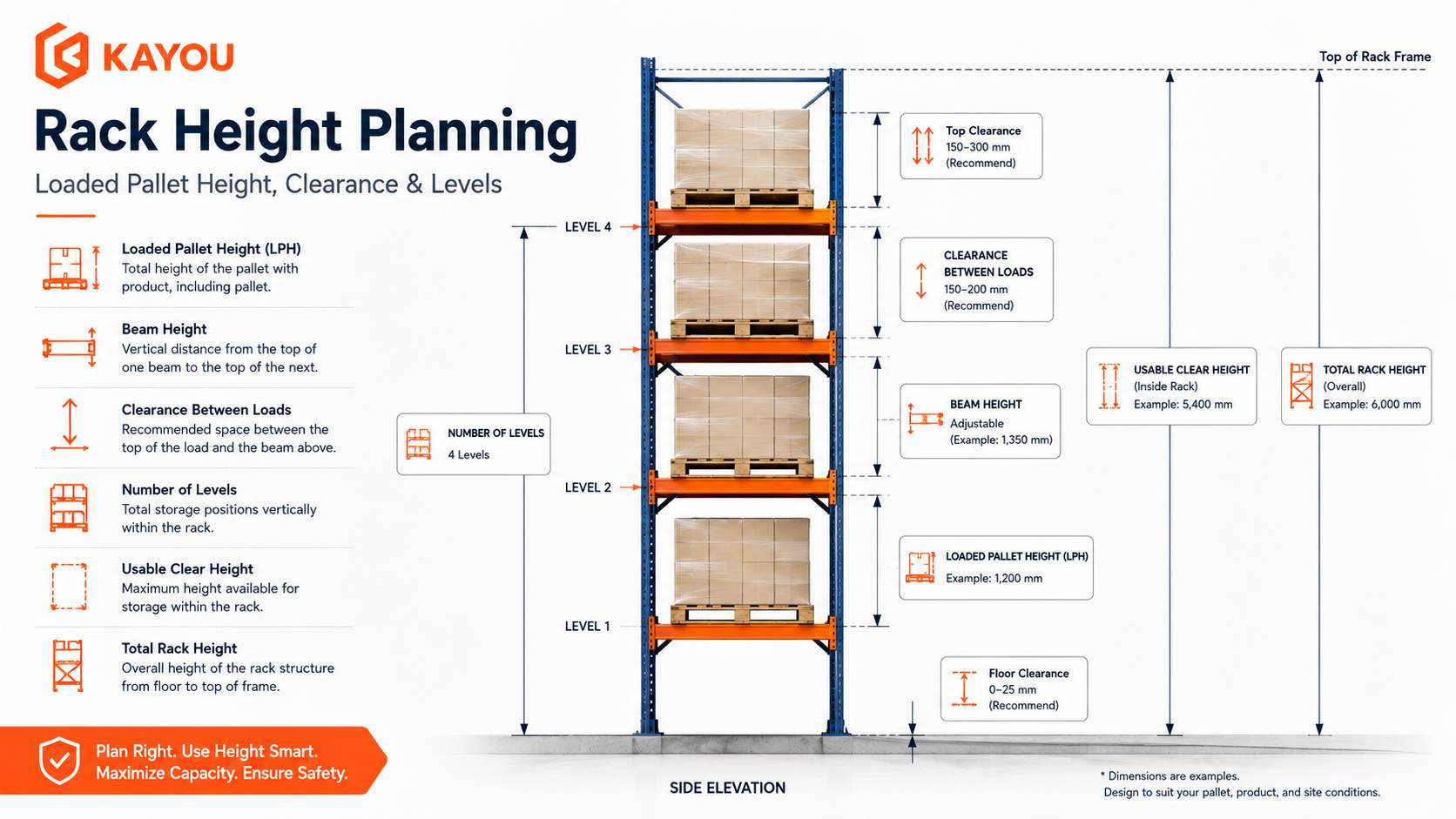
4. Confirm the Loaded Pallet Height
The height of the palletized goods is another critical input.
Consider:
Empty pallet height
Product height
Packaging height
Required handling clearance
For example:
Pallet: 150 mm high
Goods: 1,350 mm high
Total loaded pallet height: 1,500 mm
Why does this matter?
Rack designers use the loaded pallet height to determine the vertical spacing between beam levels.
The difference can determine whether the warehouse can accommodate:
3 storage levels
4 storage levels
5 storage levels
within the same usable building height.
Increasing the number of pallet levels can significantly improve vertical space utilization — but only when forklift lift height, structural requirements and building clearances allow it.
Recommended visual:
Side elevation showing pallet height, beam height, level spacing and total rack height.
Suggested ALT:
pallet racking level height and pallet clearance diagram
5. Define the Required Number of Pallet Positions
Instead of only saying:
“We need 100 racks,”
tell the supplier how many pallets you actually need to store.
For example:
Current inventory: 420 pallets
Peak inventory: 500 pallets
Expected future requirement: 600 pallets
This is much more useful.
A warehouse racking project should ideally consider both current requirements and reasonable future growth.
Why Pallet Position Matters More Than Rack Quantity
A “rack” or “bay” can contain different numbers of pallet positions depending on:
Number of beam levels
Pallets per level
Floor-level storage
Rack height
Layout configuration
Therefore, the more useful question is:
How many pallet positions does the warehouse need?
rather than:
How many racks should we buy?
This also allows the designer to compare different layout options more accurately.
6. Tell the Supplier About Your SKUs and Inventory Flow
Storage capacity is only one part of warehouse design.
Accessibility is equally important.
A warehouse storing 500 pallets of 20 SKUs has different operational requirements from a warehouse storing 500 pallets of 450 SKUs.
Provide basic information about:
Number of SKUs
Pallets per SKU
Fast-moving items
Slow-moving items
Inventory rotation
Batch management
FIFO requirements
LIFO requirements
Expiration-date requirements if applicable
This information can influence which warehouse racking system is more appropriate.
Common Storage Situations
| Storage Requirement | Typical Racking Direction |
| Many SKUs and direct pallet access | Selective Pallet Racking |
| Fewer SKUs with high pallet quantity | Drive-In Racking |
| Higher density with reduced direct access | Double Deep Racking |
| FIFO and high-throughput pallet movement | Pallet Flow Racking |
| Long pipes, steel sections or timber | Cantilever Racking |
These are general selection directions rather than final engineering recommendations.
The final system should be selected according to the actual goods, warehouse layout and operating workflow.
SKU quantity and inventory flow can change the best storage method. Explore KAYOU Warehouse Racking Systems to compare common racking solutions before the final engineering design.
7. Confirm Your Forklift Type and Operating Aisle
A common warehouse planning mistake is designing the racks first and considering the forklift later.
The two must be planned together.
Tell the racking supplier which handling equipment will operate in the warehouse, such as:
Counterbalance forklift
Reach truck
Very narrow aisle truck
Electric stacker
Manual pallet truck
Other specialized equipment
Useful forklift information includes:
Model
Turning radius
Required operating aisle
Maximum lift height
Load capacity at required lift height
Why is this important?
Aisle Width Affects Storage Capacity
Wide aisles use more warehouse floor area.
Narrower aisles may increase potential storage density but require suitable material-handling equipment.
Therefore, warehouse optimization is not simply:
“Make every aisle as narrow as possible.”
It is about finding a practical balance between:
Storage Density + Forklift Safety + Handling Efficiency + Operational Speed
A good pallet racking layout should allow forklifts to load, retrieve and turn efficiently without creating unnecessary congestion.
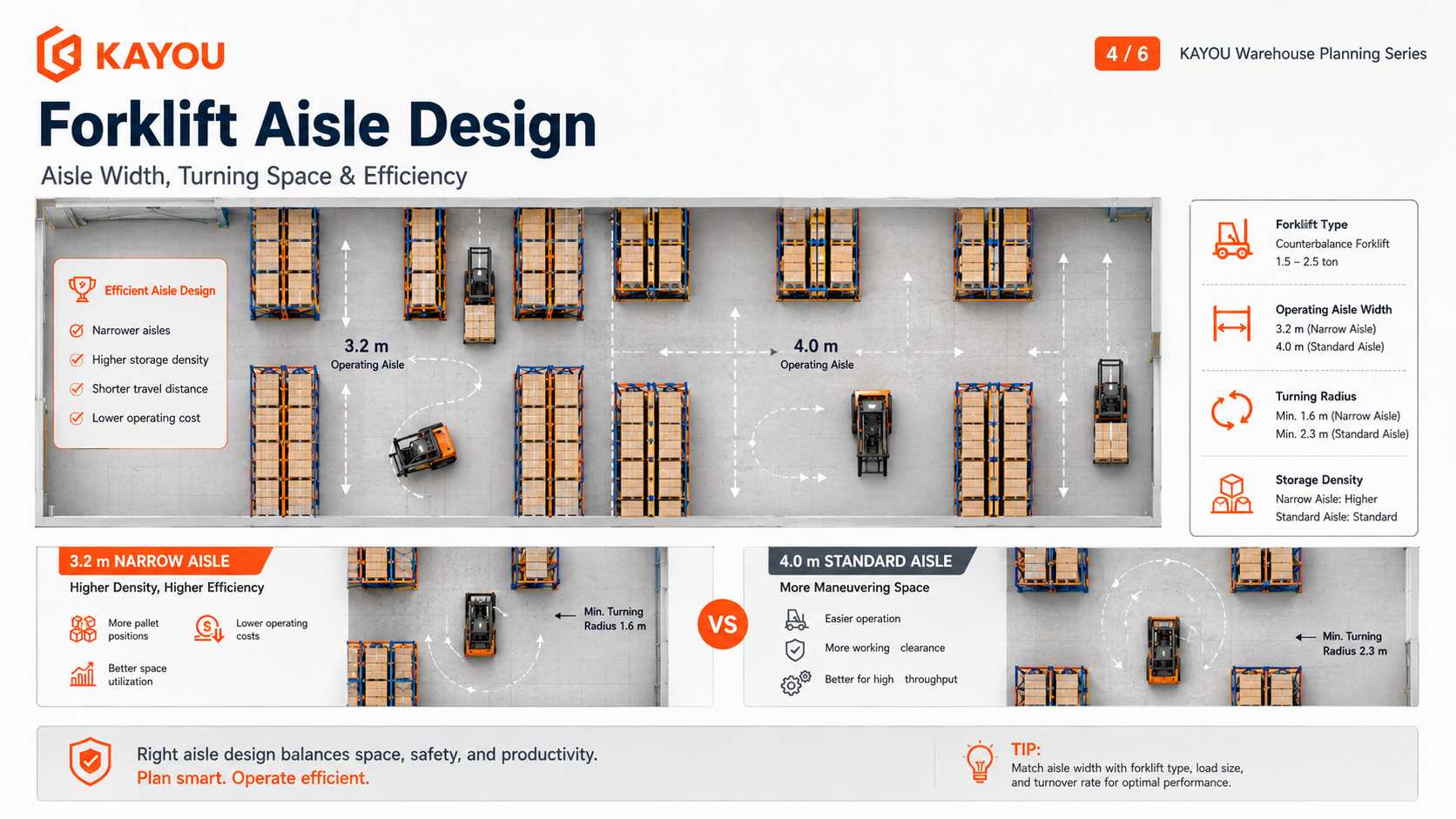
Recommended visual:
Top-view comparison of pallet racking rows and forklift aisle.
Suggested ALT:
warehouse pallet racking aisle width and forklift layout
8. Provide the Available Warehouse Clear Height
Buyers sometimes provide the building height but overlook internal obstructions.
What matters to a rack designer is the usable clear height.
Check for:
Roof beams
Sprinklers
Lighting
Ventilation ducts
Crane systems
Pipes
Electrical services
Other overhead installations
For example:
Building height: 9,000 mm
Lowest obstruction: 7,800 mm
The second dimension may be much more important for the actual rack design.
The designer must also consider whether the forklift can safely reach the proposed upper pallet levels.
This is why simply requesting “8-meter pallet racking” without site details may not produce the best warehouse solution.
9. Explain the Floor Conditions and Safety Requirements
Industrial pallet racks transfer substantial loads through their upright frames and base plates into the warehouse floor.
Where available, provide information about:
Concrete floor condition
Slab thickness
Floor level
Floor loading information
Existing cracks or joints
Anchor restrictions
Seismic requirements
Local safety requirements
Depending on the project, buyers may also require accessories such as:
Upright protectors
Frame guards
Safety barriers
Beam safety locks
Pallet support bars
Wire mesh decking
Back mesh
Load signs
End-of-aisle protection
Safety accessories should not be treated as decorative extras.
They need to be selected according to the actual warehouse operating environment.
For example, facilities with frequent forklift traffic may require additional rack protection in high-impact areas.
Evaluating rack safety and manufacturing consistency? Review KAYOU Quality Control to see how materials, dimensions, welding, surface treatment and product inspection are managed.
Recommended visual:
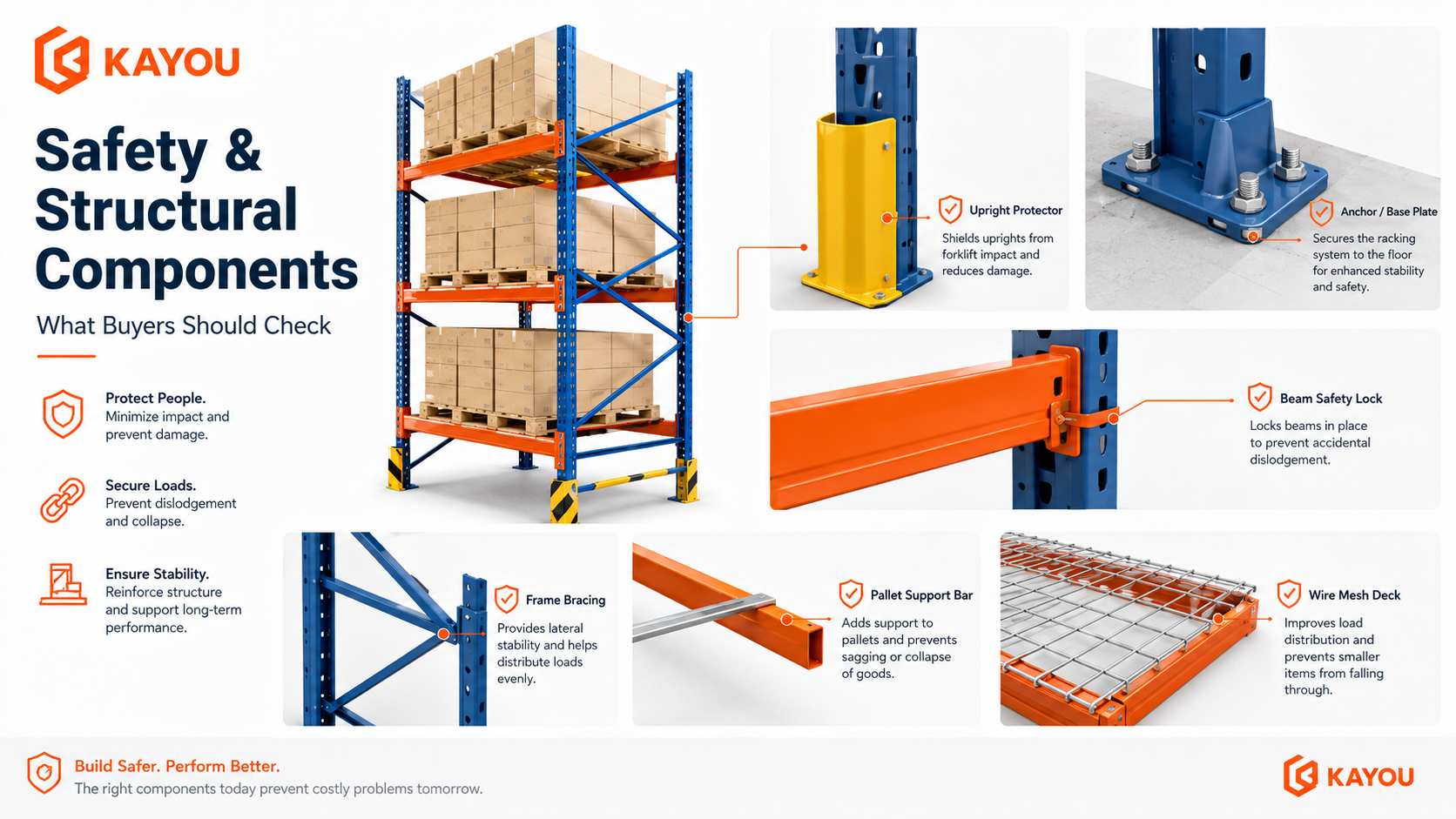
Close-up collage of upright protector, anchor, beam safety lock and rack bracing.
Suggested ALT:
pallet racking safety components upright protector anchor and beam lock
10. Provide the Project Country, Quantity and Delivery Requirement
For international B2B purchasing, the rack structure is only part of the total project cost.
The supplier should also understand:
Destination country
Destination port
Required quantity
Target delivery time
Packaging requirements
Incoterm requirement
Installation requirements
Documentation requirements
Possible commercial terms may include:
EXW
FOB
CIF
depending on the order and shipping arrangement.
Why Does the Destination Matter?
Steel racking is bulky.
Packaging and container loading efficiency can influence the landed cost of an international order.
Two designs with similar storage capacity may have different:
Component quantities
Packing volumes
Container utilization
Transportation costs
For this reason, an experienced export supplier should consider not only the rack itself but also practical packing and loading requirements.
Pallet Racking RFQ Checklist
Before contacting a supplier, use this checklist.
| Information Needed | Your Project Information |
| Warehouse Length | ______ |
| Warehouse Width | ______ |
| Usable Clear Height | ______ |
| Pallet Size | ______ |
| Maximum Loaded Pallet Weight | ______ |
| Loaded Pallet Height | ______ |
| Current Pallet Quantity | ______ |
| Required Pallet Positions | ______ |
| Number of SKUs | ______ |
| Forklift Type | ______ |
| Forklift Operating Aisle | ______ |
| Target Rack Levels | Supplier to recommend / ______ |
| Destination Country | ______ |
| Destination Port | ______ |
| Required Delivery Time | ______ |
| CAD / PDF / Warehouse Drawing | Available / Not Available |
Minimum Information for an Initial Quote
If you do not have all the information yet, start with these five items:
Warehouse dimensions
Pallet size
Maximum pallet weight
Required pallet quantity
Destination country
KAYOU can then discuss the remaining design requirements with your team.
Send These 5 Details and Start Your Pallet Racking Design
Warehouse Size + Pallet Size + Pallet Weight + Pallet Quantity + Destination
Example: How Project Information Becomes a Racking Solution
A useful pallet racking quotation should not simply list steel components.
It should explain how the proposed system relates to the customer's warehouse and storage requirements.
For example, the design process may look like this:
Buyer Provides
Warehouse floor plan
Pallet dimensions
Loaded pallet weight
Pallet quantity
SKU information
Forklift model
Destination
Engineering Review
The supplier evaluates:
Available storage zones
Rack row direction
Pallets per bay
Number of levels
Aisle configuration
Access requirements
Structural requirements
Safety accessories
Layout Proposal
A preliminary layout can then show:
Rack positions
Aisles
Pallet positions
Building columns
Main access routes
Required safety zones
Technical Quotation
The quotation can then be based on the approved configuration rather than a generic rack price.
This process gives buyers a much stronger basis for comparing proposals from different suppliers.
Recommended visual:
“Customer Drawing → 2D Layout → 3D Design → Finished Pallet Racking” four-step graphic.
Suggested ALT:
KAYOU pallet racking design process from warehouse drawing to quotation
Real Project Reference: Thailand Pallet Racking Warehouse
KAYOU has previously developed a customized pallet racking solution for a B2B distribution warehouse in Thailand.
Before the new system, the customer relied heavily on floor stacking and fixed shelving, which limited vertical space utilization and made pallet access less efficient.
After reviewing the warehouse layout, pallet requirements, forklift aisle and inventory flow, a selective pallet racking solution was used to improve direct pallet access and make better use of available vertical storage space.
The project reported a 70% increase in storage capacity within the same warehouse area.
More importantly, the project demonstrates why accurate input data matters before requesting a quotation.
The final warehouse solution was not selected from rack dimensions alone. It depended on the combination of:
Warehouse layout
Pallet load
Forklift access
SKU management
Storage density
Future expansion requirements
Recommended visual:
Real Thailand pallet racking project image or before-and-after layout.
Suggested ALT:
KAYOU Thailand selective pallet racking warehouse project
What Should Buyers Compare Between Pallet Racking Quotations?
A lower quotation does not automatically mean a lower total project cost.
When comparing quotations, check whether each supplier is quoting the same scope.
Compare These Items
1. Rack Configuration
Check:
Rack height
Frame depth
Beam length
Beam levels
Pallets per level
2. Load Requirement
Confirm that the quotation is based on your actual pallet load and rack configuration.
3. Steel Specifications
Compare the proposed structural sections and relevant material specifications.
4. Accessories
Check whether the price includes:
Anchors
Safety locks
Pallet supports
Decking
Upright guards
Barriers
Load signs
5. Design Scope
Does the supplier provide:
Layout drawing?
Technical confirmation?
2D design?
3D visualization?
Installation drawing?
6. Packaging
Confirm how the components will be protected for export transportation.
7. Shipping Scope
Make sure you understand whether the quotation is:
EXW, FOB, CIF or another agreed term.
8. Installation Support
Check whether the supplier provides:
Installation instructions
Drawings
Online technical support
On-site support where agreed
Comparing these items creates a much fairer supplier evaluation than simply comparing the final price.
How KAYOU Supports Pallet Racking Projects
KAYOU provides customized warehouse storage solutions for global B2B buyers, including warehouse pallet racking and other industrial racking systems.
For project buyers, distributors, warehouse operators and contractors, the process can begin with a warehouse drawing and basic storage information.
KAYOU can support the project with:
Customized rack dimensions
Customized load requirements
2D warehouse layout support
3D layout visualization
Rack configuration planning
OEM/ODM requirements
Quality inspection
Export packaging
Container loading support
Installation guidance
The objective is not simply to sell more rack components.
The objective is to configure a storage system around the actual warehouse operation.
For non-standard layouts, special loads or project-specific configurations, explore KAYOU's custom warehouse racking systems and discuss your warehouse requirements with our engineering team.
Frequently Asked Questions About Pallet Racking Quotes
What information do I need for a pallet racking quote?
At minimum, provide your warehouse dimensions, pallet size, maximum loaded pallet weight, required pallet quantity and destination. For a more accurate layout, also provide clear warehouse height, SKU quantity, forklift information, aisle requirements and building obstacles.
Can I get a pallet racking quote without a CAD drawing?
Yes. A CAD drawing is helpful but not always necessary for the first discussion. A PDF plan, dimensioned sketch or clearly marked warehouse drawing can also be used to understand the project.
Why does a pallet racking supplier need my forklift information?
The forklift influences operating aisle width, turning requirements and maximum usable rack height. Rack rows and forklift routes should therefore be planned together.
Should I provide average pallet weight or maximum pallet weight?
Provide the maximum expected loaded pallet weight. Designing around an average weight may not represent the heaviest pallet that the rack will need to support.
How do I know how many pallet positions I need?
Start with your current pallet quantity, peak inventory and expected growth. Your supplier can then use the warehouse dimensions and rack configuration to estimate how many pallet positions can fit into the available area.
Can KAYOU recommend the number of rack levels?
Yes. The appropriate number of levels depends on loaded pallet height, usable warehouse height, structural requirements and forklift lift capability.
Can rack size and load capacity be customized?
Yes. Pallet racking projects can be customized according to pallet dimensions, load requirements, warehouse layout and operational requirements.
Which pallet racking system is best for warehouses with many SKUs?
Selective pallet racking is commonly considered when direct access to many different palletized SKUs is important. However, the final system should be selected after reviewing storage density, inventory rotation and forklift operation.
Does the quotation include safety accessories?
This depends on the agreed quotation scope. Buyers should confirm whether anchors, upright protectors, barriers, pallet supports, decking and other safety components are included.
Can KAYOU help with warehouse layout design before ordering?
Yes. Buyers can provide warehouse dimensions, pallet information and storage requirements for layout discussion. 2D and 3D design support can help confirm the storage arrangement before production.
Can I request a CIF pallet racking quotation?
International shipping terms can be discussed according to the project, destination and order requirements. Provide the destination country and port when requesting the quotation.
How can I get a faster and more accurate quotation?
Send as much of the following information as possible in your first inquiry:
Warehouse dimensions + drawing + pallet size + maximum pallet weight + pallet quantity + loaded pallet height + forklift information + destination.
This reduces repeated clarification and allows the supplier to work from a clearer technical basis.
Ready to Request Your Pallet Racking Quote?
A good pallet racking quotation starts with good project information.
If you are planning a new warehouse, expanding storage capacity or replacing floor stacking with a more organized pallet storage system, send KAYOU your project requirements.
Please Send Us:
Warehouse dimensions or drawing
Pallet size
Maximum loaded pallet weight
Pallet quantity
Loaded pallet height
Forklift type
Destination country
Our team can review the information and help prepare a customized pallet racking layout and quotation according to your project requirements.
Get Your Pallet Racking Layout & Quote
Ready to Get Your Pallet Racking Layout & Quote?
Send KAYOU your warehouse drawing, pallet size, maximum loaded pallet weight, pallet quantity, forklift information and destination. Our team can review your project and prepare a customized racking solution.