
KAYOU Rack Safety Guide
Pallet Rack Inspection Checklist: 15 Signs of Damage Buyers Should Never Ignore
Pallet rack damage is rarely just cosmetic. A forklift strike can deform a column, loosen an anchor or partly disengage a beam. The rack may remain standing while its load path no longer matches the approved design. Buyers and operators must ask whether the installed system still matches its approved configuration and safely transfers the intended load. This checklist is a first-screening method, not authorization to calculate residual capacity or perform structural repairs.
Start with the Approved Rack Configuration
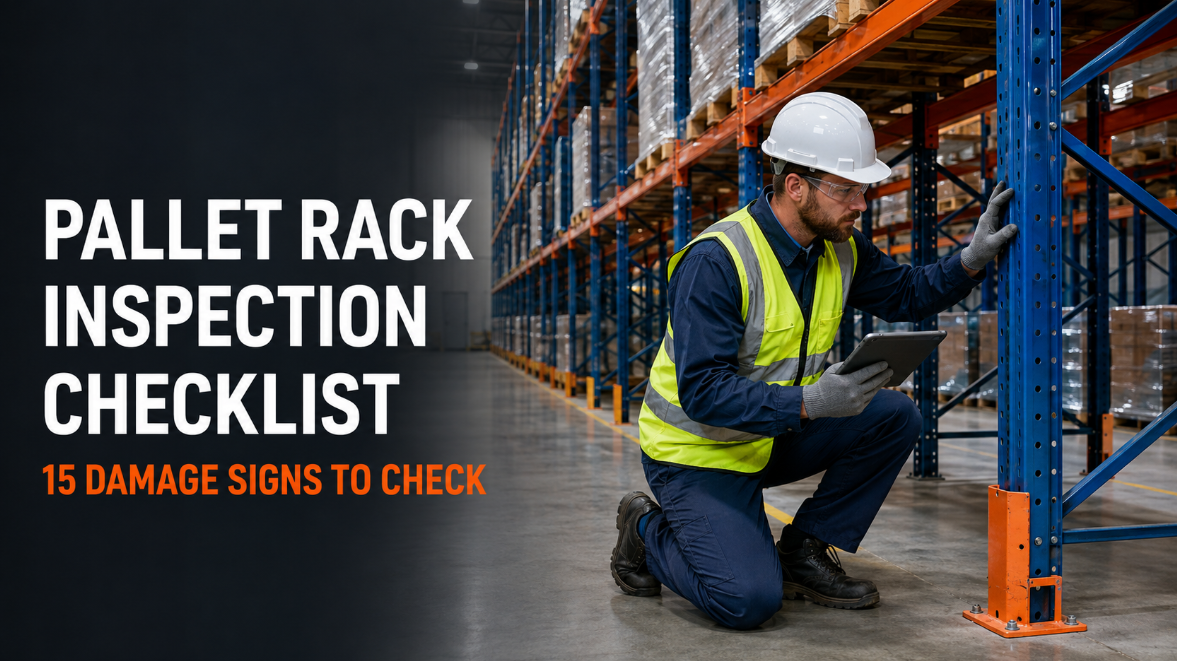
Before walking the aisles, obtain the manufacturer’s load application and rack configuration drawings—often called LARC drawings—plus the installation instructions and load-capacity plaques. Compare the installed beam elevations, bay widths, number of levels, anchors and accessories with those documents.
The current US industry standard is ANSI MH16.1-2023, Design, Testing, and Utilization of Industrial Steel Storage Racks. Other markets may require different methods or limits. Never apply one internet measurement to every rack profile and jurisdiction.
A Simple Initial Response System
| Finding | Initial response |
|---|---|
| Collapse risk, dislodged beam, severely deformed column, failed anchor or cracked structural weld | Keep people and equipment away; isolate the area and obtain urgent qualified assessment |
| Visible deformation, corrosion, floor damage or configuration change without immediate instability | Prevent additional loading and arrange documented professional evaluation |
| Minor coating marks with no visible deformation | Record, monitor and investigate the impact source; escalate if condition changes |
Only trained personnel should decide whether unloading can be performed safely. Do not climb the rack or stand beneath a suspect bay.
15 Pallet Rack Damage Signs You Should Never Ignore
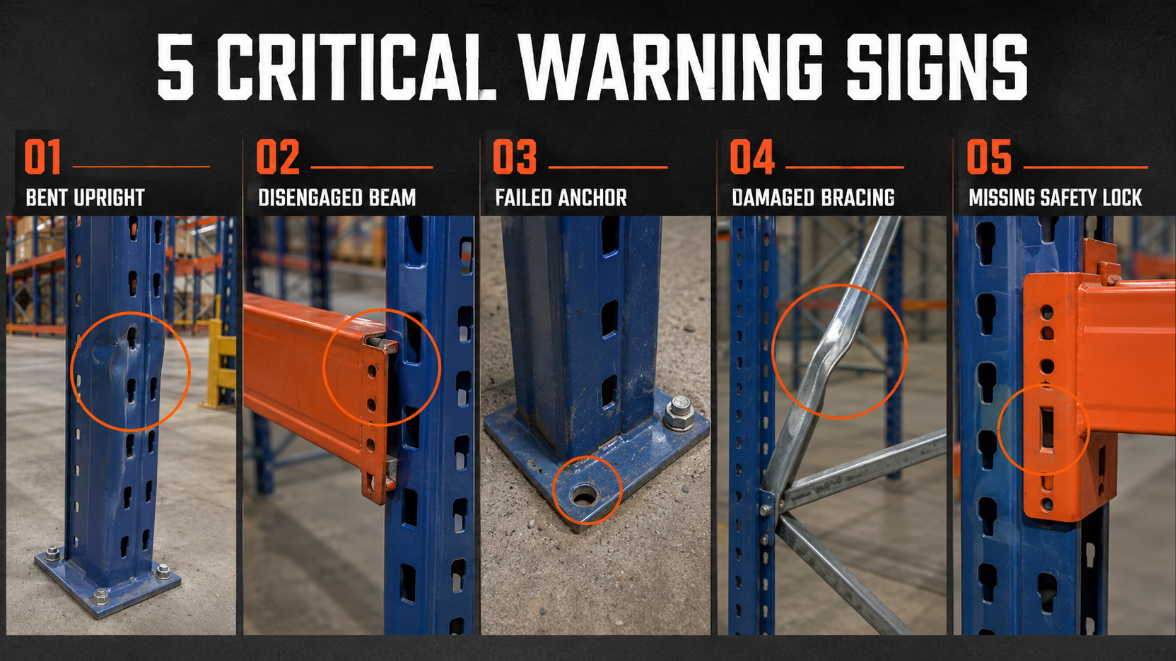
1. Bent, Dented or Creased Uprights
Inspect front columns at forklift height first, then the full upright. Look for dents, inward folds, local buckling, twisting or a sharp crease. Damage to one column can change how the frame carries vertical and horizontal forces. Treat a kink or visibly distorted upright as a structural concern, not a paint defect.
2. Torn Connector Slots or Cracked Upright Welds
Elongated connector holes, torn metal or cracks around an upright slot can prevent correct beam engagement. Also examine base-plate and brace welds. Do not grind, weld or cover a crack before a qualified review documents it.
3. Bent, Broken or Missing Frame Bracing
Horizontal and diagonal braces stabilize the frame. A brace that is bent, detached or missing can reduce lateral stiffness and alter the effective length of the upright. Check brace-to-column connections and welds, including damage hidden behind stored goods or column guards.
4. Missing, Loose, Bent or Sheared Anchors
Anchors help resist impact, overturning and seismic forces. Inspect front and rear base plates. Missing nuts, pulled-out bolts, movement, bending or sheared anchors require assessment. Replacement without checking the slab and original specification may be unsafe.
5. Distorted Base Plates or Cracked Concrete
A lifted, bent or torn base plate suggests that an impact or overload has reached the column base. Cracks, spalling or a gap in the concrete near an anchor may compromise the connection. Record the location and have the rack and slab conditions reviewed together.
6. Permanently Bent or Twisted Load Beams
Loaded beams normally deflect within approved criteria. A beam that stays bowed after unloading, has a dent, twists or shows weld damage may have been overloaded or struck. Assess it against the exact beam and span.
7. Partly Disengaged Beam-End Connectors
A forklift or pallet can lift a beam and leave its connector only partly seated in the upright. Compare both ends and confirm all hooks are fully engaged. A gap, uneven elevation or connector pulled away from the column is a serious warning because further movement can release the beam.
8. Missing or Damaged Beam Safety Locks
Safety clips, pins or locking devices help prevent accidental beam uplift. Check both ends of every beam. Missing, broken, incorrectly fitted or improvised locks should be corrected with compatible manufacturer-approved parts. A bolt, wire or similar makeshift item is not automatically an acceptable substitute.
9. Damaged Pallet Supports, Safety Bars or Decking
Look for displaced pallet supports, bent crossbars, broken welds, cut wire decking, excessive deck deformation and accessories that no longer seat on the beams. Decking and supports have specific functions and capacities; they do not increase beam or rack capacity unless the system was designed on that basis.
10. Leaning Frames or Misaligned Rack Rows
Sight down each aisle from floor level. Unexpected lean, progressive misalignment, changed row spacing or frames no longer vertical can indicate impact, anchor movement, floor settlement or missing connections. Do not pull a rack straight with a forklift or tensioning device without an engineered method.
11. Corrosion, Rust Scale or Measurable Metal Loss
Flaking rust, pitting, swelling around connections or repeated wetting requires closer evaluation, especially in cold stores, coastal locations and chemical environments. Repainting can hide deterioration without restoring strength.
12. Fresh Impact Marks or Damaged Column Guards
Scraped paint, tyre marks, pallet splinters and a displaced guard are evidence of an impact even when the upright initially looks straight. Inspect the column, anchors, braces and adjacent beam connections. Repeated impacts also indicate a layout, aisle-clearance, visibility or operator-training problem that should be corrected.
13. Missing, Illegible or Incorrect Load Plaques
A load plaque should match the installed configuration and state the applicable load limits. Missing signage, unreadable information or a plaque left unchanged after beam levels or stored products change creates an overloading risk. Capacity cannot be verified by beam colour or component size alone.
14. Unauthorized Repairs, Holes or Mixed Components
Watch for field welding, drilled holes, straightened columns, splice plates, unapproved kits and mixed connectors. Similar-looking components are not necessarily compatible. Request written approval identifying the repair and resulting capacity.
15. Damaged Pallets, Excessive Overhang or Changed Loads
The rack may be intact while its use has become unsafe. Check broken pallet boards, missing stringers, unstable cartons, point loads, excessive front or rear overhang and loads that exceed the plaque. A new pallet size, SKU weight or handling method may require the rack configuration to be reassessed.
What to Do When Damage Is Found
Use a controlled process rather than an improvised repair:
Stop access and isolate the affected bay or surrounding area.
Report the impact or defect through the site’s safety procedure.
Photograph the damage, record aisle/bay/level and mark the inspection date.
Check the LARC drawing, load plaque and maintenance history.
Have the manufacturer, qualified rack inspector or structural engineer assess it.
Repair or replace components only under an approved method.
Reopen the area only after authorization, then update records and signage.
RMI guidance on discovered rack damage states that owners should implement inspection, maintenance and reporting procedures for visible damage or other conditions that may affect capacity or structural performance. OSHA 29 CFR 1910.176(b) also requires stored materials to remain stable and secure against sliding or collapse.
How Often Should Pallet Racks Be Inspected?
There is no universal interval. RMI’s 2026 rack inspection guidance recommends frequent visual checks, formal documented inspections and a schedule based on operational risk.
Use shorter intervals where there is heavy forklift traffic, narrow clearance, frequent high-level placement, recurring impacts, outdoor exposure or rapidly changing loads. Employees should report an impact immediately rather than waiting for the next scheduled inspection. A competent or qualified person should perform formal assessments, particularly after collisions or configuration changes.
Pallet Rack Inspection Checklist for Buyers
Before purchasing a new system—or taking over an existing warehouse—request:
Approved layout, LARC drawings and load calculations or test basis
Component list, steel specifications and connector details
Beam, bay and frame capacity definitions
Base-plate, anchor and floor requirements
Load-plaque samples and installation instructions
Inspection, damage-reporting and approved-repair procedure
Spare-part availability and component traceability
Installation and final acceptance records
KAYOU can support project drawing review, material verification and pre-shipment checks through its quality control process. Explore KAYOU warehouse racking systems and provide the intended pallet dimensions, maximum unit load, beam levels, warehouse layout and destination-market requirements when requesting a proposal.
Practical Experience: Inspect from the Floor Up
For a consistent walk-through, KAYOU recommends following the load path: floor and anchors, base plates, uprights and bracing, beam connectors and locks, beams and decking, then pallets and loads. Finish by comparing the installed rack with its drawing and load plaque. This sequence reduces the chance of checking obvious dents while missing the connection or configuration issue that caused them.
Frequently Asked Questions
Can a bent upright be straightened and reused?
Not without documented approval. Straightening can alter steel properties or create hidden cracking. Use a manufacturer- or engineer-approved repair or replacement method.
Is visible beam deflection always a failure?
No. Some elastic deflection under load is expected. Permanent deformation, increasing deflection, local damage or movement at the connector requires evaluation against the exact beam, span and load.
Can warehouse staff approve a damaged rack?
Staff can report, photograph and isolate damage. Structural acceptance, residual-capacity decisions and repairs should be handled by appropriately qualified personnel under local requirements.
Conclusion
A useful pallet rack inspection is more than a quick search for bent steel. It follows the complete load path, checks the installed configuration against approved documents and records corrective action. When damage is uncertain, isolate first and obtain qualified advice—because a rack that remains standing is not necessarily a rack that retains its rated capacity.
Safety and engineering notice: This article is a general visual-inspection and procurement guide. It does not establish damage tolerances, certify an existing rack or replace the manufacturer’s instructions, a qualified inspection or applicable law. Do not unload, repair or re-enter an unstable area unless the task has been assessed and controlled by competent personnel.
Request a Pallet Racking Review from KAYOU
Planning a new warehouse or replacing damaged racking? Send KAYOU your layout, pallet dimensions, maximum unit load, required levels and site conditions for a project-specific proposal.