
KAYOU Pallet Rack Safety Guide
Damaged Pallet Rack: Repair, Replace or Isolate the Bay?
A practical B2B guide for warehouse operators, distributors and project buyers evaluating damaged pallet racking, replacement components and engineered repairs.
A forklift clips an upright. A beam is struck during pallet placement. An anchor becomes loose. A brace is visibly bent.
The rack may still be standing.
But does that mean it is still safe to use?
Not necessarily.
Pallet racking is a structural storage system. Damage to an upright, beam connection, brace, base plate or anchor can change how loads are transferred through the rack. The remaining capacity cannot always be judged from appearance alone.
For warehouse operators, the first decision after discovering damage should therefore not be:
“Can we straighten this?”
A better question is:
“Should this area remain in service until the damage has been assessed?”
In the United States, OSHA advises warehouse operators to inspect and maintain shelving and racking to prevent collapse and to immediately isolate an affected area when damage occurs. OSHA 29 CFR 1910.176(b) also requires stored materials to remain stable and secure against sliding or collapse.
This article explains a practical decision process for damaged selective pallet racking. It is intended as a warehouse management and purchasing guide—not as authorization to calculate residual capacity or perform structural repairs.
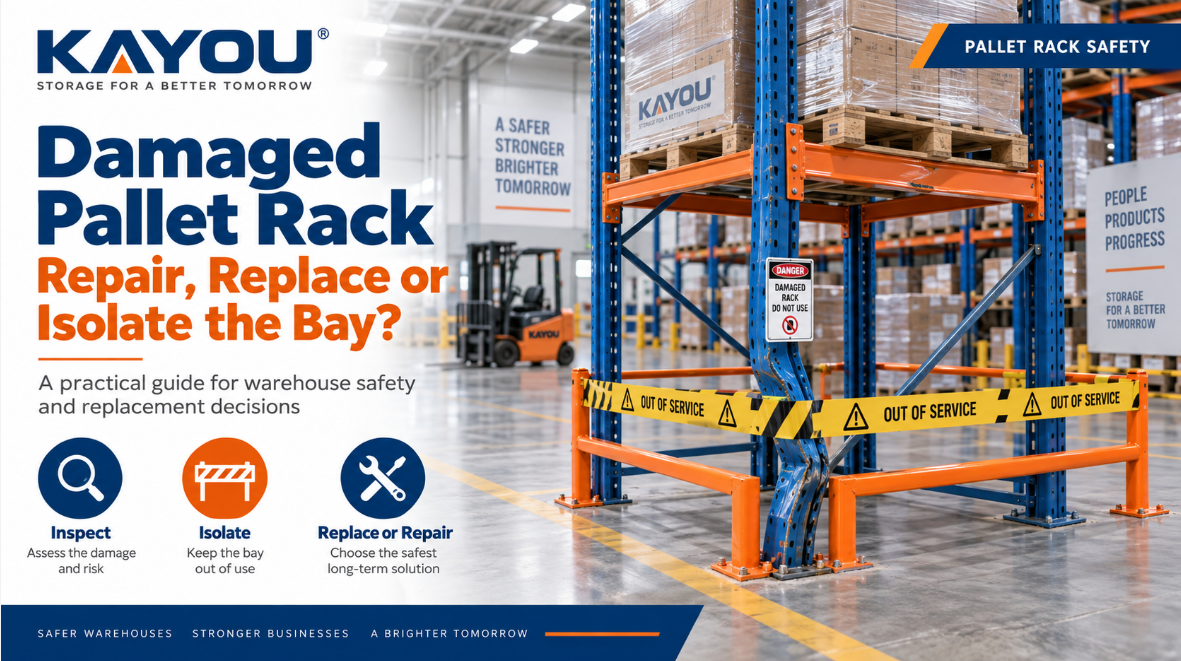
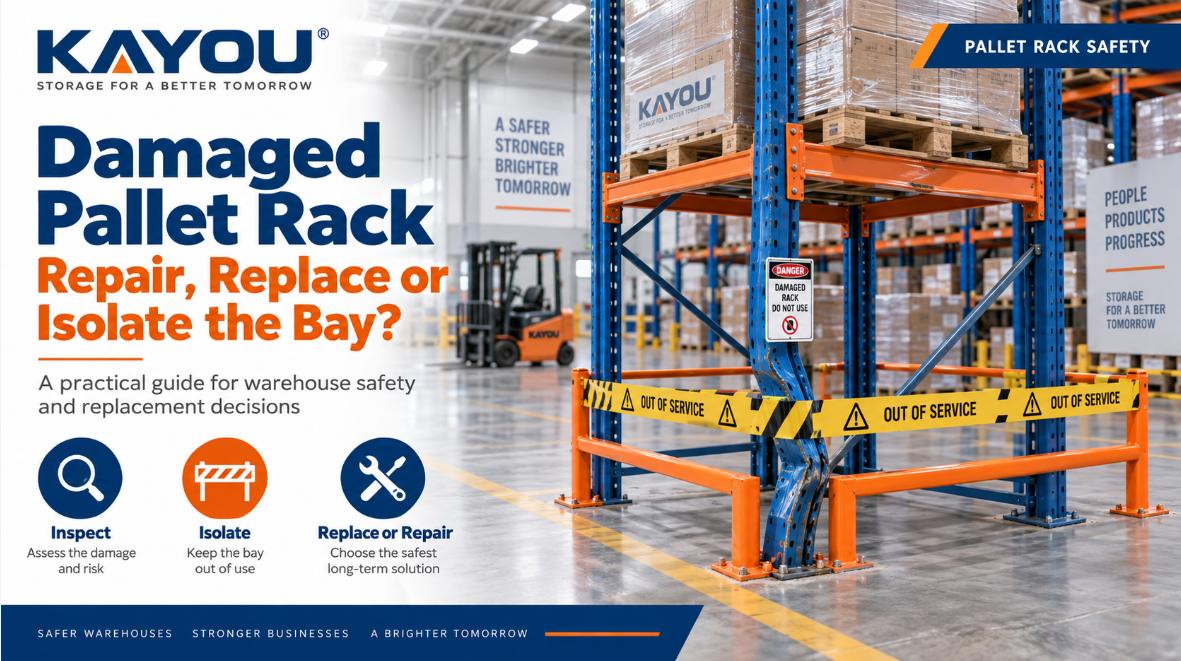
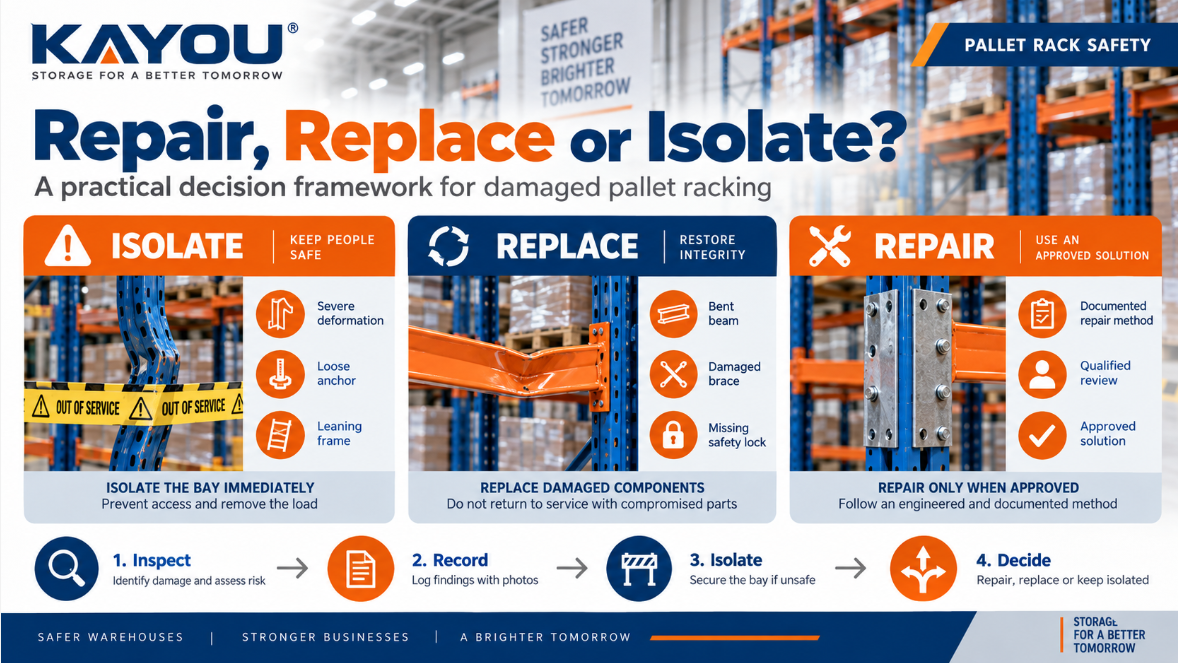
1. First Response: Isolate Before You Decide How to Fix It
When damage may affect structural safety, isolation is a temporary control, not a repair.
The purpose is to prevent additional forklift traffic, loading or employee exposure while the condition is assessed.
This is especially important when you see a severely bent or creased upright, partly disengaged beam, cracked structural weld, damaged base plate, failed anchor, leaning frame or significant impact around the bottom of an upright.
The UK Health and Safety Executive gives similar guidance: where damage affects the safety of a racking system, the rack should be offloaded and controls introduced to prevent further use until remedial work is completed.
The exact unloading method also matters. If a rack appears unstable, do not send workers or equipment into a hazardous area simply to remove the pallets. The unloading and exclusion method should itself be planned by competent personnel.
2. Repair, Replace or Isolate? A Practical Decision Framework
The correct response depends on the component, severity of damage, rack design, available documentation and engineering assessment.
| Condition | Typical Initial Action | Possible Final Action |
|---|---|---|
| Severe upright deformation or instability | Isolate immediately | Replace frame/component or engineered repair |
| Beam partly disengaged | Stop use of affected level | Re-seat only after inspection; replace damaged parts |
| Permanently bent or twisted beam | Isolate affected level | Usually replace with approved compatible beam |
| Damaged brace | Prevent further loading | Replace or engineered repair |
| Loose, missing or failed anchor | Isolate/limit access | Assess rack, base plate, anchor and slab |
| Missing safety lock | Stop using affected connection as required | Install correct compatible locking device |
| Surface paint scrape only | Record and inspect | Monitor if no structural damage is found |
| Corrosion with pitting or metal loss | Restrict use pending evaluation | Component replacement or engineered assessment |
| Unknown or questionable field repair | Treat as unverified | Engineering review, repair approval or replacement |
The word “typical” is important. This table is not a universal damage-tolerance chart.
Rack profiles, steel grades, connection designs, loading arrangements and local requirements differ. A measurement taken from another manufacturer's rack should not automatically be applied to your installation.
3. When Is Replacement Usually the Better Option?
Replacement is often the clearest solution when damage is localized and an approved, compatible component is available.
Consider a load beam that has been struck by a forklift and remains permanently bent after unloading. Replacing the beam with the correct part may be more practical than attempting to restore the original member.
The same principle can apply to badly damaged braces, safety locks and certain upright-frame components.
However, replacement does not mean “find something that fits.”
KAYOU's existing spare-parts guidance emphasizes that a beam from another system may physically connect to an upright while still differing in steel section, connector geometry, locking method or tested structural performance. Similar appearance does not establish compatibility.
Before ordering a replacement component, confirm the original manufacturer or rack series where possible, component dimensions, beam connector, upright profile, steel specification, load condition and existing drawings.
For KAYOU pallet racking, the original order reference and project drawings can make this verification much easier.
4. When Can Pallet Rack Damage Be Repaired?
An engineered repair can be a valid option in some projects, particularly where replacing a complete frame would create major operational disruption or where original components are no longer readily available.
But “repair” should not mean:
hammering an upright straight, welding a plate over the damage, drilling new holes or heating and bending a member until it looks correct.
Cold-formed rack members are structural components. Changing their geometry or material condition may change their performance.
RMI publishes a dedicated Guideline for the Assessment and Repair or Replacement of Damaged Rack, which is intended to help owners, users, designers and purchasers evaluate these decisions. RMI also makes clear that the document is advisory and not a substitute for a comprehensive safety program or appropriate professional advice.
A legitimate rack repair should therefore have a documented technical basis. Depending on the project, this may involve the original manufacturer, a qualified rack designer or an appropriately qualified structural engineer.
The repair documentation should identify what component is being repaired, the repair method, limitations, resulting capacity and any required changes to drawings or load notices.
5. Upright Damage Requires More Than Measuring the Dent
Uprights are particularly important because they carry vertical loads while also forming part of the frame's lateral stability system.
Forklift impacts commonly occur close to floor level, where the upright also interacts with the base plate and anchor.
When an upright is struck, examine more than the visible dent.
The impact may also have affected:
the base plate, floor anchor, frame bracing, adjacent beam connection, row alignment and concrete around the anchor.
A sharp crease, twist, local buckling or torn connector slot deserves more attention than a superficial coating mark.
KAYOU's pallet rack inspection guide recommends following the load path during inspection: start at the floor and anchors, then inspect base plates, uprights and bracing, beam connectors and locking devices, beams and decking, and finally pallets and stored loads.
That method helps prevent one common mistake: replacing the visibly damaged part while overlooking related damage created by the same collision.
6. What About Damaged Beams?
Some beam deflection under load can be part of normal structural behavior. Permanent deformation is different.
Warning signs include a beam that remains bent after unloading, local dents, twisting, damaged end connectors, cracked welds or one beam end sitting differently from the opposite side.
Beam-end connections also deserve attention after an impact.
A forklift may lift a beam slightly without causing it to fall. The connector can then remain partly disengaged from the upright.
Likewise, a missing or damaged locking pin should not be replaced with an arbitrary bolt, wire or improvised part simply because it fits through the opening.
Use the locking device specified or approved for that beam-to-upright connection.
7. Do Not Treat Anchor Damage as a Simple Maintenance Job
If a front upright receives a strong impact, the force can reach the base plate, anchor and concrete slab.
Possible warning signs include a bent base plate, missing or loose anchor, pulled anchor, cracked concrete, spalling around the fixing or movement between the column and floor.
Simply installing another anchor into the same damaged location may not resolve the underlying issue.
The condition of the slab, original anchor specification, embedment, edge distance and rack design may all matter.
For this reason, anchor and base damage should be reviewed as part of the rack system rather than treated as an isolated fastener problem.
8. Repair Cost vs Replacement Cost: Compare Total Risk, Not Only Parts
A repair can appear cheaper because fewer components are removed.
Replacement can appear more expensive because pallets must be relocated and a frame may need to be dismantled.
The lowest initial cost is not necessarily the best purchasing decision.
A B2B buyer should compare engineering review, downtime, unloading and installation labor, repair materials, replacement components, spare-part availability, future inspection requirements, load-rating documentation and the risk of another shutdown if the solution cannot be properly verified.
For an older or unidentified rack, replacing a larger section may sometimes provide better traceability than repeatedly repairing individual unknown components.
For a recent installation with complete drawings and available matching components, direct component replacement may be much simpler.
The decision should follow the engineering condition of the rack—not merely the price of steel.
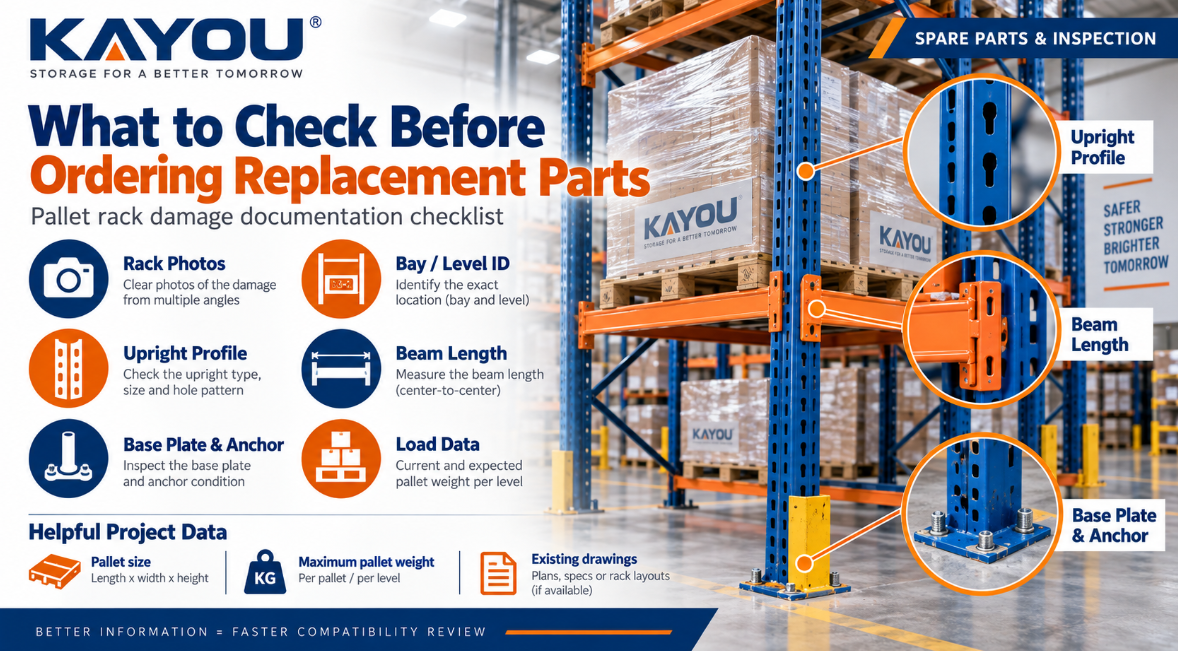
9. Document the Damage Before Ordering Parts
Good documentation speeds up technical review and reduces the chance of ordering the wrong component.
For a damaged rack enquiry, record the aisle, bay and level; photographs of the full rack row and damaged area; close-ups of the upright, beam connection, base plate, anchors and bracing; manufacturer and model information if available; upright profile and frame depth; beam span and beam section; beam-level positions; pallet size; maximum loaded pallet weight; number of pallets per level; load plaque; original drawings; and a description of how the damage occurred.
KAYOU's component compatibility guidance recommends using original order information, drawings and complete-bay photographs whenever possible rather than identifying parts from appearance alone.
10. Prevent the Same Damage From Happening Again
Replacing an upright without understanding why it was hit can lead to another damaged upright several weeks later.
Repeated rack impacts may indicate an operating problem such as insufficient aisle clearance, forklift turning limitations, poor visibility, pallet overhang, unsuitable loading practice, missing protection or a layout that no longer matches the current operation.
Rack protection can help in high-impact locations, but guards are not a substitute for correct layout and forklift operation.
KAYOU warehouse pallet racking can be configured with accessories such as column protectors, safety pins, row spacers, pallet support bars and wire decking according to the storage application.
Prevention should therefore form part of the corrective action.
11. Which Standard Should You Follow?
For U.S. industrial steel storage racks within its scope, ANSI MH16.1-2023 is the current RMI/ANSI standard covering design, testing and utilization. It includes selective pallet racking and several other industrial rack systems, while some rack types—such as drive-in, drive-through and cantilever racks—fall outside its stated scope or require other guidance.
This distinction matters for international buyers.
A U.S. standard, UK HSE document or generic online damage chart should not automatically be treated as the governing requirement for a warehouse in another country.
Always check the applicable local building, occupational safety, seismic and inspection requirements together with the rack manufacturer's instructions.
FAQ
Can warehouse staff decide that a bent rack is safe?
Warehouse staff can identify, photograph, report and isolate damage. Structural acceptance or residual-capacity decisions should be made through the appropriate qualified review for the installation.
Can a bent pallet rack upright simply be straightened?
Do not assume so. Straightening may alter the member or conceal damage. Any proposed repair should follow a documented, system-specific method approved by the responsible manufacturer or qualified engineering professional.
Should a damaged rack always be replaced?
Not necessarily. Some systems can be repaired using an engineered method. In other cases, component or frame replacement is more practical and easier to verify. The decision depends on the damage and rack configuration.
Can I replace a damaged beam with one from another supplier?
Only after compatibility has been properly established. Matching length, color or hole pattern does not prove structural compatibility.
When should a damaged pallet rack bay be isolated?
If damage may affect stability, capacity or safe operation—or if the severity is uncertain—restrict access and loading until the rack has been appropriately assessed. OSHA's warehouse guidance specifically recommends immediately isolating an affected area when racking damage occurs.
Need Replacement Pallet Rack Components or a New Racking Section?
A damaged rack should not become a guessing exercise.
Send KAYOU your rack photographs, existing drawings, upright and beam dimensions, pallet size, maximum pallet weight, required quantities and project destination.
For an existing KAYOU system, include the original order number if available. For another manufacturer's system, provide as much identification and technical information as possible so compatibility can be reviewed before a replacement is proposed.
KAYOU provides customized warehouse pallet racking, replacement components and project-based storage solutions for warehouses, factories, logistics centers and distributors. Its quality-control process covers material, dimensions, welding, surface treatment, accessories and final product inspection.
Contact KAYOU for a Pallet Racking ProposalContact KAYOU for a Pallet Racking Proposal