
KAYOU Stainless Steel Shelving Guide
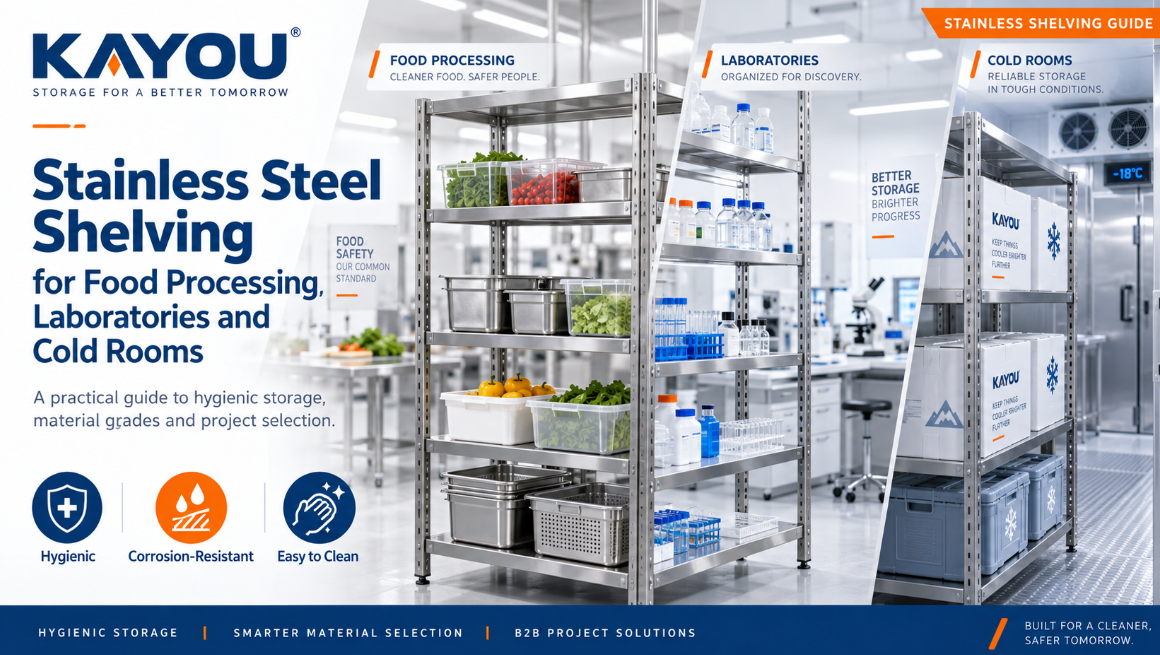
Stainless Steel Shelving for Food Processing, Laboratories and Cold Rooms
A practical B2B guide to stainless grades, hygienic storage, shelf design, corrosion exposure, cleaning requirements and RFQ preparation.
A shelving system that performs well in a dry warehouse may not be the right choice for a food-processing room, laboratory or cold-storage facility.
These environments introduce additional challenges:
moisture, condensation, cleaning chemicals, sanitation routines, temperature changes and—in some laboratories—chemical compatibility requirements.
That is why stainless steel shelving is widely considered for applications where corrosion resistance and cleanability matter.
However, specifying simply “stainless steel rack” is not enough.
A professional buyer should also consider the stainless steel grade, shelf construction, surface finish, stored materials, cleaning method, load per level and operating environment.
KAYOU manufactures stainless steel shelving in 201, 304 and 316 stainless steel, with flat, perforated or wire-style shelves, customized shelf levels, dimensions and load requirements. The final configuration should be selected according to the actual application rather than treating every stainless steel grade as interchangeable.
1. Why Stainless Steel Is Used in Hygienic and Humid Storage Areas
Stainless steel combines structural strength with a corrosion-resistant surface that can be repeatedly cleaned.
For food-related equipment, cleanability is particularly important. FDA guidance states that food-contact surfaces should be durable, corrosion-resistant, nonabsorbent, smooth and easily cleanable. Even non-food-contact surfaces exposed to splash or food debris should be corrosion-resistant and suitable for cleaning.
The same basic principle matters in cold rooms and laboratories: equipment should tolerate the conditions in which it will actually be used.
The advantages of stainless shelving can include:
resistance to moisture and routine washdown;
smooth surfaces that simplify cleaning;
no powder-coated layer that can chip away from normal surface corrosion;
good structural strength;
suitability for modular and adjustable shelving;
compatibility with commercial, food-storage and controlled environments.
But corrosion resistance is relative, not absolute.
Salt, chlorine-containing cleaners, acids, high humidity and stagnant moisture can all influence stainless steel performance.
2. Stainless Steel Shelving for Food Processing
Food-processing environments place a high priority on hygiene.
Shelving may hold ingredient containers, packaging materials, utensils, trays, food bins or finished goods. Depending on where the rack is installed, surfaces may be exposed to water, food debris, detergent and sanitizing chemicals.
The FDA Food Code emphasizes that surfaces requiring frequent cleaning should be smooth, corrosion-resistant and nonabsorbent. USDA sanitation guidance likewise stresses durable, easily cleanable and corrosion-resistant materials for food equipment.
Why Grade Selection Matters
For many food and beverage applications, Type 304 stainless steel is one of the most commonly used grades. The Nickel Institute identifies 304 as the most common stainless steel alloy used in food and beverage applications.
However, a more aggressive environment may justify 316.
Type 316 contains molybdenum, which improves resistance to chlorides and reducing acids compared with 304. This can matter where shelving is exposed to salty products, chloride-containing solutions or more demanding cleaning environments.
This does not mean every food rack must be 316.
The correct question is:
What will the shelving be exposed to during normal use and cleaning?
For example, dry packaged goods in a controlled room and seafood containers in a regularly washed processing area do not create the same corrosion conditions.
3. Stainless Steel Shelving for Laboratories
Laboratory shelving requires a different evaluation.
A stainless steel rack may be appropriate for instruments, samples, clean supplies, sealed containers and general laboratory storage, but stainless steel alone does not make a shelf suitable for every chemical.
Laboratory buyers must first identify what will be stored.
OSHA laboratory guidance recommends separating chemicals according to hazard and compatibility, following SDS storage information, securing open shelves to the wall and using shelf lips and secondary containment where appropriate.
Therefore, laboratory shelving design may need to consider:
chemical compatibility;
secondary containment trays;
front-edge retaining lips;
secure anchoring;
shelf height;
segregation of incompatible substances;
accessibility for cleaning;
load distribution.
For hazardous chemicals, a conventional open stainless steel shelf may not replace an approved flammable-liquid cabinet, corrosive chemical cabinet or other purpose-designed containment system.
This distinction is important.
A laboratory shelf is a storage platform—not automatically a chemical-safety cabinet.
The CDC's BMBL guidance also emphasizes that laboratory furniture should support anticipated loads and that surfaces used in laboratory environments should be selected for resistance to relevant chemicals and cleaning conditions.
4. Stainless Steel Shelving for Cold Rooms
Cold rooms create a different challenge: persistent humidity and condensation.
When doors open, warm humid air can enter and moisture can condense on colder surfaces. During cleaning, shelving may also be repeatedly exposed to water.
For this reason, corrosion resistance and cleanability are important selection factors.
Some jurisdictions have explicit cold-room shelving requirements. For example, Singapore Food Agency licensing conditions specify stainless steel racking for food cold stores and state that the lowest shelf should be at least 30 cm above the base of the cold store. This is a Singapore-specific requirement and should not be treated as a universal international dimension.
For international projects, buyers should check local food, sanitation and building requirements.
From a practical storage-design perspective, cold-room shelving should also consider:
air circulation, drainage, floor cleaning, product access and clearance around walls and refrigeration equipment.
Perforated or wire-style shelving can sometimes help airflow around stored goods, while solid stainless panels may be preferred where small items or spill containment are more important.
The correct design depends on the stored product and hygiene process.
5. 201 vs 304 vs 316 Stainless Steel Shelving
KAYOU offers 201, 304 and 316 options, but buyers should not select the grade by price alone.
| Grade | Typical Selection Consideration | Suitable Direction |
|---|---|---|
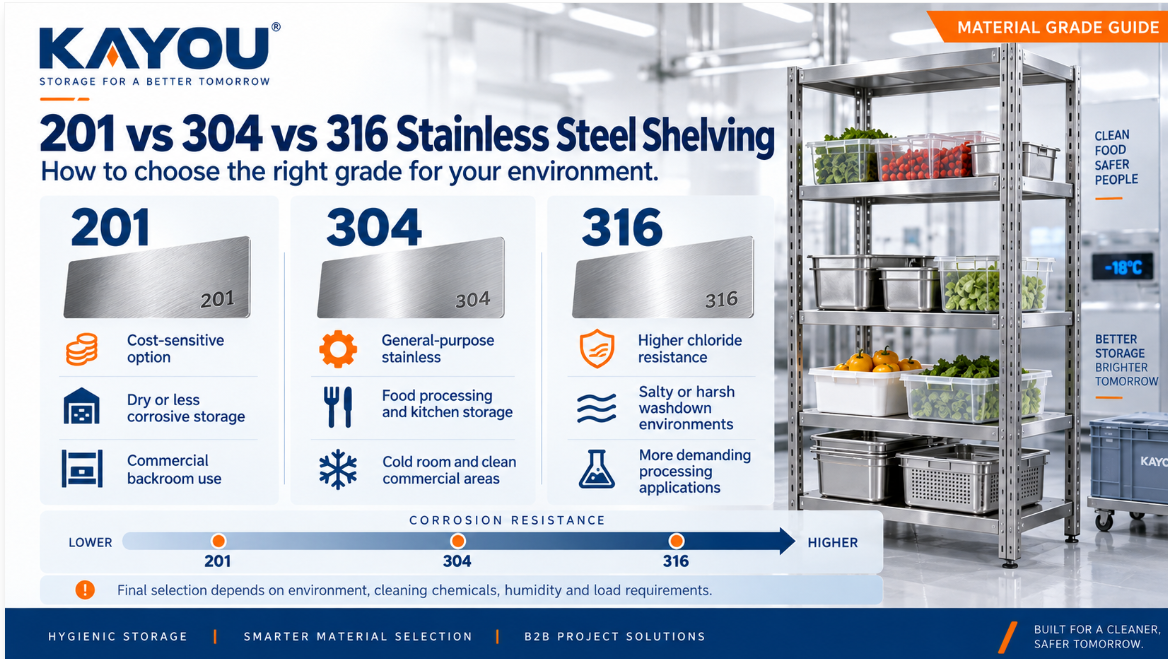
| 201 | Cost-sensitive stainless option; environmental exposure must be reviewed | Dry or less corrosive commercial storage |
| 304 | Widely used general-purpose austenitic stainless steel with good corrosion resistance | Food storage, kitchens, many cold rooms and clean commercial areas |
| 316 | Added molybdenum improves chloride resistance compared with 304 | More aggressive, salty, chloride-rich or demanding processing environments |
Tests referenced by the Nickel Institute show that Type 304 can provide equivalent or higher corrosion resistance than Type 201 in a range of evaluated environments, although real performance always depends on the actual chemical exposure.
Type 316 generally provides better resistance than 304 in chloride environments because of its molybdenum content.
That still does not make 316 universally “best.”
Material selection should also consider:
temperature + chemical concentration + cleaning agent + contact time + humidity + surface condition.
6. Flat, Perforated or Wire Shelves?
Shelf style can be just as important as material grade.
Flat Stainless Steel Shelves
Best when buyers want a continuous surface for boxes, containers, tools or small products.
Advantages include:
good support for small items;
simple wiping;
no items falling through openings.
However, standing water should not be allowed to remain indefinitely.
Perforated Stainless Steel Shelves
Perforations can support:
airflow;
drainage;
reduced water accumulation;
cold-room applications.
They are often considered where ventilation around stored items matters.
Stainless Steel Wire Shelving
Wire designs maximize airflow and reduce the amount of horizontal surface where dust or moisture can collect.
However, wire geometry may require more cleaning effort where food residues or sticky contamination are present.
There is no single best shelf style for all hygienic applications.
7. Do Not Specify the Rack by Dimensions Alone
A common RFQ may say:
2000 × 600 × 2000 mm, five levels, stainless steel.
That is not enough for a reliable quotation.
Two racks with the same outside dimensions may use very different:
upright sections;
beam sizes;
shelf thicknesses;
reinforcement ribs;
steel grades;
shelf spans;
connections.
These factors affect both weight and load capacity.
KAYOU's stainless steel shelving range can be configured for different dimensions, levels and load requirements, with its current product information listing customizable load capacity from approximately 100–500 kg per level depending on specification. Final capacity depends on the approved structure and uniformly distributed load conditions.
For a serious B2B enquiry, specify the required UDL per level, not simply “heavy duty.”
8. Cleaning and Corrosion: Common Mistakes
Even stainless steel requires correct maintenance.
Common problems include allowing chloride-containing residues to remain on the surface, failing to rinse cleaning chemicals, allowing standing water to remain in crevices and using unsuitable abrasive tools.
The Nickel Institute notes that hypochlorite-based sanitizers can cause localized corrosion if they remain on stainless steel and are not adequately rinsed after the prescribed contact period.
Buyers should therefore review the cleaning procedure before choosing the material grade.
Ask:
What detergent or sanitizer is used?
At what concentration?
At what temperature?
How often is the rack washed?
Is clean water used for rinsing?
These answers can materially change the correct specification.
9. What Should Buyers Include in a Stainless Steel Shelving RFQ?
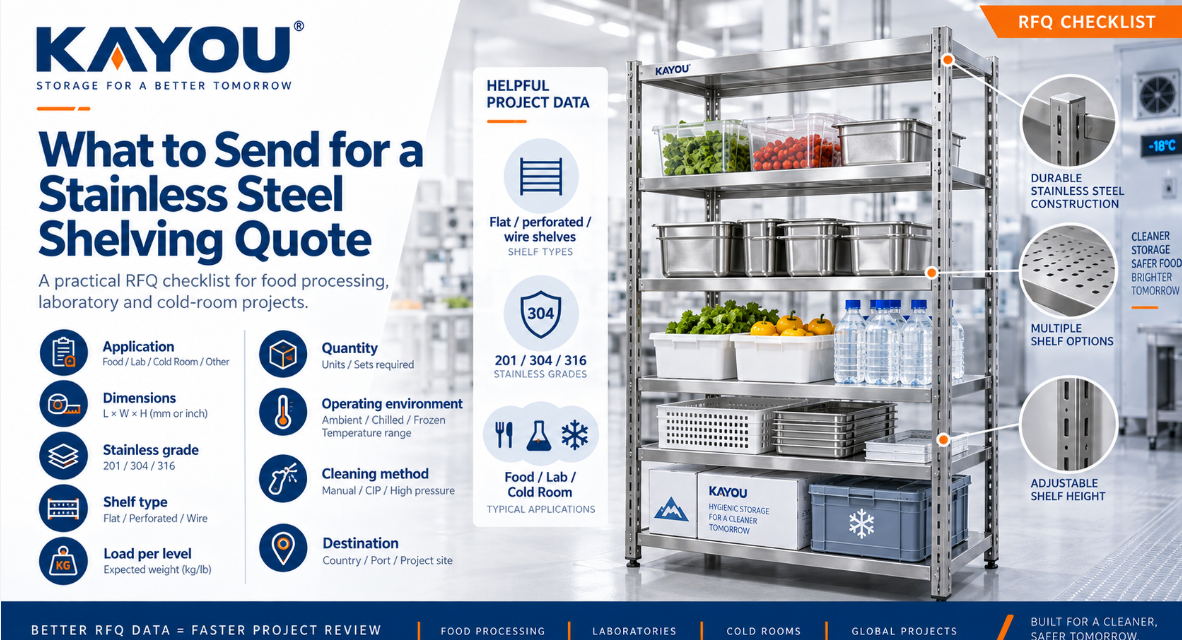
To prepare a more useful quotation, provide:
| RFQ Information | Example |
|---|---|
| Application | Food factory / laboratory / cold room |
| Rack size | L2000 × D600 × H2000 mm |
| Required grade | 304 stainless steel |
| Shelf levels | 5 levels |
| Load per level | 250 kg UDL |
| Shelf type | Flat / perforated / wire |
| Stored goods | Food cartons / samples / containers |
| Environment | Dry / humid / refrigerated / washdown |
| Cleaning chemicals | If applicable |
| Quantity | 50 sets |
| Installation country | Required for project review |
| Packaging | Export carton / pallet |
| Special requirements | Lips / adjustable feet / casters / branding |
For food or laboratory projects, buyers should also tell the supplier if there are specific local hygiene, certification or chemical-resistance requirements.
Do not assume that a generic stainless rack automatically meets every food, pharmaceutical or laboratory regulation.
10. How KAYOU Configures Stainless Steel Shelving
KAYOU's current stainless steel shelving range is designed for kitchens, food storage, cold rooms, warehouses and commercial projects, with configurable 201 / 304 / 316 material, flat / perforated / wire shelves, custom dimensions, shelf levels, surface finish and load capacity.
For project buyers, the better purchasing process is:
Application → Environment → Stainless Grade → Shelf Type → Dimensions → Load → Cleaning Conditions → Final Specification
rather than:
Price → Size → Order
That approach reduces the risk of selecting a rack that looks correct on a quotation but is poorly matched to its operating environment.
FAQ
Is 304 stainless steel suitable for food-processing shelving?
304 is widely used in food and beverage applications because of its corrosion resistance, durability and cleanability. However, aggressive chemicals, high chloride exposure or specific local food-contact rules may require a different material or design.
When should I consider 316 instead of 304?
Consider 316 where chloride exposure or more aggressive chemical conditions make additional corrosion resistance valuable. Its molybdenum content provides better chloride resistance than 304 in many environments.
Can stainless steel shelving be used in laboratories?
Yes, for many applications, but chemical compatibility must be checked. Hazardous chemicals may require dedicated cabinets, secondary containment and segregation rather than conventional open shelving.
Is stainless steel suitable for cold rooms?
Yes. Stainless steel's corrosion resistance and cleanability make it useful in humid and refrigerated environments when the appropriate grade and structure are selected. KAYOU lists cold rooms among the applications for its stainless shelving.
Which shelf style is best for a cold room?
Perforated or wire shelves can help airflow and drainage, while flat panels provide better support for small goods. The correct option depends on product type, cleaning requirements and storage layout.
What information does KAYOU need for a quotation?
Send your rack dimensions, stainless steel grade, shelf type, number of levels, required load per level, quantity, application, operating environment and delivery destination.
Need Stainless Steel Shelving for Your Project?
Food processing, laboratory and cold-room projects should not be specified by rack dimensions alone.
Send KAYOU your:
application + dimensions + stainless steel grade + shelf type + load per level + quantity + operating environment + destination
and our team can review the requirements and prepare a customized stainless steel shelving proposal.
KAYOU — Custom Stainless Steel Storage Solutions for Global B2B Projects
Contact KAYOU: