


How to Choose Stainless Steel Shelving: 201 vs 304, Structure and Quality Checks
How to Choose Stainless Steel Shelving: A Factory-Based Guide from KAYOU
Stainless steel shelving can appear simple when viewed in a product catalog.
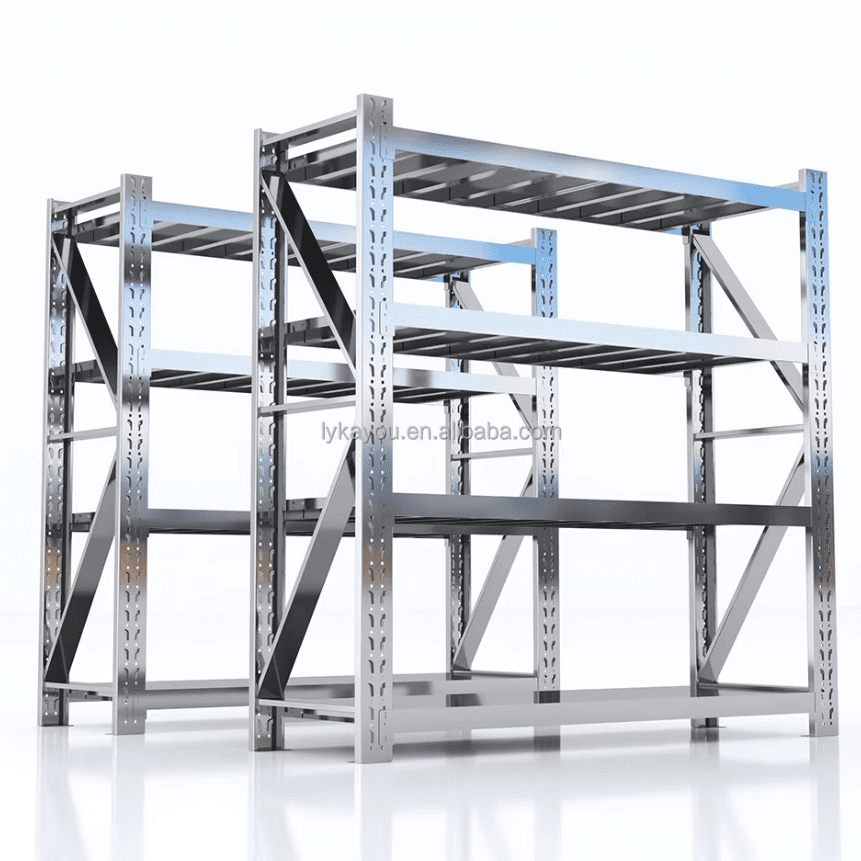
Four uprights, several shelves and a set of side braces may look similar from one supplier to another. However, the actual performance of a stainless steel storage rack depends on much more than its polished appearance.
Commercial buyers need to consider:
Stainless steel grade
Material thickness
Upright and beam profiles
Shelf reinforcement
Connection structure
Load distribution
Surface finishing
Storage environment
Manufacturing consistency
The factory images shown in this article document an actual KAYOU stainless steel shelving production process—from formed uprights and assembled side frames to shelf components prepared for bulk packing.
This gives buyers a clearer view of how a stainless steel rack is constructed before it reaches the warehouse, commercial kitchen, cold room or retail stockroom.
Quick Answer: Which Stainless Steel Shelving Should You Choose?
For most buyers, the correct choice depends on the operating environment.
201 stainless steel shelving may be suitable for dry indoor storage and projects where cost control is important.
304 stainless steel shelving is generally preferred for humid environments, commercial kitchens, food-related storage, frequent cleaning and locations requiring stronger corrosion resistance.
For coastal areas, high-chloride environments or more aggressive chemicals, a higher-corrosion-resistant material may be required and should be reviewed according to the actual application.
Stainless steel is not one single material. Its performance changes according to grade, alloy composition and operating environment, so the material should be selected for the application rather than by appearance alone.
What the KAYOU Factory Photos Show
The supplied images show several important stages and structural details of stainless steel shelving production.
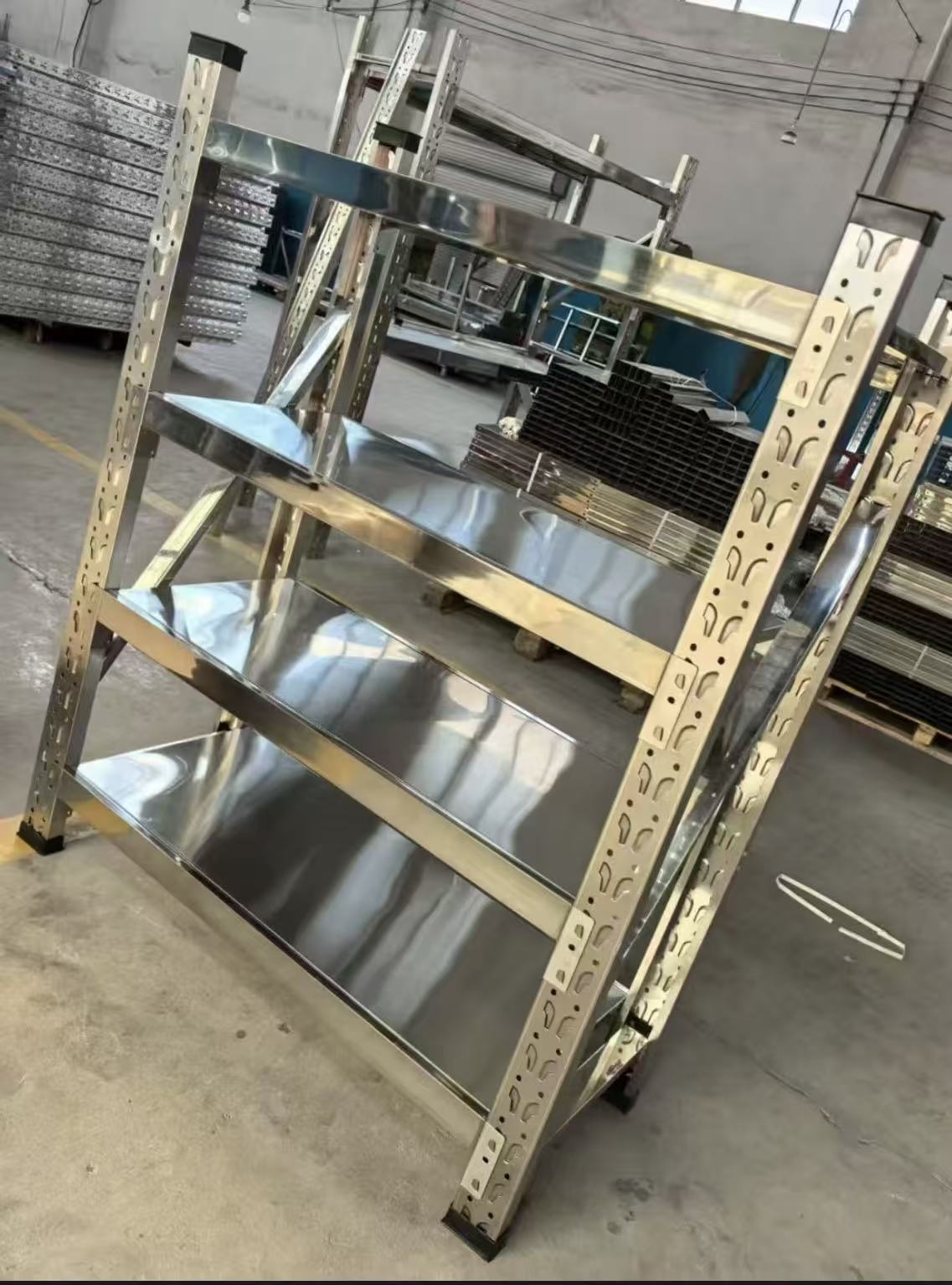
An Assembled Adjustable Shelving Unit
The finished rack uses:
Slotted upright profiles
Adjustable shelf levels
Solid metal shelf panels
Front and rear supporting beams
Side-frame bracing
Boltless or hook-in connections
Protective feet or end caps
This modular structure allows buyers to adjust the shelf spacing according to cartons, kitchen supplies, tools, spare parts or other stored products.
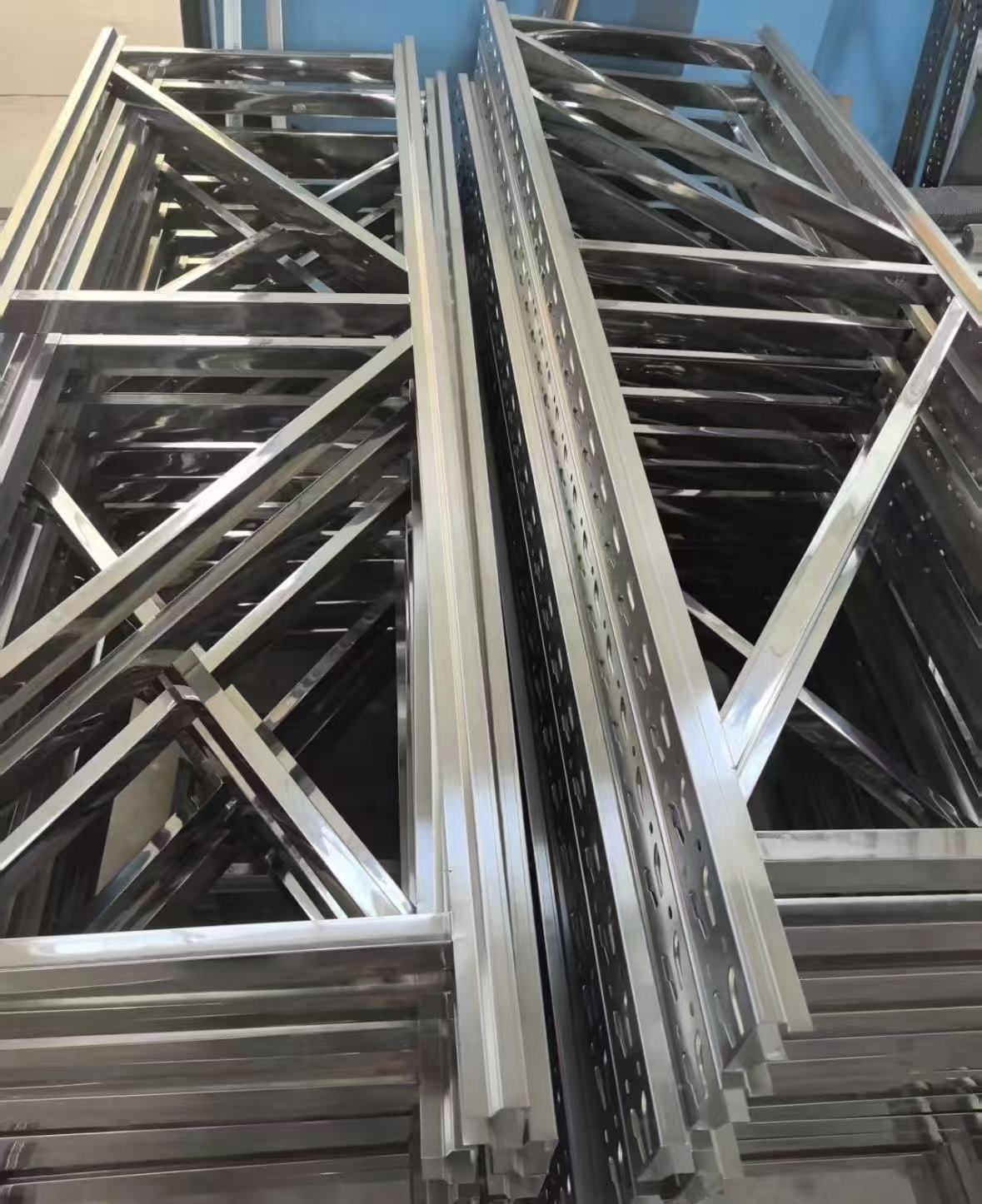
Completed Side Frames and Bracing
The second factory photo shows multiple side frames stacked after fabrication.
Each side frame includes uprights, horizontal members and diagonal braces. These components help control lateral movement and improve the stability of the complete shelving unit.
Side-frame quality should be evaluated by checking:
Upright straightness
Bracing arrangement
Joint accuracy
Frame squareness
Surface condition
Connection consistency
A shelf may use thick material but still feel unstable if the side-frame structure or connection accuracy is poor.
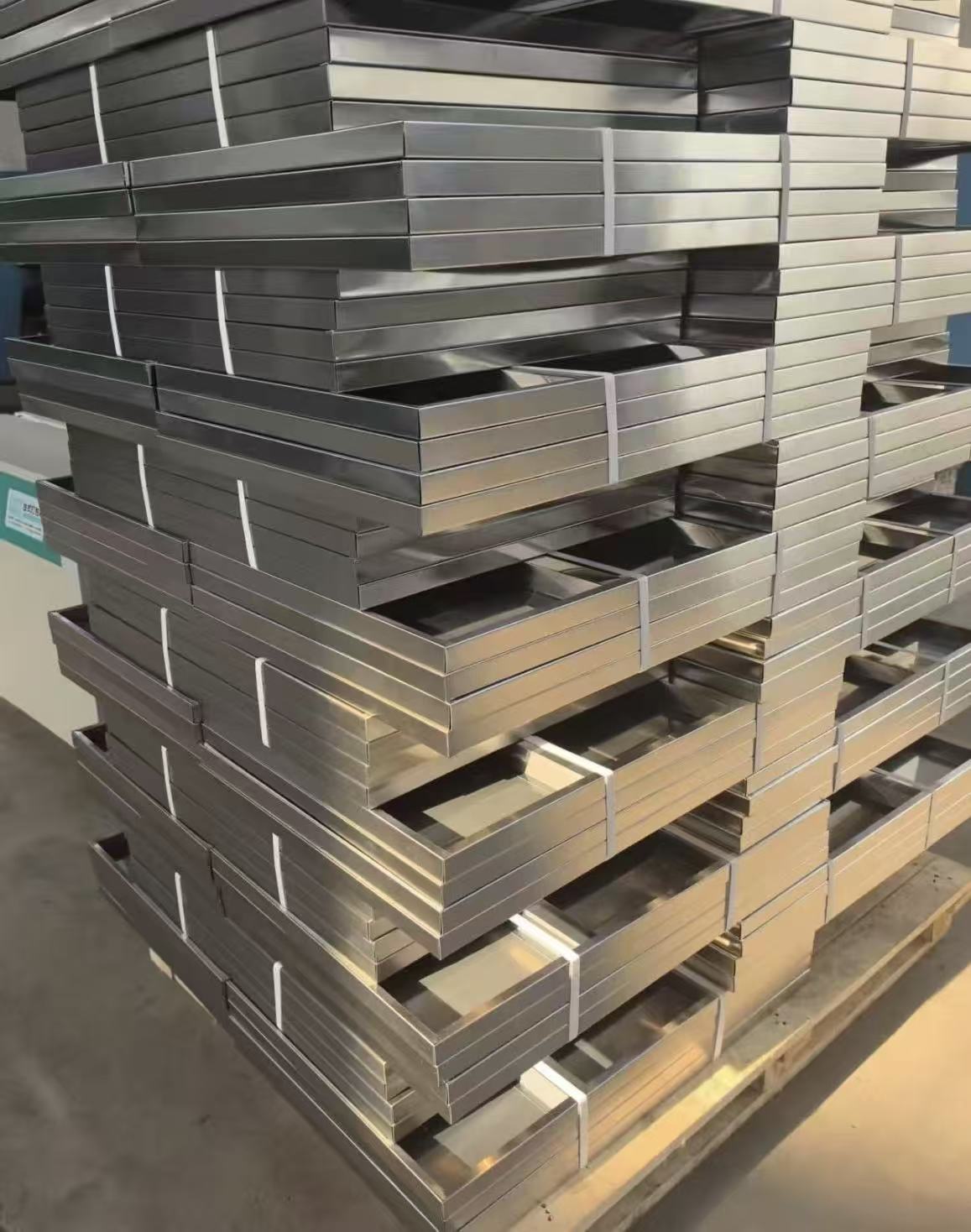
Formed Shelf and Beam Components
The bundled rectangular sections shown in the production photos demonstrate how shelves and beams are formed before assembly.
Folded profiles are important because bends and reinforcing edges increase structural stiffness without requiring every component to use excessively thick material.
Buyers should therefore compare the complete profile rather than asking only:
“What is the steel thickness?”
A professional comparison should include thickness, profile height, folded edges, reinforcement quantity and usable shelf span.
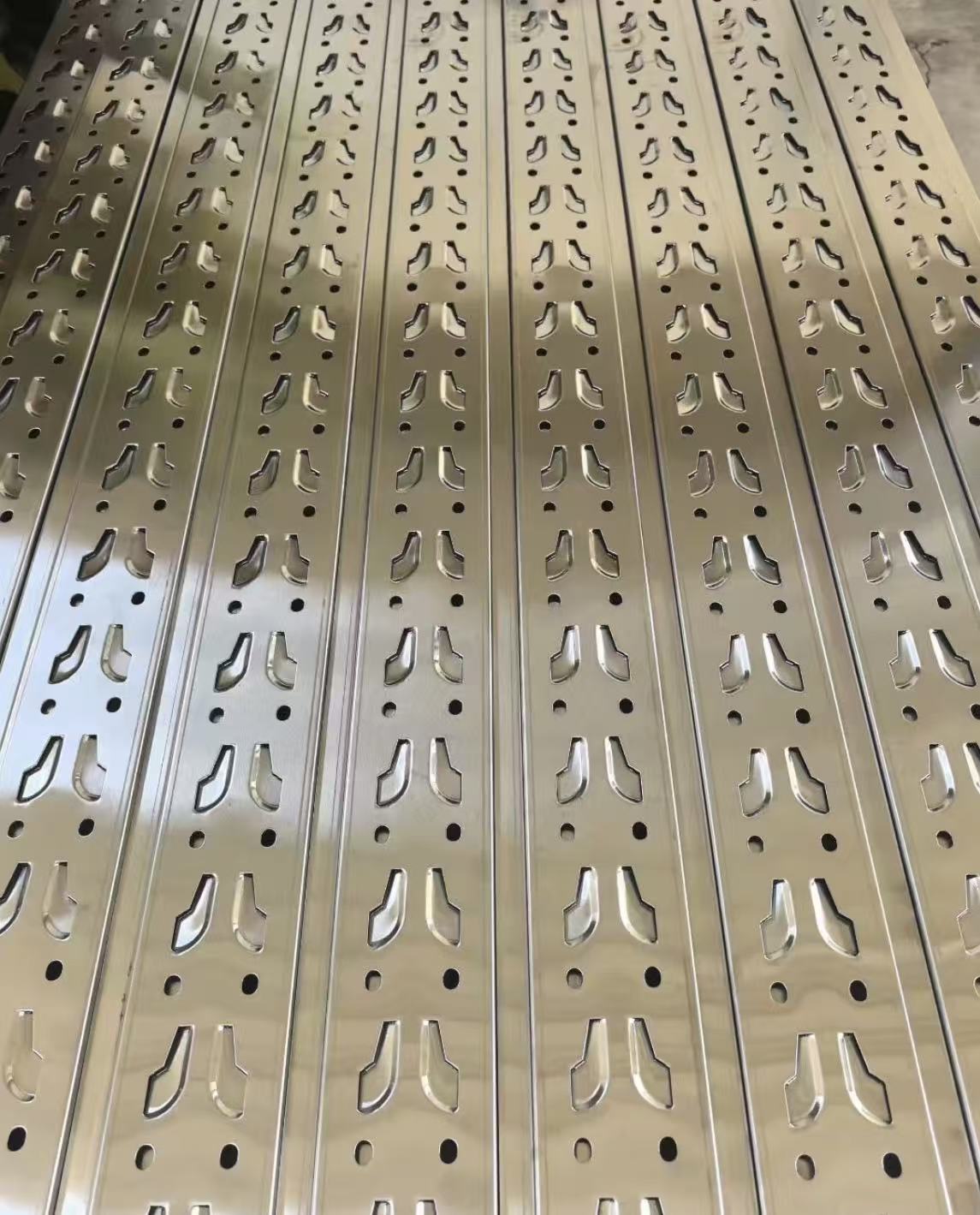
Repeated Upright Slot Production
The close-up image of the uprights shows regularly spaced punched slots.
Accurate slot spacing is important because inconsistent punching can cause:
Uneven shelf levels
Difficult beam installation
Loose connections
Misaligned frames
Reduced structural stability
For adjustable stainless steel shelving, hole accuracy and connector engagement are as important as the material itself.
Why Stainless Steel Shelving Is Receiving More Buyer Attention
Recent commercial buying content repeatedly focuses on topics such as:
304 vs 201 stainless steel
Commercial kitchen storage
Adjustable heavy-duty shelves
Corrosion-resistant shelving
Cold-room storage
Easy-clean surfaces
Material-grade verification
Load capacity per shelf
These topics reflect a change in buyer behavior. Customers are no longer satisfied with general descriptions such as “high quality stainless steel” or “heavy-duty construction.” They want to know exactly which grade is used, where it can be used and how its quality can be verified.
Stainless steel is widely used in food and beverage environments because suitable grades can provide cleanable, non-absorbent and corrosion-resistant surfaces. Grade selection, hygienic design and fabrication quality still need to match the intended application.
201 vs 304 Stainless Steel Shelving
One of the most common questions from commercial shelving buyers is:
“Should I choose 201 or 304 stainless steel?”
Both materials can be used to manufacture shelving, but they should not be treated as identical.
| Comparison | 201 Stainless Steel | 304 Stainless Steel |
|---|---|---|
| Relative cost | More economical | Higher initial cost |
| Typical environment | Dry indoor storage | Humid and frequently cleaned areas |
| Corrosion resistance | Moderate | Generally stronger |
| Suitable applications | Dry stockrooms, workshops, indoor storage | Kitchens, food storage, cold rooms, humid facilities |
| Buyer priority | Budget and indoor use | Hygiene, moisture resistance and durability |
| Verification | Material specification required | Material specification required |
When 201 Stainless Steel May Be Suitable
201 stainless steel can be considered for:
Dry warehouses
Indoor retail stockrooms
General spare-parts storage
Offices and archives
Low-humidity workshops
Cost-sensitive commercial projects
It may offer a practical balance between metallic appearance, structural performance and project cost when the shelving is kept indoors and away from persistent moisture, salt and aggressive cleaning chemicals.
However, buyers should not select it only because the sample looks bright and polished. The actual environment should be evaluated first.
When 304 Stainless Steel Is Usually Preferred
304 stainless steel is commonly selected for:
Commercial kitchens
Food preparation facilities
Restaurant storage rooms
Cold rooms and walk-in coolers
Hospitals and healthcare storage
Laboratories
Humid production areas
Locations requiring frequent washing
Type 304 is widely used in food and beverage applications and is valued for its combination of corrosion resistance, formability and cleanability.
Nevertheless, calling a rack “304 stainless steel” does not automatically prove that it holds a particular food-contact or sanitation certification.
Certification, surface treatment, weld quality, cleanability and local regulatory requirements must be confirmed separately for each project.
Stainless Steel Does Not Mean “Never Rusts”
A common purchasing misunderstanding is that all stainless steel is completely rust-proof.
Stainless steel depends on a chromium-rich passive surface layer for corrosion resistance. Its real-world performance can still be affected by:
Incorrect material grade
Chloride or salt exposure
Strong cleaning chemicals
Prolonged surface contamination
Metal dust from carbon-steel processing
Scratches and damaged surfaces
Poor welding or grinding
Inadequate cleaning and maintenance
Even a high-quality stainless steel can experience corrosion if the selected grade is unsuitable for the operating environment.
For this reason, KAYOU recommends that buyers describe the actual environment when requesting a quotation.
Useful information includes:
Indoor or outdoor use
Average humidity
Contact with water
Contact with salt or acidic materials
Cleaning frequency
Cleaning chemicals
Storage temperature
Food-related or general industrial use
This allows the material and structure to be matched to the real application.
The Structure Matters as Much as the Stainless Steel Grade
Selecting 304 instead of 201 does not automatically guarantee a strong shelving unit.
Load capacity and stability also depend on the mechanical structure.
1. Upright Profile
The upright transfers the shelf loads to the floor.
Buyers should confirm:
Upright width and depth
Steel thickness
Cross-sectional shape
Number of folded edges
Slot spacing
Upright height
One-piece or connected upright construction
A properly formed upright profile can resist bending and twisting more effectively than a simple flat strip of similar thickness.
2. Beam Height and Profile
The front and rear beams support the shelf span.
Important beam details include:
Beam height
Material thickness
Folded profile shape
Connection hooks
Effective span
Engagement depth
Reinforcement arrangement
As shelf width increases, beam deflection becomes more important. The same profile may perform differently on a short shelf and a long shelf.
3. Shelf-Panel Construction
The product shown uses solid stainless steel shelf panels.
Solid panels can be useful for:
Small cartons
Loose components
Bottles and containers
Kitchen tools
Packaged food
Items that could fall through wire shelving
When reviewing a solid shelf, buyers should check:
Panel thickness
Folded-edge height
Number of reinforcing ribs
Number of panels per level
Surface flatness
Sharp-edge treatment
Connection with the supporting beams
For cold rooms or applications requiring more airflow, perforated or wire shelving may be more appropriate. The decision should be based on the stored goods, cleaning process and ventilation requirements.
4. Side Bracing
The diagonal members visible in the factory photos help reduce lateral movement.
Bracing is especially important for:
Tall shelving units
Narrow rack depths
Frequently accessed storage
Unevenly distributed loads
Freestanding installations
A rack that appears strong from the front can still sway sideways if the bracing system is inadequate.
5. Feet and Floor Conditions
The bottom of the shelving should match the installation environment.
Depending on the project, the system may use:
Plastic protective feet
Adjustable leveling feet
Stainless steel feet
Anchoring plates
Locking casters
Adjustable feet can help compensate for minor floor unevenness. Mobile units require additional attention because installing casters can change the stability and permissible load of the shelving.
How to Understand Load Capacity per Shelf
“Load capacity” is one of the most important stainless steel shelving keywords, but it is often used without enough explanation.
Buyers should determine whether the stated figure represents:
Capacity per shelf
Total capacity for the whole unit
Uniformly distributed load
Concentrated load
Static load
Mobile operating load
Recommended working load
Test load
A shelf carrying multiple cartons evenly distributed across the surface experiences a different loading condition from a shelf supporting one heavy machine in the center.
Therefore, a supplier should not calculate load capacity using thickness alone.
The following information should be reviewed together:
Shelf width + shelf depth + beam profile + upright profile + material thickness + reinforcement quantity + load position + installation condition.
How KAYOU Controls Stainless Steel Shelving Quality
The factory photos provide valuable first-hand evidence because they show actual components rather than only a studio rendering.
For customized stainless steel shelving orders, the quality-control process can include the following steps.
1. Confirm the Application
Before selecting the material, KAYOU reviews:
Intended use
Installation environment
Required dimensions
Number of shelf levels
Expected load per shelf
Stored-product dimensions
Humidity and cleaning requirements
Order quantity
Packaging requirements
This helps prevent over-specification and under-specification.
2. Confirm the Material Grade in Writing
The agreed stainless steel grade should be recorded in the:
Quotation
Proforma invoice
Technical drawing
Product specification
Approved sample
Purchase contract
The description should clearly state whether the order uses 201, 304 or another confirmed material.
3. Verify Material Thickness by Component
Different parts of one rack may use different material thicknesses.
The supplier should identify the thickness of the:
Upright
Beam
Shelf panel
Reinforcement
Side brace
Connector
One large thickness number should not be used to represent the entire shelving unit unless all components genuinely use the same material.
4. Check Forming and Punching Accuracy
During production, quality inspection may review:
Slot position
Hole spacing
Folded-edge dimensions
Profile straightness
Beam consistency
Shelf-panel flatness
Cutting quality
These details directly affect assembly and stability.
5. Conduct Trial Assembly
A trial assembly helps verify:
Beam-to-upright engagement
Shelf alignment
Rack dimensions
Frame squareness
Side-brace position
Shelf spacing
Overall stability
This step is particularly useful for customized dimensions or a new structural configuration.
6. Inspect the Surface
The finished components should be checked for:
Scratches
Oil contamination
Welding discoloration
Sharp edges
Uneven polishing
Deformation
Surface dents
Carbon-steel contamination
A reflective finish alone does not prove the grade, but surface quality still affects appearance, hygiene and long-term maintenance.
7. Prepare Export Packaging
The factory images show components grouped and bundled for handling.
For international orders, packaging should help protect:
Corners
Polished surfaces
Upright slots
Shelf edges
Hardware and connectors
Product labels
Knock-down packaging can reduce shipping volume, but components must be clearly identified so that the customer can assemble the racks efficiently after delivery.
How Buyers Can Verify Stainless Steel Grade
Because new 201 and 304 stainless steel components may look similar, visual inspection alone is not reliable.
Buyers may request:
Material specification sheets
Mill test certificates
Raw-material records
Grade test reports
Portable alloy-analyzer testing
Third-party inspection
Production photos and videos
Approved samples
A magnet test may provide limited reference information, but it should not be treated as conclusive proof of stainless steel grade.
Cold working, forming and material condition can affect magnetic response. Written material records or appropriate alloy verification are more dependable for professional purchasing.
Stainless Steel vs Galvanized Steel Shelving
Another growing search topic is the comparison between stainless steel and galvanized shelving.
| Factor | Stainless Steel Shelving | Galvanized Steel Shelving |
|---|---|---|
| Base material | Stainless alloy | Carbon steel with zinc coating |
| Corrosion protection | Comes from alloy composition and passive layer | Comes mainly from zinc coating |
| Appearance | Metallic stainless finish | Spangled or uniform zinc finish |
| Cleaning | Suitable grades are easy to clean | Depends on coating condition |
| Wet environments | Grade-dependent | Coating can be damaged over time |
| Cost | Usually higher | Usually more economical |
| Typical use | Kitchens, laboratories, humid storage | Warehouses, workshops, general storage |
Neither option is automatically better for every project.
Galvanized shelving can be economical and practical for general warehouse applications. Stainless steel is more suitable when the buyer prioritizes moisture resistance, cleanability, appearance or a stainless material specification.
Recommended Applications for KAYOU Stainless Steel Shelving
KAYOU stainless steel storage racks can be designed for different commercial and industrial environments, including:
Commercial Kitchens
For storing cookware, trays, packaged ingredients, containers and kitchen supplies.
Restaurants and Catering Facilities
For back-of-house organization, dry storage and utility areas.
Food Processing and Packaging Areas
For applications requiring cleanable metal storage, subject to the confirmed material grade and local requirements.
Cold Rooms
For packaged products, containers and supplies in chilled environments.
Laboratories and Healthcare Facilities
For equipment, consumables and organized storage where smooth, cleanable surfaces are preferred.
Warehouses and Workshops
For tools, spare parts, components and moisture-sensitive products.
Retail Stockrooms
For organized inventory storage and frequently accessed goods.
Agricultural and Indoor Growing Projects
For trays, cultivation equipment, tools and supporting accessories in humid environments.
Buyer Checklist Before Requesting a Quotation
Send the following information to the supplier:
Overall width, depth and height
Number of shelf levels
Load required per shelf
Stored-product dimensions
Stainless steel grade
Material thickness requirements
Solid, perforated or wire shelf preference
Fixed feet, adjustable feet or casters
Indoor, outdoor, wet or dry environment
Cleaning and chemical exposure
Required quantity
Destination country
Packaging requirements
Certification or inspection requirements
The more complete the information, the more accurate the structural recommendation and quotation will be.
Frequently Asked Questions
Is 304 stainless steel shelving always necessary?
No. For dry indoor storage, 201 stainless steel may provide a more economical solution. For humid, frequently cleaned or food-related environments, 304 is generally the safer material choice.
Does stainless steel shelving rust?
Suitable stainless steel provides strong corrosion resistance, but no grade is appropriate for every environment. Salt, chlorine, aggressive chemicals, contamination and poor maintenance can still cause corrosion.
Is 201 stainless steel suitable for commercial kitchens?
It may be used in dry, non-critical storage areas, but 304 is generally preferred for wet, hygienic and frequently cleaned environments.
Can KAYOU customize the shelving dimensions?
Yes. Width, depth, height, number of levels, shelf spacing, material grade, structural profiles, shelf type and feet can be configured according to the confirmed requirements.
Is this shelving boltless?
The pictured structure uses adjustable hook-in or boltless-style shelf connections. The exact connection design should be confirmed in the technical drawing before production.
Are the shelves height-adjustable?
Yes. The repeated upright slots allow the shelf levels to be repositioned within the available adjustment pitch.
What is the load capacity per shelf?
The capacity depends on shelf dimensions, material thickness, beam profile, reinforcement and load distribution. KAYOU calculates the structure after confirming the project requirements.
Can buyers request 201 and 304 material options?
Separate material options can be evaluated so that buyers can compare cost, environment suitability and expected service conditions.
Can KAYOU provide material verification?
Material specifications, inspection photos, measurement videos and third-party inspection support can be arranged according to the confirmed order requirements.
Is the shelving suitable for direct food contact?
Storage suitability and direct food-contact compliance are different requirements. Buyers should clearly identify whether products will directly contact food and specify the required material, surface finish and certification.
Choose the Right Stainless Steel Shelf—not Simply the Brightest One
A professional stainless steel shelving decision should not be based only on surface shine or an advertised load figure.
The buyer should evaluate the complete system:
Material grade, actual thickness, profile design, shelf reinforcement, bracing, connection accuracy, load distribution and operating environment.
The factory images shown here demonstrate KAYOU’s focus on real components, repeatable production and practical shelving structures.
For importers, distributors, commercial kitchen suppliers and storage-project buyers, this transparency makes it easier to compare products and confirm what will actually be manufactured.
Need a Stainless Steel Shelving Quotation?
Send KAYOU your required dimensions, number of shelf levels, expected load, stainless steel grade, application environment and order quantity.
Our team will review the requirements and prepare a suitable shelving configuration for your project.
CUSTOM STAINLESS STEEL SHELVING
Need a Stainless Steel Shelving Solution for Your Project?
Send us your dimensions, load per shelf, preferred stainless steel grade, application environment and order quantity.