
Powder-Coated vs Galvanized Racking: Which Finish Is Better?
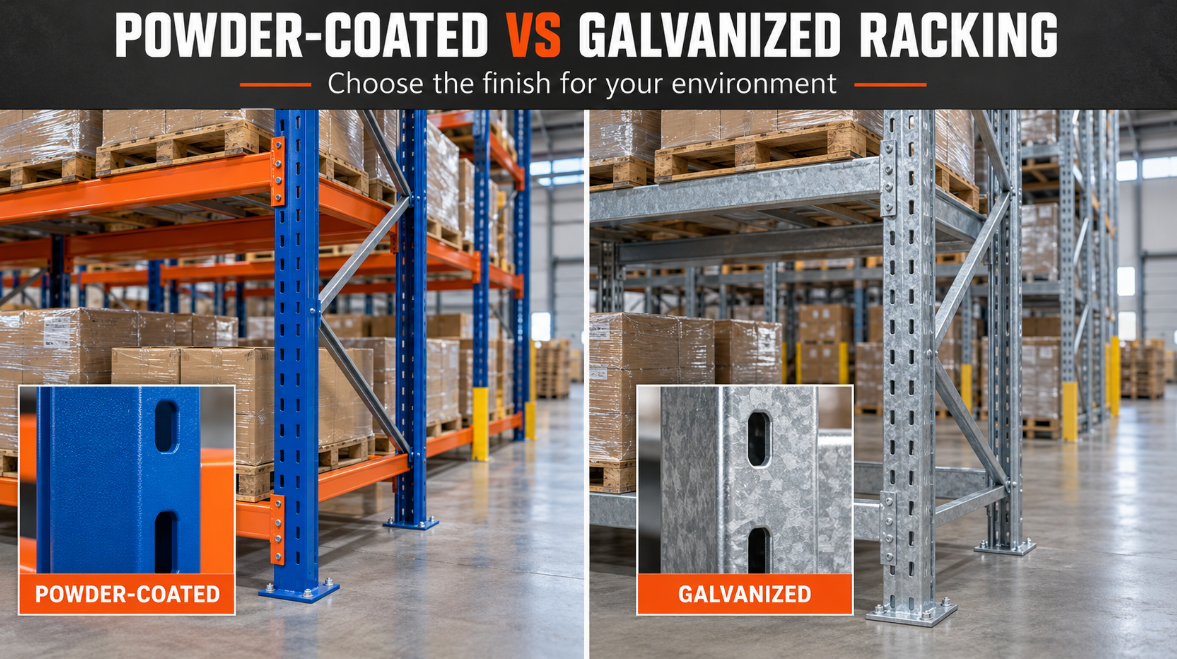
Choosing between powder-coated and galvanized racking is not simply a matter of appearance. The correct finish depends on moisture, salt or chemical exposure, risk of scratching and expected maintenance.
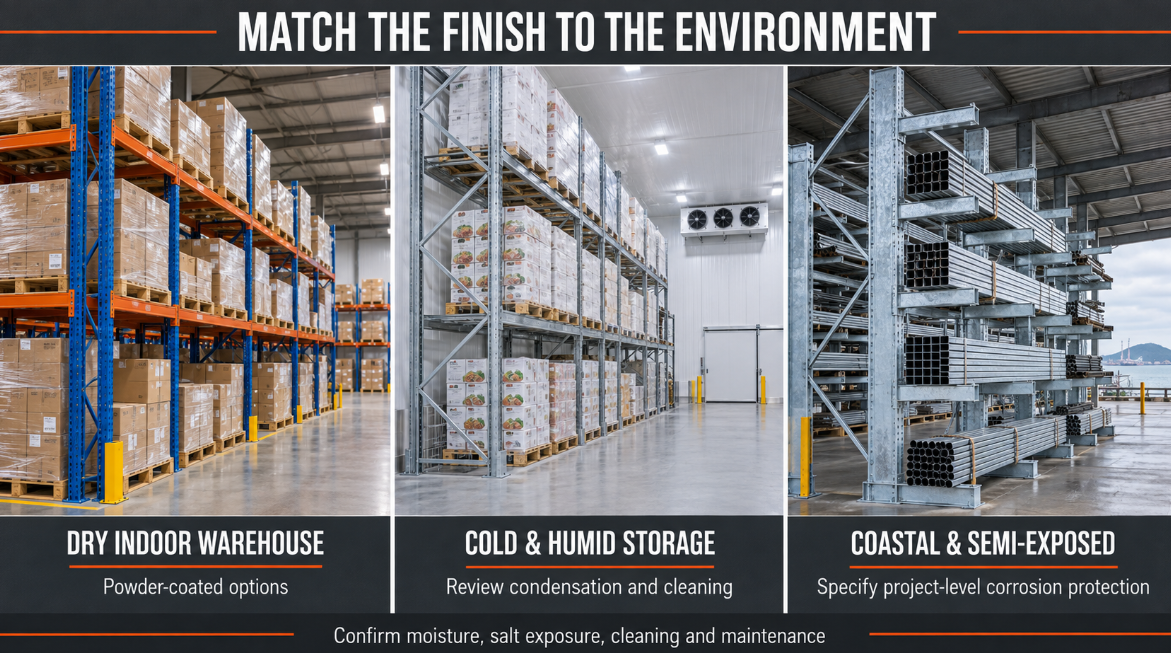
For a clean, dry indoor warehouse, a properly pretreated and powder-coated steel rack is usually the more practical and economical choice. For outdoor, coastal, washdown or persistently damp environments, galvanized steel often provides more robust corrosion protection. In particularly aggressive conditions, buyers may need a duplex system—powder coating over galvanized steel—or a suitable stainless steel grade.
This guide helps warehouse owners, distributors and project buyers specify the right finish instead of relying on vague “anti-rust” claims.
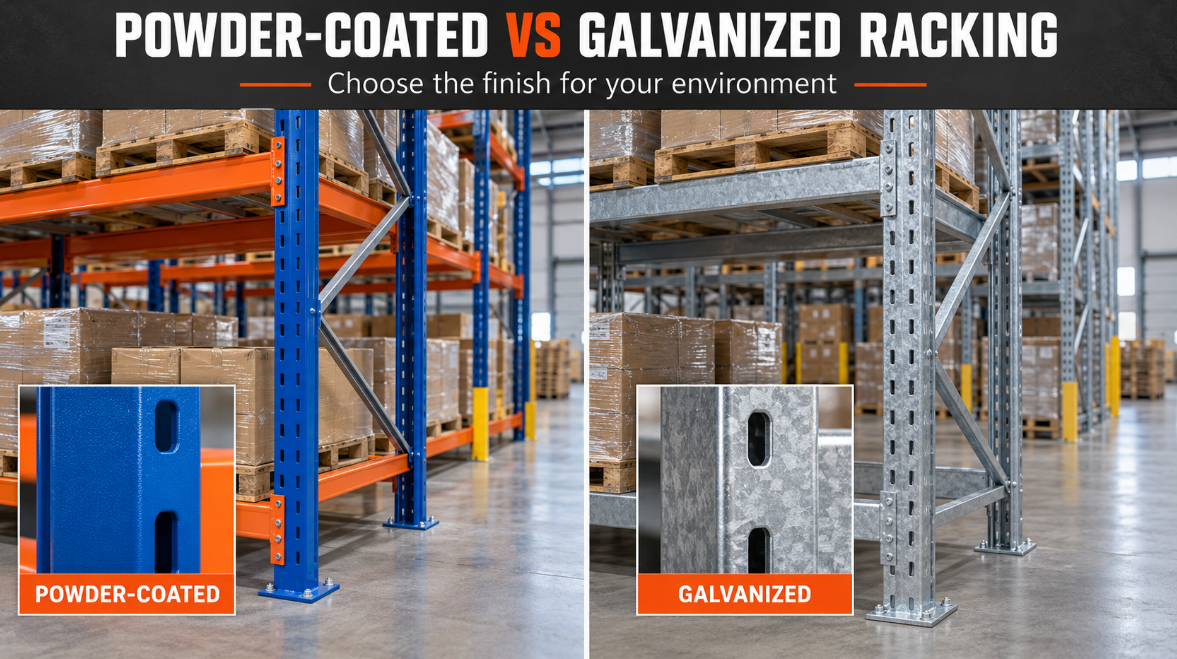
Quick Comparison: Powder-Coated vs Galvanized Racking
| Factor | Powder-Coated Carbon Steel | Galvanized Steel |
|---|---|---|
| Protection method | An organic coating creates a barrier between steel and the environment | Zinc provides both barrier and sacrificial protection |
| Appearance | Smooth finish with a wide choice of colors | Metallic silver or gray; appearance can vary |
| Best fit | Dry indoor warehouses, workshops, retail storage and general industrial use | Humid, cold, semi-exposed, outdoor or more corrosive locations |
| Scratch behavior | A deep scratch can expose carbon steel and allow localized rust | Surrounding zinc can help protect small exposed areas sacrificially |
| Color coding | Easy to specify by project or brand color | Limited unless an additional topcoat is applied |
| Surface uniformity | Usually smoother and more decorative | May show runs, roughness, drainage marks or color variation, depending on the process |
| Fabrication impact | Components are normally fabricated before pretreatment and coating | The result depends on whether steel is galvanized before or after fabrication |
| Typical initial cost | Often lower for standard indoor rack production | Commonly higher, especially for after-fabrication hot-dip galvanizing |
| Maintenance decision | Inspect and repair chips before corrosion spreads | Inspect zinc loss, damaged areas, cut edges and repaired welds |
These are general differences, not guaranteed performance levels. Coating quality, zinc thickness, component geometry, workmanship and the actual environment all affect service life.
What Is Powder-Coated Racking?
Powder coating is a dry finishing process. Electrically charged powder particles are sprayed onto prepared steel components and then heated until they melt, flow and cure into a continuous protective film.
The coating acts as a barrier against moisture, oxygen and contaminants while providing a clean, consistent finish. The Powder Coating Institute notes that powder-coated products can resist impact, moisture, chemicals and ultraviolet exposure, although performance depends on the selected system and environment. Powder Coating Institute: What Is Powder Coating?
“Powder-coated” does not define a complete specification. Buyers should ask about:
Surface cleaning and pretreatment
Conversion coating or phosphating
Powder chemistry and intended environment
Target dry-film thickness
Oven temperature and curing time
Coverage around holes, welds, corners and edges
Adhesion, impact and corrosion-test requirements
Pretreatment is critical because a clean surface and suitable conversion coating improve adhesion and corrosion resistance. IGP Powder Coatings: Pretreatment of Metals
Advantages of Powder-Coated Racking
1. Color flexibility
Buyers can specify colors for branding, warehouse zones or safety identification.
2. Smooth indoor finish
Powder coating creates a clean surface suited to warehouses, workshops, retail storage and customer-facing facilities.
3. Efficient repeat production
It works well for production of uprights, beams, shelves and accessories and is widely used for medium-duty steel shelving and indoor warehouse pallet racking.
4. Practical indoor cost
In a dry warehouse, a correctly specified system balances cost, appearance and corrosion resistance.
Limitations of Powder-Coated Racking
Powder coating does not make carbon steel rustproof. A deep scratch can expose the substrate, while poor adhesion may allow corrosion to spread beneath the film. Risk also increases at edges, bolt holes, welds and feet in contact with wet floors. Standard indoor powder may be unsuitable for constant condensation, salt, chemical cleaning or outdoor weather.
For a deeper explanation, see KAYOU’s guide: Does Powder-Coated Steel Shelving Rust?
What Is Galvanized Racking?
Galvanizing protects steel with zinc. Besides acting as a barrier, zinc provides sacrificial protection and can help protect small exposed areas of adjacent steel. AGA: Corrosion Protection
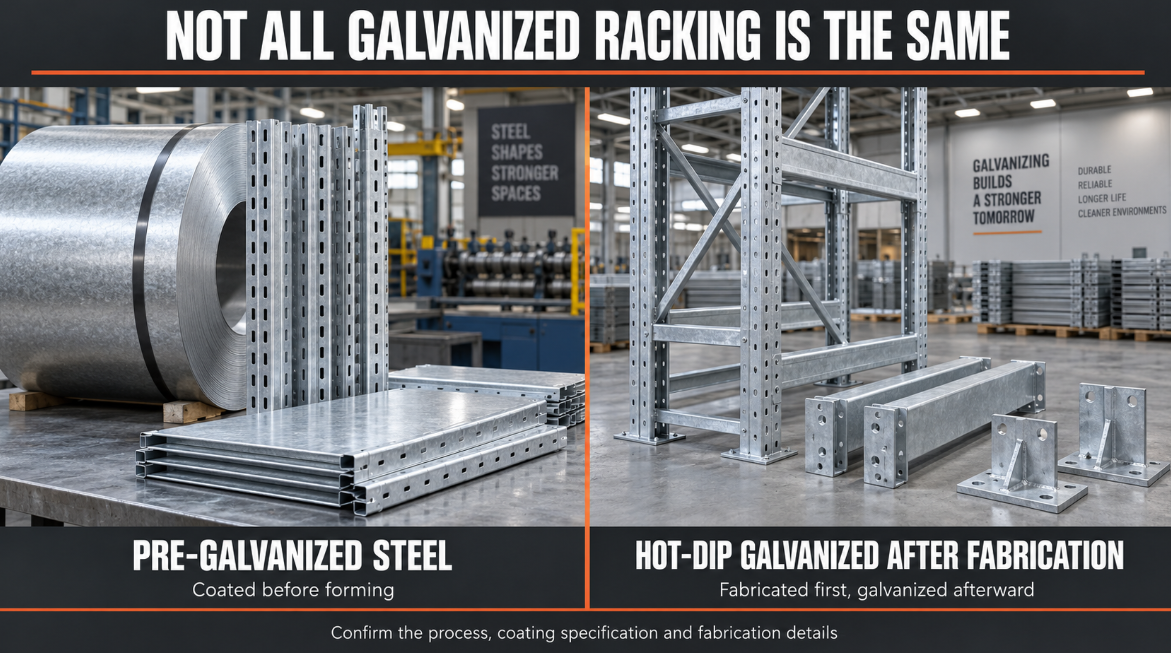
But “galvanized racking” is not a complete specification. Two products with that description may use very different processes.
Continuously galvanized or pre-galvanized steel
Steel sheet or coil is zinc-coated before it is formed, punched, cut or assembled. It provides uniform sheet coating and good formability, but buyers must check cut edges, holes and welded zones because later fabrication can disturb local coverage. AGA: Continuous Sheet Galvanizing
Hot-dip galvanized after fabrication
The component is fabricated first and then immersed in cleaning solutions, flux and molten zinc. This can cover edges, welded areas and accessible internal surfaces. ASTM A123/A123M covers general requirements for this type of coating. ASTM A123/A123M-24
Hollow sections need suitable vent and drain holes. Poor drainage design can cause bare areas, excessive zinc build-up or appearance problems. AGA: Venting and Drainage
Advantages of Galvanized Racking
1. Better tolerance of small damage
Protection does not depend only on an intact surface film because zinc can protect small exposed areas sacrificially.
2. Better fit for wet exposure
Galvanized racking is often considered for cold rooms, humid warehouses, covered outdoor storage and locations with frequent condensation.
3. Less emphasis on decorative maintenance
The zinc may continue protecting steel even when its metallic appearance changes.
4. Coverage after fabrication
Batch galvanizing can protect edges, welds and accessible interior surfaces when components are designed correctly for the process.
Limitations of Galvanized Racking
Galvanizing is not automatically the correct choice for every rack.
The metallic surface may not provide the color or smooth appearance required for retail, office or branded facilities.
Hot-dip galvanized appearance can vary between parts without necessarily indicating poor protection.
Zinc build-up may affect close-tolerance holes, slots, threads or interlocking connectors unless allowances and post-processing are planned.
Thin, asymmetric or mixed-thickness fabrications require attention to distortion risk during hot-dip galvanizing.
Pre-galvanized components require special attention at cuts and welds.
Zinc can be attacked by some strongly acidic or alkaline chemicals, so “galvanized” does not mean universally chemical-resistant.
For adjustable racking, dimensional fit and connector operation must be checked after the selected finishing process—not assumed from the uncoated prototype.
Which Finish Should You Choose?
Choose powder-coated racking when:
The rack will be used in a dry indoor warehouse
Color matching or safety color coding is important
A smooth, uniform appearance is preferred
The site has limited condensation and no regular washdown
The buyer wants a cost-effective finish for standard industrial storage
Damage can be inspected and repaired as part of routine maintenance
Choose galvanized racking when:
The environment is humid, damp or subject to frequent condensation
The rack may be installed in a cold room or semi-exposed area
Scratches and abrasive handling are more likely
A metallic industrial appearance is acceptable
Longer-term corrosion protection is more important than custom color
The process, zinc coating specification and post-fabrication details are clearly defined
Consider stainless steel when:
The rack is exposed to frequent washdown or strict hygiene requirements
Food, pharmaceutical, laboratory or clean processing conditions apply
The environment contains chemicals incompatible with zinc or the proposed powder system
The project requires a corrosion-resistant material rather than a coating over carbon steel
What About Powder Coating Over Galvanized Steel?
A duplex system combines galvanizing with a powder topcoat. The powder provides color and an additional barrier, while zinc remains underneath for further protection.
It can suit coastal, outdoor or color-coded projects, but powder must not simply be sprayed onto untreated galvanized steel. ASTM D7803 addresses preparation of hot-dip galvanized surfaces for powder coating. AGA: Preparing HDG for Powder Coating
It adds cost and inspection requirements and should be selected only when the exposure justifies it.
Do Not Compare Finishes by Salt-Spray Hours Alone
Salt-spray hours can help compare defined coating systems under the same laboratory method, but they do not universally predict service life.
Before comparing results, confirm:
Test standard and edition
Substrate and pretreatment
Powder or zinc specification
Film or zinc thickness
Whether the test panel had a scribe
Evaluation criteria for red rust, blistering and underfilm creep
A flat test panel does not reproduce every edge, weld, slot and water trap on a finished rack.
What Buyers Should Put in the RFQ
Instead of writing only “anti-rust finish,” provide:
Indoor, outdoor, cold-room or covered-exterior location
Expected temperature and humidity range
Condensation, salt, chemical or washdown exposure
Required color and appearance
Rack dimensions, loading and component configuration
Preferred galvanizing method, if already specified
Required coating or zinc thickness and test method
Cut-edge, hole, thread and weld-repair requirements
Inspection and acceptance criteria
For powder coating, request process and curing controls. For galvanized racking, confirm the applicable standard, zinc thickness, repair method and whether coating occurs before or after fabrication.
How KAYOU Helps Select a Racking Finish
KAYOU supplies customizable warehouse racking systems and industrial storage shelving for global B2B projects. The finish can be evaluated together with the rack structure, loading, warehouse environment, shipping method and installation conditions.
Depending on the project, KAYOU can discuss powder-coated, galvanized or alternative material solutions and prepare a quotation based on the confirmed specification. Final availability and performance requirements should be agreed before production because different rack components and fabrication methods may require different finishing routes.
Frequently Asked Questions
Is galvanized racking always better than powder-coated racking?
No. Galvanized racking usually offers an advantage in humid or exposed conditions, but powder-coated racking can be more economical, smoother and easier to color-code for dry indoor warehouses. The better choice is the one matched to the environment and verified specification.
Can powder-coated racking be used in a cold room?
Possibly, but the decision should consider condensation, cleaning, temperature cycling, coating damage and required maintenance. Standard indoor powder coating should not automatically be assumed suitable for every freezer or cold-storage project.
Is pre-galvanized steel the same as hot-dip galvanized after fabrication?
No. Pre-galvanized sheet is coated before cutting and forming. Batch hot-dip galvanized components are fabricated first and immersed afterward. Coating thickness, abrasion resistance and coverage of cuts, welds and internal surfaces can differ.
Can galvanized racks be powder-coated in a custom color?
Yes. This is a duplex system, but the galvanized surface must be prepared specifically for powder-coating adhesion. The galvanizer, fabricator and coating supplier should coordinate the process before production.
What is the best finish for coastal warehouse racking?
Coastal salt exposure requires a project-specific corrosion assessment. Depending on whether the rack is indoors, sheltered or directly exposed, the solution may involve hot-dip galvanizing, a duplex system, specialized coating or an appropriate stainless steel grade.
Final Recommendation
Use powder-coated racking for normal dry indoor storage when appearance, color choice and cost efficiency are priorities. Consider galvanized racking when moisture, condensation, abrasion or outdoor exposure creates a higher corrosion risk. For severe exposure, evaluate a duplex system or stainless steel rather than relying on an undefined “anti-rust” claim.
The safest purchasing decision is based on the complete system: environment, steel preparation, coating or zinc process, thickness, fabrication details, inspection and maintenance.
Need Help Selecting the Right Racking Finish?
Send KAYOU your warehouse location, indoor or outdoor conditions, temperature, humidity, stored goods, rack dimensions, load capacity, quantity and destination.
Our team can help evaluate a suitable racking structure and surface-treatment option for your project.