
Does Powder-Coated Steel Shelving Rust?
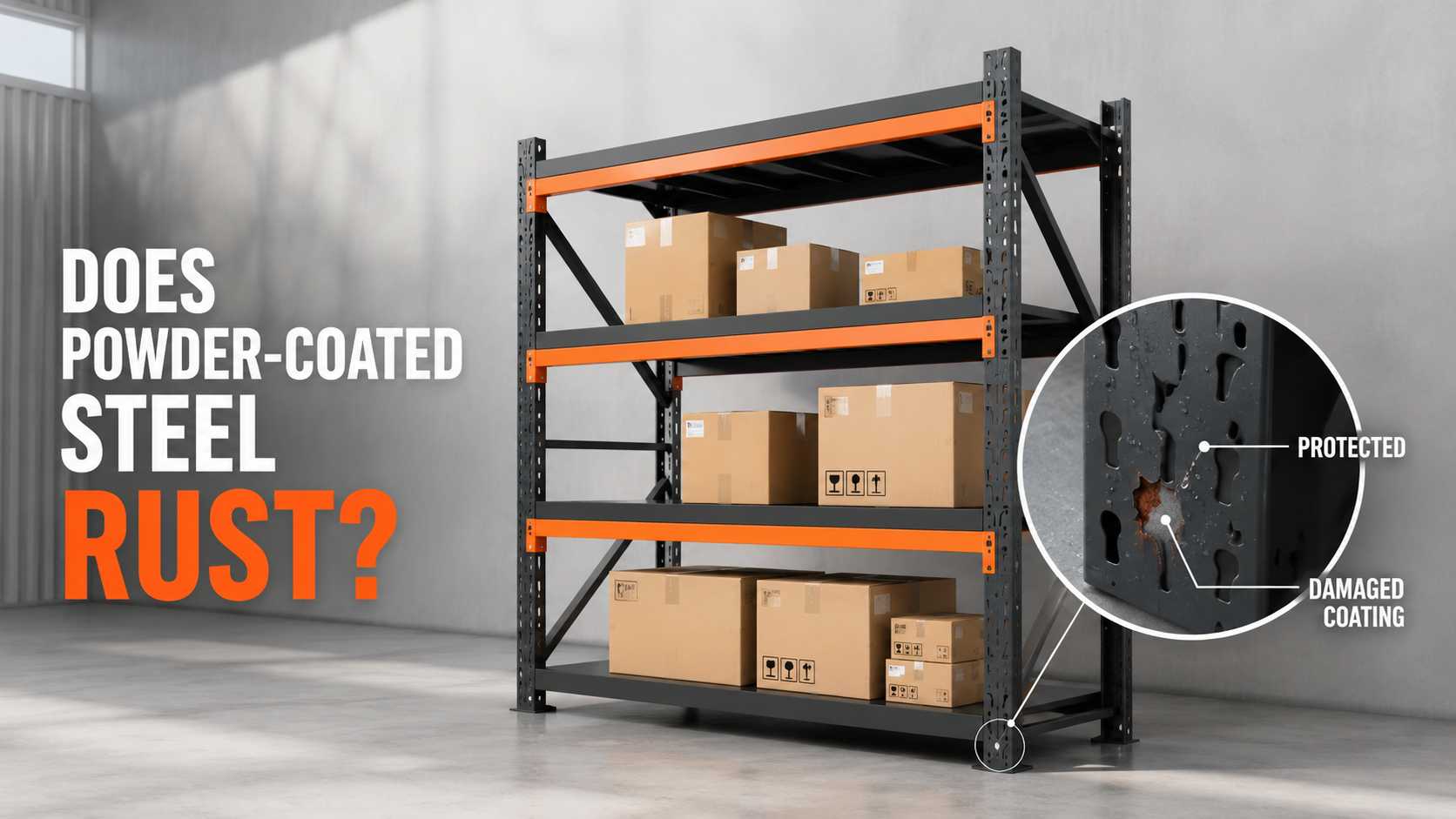
Yes, powder-coated steel shelving can rust, but a correctly prepared and properly coated shelving system can provide reliable corrosion resistance for many indoor warehouse, stockroom, workshop and garage applications. Powder coating forms a protective barrier over the steel; it does not permanently change ordinary carbon steel into a rustproof material.
Rust can begin when moisture and oxygen reach the steel through a scratch, chip, thin area, poorly covered edge or manufacturing defect. It can also develop beneath an apparently intact finish when surface preparation or coating adhesion is inadequate. Humidity, condensation, salt, cleaning chemicals and prolonged water exposure can accelerate the process.
The practical question for a buyer is therefore not simply, “Is the shelving powder-coated?” A more useful question is:
Is the complete coating system suitable for the actual storage environment, and how will its quality be verified?
This guide explains how powder coating protects steel shelving, why rust sometimes appears, how buyers can compare corrosion-protection options and what maintenance helps extend service life.
Quick Answer: When Is Powder-Coated Shelving Likely to Rust?
| Condition | Relative rust risk | What it means for the buyer |
|---|---|---|
| Dry, clean indoor warehouse with intact coating | Low | Standard powder-coated shelving is usually a practical choice when manufactured and maintained correctly |
| Indoor stockroom with occasional humidity | Low to moderate | Specify good pretreatment, full edge coverage and routine inspection |
| Garage or workshop with condensation, wet tools or chemical splashes | Moderate | Confirm the operating environment and request an upgraded coating specification if necessary |
| Cold room, washdown zone or continuously damp area | High | Standard indoor powder coating may be insufficient; consider a specialized system or stainless steel |
| Coastal, salt-laden or exposed outdoor location | High to very high | Use a project-specific corrosion-protection system, galvanized-plus-powder-coated steel or a suitable stainless steel grade |
| Coating is scratched through to bare steel | Localized high risk | Repair the damaged area promptly before corrosion spreads beneath the coating |
These categories are general planning guidance. Actual performance depends on the steel, component geometry, pretreatment, powder chemistry, film thickness, curing, exposure conditions and maintenance.
How Does Powder Coating Protect Steel Shelving?
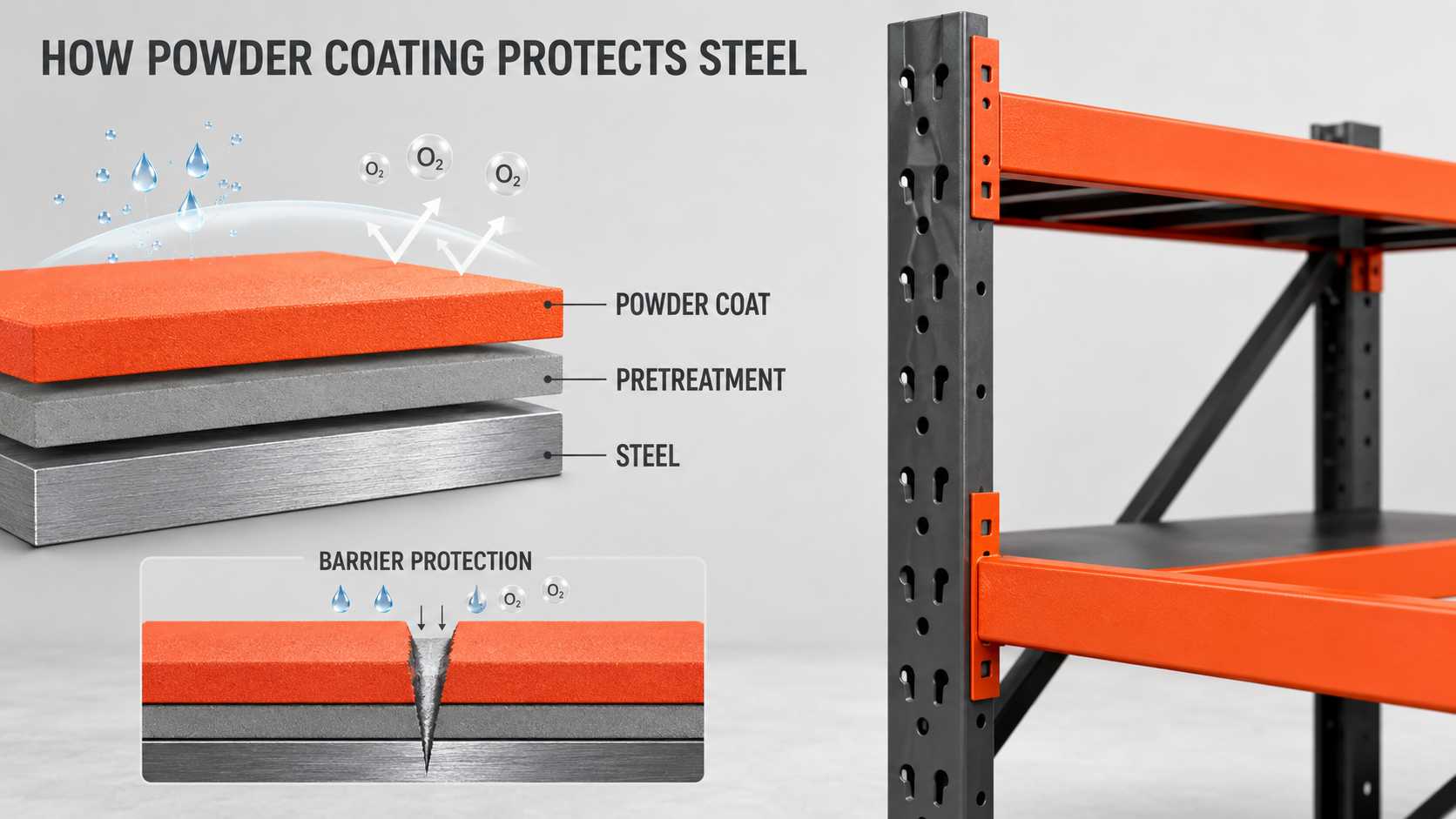
Powder coating is a dry finishing process. Electrically charged powder particles are applied to a prepared metal surface and then heated so that they melt, flow and cure into a continuous film.
The cured coating helps protect steel in three main ways:
Barrier protection: It separates the steel from water, oxygen, dirt and many everyday contaminants.
Surface durability: A suitable cured powder finish can resist normal handling, abrasion and minor impacts better than many basic wet-paint finishes.
Easy maintenance: The smooth surface is easier to wipe clean, reducing the time that moisture and contaminants remain on the shelving.
However, the powder layer is only one part of the protective system. The metal surface must first be cleaned and pretreated so that the coating can adhere and resist under-film corrosion. The Powder Coating Institute defines pretreatment as preparation performed before powder application to improve adhesion and corrosion resistance.
A high-quality powder applied over oil, rust, scale, welding residue or poorly rinsed pretreatment can still fail. For this reason, experienced buyers evaluate the complete process, not only the final color or gloss.
Powder-Coated Does Not Mean Permanently Rustproof
The terms rust-resistant, corrosion-resistant and rustproof are often used as if they mean the same thing. They do not.
Rust-resistant means the product is designed to slow or reduce rust formation under specified conditions.
Corrosion-resistant is a broader term that describes resistance to environmental or chemical attack.
Rustproof suggests that rust cannot occur. This is generally an inappropriate promise for ordinary powder-coated carbon-steel shelving.
Even a well-finished rack may eventually corrode if it is used outside its intended environment, remains wet for long periods or suffers coating damage. Responsible product specifications should describe the intended use and confirmed performance rather than promise unlimited protection.
KAYOU medium duty steel shelving uses surface pretreatment followed by electrostatic powder coating for normal indoor storage applications. The finish improves corrosion resistance and makes the shelving easier to clean, but the required protection should be upgraded when the site is humid, coastal, chemically aggressive or frequently wet.
Nine Reasons Powder-Coated Steel Shelving Can Rust
1. Scratches and chips expose bare steel
The most obvious cause is mechanical damage. Shelving components can be scratched during transport, assembly, stock handling or contact with tools and trolleys. A deep scratch that reaches the substrate creates a path for water and oxygen.
Damage commonly appears on:
Front beam edges
Upright corners
Shelf-panel edges
Bolt holes and connection points
Feet near the floor
Areas hit by carts, pallets or stored metal parts
A small chip does not necessarily mean the entire coating system has failed. It does mean the exposed area should be cleaned and repaired before rust spreads under the surrounding film.
2. Surface preparation was incomplete
Steel arrives with oil, dust, oxide, fingerprints and processing residues. Welding and grinding add further contamination. If these materials remain beneath the coating, adhesion and corrosion resistance may be reduced.
A suitable process can include degreasing, rinsing, conversion treatment and controlled drying. The exact sequence should match the substrate and required performance. For demanding steel applications, the Powder Coating Institute notes that different pretreatments can provide different performance levels.
Buyers should not judge pretreatment only by the number of stages in a marketing description. Chemical concentration, temperature, contact time, water quality, rinsing, bath maintenance and drying are also important.
3. Coating thickness is uneven or insufficient
Powder must reach flat surfaces, corners, recesses, holes, welds and complex connections. Electrostatic effects can make some recessed areas more difficult to coat uniformly. If the protective film is too thin in one location, that point may become the first corrosion site.
More coating is not automatically better. Excessive film thickness can create its own appearance, fit or curing problems. The correct approach is to define a target range suitable for the powder supplier's technical data and component design, then verify representative areas.
There is no single coating thickness that is correct for every shelf. Buyers should ask the manufacturer to state the agreed thickness range rather than copying an arbitrary value from a different product.
4. The powder was not cured correctly
Powder coating must reach the required metal temperature for the required time. An oven air-temperature reading alone does not prove that a thick or densely loaded steel component reached the necessary cure condition.
Under-curing can reduce adhesion, hardness, chemical resistance and long-term performance. Excessive heat can also affect color or coating properties. Production control should follow the powder supplier's cure schedule and, when necessary, use part-temperature profiling rather than relying only on the oven setting.
5. Edges, holes, welds and cut ends receive less protection
Sharp edges tend to have lower film build than broad flat surfaces. Laser-cut holes, sheared edges, weld seams, drainage points and tube ends can therefore become early corrosion locations.
Good design and manufacturing practices may include:
Removing scale, slag and sharp burrs
Smoothing critical edges
Providing suitable drainage and venting
Avoiding water traps
Coating components after cutting and welding whenever practical
Sealing or protecting exposed tube ends where required
Inspecting hard-to-reach areas separately from flat panels
When shelving is modified on site, newly drilled or cut surfaces must be protected. Otherwise, the factory coating may remain perfect while the field-cut edge starts to rust.
6. Condensation keeps the steel wet
A warehouse can be indoors and still be corrosive. Condensation forms when humid air contacts a cooler surface. This is common near external doors, uninsulated roofs, cold-room entrances and locations with large day-to-night temperature changes.
Repeated wetting and drying can be more damaging than buyers expect, especially around shelf feet, overlaps and joints where water remains longer. Improve ventilation, control humidity, repair roof leaks and keep shelving away from persistent sources of condensation when possible.
7. Salt and chemicals accelerate corrosion
Chloride salts from coastal air, winter road residue or process materials can remain on a shelf after the visible water evaporates. Some cleaning chemicals, acids, alkalis, fertilizers, batteries and industrial products can also attack the coating or the steel beneath it.
Do not assume that a finish suitable for ordinary cartons is also suitable for chemical storage. Tell the manufacturer which substances may contact the rack, including cleaning products and accidental spills.
8. Water is trapped at the floor or between components
Shelf feet are vulnerable when floors are washed, drainage is poor or water collects around the uprights. Tight overlaps, unsealed joints and cartons placed directly against wet panels can also retain moisture.
Operational controls may include:
Keeping floors dry and repairing leaks
Allowing airflow around shelving
Using appropriate feet, plinths or spacers when the design permits
Avoiding direct contact with corrosive floor-cleaning residues
Removing wet cartons promptly
The structural and anchoring requirements must still be respected. Do not place improvised pads under an anchored rack without approval.
9. The coating system does not match the environment
An indoor-grade powder-coated shelf may perform well in a dry distribution center but poorly in an open coastal shed. The environment, not the product name, determines the protection required.
ISO 12944-2 classifies atmospheric environments by corrosivity and identifies environmental exposure as a key factor in selecting protective systems. Although ordinary shelving is not automatically specified under ISO 12944, the principle is useful: define the exposure before selecting the finish.
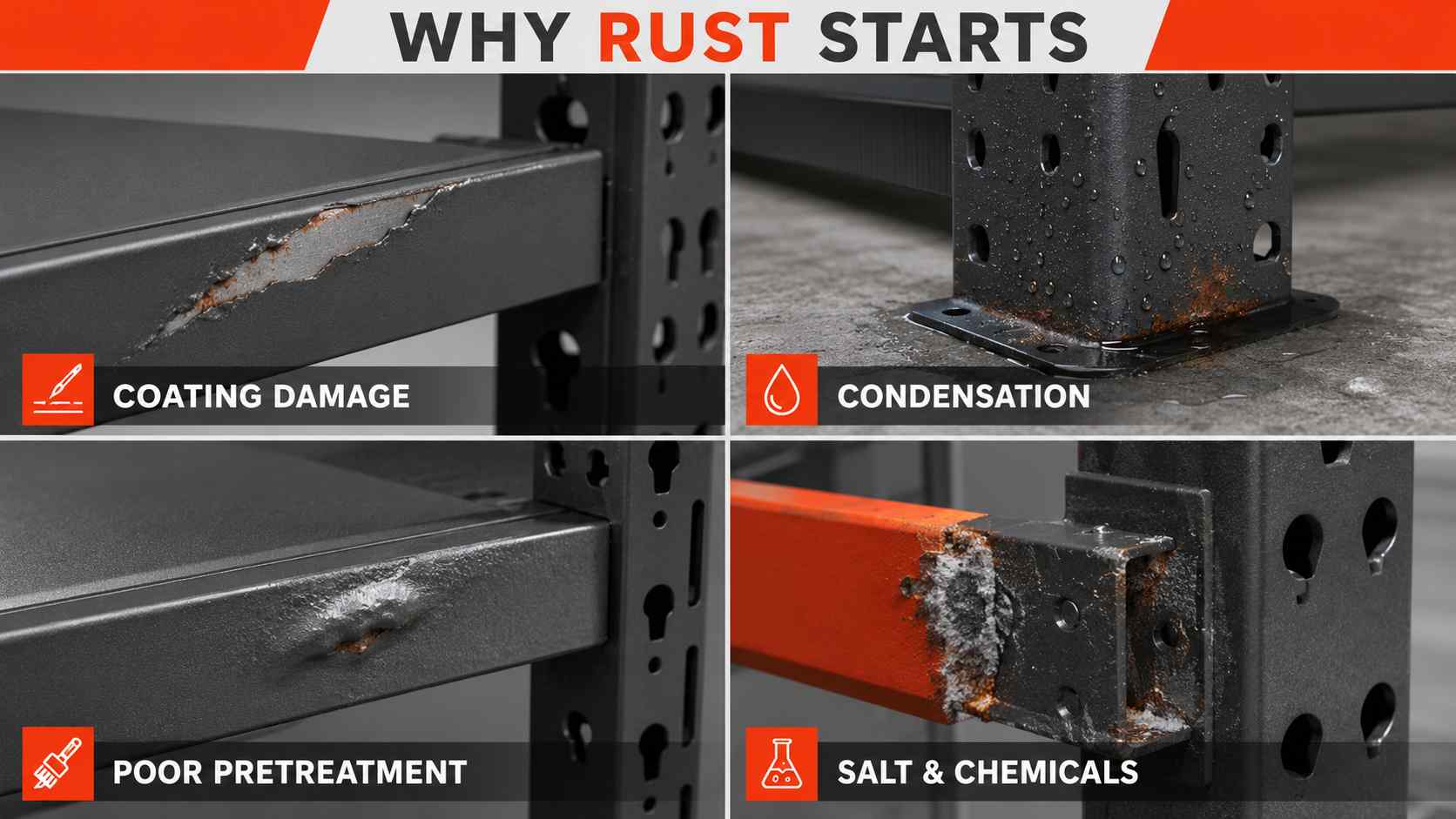
Early Signs of Corrosion to Watch For
Rust is easier to control when detected early. During regular inspections, look for:
Orange or brown specks at scratches, holes and edges
Rust-colored streaks emerging from joints
Blistering or bubbling beneath the coating
Flaking, peeling or loss of adhesion
White deposits or staining from chemical or salt exposure
Persistent moisture around the base of uprights
Swelling or deformation caused by trapped corrosion products
Structural section loss, pitting or cracked connections
Not every stain is rust. Dirt, carton dye and transferred metal particles can resemble corrosion. Clean a small area using an approved mild method and inspect it again. If rust appears beneath the coating or a load-bearing component has material loss, isolate the affected area and obtain a professional assessment.
Which Shelving Finish Is Suitable for Each Environment?
| Storage environment | Typical exposure | Practical starting point | Important qualification |
| Heated, dry indoor warehouse | Cartons, tools and general merchandise; low condensation | Properly pretreated powder-coated carbon steel | Inspect impact zones and keep floors dry |
| Retail stockroom or office storage | Clean indoor air and light handling | Powder-coated steel | Standard indoor system is generally appropriate |
| Normal indoor garage or workshop | Occasional humidity, oils and handling damage | Durable powder-coated steel with good pretreatment | Declare chemical splashes and condensation risk |
| Humid warehouse | High relative humidity or seasonal condensation | Enhanced pretreatment and project-specific powder system | Test requirements should be agreed before production |
| Cold room or washdown area | Condensation, frequent cleaning or persistent moisture | Suitable stainless steel or a specialist coated/galvanized system | Hygiene, temperature and chemicals must be reviewed together |
| Coastal or salt-laden indoor site | Airborne chlorides and persistent humidity | Duplex galvanized-and-coated system or suitable stainless steel | Distance from coast alone does not define exposure |
| Outdoor covered storage | Rain ingress, ultraviolet light and condensation | Exterior-grade, project-specific protection | Confirm powder chemistry, drainage and maintenance plan |
| Fully exposed outdoor or aggressive chemical area | Direct weather, salts or chemicals | Engineered corrosion-protection system, often galvanized or stainless | Standard indoor shelving should not be substituted |
The table is a purchasing guide, not a universal engineering specification. Confirm the substrate, coating system, expected life, maintenance and local requirements for the actual project.
Powder-Coated Steel vs Galvanized Steel vs Stainless Steel
| Material or finish | Main corrosion-protection method | Key advantages | Main limitations | Common shelving use |
| Powder-coated carbon steel | Organic barrier coating over pretreated steel | Good appearance, wide color choice, smooth finish and cost efficiency | Local damage can expose carbon steel; system must match the environment | Dry indoor warehouses, stockrooms, garages and workshops |
| Galvanized steel | Zinc layer provides barrier and sacrificial protection | Better tolerance of local scratches and humid conditions than basic painted steel | Appearance and edge protection depend on the galvanizing method; chemicals can still attack zinc | Humid storage, industrial applications and some semi-exposed areas |
| Galvanized plus powder-coated steel | Zinc protection combined with an organic top layer | Enhanced protection, color and appearance when the systems are compatible | More process control and cost; trapped gases and adhesion need proper management | Coastal, humid or higher-specification projects |
| Stainless steel | Alloy composition forms a passive protective surface | Strong corrosion resistance and easy cleaning with no paint film to chip | Higher cost; grade selection still matters, and stainless steel is not immune to every chloride or chemical | Kitchens, cold rooms, laboratories, food processing and wet areas |
The cheapest initial finish is not always the lowest life-cycle-cost option. A dry warehouse may not benefit economically from stainless steel, while standard indoor powder coating may create avoidable replacement costs in a continuously wet or salt-laden environment.
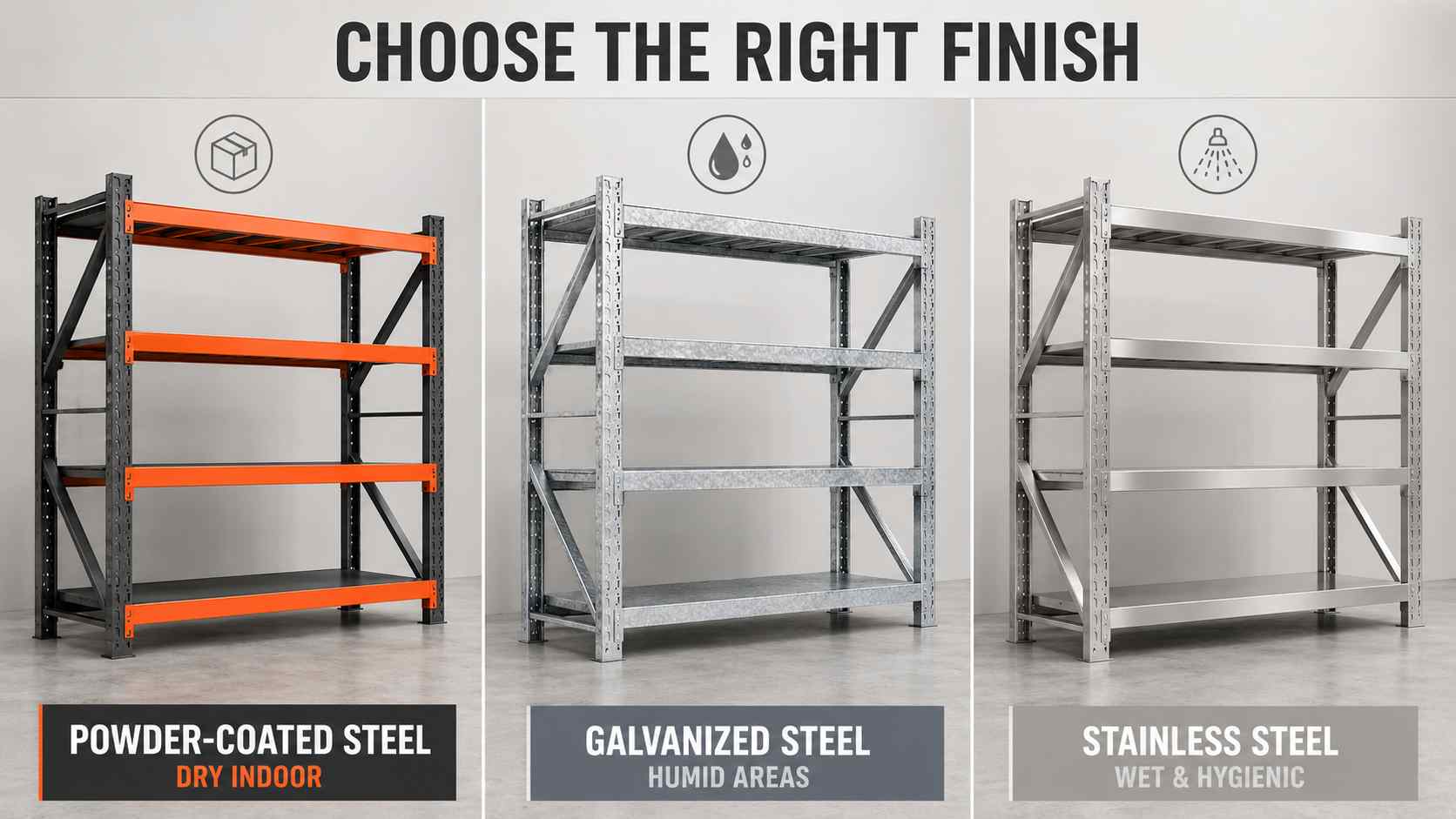
Does Powder Type Matter?
Yes. Powder coatings use different resin chemistries, and their suitability varies.
Epoxy powders can provide strong adhesion and chemical resistance but generally have limited ultraviolet weathering performance.
Polyester powders are widely used where better exterior color and weather resistance are required.
Hybrid powders balance properties for many interior applications.
Specialized systems may be formulated for enhanced corrosion, chemical, antimicrobial or weathering performance.
Resin name alone does not guarantee the result. Pretreatment, film continuity, cure, component geometry and exposure still control performance. Ask the manufacturer to identify whether the selected powder is intended for interior or exterior use and to follow the coating supplier's technical instructions.
Color is not a reliable indicator of corrosion resistance. Black, white, blue and orange versions can perform similarly when they use the same properly applied coating system. Conversely, two shelves with the same color may have very different pretreatment and coating quality.
How B2B Buyers Can Verify Coating Quality
1. Define the environment in the RFQ
Provide more than “indoor” or “outdoor.” State:
Country and installation location
Indoor, covered outdoor or fully exposed use
Temperature and relative humidity range
Condensation or washdown frequency
Distance from saltwater and exposure to road salt
Chemicals, cleaners, oils or food products present
Required design life and maintenance conditions
Applicable customer, industry or project standard
Without this information, a manufacturer may quote a standard indoor finish that does not meet the real application.
2. Request a written coating specification
The quotation or technical data sheet should identify, as applicable:
Steel substrate
Cleaning and pretreatment route
Powder manufacturer or approved powder type
Interior or exterior formulation
Color and gloss range
Target cured film-thickness range
Cure-control method
Special edge, weld or cut-end treatment
Repair method for transport and installation damage
Avoid specifications that say only “anti-rust powder coating.” That phrase does not define a measurable performance level.
3. Agree on inspection and test methods
Tests should be selected according to the agreed application, not added as decorative certificate names.
Useful checks may include:
Visual inspection: coverage, color, gloss, craters, pinholes, dirt and mechanical damage
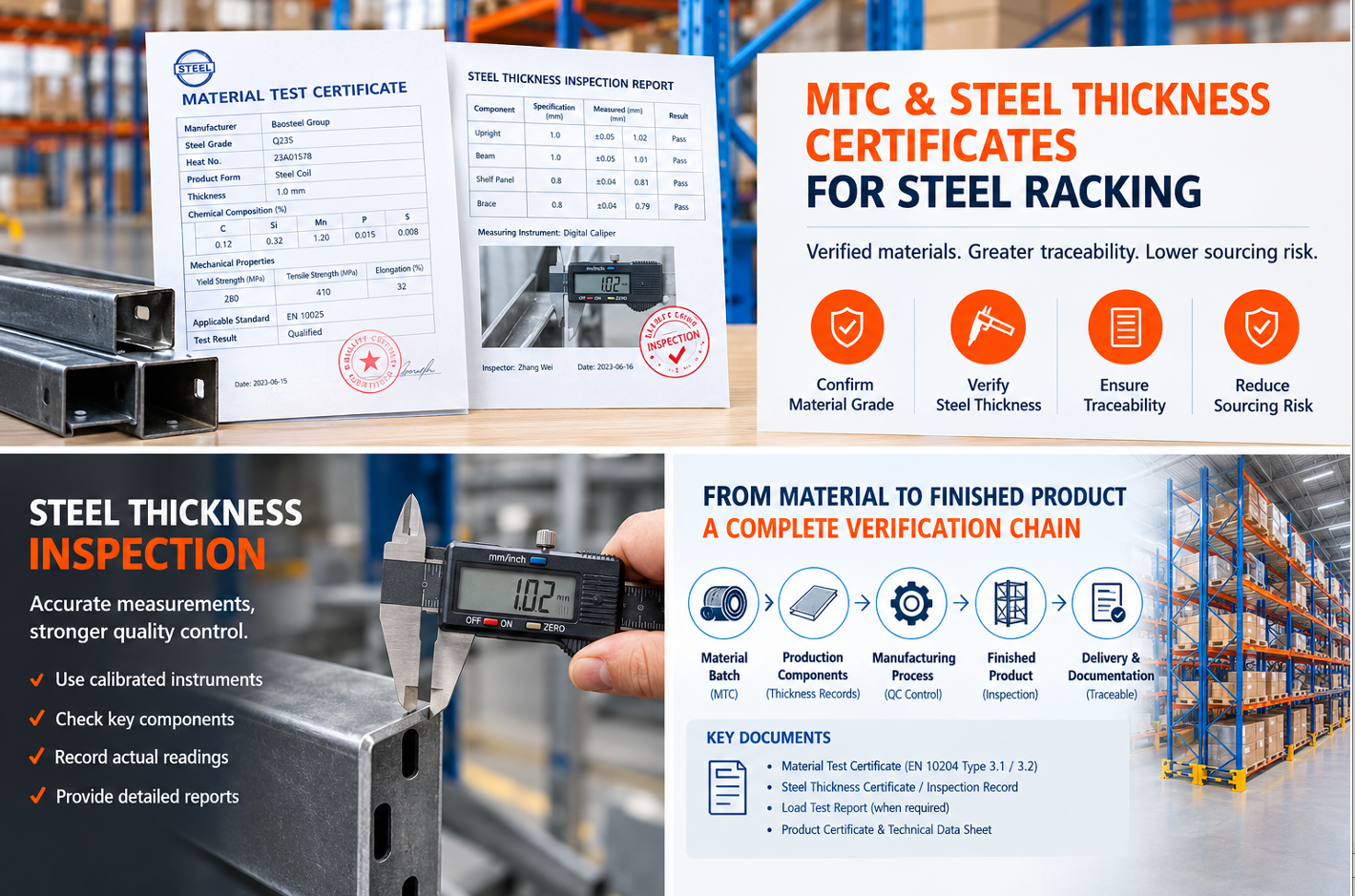
Dry film thickness: ASTM D7091 describes the use of magnetic and eddy-current gauges for nondestructive thickness measurement
Adhesion: ASTM D3359 evaluates whether coating adhesion is adequate for the user's application; ISO 2409 may also be specified where appropriate
Cure verification: a suitable method agreed with the powder supplier and manufacturer
Impact, hardness or bend performance: when relevant to the component and service conditions
Corrosion testing: neutral salt spray, cyclic corrosion or another method appropriate to the agreed specification
The sampling locations matter. A flat center panel may pass while edges and recesses remain under-protected. Include representative uprights, beams, panels, welds, holes and corners in the inspection plan.
4. Interpret salt-spray claims correctly
ASTM B117 defines the apparatus, procedure and conditions for a controlled salt-fog environment. It does not by itself define the correct exposure duration, specimen, acceptance criteria or interpretation for every shelving product. ASTM's own scope states that the practice does not prescribe the specimen, exposure period or result interpretation.
Therefore, a claim such as “500-hour salt spray” is incomplete unless the supplier also states:
Which standard and edition were used
The substrate and complete coating system tested
Whether the specimen was scribed
The exposure duration
How rust, blistering and corrosion creep were evaluated
The acceptance criteria
Whether the test panel represents current production
Laboratory hours should not be converted directly into a guaranteed number of years in service. Real warehouses have different wet-dry cycles, pollutants, temperatures, damage and maintenance.
5. Inspect packaging and transport protection
A good finish can be damaged before installation. Check that components are separated where necessary and protected from metal-to-metal rubbing. Packaging should manage moisture without trapping it for prolonged periods.
After delivery, inspect for dents, chips and wet packaging before signing off the goods. Photograph any damage and repair affected areas using the agreed procedure.
Maintenance: How to Keep Powder-Coated Shelving from Rusting
Keep the shelving dry
Repair roof leaks, prevent persistent condensation and remove wet cartons. Do not allow water to pool around upright bases.
Clean with a compatible mild method
Use a soft cloth and a mild cleaner suitable for the coating. Avoid steel wool, aggressive abrasives and unapproved solvents. Rinse away residues when required and dry the surface.
Remove salt and chemical contamination promptly
Airborne salts, battery residue, fertilizers and process chemicals can continue attacking the finish after a spill appears dry. Follow the site's safety data and cleaning procedure.
Inspect impact zones regularly
Front beams, aisle-facing uprights, shelf edges and feet receive the most damage. Inspection frequency should reflect traffic, exposure and the consequences of failure.
Repair coating damage early
For a small superficial chip, remove loose contamination and rust, prepare the area and apply the manufacturer-approved repair coating. A touch-up paint may not exactly reproduce the factory powder system, but a correct repair can restore local barrier protection.
Do not simply paint over active rust, moisture or loose coating. The repair will trap the problem rather than solve it.
Do not drill or cut without protecting the new edge
Site modifications expose bare steel and may also affect capacity or stability. Obtain structural approval before modifying a shelving component, then protect every approved cut or hole using the specified method.
Replace severely corroded structural components
If an upright, beam, connector or shelf support shows deep pitting, perforation, deformation or section loss, cosmetic touch-up is not sufficient. Unload and isolate the affected area, then ask the manufacturer or a competent professional whether the component must be replaced.
What Should You Do If Powder-Coated Shelving Has Already Rusted?
Use a risk-based response:
Unload or isolate the affected area if rust involves a load-bearing connection, upright or beam.
Identify the moisture or chemical source before repairing the finish.
Determine whether corrosion is superficial or structural. Light surface rust at a chip is different from deep pitting or rust beneath a large blistered area.
Remove loose rust and failed coating using an approved preparation method.
Apply a compatible repair system according to the manufacturer's instructions.
Replace the component when corrosion has reduced thickness, affected a connection or created uncertainty about capacity.
Inspect nearby components because the same exposure may have affected the rest of the row.
Never increase the load on a corroded rack based only on its original rating label. Its condition must be assessed first.
Common Purchasing Mistakes
Choosing by appearance alone
A smooth, glossy coating can still hide weak pretreatment or incomplete cure. Appearance inspection is necessary but not sufficient.
Treating every indoor warehouse as a dry environment
Open doors, uninsulated roofs, cold products and floor washing can create repeated condensation even when racks never see rain.
Comparing only coating thickness
Film thickness is one control point. A thick coating over contamination may perform worse than a correctly specified thinner system with sound pretreatment and cure.
Accepting an undefined salt-spray claim
Test hours without a standard, specimen description and acceptance criteria cannot support a fair comparison.
Assuming galvanized and stainless steel are interchangeable
Each option has different strengths, limits, appearance and cost. Select according to the environment and stored materials.
Ignoring damage during shipping and assembly
Corrosion may start at a packaging rub mark or unprotected site-drilled hole rather than from the original factory finish.
Powder-Coated Shelving RFQ Checklist
| RFQ item | Information to specify or request |
| Installation environment | Indoor, covered outdoor or exposed; temperature, humidity and condensation |
| Corrosive exposure | Salt, cleaning chemicals, process fumes, fertilizers, batteries, oils or washdown |
| Steel and construction | Material, component profiles, welds, holes, cut edges and enclosed sections |
| Pretreatment | Agreed cleaning and conversion-treatment process |
| Powder system | Resin type, interior/exterior suitability, color and gloss |
| Film thickness | Target cured range and measurement method |
| Cure control | Powder supplier's cure requirement and production-control method |
| Inspection | Visual coverage, edges, recesses, holes, welds and shipping damage |
| Testing | Agreed adhesion, thickness, corrosion or other relevant test methods and acceptance criteria |
| Packaging | Protection against rubbing, impact and trapped moisture |
| Maintenance | Cleaning, inspection and repair recommendations |
| Documentation | Approved technical data sheet, drawings, inspection records and test reports where required |
How KAYOU Approaches Powder-Coated Steel Shelving
KAYOU supplies configurable steel shelving for warehouses, factories, stockrooms, garages, workshops and commercial storage projects. Our standard powder-coated systems are designed primarily for normal indoor applications, while demanding environments should be discussed before the structure and finish are confirmed.
Depending on the project, buyers can request:
Customized shelf width, depth and height
Adjustable shelf levels
Load capacities configured for the final dimensions
Surface pretreatment and electrostatic powder coating
Custom color and gloss
Enhanced corrosion-protection requirements
Galvanized or stainless steel alternatives where appropriate
Coating-thickness and adhesion inspection
Technical drawings and project documentation
Export packaging designed to reduce transport damage
Visit KAYOU Quality Control to learn more about the manufacturing and inspection approach, or explore our storage shelving range.
Frequently Asked Questions
Is powder-coated steel shelving waterproof?
An intact coating can resist ordinary moisture, but powder-coated shelving should not automatically be described as waterproof. Joints, holes, scratches and thin edges can allow water to reach the steel, and prolonged immersion or standing water requires a different specification.
How long does powder-coated steel shelving last before rusting?
There is no universal service-life number. Performance depends on pretreatment, powder type, film quality, cure, component design, humidity, salt, chemicals, damage and maintenance. A dry indoor rack may remain in good condition for many years, while the same product can corrode much sooner in a wet coastal site.
Can powder-coated shelving be used outdoors?
Only when the complete system has been specified for outdoor exposure. Standard indoor powder may fade, chalk or lose protection under ultraviolet light and weather. Outdoor use requires suitable pretreatment, exterior-grade powder, drainage, edge protection and a maintenance plan; galvanized or stainless alternatives may be more appropriate.
Will one scratch make the whole shelf rust?
Not immediately. A scratch normally creates localized risk, but corrosion can spread beneath the surrounding coating if moisture remains. Clean and repair damage promptly and inspect nearby edges and connections.
Can rusty powder-coated shelving be repainted?
Minor surface corrosion may be repairable after loose coating and rust are properly removed and the substrate is prepared. Severely pitted or structurally weakened parts should be replaced rather than cosmetically repainted.
Is powder coating better than galvanizing for shelving?
Neither is universally better. Powder coating offers color, appearance and a smooth barrier finish. Galvanizing adds zinc protection and can be more tolerant of local damage. The correct choice depends on exposure, appearance, budget and required life.
Is stainless steel always rustproof?
No material is suitable for every chemical and environment. Stainless steel provides strong corrosion resistance, but the correct grade, fabrication and cleaning still matter—especially in chloride-rich conditions.
Does powder-coating color affect rust resistance?
Color alone is not a reliable indicator. Pretreatment, powder formulation, film thickness, cure and exposure have a much greater effect. Confirm the complete system rather than choosing by color.
Does a salt-spray test prove outdoor service life?
No. A salt-spray test is a controlled comparative test when the specimen, exposure and acceptance criteria are defined. Its hours should not be converted directly into years of real-world service.
What coating information should I send KAYOU?
Provide the installation location, indoor or outdoor exposure, temperature, humidity, condensation, salt, chemicals, cleaning method, required service life and any mandatory test standard. KAYOU can then recommend a more suitable material and finishing route.
Get a Corrosion-Resistant Shelving Recommendation
Send KAYOU your installation environment, stored products, required dimensions, load per level and expected order quantity. We can help compare powder-coated, galvanized and stainless steel options for your project.