

How to Audit a Steel Shelving Manufacturer in China: A Practical Guide for B2B Buyers
To audit a steel shelving manufacturer in China, verify the legal company first, then trace one actual shelving model from its approved drawing and bill of materials through raw steel, forming, welding, coating, assembly, load evidence, final inspection and export packaging. Judge the supplier by consistent, model-specific records and measurements—not by certificates, showroom samples or factory size alone.
For importers, distributors and warehouse project buyers, a factory audit is not simply a tour of machines. Its purpose is to answer four commercial questions:
Can this supplier manufacture the exact product it quoted?
Can it repeat the same specification throughout mass production?
Can it prove the stated load capacity and finish quality?
Can it deliver the correct quantity, packaging and documents on time?
This guide focuses on medium duty shelving, long span shelving, boltless steel shelving and other hand-loaded industrial shelving. Pallet racking, cantilever racking and mezzanine structures require additional project-specific engineering and may fall under different standards.

Why a Steel Shelving Factory Audit Matters
Two shelving quotations can show the same outside dimensions, number of levels and advertised load, yet describe very different products.
The differences may be hidden in:
Upright profile and developed section size
Actual steel thickness after forming
Beam height, geometry and connector design
Shelf-panel thickness and reinforcement
Clear beam span
Number and spacing of shelf levels
Bracing arrangement
Steel grade and material consistency
Pretreatment and powder-coating process
Load distribution used for rating
Packaging protection and loading quantity
A small reduction in thickness or reinforcement may lower price and shipping weight, but it can also change stiffness, deflection, stability and service life. That is why a professional audit compares the supplier's sales specification with physical components, controlled records and repeatable test evidence.
Start with a Fixed Technical Specification
Do not audit a vague product such as “a five-tier heavy duty shelf.” Before the audit, issue a controlled specification or request that the supplier prepare one for approval.
At minimum, confirm:
| Item | Information to Fix Before the Audit |
|---|---|
| Product type | Boltless shelving, long span shelving, steel-panel shelving or another defined system |
| Overall size | Length × depth × height in mm and inches |
| Clear dimensions | Clear shelf width, usable depth and clear height between levels |
| Shelf levels | Number, position and adjustment pitch |
| Rated load | kg per level, stated as UDL or another clearly defined loading condition |
| Total bay load | Maximum permitted merchandise load for the complete bay |
| Main sections | Upright, beam, bracing and shelf-panel profiles and thicknesses |
| Decking | Steel panels, wire mesh, plywood or another approved material |
| Surface finish | Powder type, color/RAL, pretreatment and required coating criteria |
| Configuration | Starter bay, add-on bay, freestanding unit or connected rows |
| Accessories | Feet, safety pins, anchors, dividers, back panels, labels and protectors |
| Packaging | Carton/pallet method, pieces per package, marks and drop-protection requirements |
| Destination | Country, use environment and any applicable local standard or regulation |
The audit is meaningful only when every document, sample and measurement refers to this same configuration.
Use Four Types of Audit Evidence
A reliable finding normally combines four kinds of evidence:
Document: drawing, bill of materials, inspection record, material certificate or test report
Observation: the process, equipment and operator activity seen in the factory
Measurement: thickness, dimensions, coating film, weight, fit or test load checked with suitable equipment
Traceability: a batch, component or finished unit connected to its material, process and inspection history
If a claim is supported by only one undated photograph or one generic certificate, it is not yet a strong audit conclusion.
1. Verify the Legal Company and the Real Factory
Begin by confirming who will sign the contract, receive payment, manufacture the goods and appear on export documents.
Request:
Chinese business licence with the unified social credit code
Registered Chinese company name and English trading name
Registered address and actual factory address
Bank beneficiary name
Export entity or trading-company relationship, if different
Factory lease or ownership evidence when relevant to a high-value project
Organization chart and key contacts for engineering, production and quality
The Chinese legal name should be checked through China's official National Enterprise Credit Information Publicity System. Compare the legal entity with the name on the contract, bank account, certificates, quotation and test records.
A trading company is not automatically a poor supplier, and a manufacturer may use an affiliated export company. The risk arises when the relationship is hidden or cannot be documented. Ask the supplier to explain the commercial and manufacturing roles clearly.
Warning Signs
The supplier refuses to disclose the Chinese legal name.
The bank beneficiary is an unrelated company or individual without explanation.
The audit address differs from the licence and quotation, but no relationship is documented.
The sales team shows a showroom but restricts access to production and inspection areas.
Certificates belong to another entity, factory or product scope.
2. Confirm the Product Is Actually Manufactured There
Some factories produce uprights and beams internally but subcontract shelf panels, wire decking, welding or powder coating. Subcontracting is not necessarily unacceptable; undisclosed and uncontrolled subcontracting is the problem.
During the visit, follow the normal production flow:
Raw-material receiving and storage
Slitting or cutting
Roll forming, punching, bending or stamping
Welding where required
Deburring and surface preparation
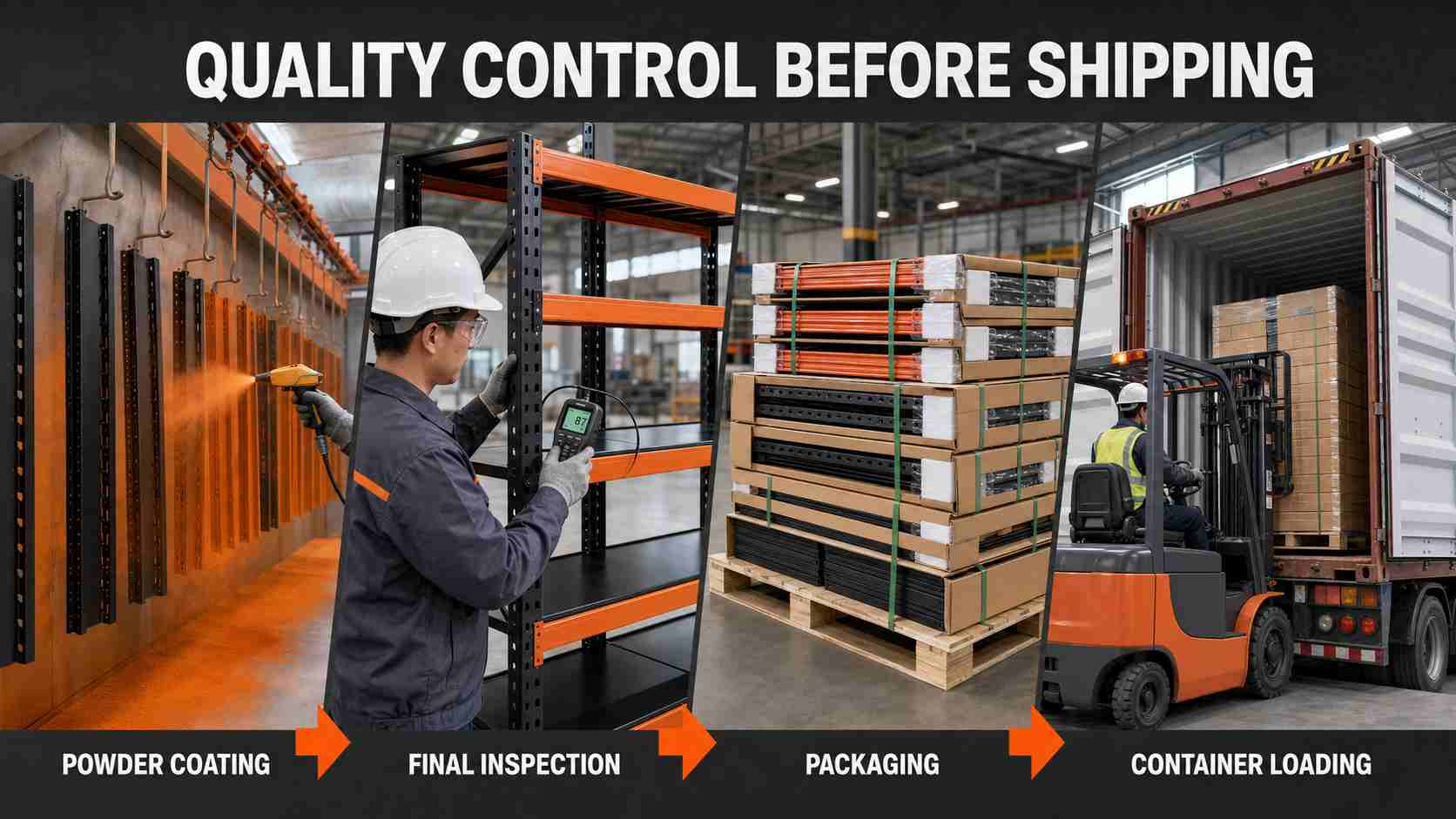
Powder coating and curing
Assembly and fit check
Final inspection
Packing and finished-goods storage
For each outsourced process, ask:
Who performs it?
What technical specification is issued?
How are incoming subcontracted parts inspected?
How are coating, welding or dimensional nonconformities controlled?
Can the supplier trace the subcontracted batch to the finished order?
An honest supplier should distinguish its internal capabilities from qualified external processes.
3. Review the Quality Management System—but Do Not Stop at ISO 9001
ISO 9001 is a quality management system standard. It can show that a company has established controlled processes, responsibilities, records and improvement mechanisms. It does not by itself certify that a particular shelf holds 300 kg, that a coating is corrosion-proof or that every shipment meets your drawing.
If the manufacturer presents an ISO certificate:
Check the company name and site address.
Check the certificate number, issue date and expiry/status.
Read the certification scope; it should be relevant to shelving, racking, metal products or the actual manufacturing activity.
Identify the certification body and its accreditation.
Validate accredited management-system certificates through the issuing body or IAF CertSearch.
Ask to see records created by the system, not only the certificate.
Useful records include:
Approved drawings and revision control
Supplier approval and incoming inspection
Process inspection sheets
Equipment calibration records
Nonconformity reports
Corrective-action records
Final inspection and release authorization
Customer complaint and improvement records
The objective is to determine whether the quality system changes daily behavior on the shop floor.
4. Evaluate Engineering and Specification Control
A capable steel shelving manufacturer should be able to convert a buyer's storage requirement into a controlled technical configuration.
Ask the engineering team to explain:
How the rated load was determined
Which dimensions and spans the rating applies to
The difference between load per level and total bay load
Whether the rating assumes a uniformly distributed load (UDL)
How concentrated loads or uneven cartons are handled
How main bays and add-on bays affect stability
When bracing, wall fixing or floor anchoring is required
Which design or test standard applies to the destination market
How drawing changes are approved and released to production
For industrial boltless steel shelving in the United States, for example, ANSI MH28.2-2022 covers design, testing and utilization within its defined scope. Industrial bin shelving, retail/consumer boltless shelving, pallet racks and work platforms are addressed separately. A test report for one category should not be presented as universal approval for every storage product.
Review a complete technical file for one current model:
General assembly drawing
Component drawings
Bill of materials (BOM)
Steel grade and thickness
Critical tolerances
Rated load and loading diagram
Test method or engineering basis
Assembly instructions
Safety and SWL/load labels
Packaging specification
The drawing number and revision should match the sample, production order and inspection record.
5. Verify Steel Grade, Thickness and Material Traceability
Material verification is one of the most important parts of a shelving audit because small thickness differences may be difficult to see after forming and coating.
Check the Material Documents
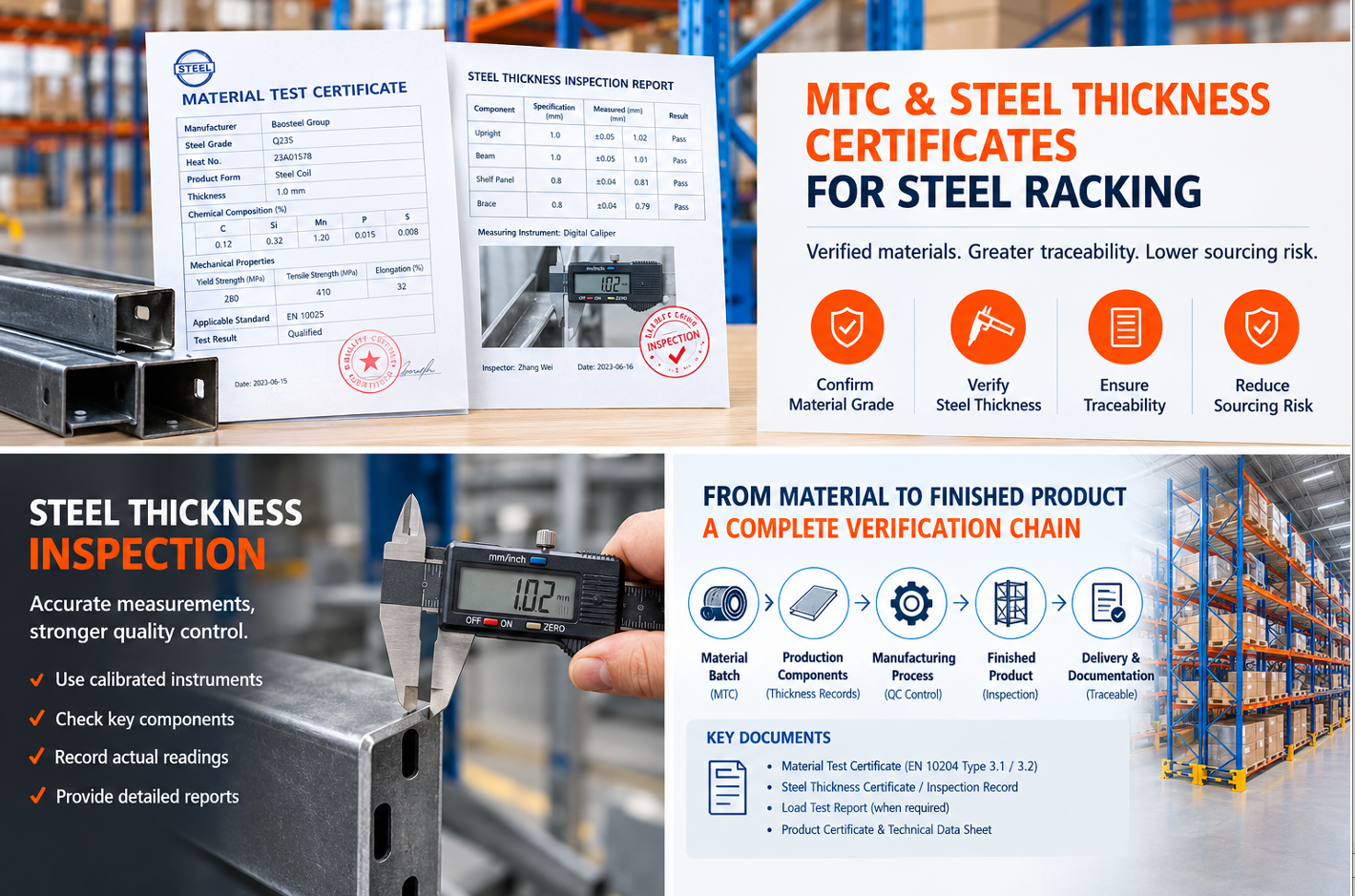
Request the mill test certificate (MTC) or material certificate for the relevant steel batch where contractually required. Check:
Steel grade
Coil or heat/batch number
Nominal thickness
Mechanical or chemical data where specified
Supplier and receiving date
Link between the certificate, incoming coil and production order
An MTC is useful only if the supplier can connect it to the material actually used. A generic certificate from a previous purchase does not prove the current batch.
Measure Physical Components
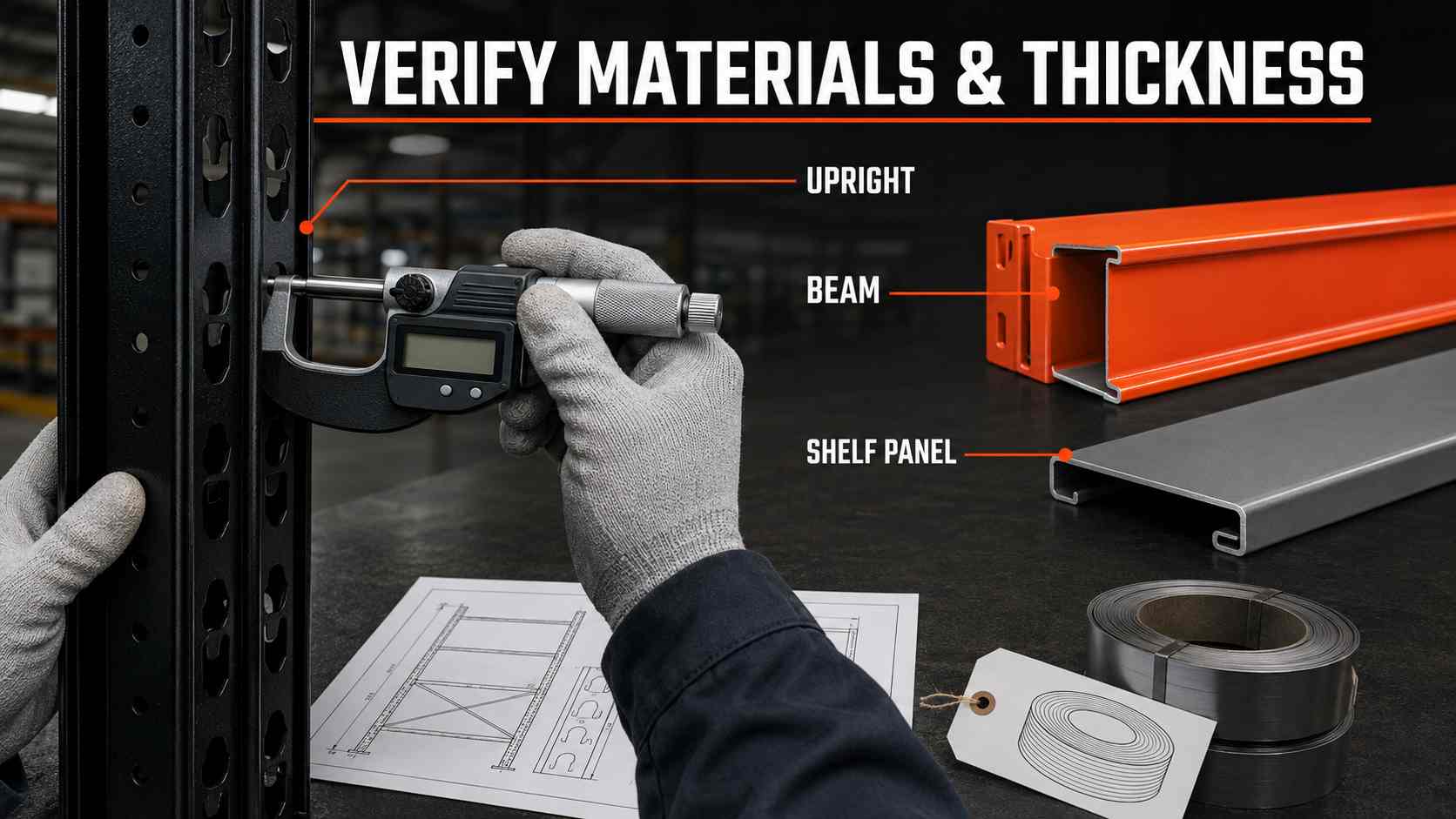
Use a calibrated micrometer or another agreed instrument to measure accessible uncoated material or apply a documented method that accounts for coating. Take several readings on:
Uprights
Load beams
Shelf panels
Bracing members
Reinforcement channels
Connectors and footplates where critical
Record the location and result. Do not compare a single reading with a nominal value without considering the purchase specification and permitted material tolerance.
Also verify:
Component weight against the approved BOM
Profile geometry and dimensions
Hole pattern and adjustment pitch
Reinforcement count and placement
Weld size and location where applicable
Weight can be a useful cross-check, but it does not replace thickness and profile verification.
6. Inspect Forming, Punching, Welding and Assembly Quality
Walk through production with the approved drawing in hand.
Formed Components
Check for:
Consistent profile shape
Excessive twisting, bowing or camber
Cracks at bends or punched openings
Burrs and sharp edges
Hole position and pitch
Connector geometry
Repeatability between components
Welded Components
Where welding is used, check:
Weld locations against the drawing
Continuity and size where specified
Excessive spatter, undercut, burn-through, porosity or missed welds
Fixture control and distortion
Operator qualification or internal competence records when contractually required
Trial Assembly
Select parts from normal production—not only a prepared showroom sample—and assemble one complete unit. Verify:
Components fit without forced correction.
Beams and shelf panels seat correctly.
Safety locks or connectors engage as intended.
The unit stands square and stable.
Shelf levels are adjustable at the specified pitch.
Starter and add-on bays connect correctly.
Required bolts, anchors and accessories are complete.
The assembly instructions match the delivered product.
A trial assembly often reveals tolerance, connector and packing-kit problems that individual component inspection may miss.
7. Examine Load-Capacity Evidence Carefully
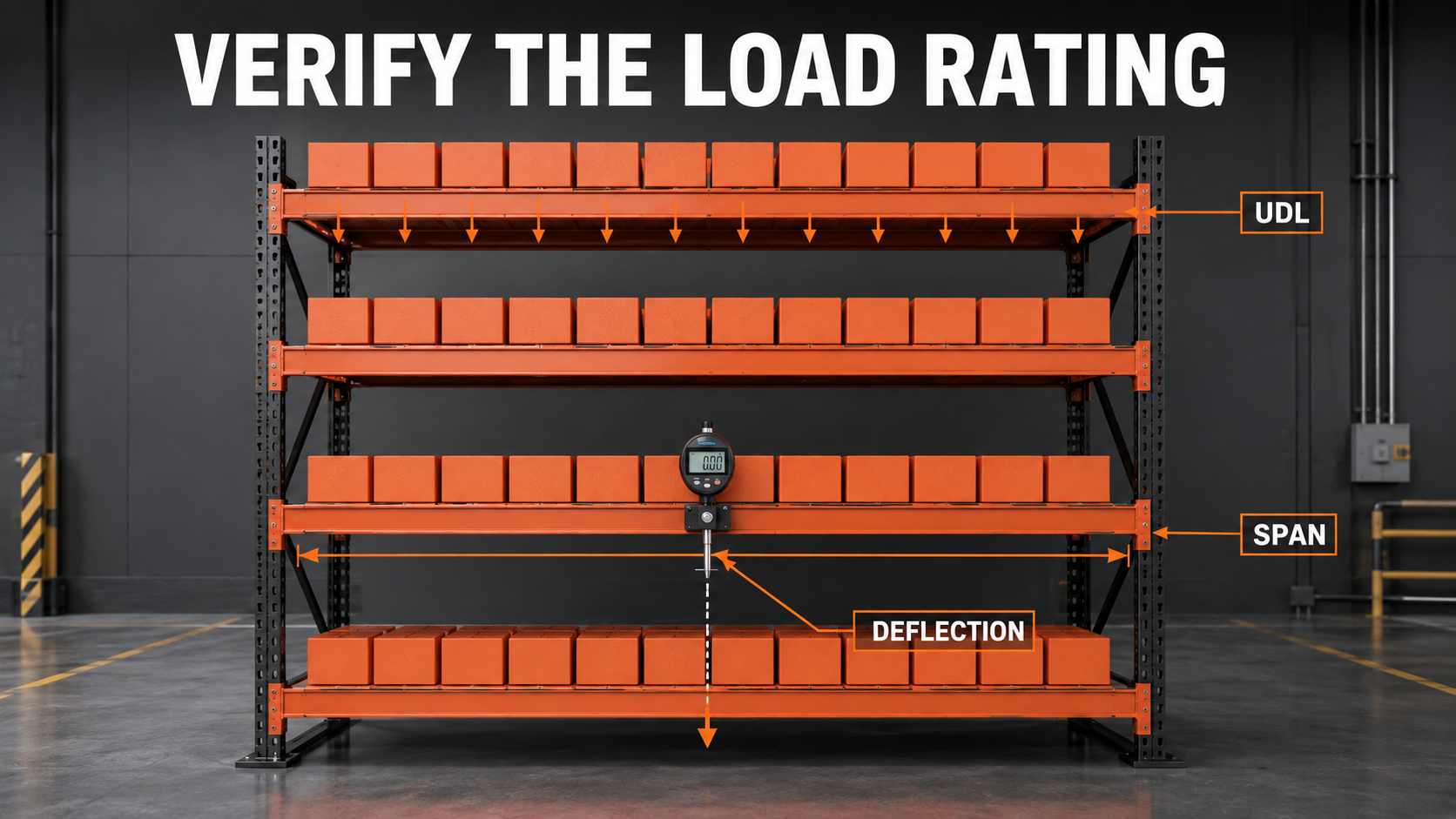
The statement “200 kg per shelf” is incomplete unless it identifies the tested or calculated configuration.
The evidence should state:
Product model and drawing revision
Overall dimensions
Clear beam span and shelf depth
Upright and beam profiles and thicknesses
Deck type and reinforcement
Number and spacing of shelf levels
Test load and rated load
Load distribution and loading pattern
Test duration
Measurement points and equipment
Deflection or displacement readings
Permanent deformation after unloading, where assessed
Failure, instability or connection observations
Test date, sample identification and responsible party
Applicable test method and acceptance criteria
UDL Is Not the Same as a Concentrated Load
A uniformly distributed load spreads weight across the shelf. The same total weight placed in one small area can create higher local stress and deck deformation. Audit the loading diagram as carefully as the kilogram value.
Do Not Accept These as Sufficient Proof
A photograph of people standing on a shelf
Concrete blocks without verified total weight
A report for a different shelf width or beam span
A report with no component thicknesses
A report for pallet racking used to support a shelving claim
A certificate that lists only a product family and no tested model
A video that does not show the loading method or measurement results
For a customized or high-volume order, agree on a model-specific test plan before production. If an independent laboratory or third-party inspector is required, define the sampling, witness points and reporting scope in the purchase contract.
8. Audit Powder Coating and Corrosion Protection
A glossy finish does not prove that the surface system is durable. The quality of powder-coated shelving depends on pretreatment, surface cleanliness, powder selection, application, curing and edge coverage.
Check:
Degreasing and pretreatment stages
Bath concentration, temperature and maintenance records where applicable
Rinsing and drying control
Powder manufacturer and product type
Color/RAL control
Electrostatic application and earthing
Coating coverage on edges, holes and weld zones
Oven temperature and curing time
Cure verification method
Film-thickness measurement
Adhesion and appearance inspection
Handling and packing after coating
Typical factory checks may include dry film thickness, color comparison, cross-cut adhesion, impact or bend performance, depending on the agreed specification.
If salt-spray evidence is requested, confirm the exact procedure, specimen preparation, exposure time and acceptance criteria. ISO 9227:2022 defines salt-spray test methods, but it does not prescribe one universal exposure period or convert test hours into years of real service. ISO also notes that these methods are not intended to rank materials generally or predict long-term corrosion resistance. The result must be interpreted against the agreed product specification and environment.
For coastal, humid, refrigerated, outdoor or chemically aggressive locations, tell the manufacturer before quotation. Standard indoor powder-coated shelving may not be the correct finish.
9. Review Incoming, In-Process and Final Inspection
Ask the quality team to show how defects are prevented and detected at each stage.
Incoming Inspection
Steel grade, thickness, width and batch identification
Powder and chemical identification
Purchased fasteners, feet, locks and accessories
Subcontracted parts or processes
In-Process Inspection
First-piece approval after machine setup
Profile and hole dimensions
Cutting length and bending angles
Weld location and appearance
Coating process parameters
Color and film thickness
Final Inspection
Overall dimensions
Quantity and component completeness
Fit and trial assembly
Surface finish and visible defects
Labels and markings
Packaging and carton/pallet condition
Order-specific documents
For lot-by-lot inspection, buyers may use a defined sampling plan. ISO 2859-1:2026 provides an acceptance-sampling system for inspection by attributes. The buyer and supplier must still agree on inspection level, lot definition, AQL values and the classification of critical, major and minor defects. “AQL inspection” without those details is not a complete inspection instruction.
Check Measurement-System Control
Review calibration or verification records for instruments such as:
Micrometers and calipers
Coating-thickness gauges
Scales and test weights
Tape measures and angle gauges
Load-test sensors or displacement devices
Oven temperature recorders
An inspector cannot create reliable data with unverified equipment.
10. Check Traceability and Nonconformity Control
Choose one finished unit or packed order and ask the factory to trace it backward.
A mature system should be able to identify, as applicable:
Sales order and approved specification
Drawing and BOM revision
Production order
Material batch
Operators or production shift
Inspection records
Coating batch or date
Final release
Packaging batch and shipping marks
Then review an actual nonconformity. Ask:
How was the problem identified?
How was affected material isolated?
Who approved rework, concession or scrap?
Was the customer informed when required?
What corrective action prevented recurrence?
A factory with no recorded defects may have a weak reporting culture rather than perfect production.
11. Verify Capacity, Lead Time and Supply-Chain Resilience
Machine count alone does not prove available capacity. Compare the promised lead time with real output, current workload and bottlenecks.
Request:
Recent monthly production records for comparable shelving
Current production schedule and order backlog
Output per shift for critical processes
Number of shifts and trained operators
Powder-coating line capacity
Tooling availability for the quoted profiles
Raw-material lead time
Planned subcontracting
Peak-season capacity and maintenance plan
Contingency for machine failure or material delay
Calculate capacity using the slowest critical process, not the fastest machine. Powder coating, welding, shelf-panel forming, special tooling or packaging may be the true bottleneck.
If the supplier promises an unusually short lead time, ask for a dated production plan showing material arrival, first-piece approval, manufacturing, inspection, packing and shipment readiness.
12. Audit Packaging and Container Loading
Steel shelving can pass factory inspection and still arrive damaged or incomplete if packaging is weak.
Inspect a packed set and confirm:
Number of components per carton or bundle
Protection between coated surfaces
Edge and corner protection
Control of movement inside the package
Moisture protection appropriate to the shipping route
Fastener and accessory kit identification
Carton strength and closures
Pallet structure and strapping where used
Shipping marks, model, quantity and package number
Assembly instructions and load labels
Barcode or private-label requirements
Gross/net weight and package dimensions
Compare the packing list with a physical pack-out. For mixed models, the package numbering system should allow the buyer to identify each bay and accessory without opening every carton.
Also review the proposed container-loading plan:
Confirm that the CBM calculation uses actual packed dimensions.
Check weight distribution and container payload limits.
Protect coated products from bands, forklift forks and container walls.
Confirm how packages will be unloaded at destination.
Request loading photographs and a final container checklist.
The cheapest package is not economical if it causes scratches, missing parts, repacking labor or customer claims.
13. Conduct a Sample or Pilot-Order Verification
A showroom sample proves only that one sample exists. Before a large private-label or project order, use a sample or pilot batch to confirm:
Dimensions and clear storage space
Component thickness and weight
Assembly time and instructions
Connector fit and adjustability
Surface finish and color
Load-test plan or evidence
Packaging method
Branding and labels
Compatibility with the buyer's cartons, bins or accessories
Keep one approved reference sample, or create a signed specification record with photographs and measured data. Mass production should be inspected against that controlled reference, not against memory.
14. Use Independent Inspection When the Risk Justifies It
A buyer does not always need a third-party auditor, but independent verification is valuable when:
The supplier is new.
The order value is high.
The product is customized.
Load capacity is safety-critical.
Local compliance documents are required.
The buyer cannot visit the factory.
The shipment has little tolerance for delay or rework.
Possible control points include:
Initial factory audit
Pre-production meeting
First-article inspection
During-production inspection
Witnessed load test
Pre-shipment inspection
Container-loading supervision
The inspection agency should receive the approved drawing, defect criteria, sampling plan, packing specification and test requirements. Asking an inspector to “check quality” without a technical checklist produces subjective results.
Suggested 100-Point Steel Shelving Factory Audit Scorecard
The following is a practical KAYOU editorial framework, not an official certification standard. Buyers should adjust the weightings to their project risk.
| Audit Area | Points | What Good Evidence Looks Like |
| Legal identity and factory relationship | 10 | Verified entity, transparent manufacturing/export roles and matching records |
| Engineering and specification control | 15 | Controlled drawings, BOM, load definition, revision history and competent technical explanation |
| Material control and traceability | 15 | Verified steel grade/thickness, batch linkage, incoming inspection and calibrated measurements |
| Production-process capability | 15 | Suitable equipment, controlled forming/welding/coating, first-piece approval and stable workmanship |
| Load-capacity evidence | 15 | Model-specific method, configuration, loading diagram, measurements and acceptance criteria |
| Surface finish and corrosion protection | 10 | Controlled pretreatment, powder, curing, thickness, adhesion and relevant test evidence |
| Quality control and calibration | 10 | Incoming, in-process and final records; sampling plan; NCR/CAPA; verified instruments |
| Packaging and export readiness | 5 | Approved pack-out, component control, protective packaging and accurate loading plan |
| Capacity and delivery control | 5 | Evidence-based output, realistic schedule, bottleneck awareness and contingency planning |
| Total | 100 |
A buyer might classify the result as:
85–100: Approved, subject to closing any project-specific actions
70–84: Conditionally approved with corrective actions and follow-up evidence
Below 70: Not approved until major risks are corrected and re-audited
Do not let a high total score hide a critical failure. Falsified records, untraceable material, unsafe structural claims or refusal to permit agreed verification should be treated as stop conditions regardless of the total.
15 Red Flags When Auditing a Shelving Supplier
The factory name does not match the quotation, certificate or payment beneficiary.
Production areas are unavailable without a credible reason.
The supplier cannot produce a controlled drawing or BOM for the quoted model.
Steel thickness changes between the quotation, sample and production record.
An MTC cannot be linked to the current material batch.
Load capacity is advertised without UDL, span or structural details.
The load report is for a different size, model or product category.
ISO certification is presented as product load certification.
Salt-spray hours are marketed as a guaranteed number of outdoor service years.
Coating or welding is outsourced but the subcontractor is not controlled.
Measuring instruments have no current calibration or verification record.
The factory records no nonconformities, rework or corrective actions.
Trial assembly requires grinding, hammering or unapproved modification.
Packaging quantities are estimated rather than verified through a pack-out.
Price and lead time are unusually low, but the supplier cannot explain how they are achieved.
How to Conduct a Remote Factory Audit
If an on-site visit is not possible, a structured remote audit is more useful than a polished factory video.
Ask for a live video session with a pre-agreed route:
Show the exterior, company sign and current date/time reference.
Move from raw-material storage through each production process.
Select a random coil, component or production order.
Show the drawing and BOM for that order.
Measure critical component dimensions and thickness live.
Show coating controls, quality records and instrument status.
Assemble randomly selected parts.
Inspect a packed set and shipping marks.
Review records by screen share or close camera view, protecting unrelated customer data.
Follow the remote audit with an independent pre-shipment inspection if the order risk is significant. A live audit can verify capability; it does not replace shipment-specific product inspection.
Documents to Request Before Approving a Manufacturer
Send this checklist before the audit so the supplier has time to prepare original, relevant records:
Business licence and company details
Factory address and organization chart
Quality-system certificates and verification links
Product catalogue limited to relevant products
Approved technical data sheet
General assembly and component drawings
BOM with steel grade, profile and thickness
Material certificate sample and traceability method
Process flow chart
Incoming, in-process and final inspection samples
Equipment and calibration list
Load-test report or proposed test plan
Coating specification and related test evidence
Assembly instructions and SWL/load-label sample
Packaging specification and container-loading plan
Production-capacity and lead-time plan
Recent nonconformity/corrective-action example with customer data removed
The objective is not to collect the largest possible PDF folder. It is to verify that the documents agree with each other and with the factory floor.
Frequently Asked Questions
Is ISO 9001 enough to approve a steel shelving manufacturer?
No. ISO 9001 concerns the quality management system. It can support supplier confidence, but it does not prove the capacity, dimensions, steel thickness or corrosion performance of a specific shelving model. Product-specific technical evidence and inspection are still required.
How can I tell whether a Chinese supplier is a manufacturer or a trading company?
Check the Chinese legal entity, registered and factory addresses, production equipment, employees, material records and production orders. If a separate trading company handles export, ask for documented evidence of its relationship with the manufacturing entity. Transparency matters more than the label alone.
What is the most important physical measurement during a shelving audit?
There is no single measurement, but component thickness, profile geometry, clear span and reinforcement should be high priorities because they directly affect the structure and are often hidden by product names. Measurements must be compared with an approved drawing and tolerance.
How do I verify a shelf load rating?
Request a report or engineering basis that identifies the exact model, dimensions, span, material, component thickness, shelf configuration, load distribution, test method, measurements and acceptance criteria. For a custom order, approve a model-specific load-test plan and use independent witnessing when justified.
Should the proof load be 1.5 times the rated load?
Do not apply a universal multiplier without reference to the applicable standard, design method and product scope. Proof-load factor, duration and acceptance criteria should be defined by a qualified engineer or the agreed test standard for the specific shelving system and destination market.
What AQL should I use for shelving inspection?
There is no universal AQL that suits every order. Define critical, major and minor defects based on product and safety risk, then agree on the lot, inspection level, sampling plan and acceptance limits. Structural mismatch, missing safety components or false load labels may require stricter treatment than minor cosmetic marks.
Can a remote audit replace an on-site audit?
A live remote audit can verify many documents, measurements and processes, especially when combined with a third-party pre-shipment inspection. It is less effective for judging factory scale, process consistency and subtle production conditions. Use a risk-based combination of remote, on-site and shipment-specific controls.
When should I audit the powder-coating subcontractor?
Audit or independently verify the coating source when finish performance is critical, the environment is corrosive, order volume is high or the shelving manufacturer cannot demonstrate adequate incoming control of coated parts. The subcontractor's process should be part of the approved supply chain.
Is the lowest-priced shelving supplier usually the highest risk?
Not always. Efficient design, high-volume production and optimized packaging can reduce legitimate cost. The risk appears when a low price depends on unspecified steel thickness, reduced reinforcement, unverified load claims, weak coating or incomplete packaging. Ask the supplier to explain the cost difference through measurable specifications.
What should I inspect before paying the balance?
Inspect quantity, dimensions, component thickness, assembly fit, finish, labels, packaging, documentation and any agreed performance tests using the approved specification. Confirm corrective actions before shipment and include container-loading verification where necessary.
How KAYOU Supports Buyer Factory Audits
KAYOU manufactures customizable steel shelving and warehouse storage products in Luoyang, China for distributors, project contractors, wholesalers and commercial buyers. We believe supplier qualification should be based on clear specifications and verifiable production evidence.
Depending on the product and project requirements, buyers can request:
Technical specification and configuration confirmation
Product and component drawings
Steel thickness and material information
Sample or pilot-order review
Load-test planning and available supporting records
Production and quality-control review
Packaging and container-loading information
Live factory communication or on-site buyer inspection
Coordination with an independent inspection company
Learn more about the KAYOU steel shelving factory, our manufacturing process and quality control.
If you are sourcing medium duty steel shelving, long span shelving or a customized warehouse storage solution, send us the required size, load per level, shelf count, quantity, destination and use environment. Our team will prepare a configuration and quotation for technical review.
Audit the Evidence, Not Just the Factory Appearance
A professional factory audit should leave the buyer with a connected evidence chain:
Requirement → Drawing and BOM → Material → Production → Test/Inspection → Packaging → Shipment
The strongest steel shelving manufacturer is not necessarily the one with the largest showroom or the most certificates. It is the supplier that can explain its technical decisions, permit relevant measurements, control repeat production, identify problems honestly and deliver traceable evidence that the finished order matches the approved specification.
Need to Audit or Source a Steel Shelving Manufacturer in China?
Tell KAYOU your shelving dimensions, rated load, number of levels, order quantity, destination market and audit requirements. We can prepare the technical information needed for your supplier review and quotation.
Contact KAYOU for a Steel Shelving Solution
WhatsApp: +86 158 3799 8881