

Steel Shelving Load Capacity: How to Verify UDL, Load Testing and Structural Design
A steel shelving specification may state “200 kg per shelf,” but that number alone does not explain how the shelving should be loaded or which configuration it covers.
Reliable load capacity information must connect the stated rating with the actual product: shelf dimensions, support arrangement, beam span, upright configuration and load distribution.
For importers, distributors and warehouse project buyers, understanding these conditions helps prevent specification errors and makes supplier documentation easier to assess.
This guide explains what uniformly distributed load means, how to evaluate load test reports, and where EN 1090 and Eurocode fit into the technical review process.
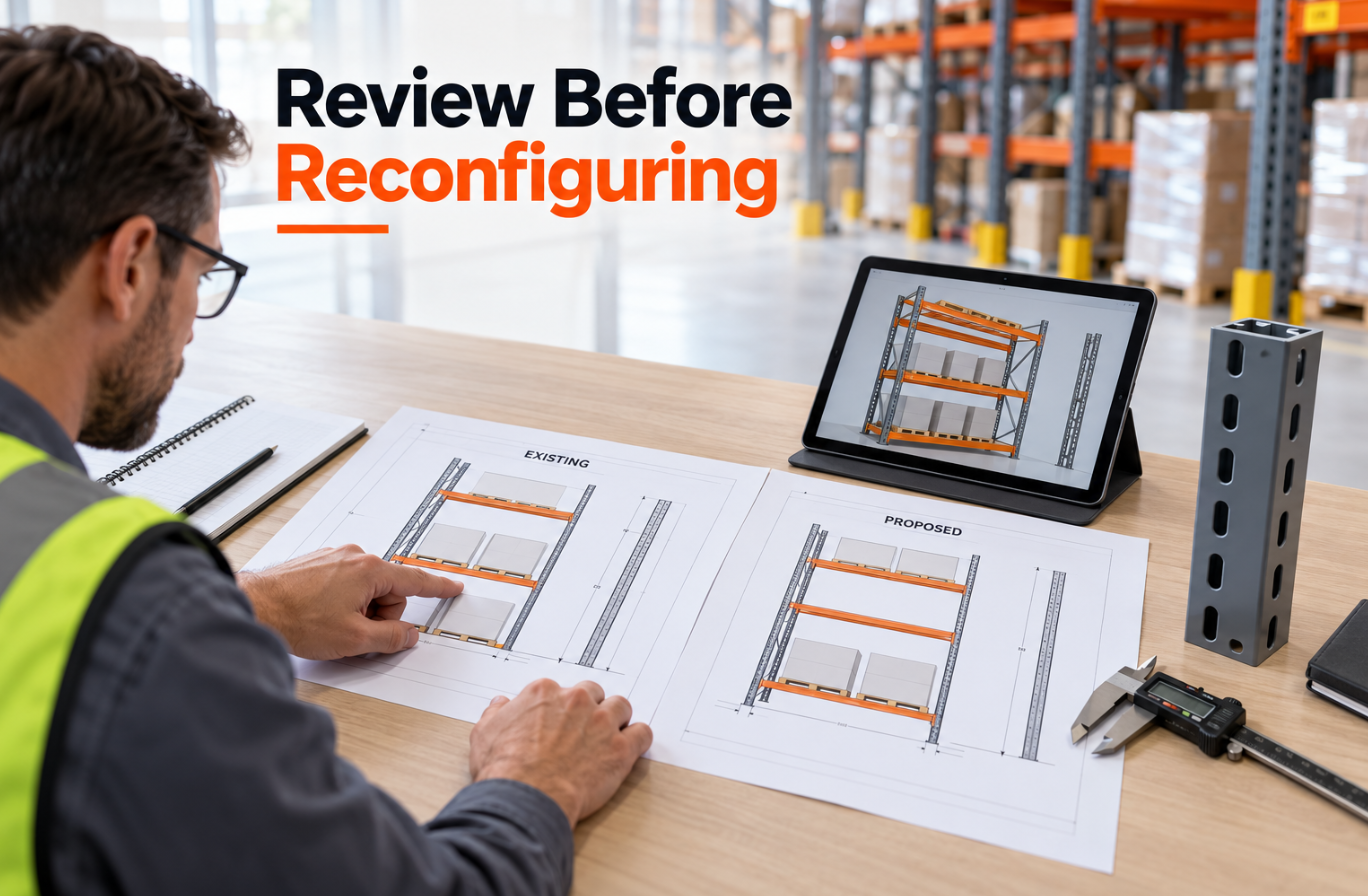
Illustrative image — AI-generated editorial illustration.
What Does Uniformly Distributed Load Mean?
A uniformly distributed load, commonly abbreviated as UDL, is spread evenly across the specified supporting surface or span.
For a shelf, this generally means distributing the stored weight over the usable shelf area rather than placing most of it in one small location.
Consider two loading arrangements with the same total weight:
Several cartons distributed evenly across a shelf.
One heavy machine resting on four small feet near the shelf centre.
The second arrangement creates concentrated reactions at the feet. It may cause different local stresses and deflection, even though the total weight is identical.
RMI guidance explains that point loads can arise from pallet runners, feet, spacers and other supports. A UDL capacity table should therefore not be used without checking the actual load arrangement.[1]
Buyer takeaway: When a supplier quotes a shelf capacity, ask whether the rating covers UDL, concentrated loads or a defined loading pattern.
Shelf Capacity, Beam Capacity and Bay Capacity Are Different
A storage system transfers load through several components. Depending on its design, these may include decking, shelf supports, beams, connectors, uprights, baseplates and anchors.
Each capacity statement should identify what it describes.
| Capacity term | What buyers should verify |
|---|---|
| Shelf or decking capacity | Rating for the specified panel and support arrangement |
| Beam-pair capacity | Rating for the stated beam span, connectors and loading pattern |
| Bay capacity | Allowable load for the defined upright, level spacing and structural configuration |
| Platform floor capacity | Area load for the complete floor system under its project design conditions |
A strong decking panel does not establish the capacity of its supporting beams or the complete rack.
Likewise, multiplying a shelf rating by the number of levels does not, by itself, prove the allowable bay load.
Buyer takeaway: Request both the level rating and the bay rating, together with the configuration to which they apply.
What Recent RMI Guidance Says About Decking Tests
On October 10, 2026, the Rack Manufacturers Institute published R-Mark Certification for Rack Decking Explained.
The article distinguishes product-specific decking certification from rack system certification. It also highlights testing under ANSI MH26.2, manufacturing consistency and the importance of actual loading conditions.[2]
This is a new technical explanation, rather than a newly issued standard revision.
RMI’s earlier announcement identifies the relevant revision as ANSI MH26.2-2023. That revision expanded coverage to additional decking materials and loading arrangements, including partially distributed loads, line loads and point loads.[3]
For buyers, the practical lesson is clear: a capacity claim is more useful when its test method and loading arrangement are stated.
ANSI MH26.2 concerns industrial storage rack decking. It should not automatically be treated as the design basis for a mezzanine floor or every type of steel shelving.
Illustrative image — AI-generated editorial illustration.
What Should a Useful Load Test Report Include?
A useful report allows the buyer to identify the tested product and understand how the result was obtained.
When reviewing a report, check for the following information:
| Report item | Why it matters |
|---|---|
| Product model and drawing reference | Connects the result to the quoted product |
| Dimensions, thickness and material | Defines the specimen being assessed |
| Reinforcement and connections | Identifies details that affect performance |
| Support spacing and boundary conditions | Explains how the specimen was supported |
| Loading pattern and load application | Shows whether the test represents the intended use |
| Test standard and edition | Identifies the evaluation basis |
| Deflection measurements and observations | Records behaviour during loading |
| Acceptance criteria and result | Explains how the conclusion was reached |
| Testing organisation and report date | Supports traceability |
These are practical review items; the applicable standard and agreed test scope determine the formal requirements.
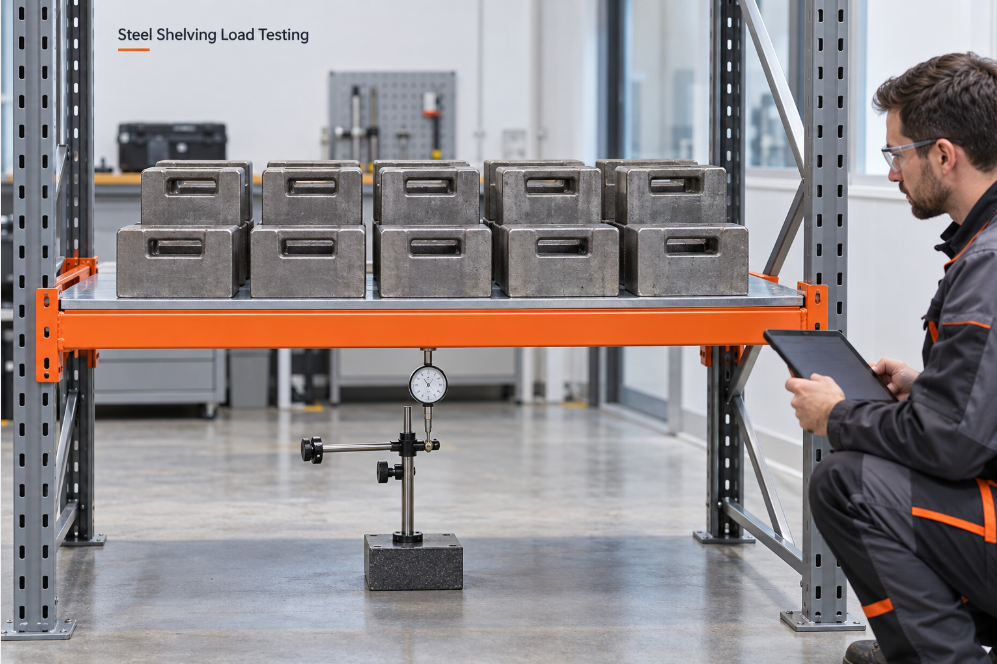
A photograph of weights on a shelf may support a demonstration, but it does not explain the complete test procedure, acceptance criteria or applicability to other sizes.
Buyer takeaway: Check whether the report covers your proposed dimensions and configuration. If details differ, request a documented explanation of applicability.
How Structural Calculations Complement Load Testing
Testing and structural calculations provide different forms of evidence.
Testing can establish the behaviour of components or assemblies under defined conditions. Calculations assess how the proposed configuration performs under its design actions.
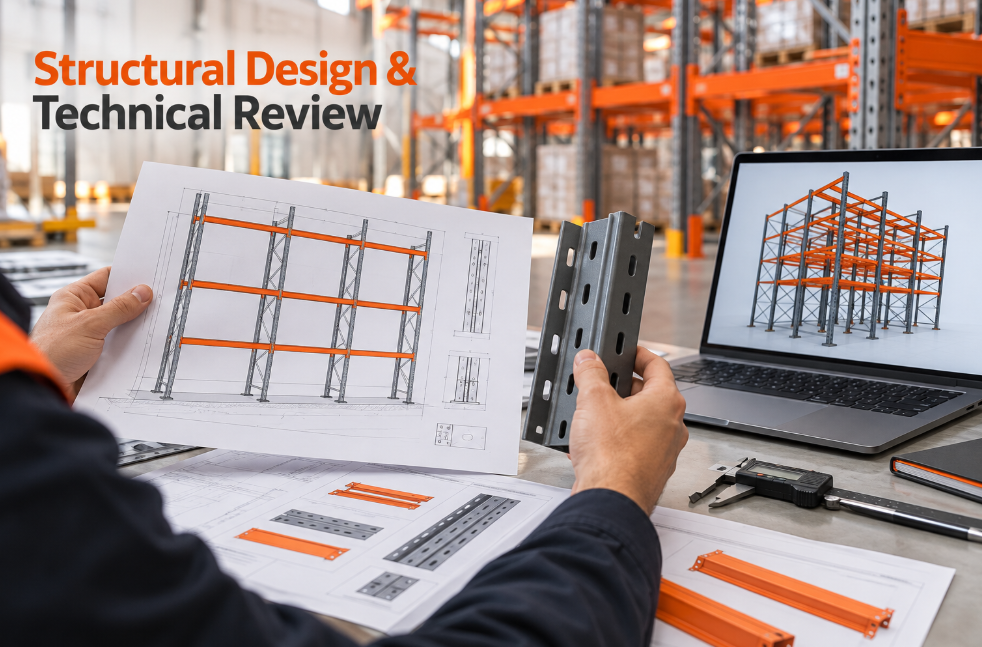
For a warehouse rack or mezzanine project, the calculation scope may need to address:
Permanent and imposed loads.
Relevant loading arrangements and combinations.
Member strength and stability.
Connection behaviour and load transfer.
Deflection and other serviceability requirements.
Baseplates, anchors and support conditions.
Applicable seismic or other site-specific actions.
The necessary checks depend on the system, project location and governing design requirements.
A change in beam span, level spacing, bracing, connection detail or anchorage may affect whether an existing assessment remains applicable.
Buyer takeaway: Keep the quotation, layout drawing, component specifications and calculation report consistent.
Where EN 1090 and Eurocode Fit
EN 1090 and Eurocode address related but different aspects of structural work.
BSI describes EN 1090 as covering requirements associated with structural steel and aluminium components, including conformity assessment. Its technical execution provisions address matters such as fabrication and erection.[4]
Eurocode provides a structural design framework. Relevant families can include EN 1990 for design basis, EN 1991 for actions and EN 1993 for steel structures.[5]
For a particular shelving, rack or mezzanine system, the applicable standards must be selected according to its product type, intended use, destination and contract requirements.
A reference to EN 1090 does not, by itself, establish a particular shelf capacity.
Similarly, “designed to Eurocode” should be supported by identifiable standard parts, editions, project assumptions and applicable National Annexes.
Preparing for the Second Generation of Eurocode
The European Commission’s Joint Research Centre states that the second-generation Eurocodes have a latest national implementation date of September 30, 2027, and a latest withdrawal date for conflicting first-generation standards of March 30, 2028.[5]
These dates describe the overall transition framework. They do not mean every project should immediately use the same new editions.
For overseas projects, buyers and designers should confirm the destination country’s implementation status and the agreed project design basis.
A standards register in the calculation report can record:
Standard number and title.
Edition and amendments.
Applicable National Annex.
Project country.
Customer-specific technical requirements.
What to Send KAYOU Before Requesting a Quotation
To help define an appropriate steel shelving or warehouse storage configuration, send:
Required length, depth and height.
Number of levels and preferred level spacing.
Maximum weight per level and per bay.
Carton, pallet or container dimensions.
How the load contacts the shelf or decking.
Fixed or mobile configuration.
Installation country and project requirements.
Required drawings, calculations or test documentation.
If heavy equipment, small support feet or unusual pallets will be stored, include photographs or a sketch of the contact arrangement.
This information helps align the proposed product with its actual use and clarifies the documentation required before production.
For more about production checks, explore KAYOU quality control and agree on the inspection documents required for your order.
Frequently Asked Questions
Does “200 kg per shelf” mean I can place 200 kg anywhere?
Only if the documented rating covers that loading arrangement. A UDL rating should not automatically be interpreted as approval for a concentrated load.
Is a layer test enough to verify the complete rack?
It provides evidence for the tested layer or assembly under defined conditions. The uprights, connections, bracing and complete configuration still require an appropriate assessment.
Can I add all shelf ratings together to determine bay capacity?
Do not assume this. Confirm the allowable bay load for the specified configuration.
Does changing the shelf size affect the rating?
It can. Span, depth, thickness, reinforcement and support conditions influence performance. Request a rating that covers the proposed specification.
Can a steel shelf panel test be used for a mezzanine floor?
Not automatically. A mezzanine requires a project-specific assessment of the complete floor and supporting structure.
What should I request from a shelving supplier?
Start with a technical data sheet, configuration drawing and clearly defined capacity information. Agree on any additional testing, calculations or material documentation required for the project.
Discuss Your Storage Requirements with KAYOU
Planning steel shelving, pallet racking or a mezzanine project?
Send KAYOU your dimensions, intended loads, storage arrangement and destination country so the proposed configuration and technical documentation requirements can be discussed together.
Sources and Further Reading
[1] RMI: Uniformly Distributed Loads — April 15, 2025
[2] RMI: R-Mark Certification for Rack Decking — October 10, 2026
[3] RMI: ANSI MH26.2 Revision — September 20, 2023
[5] European Commission JRC: Second Generation Eurocodes
Need Shelving Matched to Your Actual Loads?
Send KAYOU your dimensions, load per level, quantity and destination country. Include photos of the load contact arrangement to discuss specifications and documentation requirements.
Contact UsWhatsApp KAYOUWhatsApp: +86 158 3799 8881