
Steel Tool Cabinet with Pegboard: A Practical Buying Guide for Garages and Workshops
A tool cabinet should do more than hide clutter. In a busy garage, maintenance room or factory workshop, it should make frequently used tools visible, protect valuable equipment, separate small parts from bulky cases and help users return every item to the correct place.
Current search results repeatedly connect steel tool cabinet with pegboard, lockable metal garage cabinet, adjustable tool storage, workshop organization and 5S tool management. Together, they describe a system combining visibility, flexible shelving and controlled access.
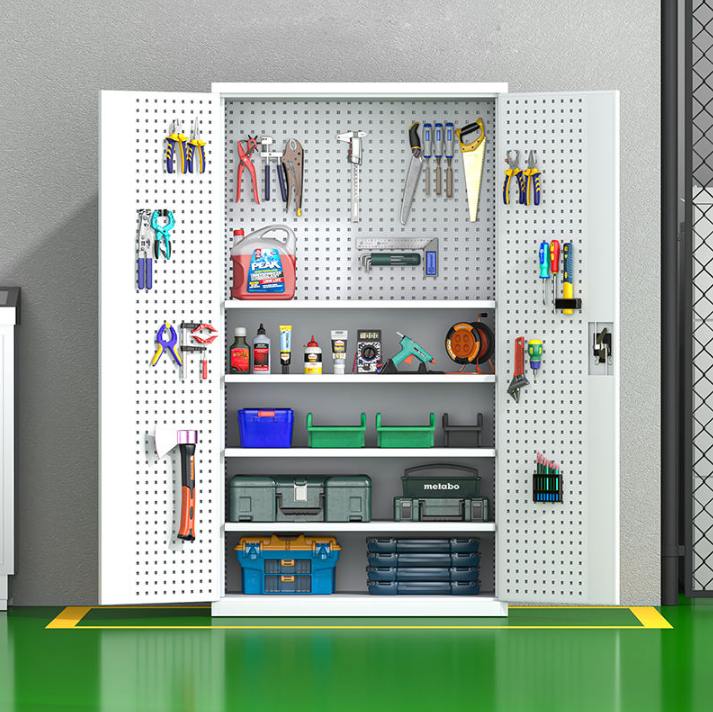
The pictured KAYOU concept is a freestanding steel cabinet with double doors, perforated door interiors, an upper rear pegboard and shelves below. Hooks display hand tools while shelves hold cases, bins and consumables. The image does not establish dimensions, thickness or capacity; confirm these for the ordered model.
Why Combine a Tool Cabinet and Pegboard?
A shelf cabinet holds cases and boxes, while an open pegboard keeps hand tools visible but exposed. A steel cabinet with internal pegboard combines both functions.
The cabinet in the image creates three storage zones:
Rear pegboard: visible positions for frequently used hand tools and measuring equipment
Door pegboards: extra vertical space for lighter accessories and tools
Shelf area: storage for tool cases, bins, spare parts, consumables and larger equipment
Closing the doors creates a cleaner appearance and controls access. “Lockable” does not mean theft-proof; doors, hinges, frame and anchoring also matter.
How This Design Supports 5S Tool Organization
The 5S method—sort, set in order, shine, standardize and sustain—is widely used to improve workplace organization. The US Environmental Protection Agency's 5S overview describes it as a repeating improvement cycle rather than a one-time clean-up.
A pegboard tool cabinet can support that process:
Sort: remove obsolete, damaged or duplicate tools before assigning cabinet space.
Set in order: give each tool, case and bin a defined location based on use frequency.
Shine: keep shelves and panels accessible for inspection and cleaning.
Standardize: use consistent labels, hook positions, colors and cabinet layouts.
Sustain: audit missing tools, overloaded shelves and changed layouts regularly.
The cabinet does not create 5S by itself. Results still depend on labels, user responsibility and periodic review. Shadow outlines or item numbers can make missing tools easier to notice.
Tool Cabinet, Drawer Chest, Open Shelving or Wall Pegboard?
| Storage option | Main advantage | Best for | Main limitation |
|---|---|---|---|
| Steel cabinet with internal pegboard | Combines visible tool hanging, shelves and lockable doors | Mixed tools, cases and consumables in shared workshops | Door and panel loads require careful control |
| Drawer tool chest | Dense classification and good access to small tools | Sockets, cutters, measuring tools and technician kits | Drawer loads, slides and tipping risk must be verified |
| Open steel shelving | Fast access and efficient storage of boxes or equipment | MRO parts, cartons, bins and bulky supplies | Limited security and less protection from dust |
| Wall-mounted pegboard | Uses vertical space and keeps tools visible | Light, frequently used hand tools near a workbench | Depends on wall strength and leaves tools exposed |
Choose by workflow: mixed tools suit the pictured cabinet, precision tools may need drawers, and large stocks may fit steel shelving with pegboard better.
Four Load Ratings Buyers Must Keep Separate
One “cabinet capacity” number is not enough. Loads follow different paths through the structure, so request four separate definitions.
For applicable products, buyers may discuss a test basis such as ISO 7170:2021, which provides methods for evaluating the strength, durability and stability of fully assembled storage units. It does not provide one universal acceptance rating for every cabinet, so the specimen, loads, cycles and pass/fail criteria must match the exact model and intended use.
Pegboard Hole and Hook Compatibility
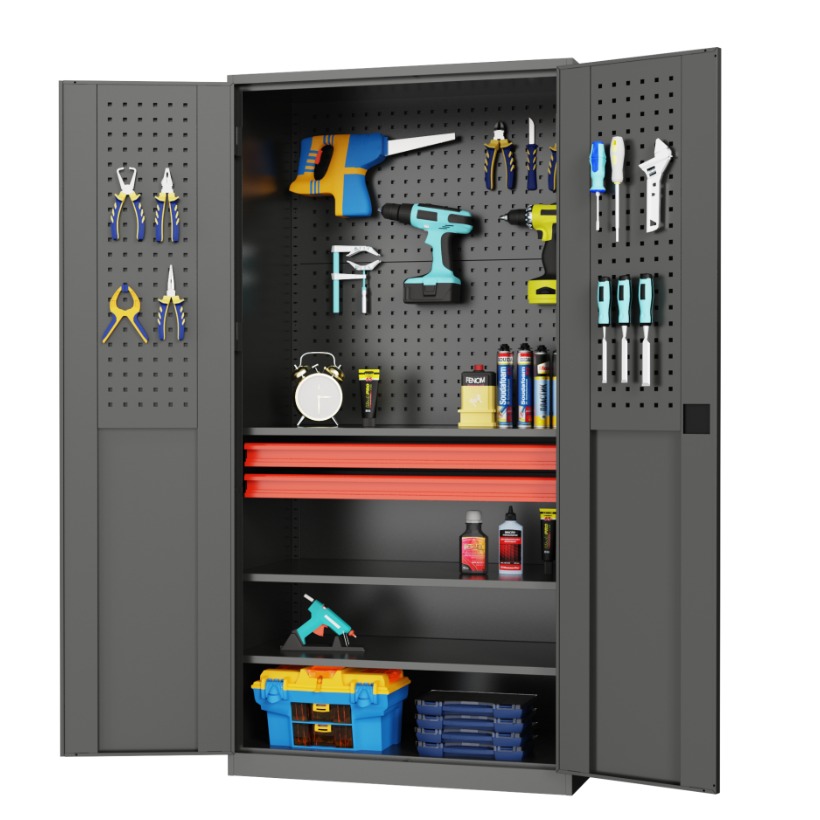
“Includes pegboard” is not a complete specification. Round, square and keyhole-style perforations can use different accessories. Confirm:
Hole shape and dimensions
Horizontal and vertical center-to-center pitch
Pegboard material and finished thickness
Hook engagement and anti-lift feature
Hook length, diameter and surface finish
Quantity of each hook, basket, bin or holder
Replacement accessory availability
A catalogue hook may fit loosely, rotate or damage the coating. Approve the panel and accessories as one system with a fitting sample and layout drawing.
Adjustable Shelves and Storage Zoning
Adjustable shelves accommodate changing combinations of cases, bins and equipment. Confirm the adjustment pitch, connection, clear level height and whether removing a shelf changes cabinet stiffness.
Place frequently used light tools within comfortable reach, small parts in labeled bins and heavier goods on lower levels. Keep the floor and door path clear.
In US workplaces, OSHA 1910.22 requires workplaces, passageways and storerooms to be kept clean, orderly and sanitary, with walking-working surfaces maintained free of hazards. Organized storage can support housekeeping, but it does not replace the employer's inspection, training and hazard-control duties.
Locking, Access Control and Tool Accountability
The correct lock depends on who uses the cabinet and how often access changes. Key locks are simple for assigned users; padlock hasps can let facilities control their own locks; mechanical combinations reduce key handling; and electronic locks can support credentials and audit functions.
Define the master-key plan, duplicate-key control, emergency opening, replacement cylinders and access records. In a shared tool crib, sign-out discipline may matter more than lock complexity.
Steel, Finish and Environment
Do not buy on thickness alone. Door folds, reinforcement, hinges, shelf supports and geometry also affect performance. State the material, finished component thicknesses, construction and tolerances.
For dry indoor use, confirm surface preparation, pretreatment, coating specification, film-thickness control, curing and color. Disclose humidity, salt, metal dust, oils and cleaning chemicals.
The pictured cabinet should not be represented as waterproof or suitable for permanent outdoor exposure without separate evidence. If the project involves wet rooms, coastal air or aggressive chemicals, evaluate an appropriate pretreatment, galvanized substrate, stainless steel or another material.
Safe Installation and Daily Use
A tall cabinet can tip if uneven, climbed on, top-heavy or loaded on both doors. Join and anchor cabinets where the approved design requires, after verifying the substrate, fasteners and concealed services.
During use:
Keep heavy items low and distribute shelf loads as approved.
Do not exceed the rated load of shelves, panels, doors or accessories.
Keep sharp tools secured and avoid protruding hooks near access routes.
Inspect hinges, locks, shelf supports, hooks and anchors regularly.
Isolate the cabinet if a door, hinge, panel or frame becomes damaged.
Do not drill, weld or modify structural parts without approval.
An ordinary tool cabinet is not automatically a flammable-liquid cabinet, chemical cabinet or battery-charging cabinet. For example, OSHA 1910.106 gives specific construction and fire-performance requirements for flammable-liquid storage cabinets. Declare chemicals, aerosols, fuels, gas cylinders or battery charging during design and obtain application-specific safety approval.
B2B RFQ Checklist for a Steel Tool Cabinet with Pegboard
Send the following information to obtain a comparable quotation:
Application: garage, workshop, factory, maintenance room, school or retail display
Overall width, depth and height, plus door-opening restrictions
Stored-item dimensions, weights and quantities
Required shelf count, spacing and load per shelf
Rear and door pegboard layout with separate load requirements
Hole pattern and a complete hook, bin and holder schedule
Lock type, master-key requirement and spare locks or keys
Steel specification, finished component thicknesses and construction type
Surface finish, color and actual operating environment
Freestanding, banked or anchored installation requirements
Knock-down or welded structure and assembly responsibility
Labels, logo, packaging, quantity, destination and spare parts
Ask for one controlled drawing and bill of materials. Check the sample for tool fit, hook engagement, doors, locks, shelf adjustment and stability. KAYOU's quality-control process covers material, dimensions, structure, coating, accessories, packaging and order accuracy; project checkpoints can be agreed before production.
Frequently Asked Questions
Is a pegboard cabinet better than a drawer tool chest?
It is better for mixed storage and visual access. Drawers are often more suitable for dense collections of small precision tools. Many workshops use both.
Can heavy tools hang on the cabinet doors?
Only within the approved door, hinge and accessory ratings. Do not assume the rear pegboard rating applies to a moving door.
Can this steel tool cabinet be used outdoors?
The pictured design should be treated as an indoor cabinet unless a supplier confirms a finish, sealing approach and maintenance plan for the actual outdoor exposure.
Can tools be charged inside the closed cabinet?
Not by default. Charging batteries introduces electrical and fire considerations. Declare the battery type, quantity and charging process, then use a purpose-designed and approved solution where required.
Can KAYOU customize the cabinet?
KAYOU supports project-based customization of cabinet size, color, shelf layout, pegboard arrangement, compatible accessories, lock type, structure, branding and export packaging. Final options depend on the approved specification and order quantity.
Conclusion
A steel tool cabinet with pegboard works best when it is designed as one coordinated system. The shelves hold cases and supplies, the rear panel keeps daily tools visible, the door panels add vertical storage, and the lock supports access control. Its real value comes from compatible accessories, separate load definitions, safe installation and a layout that workers can sustain.
KAYOU supplies customizable heavy-duty metal tool cabinets and other steel furniture solutions for garages, workshops, factories, warehouses, training centers and distributors. Send us your cabinet dimensions, tool list, shelf loads, pegboard layout, accessory schedule, quantity and destination for a technical proposal and quotation.
Plan Your Steel Tool Cabinet Project
Share your cabinet size, stored tools, shelf loads, pegboard layout, quantity and destination with KAYOU for a technical proposal and quotation.