
Wire Mesh Deck Steel Shelving for Garages, Workshops and Warehouses
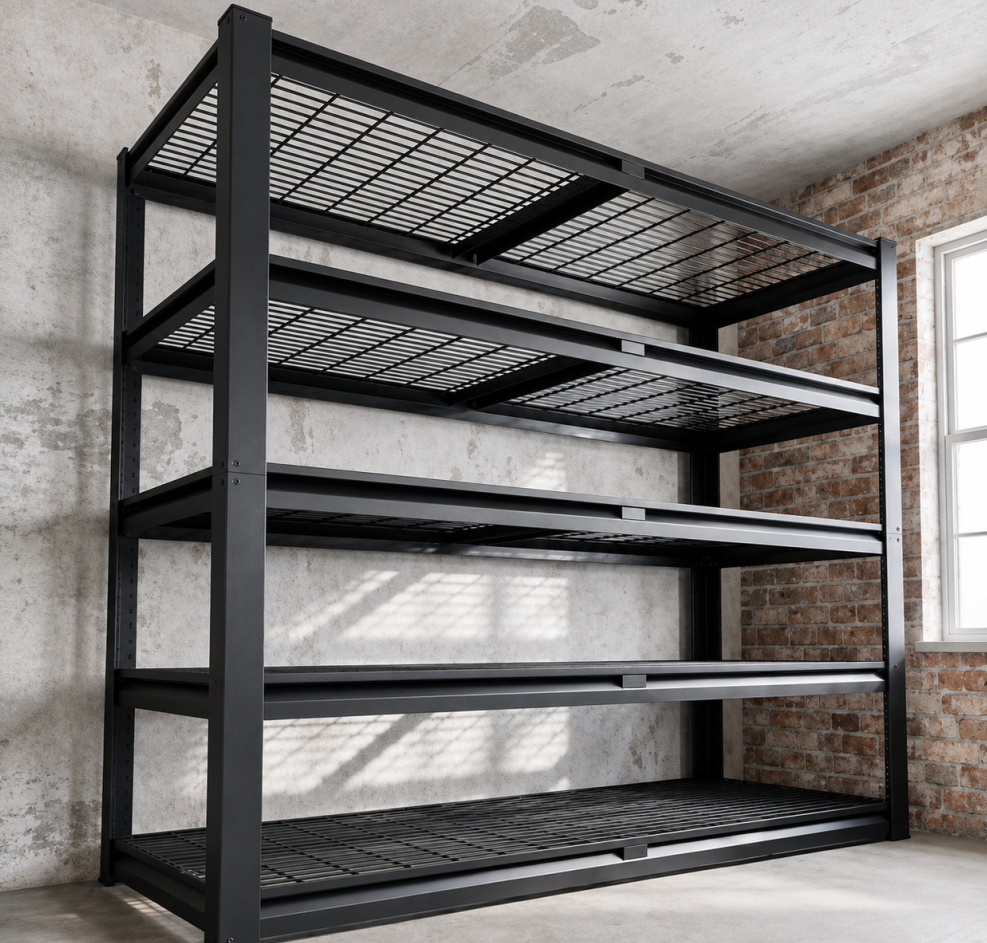
Wire mesh deck steel shelving combines open visibility, multi-level organization and steel construction. The five-level black rack shown organizes toolboxes, bins, portable equipment, reels, tires and containers. However, appearance alone cannot confirm suitability. Buyers must match the complete structure to the goods, loading pattern, floor and environment.
Why Choose Wire Mesh Decks?
Better visibility
Open mesh helps users see goods from different angles and locate tools, components and bins quickly.
Less dust accumulation on the deck
An open grid provides less continuous surface for dust to collect and can simplify visual inspection, although the floor still requires housekeeping.
Light and air can pass through
The open structure reduces shadows and permits airflow. This does not establish fire-code compliance; sprinkler arrangements, storage height and flue spaces must be assessed for the building and local rules.
Flexible use with bins and tools
Wire decks can support suitable cartons, tool cases, bins and equipment. Small parts or narrow feet may need compatible containers, trays or an approved load spreader.
The Deck Is Only One Part of the Load Rating
The wire panel’s capacity is not automatically the rack capacity. The deck, supports, beams, connectors, uprights, bracing, anchors or floor may govern.
Buyers should separate three numbers:
Load per level: the permitted load on one complete storage level.
Total bay load: the maximum load carried by the full shelving bay.
Point or unit load: the permitted load from one machine, bin, tire stack or other concentrated item.
Loading method matters. A uniformly distributed load (UDL) is spread over the usable shelf; a machine on four small feet can create higher local stress than cartons of the same total mass.
Do not multiply the load per level by five and assume the result is the allowable bay load. The complete frame and the approved position of each level must also support that total.
Seven Specifications to Confirm Before Ordering
1. Overall dimensions and usable shelf area
Confirm external dimensions and clear space between uprights. Usable deck area determines whether bins, tires and equipment fit.
2. Mesh opening and contact area
Compare the grid with the smallest carton, foot, wheel or container base. If a liner is needed, ask whether it changes ventilation, cleaning, load distribution or fire assessment.
3. Deck support arrangement
Request the number, profile and spacing of deck supports. Wide shelves or concentrated loads may need more support, and decks must seat securely on the frame.
4. Upright, beam and connector specification
Ask for profiles, steel grade, nominal thickness and connection type, linked to one controlled drawing. Similar-looking racks can have different capacities.
5. Number and position of levels
Moving levels can change unsupported upright length and force distribution. Follow approved level spacing rather than assuming every slot provides the same capacity.
6. Surface finish and environment
The rack has a black-coated appearance, but a photo cannot confirm coating chemistry or corrosion performance. Specify the humidity, chemicals and cleaning conditions. Review KAYOU’s general approach on our Quality Control page.
7. Stability, anchoring and floor conditions
Confirm levelling, anchoring, wall clearance, floor capacity and seismic requirements. A freestanding product image does not prove anchors are unnecessary.
Wire Mesh, Solid Steel or Engineered Board?
\n
\n
| Deck Type | Practical Advantages | Points to Verify |
|---|---|---|
| Wire mesh | Open visibility, airflow, less deck-surface dust and easy use with bins | Grid size, point loads, deck supports and small-item containment |
| Solid steel panel | Continuous surface for cartons and small items; easy to wipe | Panel reinforcement, liquid retention, weight and corrosion protection |
| Engineered board | Flat surface and often economical for dry indoor storage | Board grade, moisture resistance, edge support and replacement conditions |
No deck type is universally best. The correct choice depends on product dimensions, weight distribution, hygiene requirements, humidity, handling method and local safety rules.
Planning the Five Levels
The loaded product image provides a useful starting point for practical zoning:
Top level: light, bulky and infrequently used items that can be handled safely.
Upper-middle levels: tool bags, labelled containers and frequently accessed supplies.
Waist-height levels: daily-use tools and parts, positioned to reduce reaching and bending.
Lower-middle level: denser equipment and larger bins that remain within the approved shelf load.
Bottom level: heavier cases, tires and stable containers, with sufficient floor and lifting clearance.
This arrangement is not a substitute for a risk assessment. Do not store incompatible chemicals together, and do not use general open shelving for flammable liquids or hazardous substances unless the storage method is specifically approved for them. Workers should use suitable access equipment rather than climbing the shelf structure.
Suitable Applications
Wire mesh deck steel shelving can be configured for:
garages and automotive service areas;
factory maintenance departments;
tool rooms and spare-parts stores;
warehouse picking and packing zones;
retail stockrooms and back-of-house storage;
equipment rooms and workshop supplies;
e-commerce inventory stored in bins or cartons.
For industrial projects, compare the pictured concept with KAYOU’s medium-duty steel shelving and broader steel storage shelving range. The final structure can then be configured around the products rather than selected by appearance alone.
Installation and Inspection Essentials
Before loading, verify that frames are level and plumb, connectors are fully engaged, locks or retainers are installed, mesh decks are seated correctly and anchors are fitted where required. Display the approved load information where users can see it.
During routine checks, look for bent uprights, damaged beams, loose connections, displaced decks, corrosion, missing anchors and permanent shelf deformation. Unload and isolate an affected area after impact or when a structural change is observed. Do not drill, weld, straighten or combine components from different systems without approval.
OSHA 29 CFR 1910.176(b) requires stored materials to be stable and secure against sliding or collapse. Product categories also matter: MHI/SMA standards distinguish industrial boltless steel shelving from retail or consumer shelving. Buyers should apply the standard and workplace rules relevant to the destination market and actual use.
B2B Buyer RFQ Checklist
Send the supplier the following information before requesting a final quotation:
overall and usable shelf dimensions;
required number and positions of levels;
maximum load per level and total bay load;
dimensions, weight and support points of the heaviest item;
UDL or concentrated-load requirement;
mesh opening, wire specification and support arrangement;
upright, beam, connector and bracing specifications;
coating system, color and operating environment;
anchoring, floor and seismic conditions;
assembly instructions, load-label sample and technical evidence;
order quantity, packaging and destination port.
Ask the supplier to identify the drawing revision covered by the load rating. Model-specific evidence is more useful than a generic test report for a different span, deck or component thickness.
Frequently Asked Questions
Is wire mesh shelving stronger than solid steel shelving?
Not automatically. Capacity depends on the complete deck and frame design. Compare model-specific ratings under the same dimensions and loading conditions.
Can small boxes sit directly on the mesh?
Only when their bases are large and stable enough for the grid. Use compatible bins or an approved liner for small items, and confirm that the accessory does not change the load assessment.
Can the shelf heights be adjusted?
The upright pattern shown may support adjustment, but the permitted range and capacity must be confirmed for the supplied model. Repositioning levels can affect frame demand.
Can tires be stored on the bottom level?
They can be stored there when the tire dimensions, total weight, support arrangement and shelf rating are suitable. Keep stacks stable and within the usable depth.
Is the black finish rustproof?
No finish should be assumed rustproof from appearance alone. Confirm surface preparation, coating type and suitability for the humidity or chemicals at the installation site.
What information is needed for a custom proposal?
Provide available space, shelf dimensions, item sizes and weights, loading pattern, number of levels, environment, quantity and destination. Photos or sketches of the stored products improve the technical review.
Conclusion
Wire mesh deck steel shelving can create clear, accessible storage for mixed tools, bins, equipment and garage supplies. Its real value comes from matching the mesh, supports and complete frame to the actual goods—not from choosing a rack by its appearance or a single capacity headline.
KAYOU supports configurable shelving solutions for distributors, project buyers, warehouses and workshops. Send us your storage list and site requirements for a model recommendation and quotation.
Build a Better Storage System with KAYOU
Send us your available space, item dimensions, load per level, quantity and destination for a suitable shelving configuration and quotation.