
KAYOU INSIGHTS · WAREHOUSE STORAGE & INTERNATIONAL SOURCING
APEC 2026 in Shenzhen: Steel Shelving for Asia-Pacific Supply Chains
By KAYOU Editorial Team · Published 19 November 2026
The official programme for APEC 2026 schedules the Economic Leaders’ Meeting for 18–19 November in Shenzhen, China. This year’s theme is “Building an Asia-Pacific Community to Prosper Together,” with openness, innovation and cooperation as the three priorities.
In its 3 November briefing, APEC also highlighted supply chain resilience and digital transformation. For warehouse operators, importers and industrial distributors, these discussions offer a useful starting point for a practical question: is your storage system suited to the goods, people and replenishment process it serves?
KAYOU’s perspective is operational: clear specifications, accessible stock and dependable order preparation deserve attention alongside cross-border sourcing. The following guide applies that perspective to steel shelving procurement.
1. Start with the goods and handling method
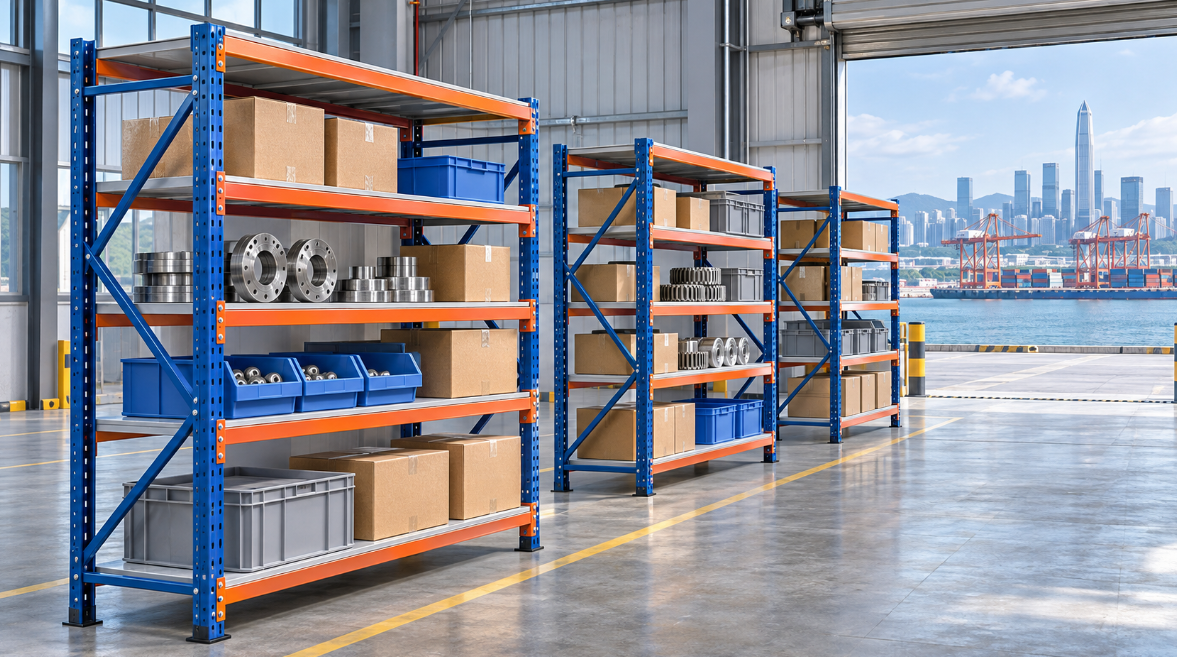
A warehouse storing hand-picked cartons needs a different arrangement from one handling full pallets. Before requesting a quotation, record the dimensions, weight and access frequency of your main products.
| Storage task | System to consider | Details to confirm |
|---|---|---|
| Hand-picked cartons and bins | Adjustable steel shelving | Usable shelf dimensions, access and load per level |
| Tools and spare parts | Steel shelving with suitable bins | Heaviest item, load distribution and identification |
| Full pallets moved by forklift | Pallet racking | Pallet dimensions, loaded weight and handling equipment |
For carton and parts storage, explore KAYOU’s adjustable heavy duty metal shelving units. For palletized goods, review our warehouse racking systems and request a configuration for your actual loads.
2. Compare complete load specifications
A capacity figure is useful only when it belongs to a defined configuration. KAYOU’s shelving product guide lists options from 100 to 500 kg per level under uniformly distributed load (UDL), depending on the selected structure.
UDL means the weight is spread evenly across the shelf. A heavy item resting on a small footprint creates a different loading condition. Tell the supplier about concentrated or uneven loads before accepting a specification.
When comparing quotations, keep the bay dimensions, shelf levels, steel sections, panel reinforcement and loading assumptions consistent. Ask for supporting information that matches the proposed model, and confirm both the level rating and the permitted total bay load.
3. Check usable space before adding more shelving
Draw the storage area with doors, columns, workstations and the routes used by people and equipment. Then place the goods within the proposed bays. This makes it easier to spot shelves that are too deep for convenient picking or levels that leave unnecessary empty space above cartons.
Illustrative planning example: two cartons measuring 600 × 400 mm occupy a nominal footprint of 1,200 × 400 mm when arranged with their 600 mm sides across the shelf. This is a starting calculation; confirm clear space between uprights, handling clearance and the actual shelf support arrangement before choosing a bay.
Confirm floor conditions, installation instructions and any anchoring requirements for the selected system. Leave access routes and equipment clearances to the project’s layout requirements.
4. Include packing and delivery in the purchasing comparison
For an importer, the quoted unit price is one part of the purchasing decision. Packing dimensions, freight, handling and installation also affect the cost of getting usable shelving into the warehouse.
Ask suppliers to identify:
The number of packages per shelving set, with dimensions and weights.
Protection for shelf edges, beams and upright components.
Component labels and assembly instructions.
The basis for the proposed container loading quantity.
The delivery term, named place or port, and quotation inclusions.
KAYOU offers knock-down shelving and discusses carton or pallet packing according to the order. Confirm shipment quantities after the dimensions, shelf levels and packaging method are agreed.
5. Make repeat orders easier to specify
For distributors and businesses with several warehouses, a shared specification sheet can make repeat purchasing easier to manage. Give each approved model a reference and record its dimensions, component list, rated loads, finish, labels and packing details.
Request written confirmation before changing components or configurations. A different bay width or shelf arrangement should be reviewed against the intended load. Keep the approved drawings, inspection requirements and assembly instructions with the order record.
Plan your next steel shelving order with KAYOU
APEC 2026 provides a timely setting for discussing regional cooperation. At warehouse level, a useful next step is to turn storage requirements into specifications that buyers and suppliers can check together.
KAYOU, based in Luoyang, China, supplies steel shelving for wholesale and project purchasing. Share the following information to start a configuration and quotation discussion:
Goods dimensions, weights and handling method.
Required bay size, shelf levels and quantity.
A simple layout or photographs of the storage area.
Delivery country and destination port or address.
Any packing, branding or inspection requirements.
Need steel shelving for your warehouse or distribution business?
Send your storage requirements to discuss a suitable configuration, packing details and bulk-order pricing.
Request a Shelving Quote Discuss on WhatsApp