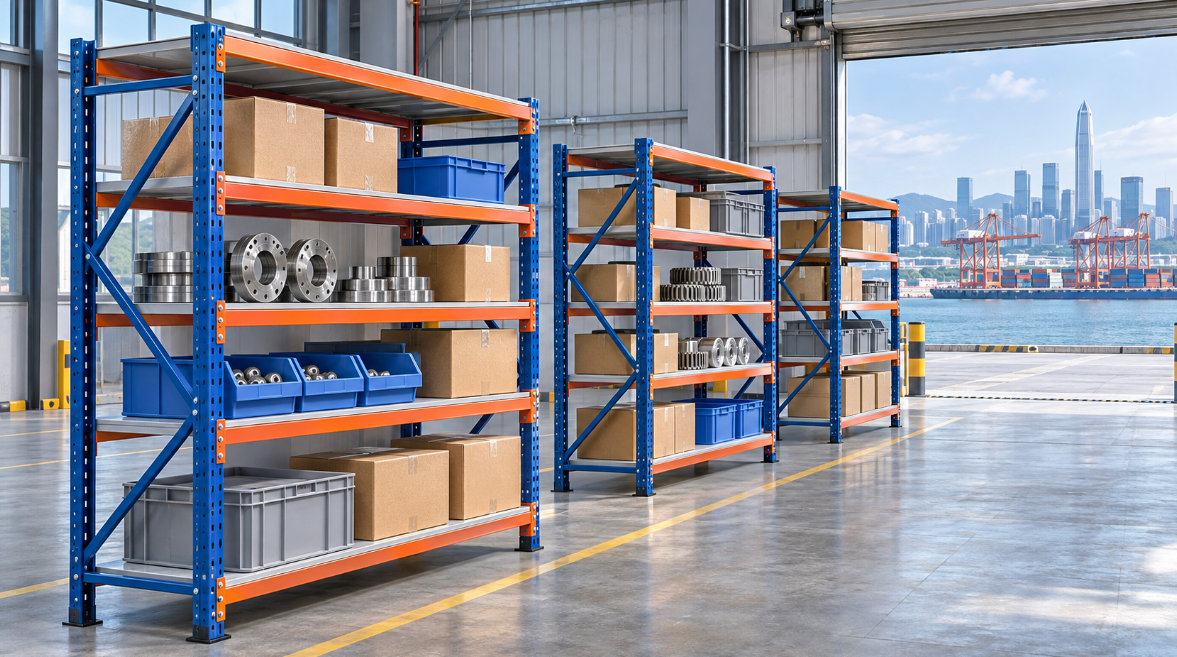



How to Find a Reliable Steel Shelving Manufacturer in China
KAYOU | Procurement Guide for Importers, Distributors and Warehouse Project Buyers
KAYOU / B2B SOURCING GUIDE
Finding a reliable steel shelving manufacturer in China starts with a clear specification and a verifiable supplier identity. Shortlist companies that already produce your shelving type, compare quotations against the same drawing, check model-specific load evidence, and approve a sample before committing to bulk production.
The objective is to find a partner that can repeatedly deliver the agreed product, packaging and support at a commercially workable cost.
1.Search for the Shelving You Actually Need
Start with the goods, handling method and buying purpose. Shelving for hand-loaded cartons, automotive parts and e-commerce bins can require different dimensions, decking and reinforcement.
Useful searches include:
Boltless steel shelving manufacturer China
Longspan shelving supplier for warehouse storage
OEM metal shelving manufacturer for distributors
Custom steel shelving with steel shelf panels
Use manufacturer websites, B2B platforms and exhibition directories to build a shortlist. Then request examples close to your required span, load, shelf material and assembly method.
Explore KAYOU storage shelving to identify a suitable starting configuration before requesting a quotation.
2.Establish Who Makes, Sells and Guarantees the Goods
Ask for the registered Chinese company name, business licence, Unified Social Credit Code and production address. Check registration details through China’s National Enterprise Credit Information Publicity System, using local assistance where necessary.
Identify the contracting company, factory operator, exporter and payment beneficiary. Where these differ, request a documented explanation of their relationship and responsibilities.
An export company working with a production facility can be a practical sourcing arrangement. What matters is knowing who controls manufacturing, approves changes and resolves claims.
Ask whether forming, welding, coating and packing are performed internally or subcontracted. Transparent answers help you evaluate control over your order.
3.Request Production Evidence Tied to Your Model
A polished catalogue shows what a supplier offers. To assess production capability, request evidence linked to the shelving you intend to buy.
A live factory walkthrough or independent visit should cover relevant manufacturing stages, measuring equipment, assembly checks and packaging. Ask to see an upright, beam and shelf panel comparable to your specification.
Check whether the supplier can explain:
How component thickness and dimensions are recorded
How connector fit, hole positions and reinforcement are checked
How coating colour and finish are controlled
How production batches are identified
For steel thickness, agree measurement locations, tolerances and whether the stated figure excludes coating. A product’s net weight can support consistency checks, but it does not establish its load capacity.
Review KAYOU’s quality-control process when preparing your inspection questions.
4.Verify the Load Claim for the Quoted Configuration
“300 kg per shelf” needs a defined configuration and loading condition. Ask whether the rating applies to a uniformly distributed load, what the maximum bay load is, and which shelf spacing and bracing arrangement were assessed.
Request a test report or engineering assessment identifying the model, dimensions, components, loading method and results. If the supporting evidence covers another configuration, ask how it applies to your order.
Manufacturer documentation illustrates why these details matter. Lyon’s shelf-capacity specifications distinguish evenly distributed loading and identify shelf spacing as information needed to evaluate post capacity. Its published figures apply to its own products and cannot be transferred to another supplier’s shelving.
Check certificates separately: company name, scope, issuing body and validity. ISO 9001 management-system certification does not replace product-specific load evidence. ISO’s certification guidance explains how accredited certifications can be verified.
5.Compare Quotations Using One Specification
Send every shortlisted supplier the same requirement sheet. Otherwise, an attractive price may describe a different product.
For example, two offers for a 2000 × 600 × 2000 mm shelving unit may use different upright sections, shelf supports or packaging. Treat this as a specification comparison before negotiating the price.
Ask suppliers to identify every deviation from your requirement sheet. This creates a clearer basis for approval and future reorders.
An illustrative fit check
Suppose a distributor needs five-level shelving for 600 × 400 mm bins. An advertised depth of 600 mm does not, by itself, confirm that a bin will fit in the intended orientation. Ask for the clear space between uprights, the usable deck depth and any intrusion from braces or connectors.
Then confirm how many bins fit on each level, including handling clearance, and whether the intended loading pattern matches the capacity assessment. Add this arrangement to the approved drawing and check it on the sample.
This is an illustrative purchasing scenario, not a reported KAYOU customer project. It shows how a familiar outside dimension can leave an important operating requirement unresolved.
6.Make Sample Approval Useful for Bulk Production
Order a sample when the product, supplier or packaging is unfamiliar. Inspect the usable opening with your actual cartons or bins, assemble the unit using its instructions, and check component fit, finish and accessories.
Record the approved drawing revision, component list, measurements, packaging and photographs. Keep the sample as a reference.
The purchase order should explain how substitutions and changes will be approved. A sample alone cannot demonstrate that every production unit will match.
Use a steel shelving sample approval checklist to document acceptance. Agree a pre-shipment inspection plan covering randomly selected production units, quantities, assembly fit and packaging before authorising shipment.
7.Evaluate the Delivered Cost and Delivery Plan
Ask for packed dimensions, packages per set, gross weight and a loading plan for your exact model mix. Container quantities should reflect both available space and permitted weight.
Compare the costs relevant to the agreed trade term: goods, export handling, freight, insurance where applicable, destination charges, import charges and inland delivery. Confirm destination-specific import requirements and charges with your customs broker.
Also ask how beams, uprights and shelf edges are protected during handling. A compact package is valuable when it arrives complete and usable.
For delivery, request milestones for materials, production, coating, packing and inspection. Clarify whether the quoted lead time ends when goods are ready at the factory or when they are loaded for shipment.
8.Check Whether the Supplier Supports Your Next Order
Distributors need consistent products across repeat purchases. Project buyers may need extra shelves or replacement components after installation.
Before ordering, confirm how the supplier manages drawing revisions, colour references, spare parts and discontinued models. Ask whether branded cartons, barcodes and assembly instructions are available for your intended sales channel.
Agree a practical claims procedure: the records required, response responsibilities and available remedies for confirmed shortages or defects. Put the agreed terms in the purchase documents.
Communication provides useful evidence here. Look for specific answers, written follow-through and early disclosure of limitations.
A Practical Supplier Decision Table
Use this table to record evidence before approving a first order. It is a purchasing aid rather than a certification scheme.
If a decision area remains unclear, obtain the missing evidence before treating that supplier’s quotation as fully comparable.
Questions Buyers Frequently Ask
Should I choose the lowest-priced manufacturer?
Compare equivalent specifications and delivered costs first. A lower quote can be suitable when the product meets your requirements and the supply scope is clear.
Is a factory video enough to verify a supplier?
A video helps you understand facilities and processes. Combine it with registration checks, model-specific documentation, sample approval and inspection evidence.
Can one test report cover every shelving size?
Ask the supplier to explain the report’s applicable configurations. A different span, component, shelf spacing or bracing arrangement may require additional assessment.
Request a Shelving Proposal from KAYOU
KAYOU supplies steel storage shelving and offers customisation for B2B requirements. To discuss a wholesale, distribution or warehouse project, send your destination, quantity, dimensions, shelf levels, goods and required load.
You can use this enquiry template:
We need [quantity] steel shelving units for [application] in [country]. Required size: [W × D × H], with [number] shelf levels and [load] kg UDL per shelf. Please quote the component specifications, load evidence, sample options, packaging, loading quantity, lead time and [trade term with named place/port]. Custom branding: [required/not required].
Attach a warehouse sketch, carton dimensions or existing product specification if available. These details help establish a useful starting point for configuration and quotation.