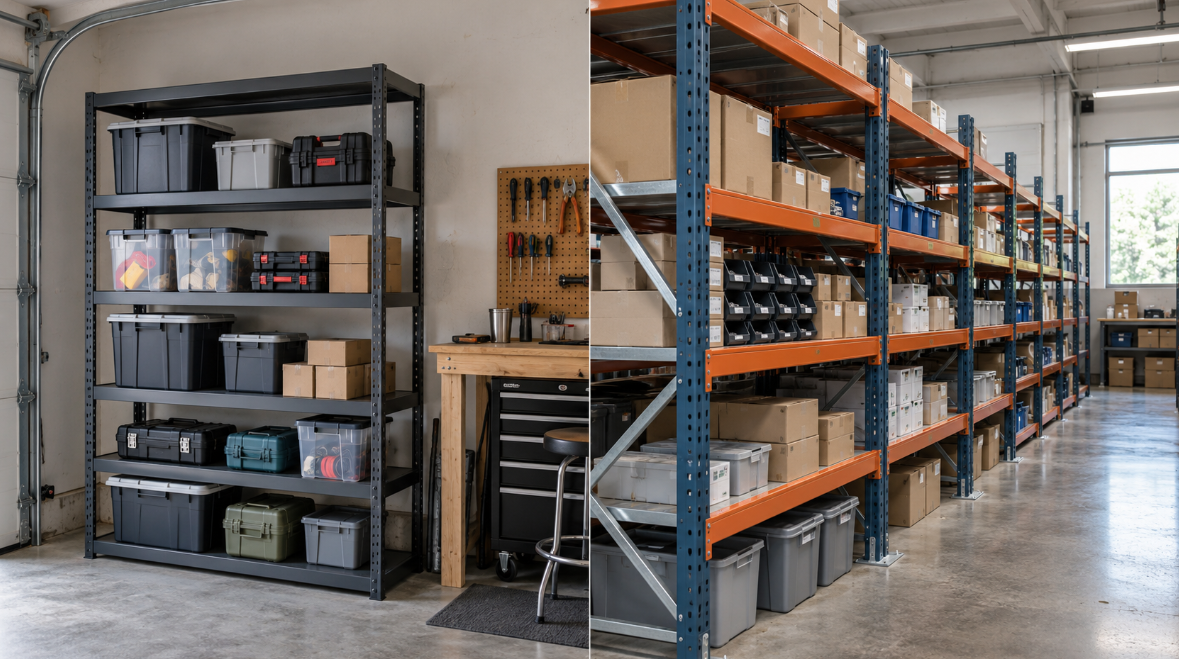




Does Metal Shelving Need Anchoring? Floor Fixing vs Wall Restraint Explained
KAYOU INSIGHTS / INSTALLATION & SAFETY
A metal shelving unit can have a high shelf load rating and still need anchoring. Capacity tells you how much a specified configuration can support; it does not, by itself, establish how the unit remains stable in its installation.
QUICK ANSWER
Metal shelving needs floor fixing, wall restraint or another specified stability arrangement when its installation instructions or project design require it. Floor fixing and wall restraint serve different connections and should not be substituted without approval.
For buyers, the useful question is: “What stability arrangement has been specified for this model, configuration and location?”
This guide explains the differences for floor-standing shelving in warehouses, stockrooms, garages and workshops. It also distinguishes shelving from pallet racking, where installation requirements can be different.
Floor Fixing vs Wall Restraint: What Is the Difference?
On smaller screens, swipe the table horizontally to view all columns.
| Item | Floor fixing | Wall restraint |
|---|---|---|
| Connection | Shelving feet or baseplates connected to the floor | Shelving frame connected to a suitable wall or building component |
| Main purpose | Provide the designed connection at the base, including resistance to specified horizontal forces and uplift | Restrain specified movement or overturning through a connection to the building |
| Supporting construction | Usually the structural floor slab, as defined by the design | The actual supporting wall, framing or structural member |
| Information needed | Baseplate detail, anchor specification, design forces and slab suitability | Tie detail, connection forces and verification of the supporting construction |
| Interchangeable? | Only if the revised arrangement is assessed and approved | Only if the revised arrangement is assessed and approved |
For a typical floor-standing unit, gravity loads pass through the shelves and uprights into the floor. A wall restraint does not automatically make the wall a support for the stored weight.
Likewise, floor anchors should not be described simply as bolts that “carry the shelf load.” In rack systems, baseplates spread column forces into the floor, while anchors provide the specified connection for actions that can include horizontal forces and uplift. Their functions need to be assessed together. [1]
Wall-mounted shelving is a separate case: its brackets and supporting wall are part of the primary load path. Guidance for restraining a floor-standing shelf should not be used to design a wall-mounted system.
Does Every Metal Shelving Unit Need the Same Fixing?
No. “Metal shelving” covers products with different uses, dimensions and installation arrangements.
For manually loaded shelving, obtain the instructions for the exact model. Check whether they require floor anchors, wall restraints, connected rows or other stability provisions. A photograph, a generic catalogue description or the word “freestanding” is not enough to approve an installation.
Pallet racking needs particular attention. RMI guidance calls for all pallet rack columns, including rear or interior columns, to be anchored to the floor. It also directs users to the manufacturer or engineer for anchor selection and positioning. This is pallet rack guidance; it should not be presented as an identical rule for every small shelving unit worldwide. [2]
Mobile shelving needs its own system-specific assessment. Do not transfer a fixing detail from a stationary shelf to a unit on wheels or a mobile carriage.
When comparing KAYOU storage shelving with warehouse racking systems, establish the product category and intended handling method before comparing installation requirements.
Can You Fix Shelving to a Wall Instead of the Floor?
Only when that arrangement is suitable for the shelving and the building, and has been approved for the application.
A wall connection transfers forces into something beyond the shelf. The connection must work through the fixing, the wall or framing, and the building structure.
MHI’s Storage Manufacturers Association advises consulting both the equipment provider and the building designer before tying shelving to walls or building columns. Its guidance explains that the building engineer needs to consider the additional forces and the interaction between the structures. [3]
Before accepting a wall restraint detail, ask:
What is the actual supporting construction behind the surface finish?
Where should each tie connect to the shelving?
What forces must the tie and its fixings resist?
Who has confirmed that the wall or structural member can accept those forces?
A wall that looks solid is not evidence of connection capacity. Concrete, masonry, framed partitions and lightweight cladding require different assessments.
Avoid adding an improvised bracket simply because the shelf is close to a wall. Proximity does not establish a suitable connection.
What Must Be Checked Before Floor Anchoring?
A sound installation requires more than an anchor bolt of the right nominal diameter.
1. The floor must suit the proposed connection
Identify the slab construction, available thickness, concrete condition and relevant design information. Locate edges, joints and damaged areas.
For rack installations, RMI’s installation guidance highlights checking floor strength, thickness and level, with slab information obtained through the building engineer. It also connects installation with the approved layout and configuration drawings. [4]
An existing warehouse floor should not be assumed suitable for any rack simply because it already supports other equipment.
2. The anchor must suit its location
Anchor selection involves the product, baseplate, substrate and calculated forces. A bolt’s diameter alone is not a complete specification.
Hilti’s engineering guidance identifies minimum spacing, edge distance and concrete thickness as installation constraints. Installing outside the applicable limits can cause problems such as concrete splitting or underside spalling. [5]
Practical purchasing implication: request the specified anchor product or an approved equivalent, together with the relevant installation requirements. A substitution based only on diameter is insufficient.
3. Concealed services and reinforcement need consideration
Before drilling, establish whether the proposed locations conflict with services, reinforcement or post-tensioning tendons. Use the site’s approved investigation and drilling procedure.
Hilti identifies locating embedded objects before anchor drilling as an application for concrete scanning. Scanning supports planning; its capability and limitations still need to be understood. [6]
4. Installation must match the approved detail
Confirm the specified anchor locations and installation method. Record any approved changes.
Do not assume every hole in a baseplate must be used, or that any available hole is acceptable. RMI notes that some baseplates have alternative holes, and that the required quantity and location come from the manufacturer or engineer. [2]
Does an Anchor Pull Test Prove the Shelving Is Safe?
No. An anchor test answers a defined question about the connection being tested. It does not establish the capacity of the entire shelving system.
Site testing can help assess a fixing in uncertain construction or check installation quality under a defined procedure. The report should identify the anchor, substrate, test method, applied load and acceptance criteria.
Hilti states that site testing cannot replace proper anchor design or product approval. [7]
For a buyer, this means an anchor pull-test report should be reviewed alongside the shelving drawings, load information and installation records. It does not verify shelf panels, beam connections, upright strength or every possible loading arrangement.
Similarly, a shelf load test does not automatically validate the proposed floor anchors. These are different parts of the evidence package.
For the distinction between a stated load rating and supporting evidence, see Steel Shelving Load Capacity: How to Verify UDL, Load Testing and Structural Design.
What If the Site Does Not Allow Floor Drilling?
Treat “no drilling” as a project constraint that needs resolving before purchase.
Ask the supplier and responsible designer whether a suitable alternative configuration is available. Options must be assessed for the actual product and site; a permitted wall connection is not automatically equivalent to floor anchoring.
For leased premises, establish who can approve floor or wall modifications. If neither is permitted, select a storage solution whose approved installation arrangement can meet that constraint.
Do not remove specified anchors and assume careful loading will compensate. The proposed installation would no longer match the original requirements.
What Should Buyers Request Before Ordering?
Include fixing requirements in the quotation review, rather than leaving them until delivery.
On smaller screens, swipe the table horizontally to view all columns.
| Request | What it helps establish |
|---|---|
| Exact model and configuration drawing | The shelving being supplied, including height, depth and shelf positions |
| Load information and its conditions | What the rating applies to and how loads must be distributed |
| Installation instructions | Required anchoring, restraints, assembly sequence and tolerances |
| Baseplate and fixing details | Specified connections, locations and installation requirements |
| Site information requirements | What must be verified about the floor, wall and surroundings |
| Scope of supply | Whether anchors, restraints and installation services are included |
| Handover records | Whether the completed installation matches the approved arrangement |
Agree responsibilities early: who supplies the shelving information, who verifies the building conditions, who installs the fixings, and who accepts the completed installation.
Product inspection and site verification serve different purposes. KAYOU’s quality control information provides context for manufacturing checks; the suitability of a specific floor or wall still needs project-specific confirmation.
Can Shelf Adjustments Affect the Fixing Requirements?
Changing shelf levels, overall height or the connected layout can change the configuration being assessed.
MHI’s shelving guidance cautions against assuming that a reconfigured unit retains its original capacity. Obtain confirmation before using a configuration outside the approved arrangement. [3]
Keep the connection question in the same review: does the revised arrangement still match the specified anchoring or restraint detail?
See Does Changing Shelf Level Spacing Affect Steel Shelving Load Capacity? for related considerations.
Adding anchors should not be used to increase a shelf’s published load rating without supporting assessment.
Inspection Before Use and After Changes
Before loading, check that the installation matches the approved documents, including the configuration and required fixings. RMI’s rack installation guidance calls for a final inspection before use. [4]
Keep the drawings, installation instructions and handover records available. If a connection is damaged, the shelving is struck, or the layout changes, arrange review before continuing affected operations. Do not treat a visibly loose or damaged fixing as a routine tightening task without identifying the cause.
Frequently Asked Questions
Can heavy items on the bottom shelf replace anchoring?
No. A loading preference does not replace anchors or restraints specified in the installation instructions. Stored stock can also be moved or removed.
Is there a universal height at which shelving must be anchored?
There is no single height rule that approves every product and installation. Use the model-specific instructions and applicable project requirements.
Can wall restraint and floor fixing be used together?
Yes, where both form part of an approved design. Adding an unassessed wall connection can introduce forces into the building, so additional fixings are not automatically beneficial.
Can I use the same anchor for every shelving installation?
Do not assume so. The connection must suit the baseplate, design forces, substrate and installation location.
Related KAYOU Guides
Discuss Your Shelving Installation with KAYOU
Planning storage for a warehouse, stockroom, workshop or garage?
Send KAYOU your proposed shelving dimensions, required loads, layout and installation constraints. Identify any floor-drilling restrictions or proposed wall connections early so that the quotation and technical discussion address them.
This article is a general purchasing guide. Installation must follow the applicable project design, product instructions and local requirements.
Sources
Sources checked on October 16, 2026. The dated RMI articles below are established guidance, not newly issued standards. This article does not reproduce or interpret inaccessible standard clauses.
Rack Manufacturers Institute, Base Plates And Anchors: The Foundation Of A Solid Rack Structure, June 20, 2020.
Rack Manufacturers Institute, Why Are Racks Anchored To The Floor?, November 10, 2017.
MHI Storage Manufacturers Association, Frequently Asked Questions, undated public guidance.
Rack Manufacturers Institute, Rack Installation Safety Requirements Detailed In RMI’s New Video, November 10, 2023.
Hilti, PROFIS and anchor load adjustements, official engineering Q&A; publication date not verified.
Hilti, PS 1000 X-Scan Concrete Scanner, official product applications; publication date not verified.
Hilti, Anchor Site Testing, official engineering service guidance; publication date not verified.