

Garage Shelving vs Industrial Shelving: What Bulk Buyers Should Compare
KAYOU INSIGHTS / BULK BUYING GUIDE
A shelving quotation arrives with an attractive price, a five-level configuration and the words “heavy duty.” Another supplier describes a similar-looking product as industrial shelving. Which should an importer, distributor or warehouse buyer choose?
The answer depends on the specification behind each offer.
Garage shelving and industrial shelving can overlap in appearance and application. Compare the model’s documented load capacity, construction, installation requirements and supply scope before deciding whether it fits your customers or project.
This guide focuses on manually loaded shelving for cartons, bins, tools and components. Forklift-loaded pallet storage requires a system specifically assessed for that handling method.
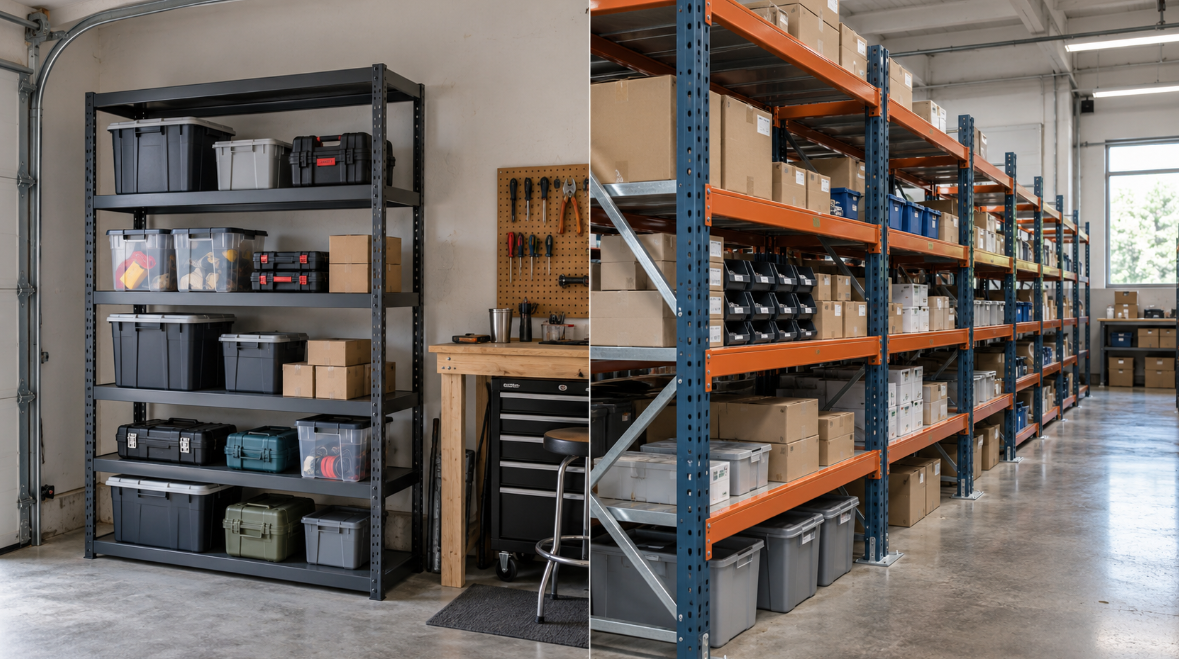
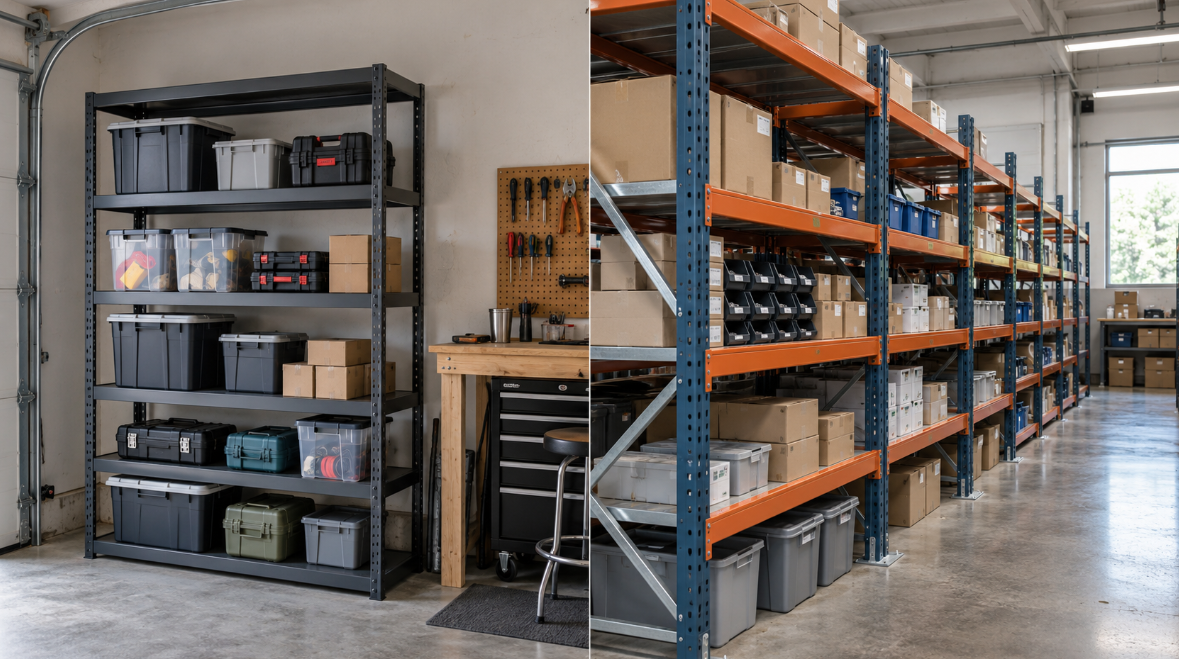
AI-generated illustration comparing garage and industrial storage settings.
Garage Shelving vs Industrial Shelving: The Main Difference
“Garage shelving” usually describes a storage application. “Industrial shelving” points towards business or industrial use, but the name alone does not establish a load rating or the suitability of a particular model.
The distinction becomes more useful when buyers define their requirements:
Scroll horizontally to view the full table.
| Buying question | Garage or retail-oriented enquiry | Industrial or project-oriented enquiry |
|---|---|---|
| What will be stored? | Household containers, tools or mixed garage items | A defined inventory of cartons, bins, components or supplies |
| Who will use it? | Individual customers or small teams | Multiple users working within an operating procedure |
| Which dimensions matter? | Fit within the available room | Usable shelf space, inventory fit, access and layout |
| What documentation is needed? | Clear product ratings, assembly and use instructions | Those items plus project-specific details where required |
| What affects purchasing cost? | Delivered unit price and assembly | Supply scope, packing, installation, replacements and repeat-order consistency |
These are purchasing scenarios, rather than fixed performance classes. A garage product still needs reliable safety information, and a commercial product still needs an assessment appropriate to its intended use.
KAYOU’s storage shelving range includes options for garages, workshops and warehouses. Selection starts with the goods and operating conditions.
1. Compare Load Ratings on the Same Basis
A headline capacity can describe one shelf, the complete unit or a particular loading arrangement. Those meanings must be separated.
Before comparing two offers, confirm:
Maximum permitted load per level.
Maximum permitted load for the complete bay or unit.
Whether the rating assumes a uniformly distributed load, or UDL.
Shelf dimensions, supports and level positions covered by the rating.
Any specific limits for concentrated items or uneven loading.
Cartons spread across a shelf create a different loading pattern from equipment resting on small feet. The total weight alone does not describe that difference.
Likewise, multiplying the shelf rating by the number of levels does not establish the permitted bay load. Request both limits for the proposed configuration.
KAYOU’s steel shelving load capacity guide explains how to review these definitions and the supporting evidence.
For bulk buyers, the practical question is: Does the supplied label accurately describe how this specific unit may be loaded?
2. Look Beyond Steel Thickness
Thickness is useful information, but a complete structure contains more than a sheet-metal measurement.
Ask for the upright and beam profiles, material specifications, shelf reinforcement, connections and support arrangement. Compare these against the same overall dimensions and loading requirement.
A practical inspection should look at:
Shelf backs and reinforcement, rather than only the top surface.
How connectors engage with the uprights.
Specified braces, locks, retainers and fasteners.
Base details and installation provisions.
Fit between components during trial assembly.
A boltless connection, bolted frame or welded upright can each be appropriate in a suitable design. The connection name alone does not establish the performance of the assembled shelving.
For buyers comparing export structures, see KAYOU’s bolted vs welded shelving upright guide.
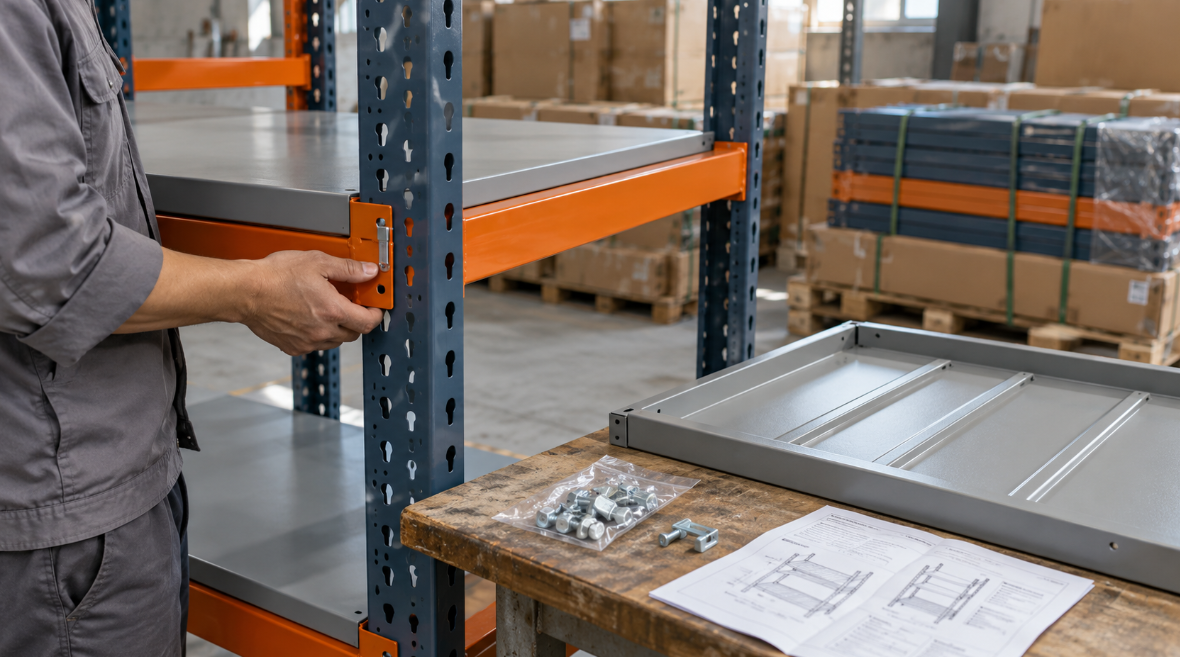
AI-generated illustration of shelving components and packing inspection.
3. Match the Deck and Adjustable Levels to the Inventory
A heavy duty metal shelving unit should be selected around the items it will support.
Solid steel panels, wire decks and engineered boards offer different surfaces and support arrangements. Review the smallest container base, equipment feet, cleaning conditions and environment before choosing.
For example, small loose components may need bins or trays on an open mesh surface. A flat deck still needs adequate support for the intended load.
Adjustable metal shelving also needs a defined operating configuration. The MHI Shelving Manufacturers Association advises checking configuration drawings before repositioning shelves and seeking approval when the proposed arrangement has not already been covered.
Request an approved range of level positions and clear loading instructions. Adjustability is a useful feature when the permitted configurations are understood.
4. Check the Product Category and Assessment Basis
Industrial and consumer shelving are addressed separately in relevant US standards.
The ANSI public catalogue lists:
Scroll horizontally to view the full table.
| Reference | Category identified in the public description |
|---|---|
| ANSI MH28.2-2022 | Industrial steel boltless shelving |
| ANSI MH28.4-2024 | Retail/consumer boltless steel shelving |
The second standard’s public scope expressly excludes industrial boltless shelving addressed by ANSI MH28.2.
This distinction gives buyers a useful question to ask: Which product category and assessment basis apply to the quoted model and destination?
The descriptions above come from public catalogue information. They do not replace the full standards or establish that a particular product complies with them.
When reviewing a test report, connect it to the quoted model, drawing revision, dimensions, components and loading conditions. If the tested sample differs from the proposed product, request an explanation of applicability.
5. Confirm Installation and Workplace Conditions
A product photograph does not show whether the shelving suits a particular floor, anchoring arrangement or operating area.
Obtain installation instructions covering the supplied configuration. Confirm the floor conditions, levelling, required fixings, clearances and responsibilities before delivery.
The MHI shelving FAQs identify correct assembly, plumbness, bolt tightening and anchoring as important installation considerations. Floor anchoring and attachment to a building should follow the applicable design and manufacturer’s instructions.
For US workplaces, OSHA 29 CFR 1910.176 addresses safe clearances and secure material storage. It should not be presented as a product-specific shelving capacity certificate.
Include the end user’s operating requirements in the enquiry, especially where handling equipment, traffic or unusual loads are involved.
6. Compare Packaging and the Delivered Supply Scope
For international bulk orders, the purchase decision extends beyond the factory price.
Request packed dimensions, gross weight, components per set, carton quantities and the proposed loading arrangement. A knock-down design may offer packing advantages, while a pre-assembled frame may reduce on-site assembly work. Check the actual proposal.
Also establish:
Which fasteners, retainers and accessories are included.
Whether labels and instructions match the destination.
How panels and coated surfaces are protected.
How replacement components will be identified.
Who supplies and installs any project-specific fixings.
Compare quotations at the same delivery and service scope. Freight, unloading, assembly and local project services should be identified where applicable.
KAYOU’s steel shelving wholesale guide explains the packing and container-planning information buyers should request.
7. Approve a Repeatable Specification Before the Bulk Order
An approved sample is most useful when its important features are recorded.
Create a controlled specification covering dimensions, components, material requirements, finish, load information, accessories and packaging. Reference the same revision in the quotation and order.
Ask the supplier to demonstrate:
Assembly using the supplied parts and instructions.
Dimensions at agreed inspection points.
The stated material and component specifications.
Relevant load-assessment evidence.
Packing contents and protection.
The process for agreeing substitutions or later changes.
KAYOU’s quality control process describes checks on materials, dimensions, production, finish, accessories and packaging. Agree the inspection scope and records required for your particular order.
A Bulk Buyer’s Shelving RFQ Checklist
Send each supplier the same requirements to make the offers easier to compare.
Scroll horizontally to view the full table.
| Information to provide | What to clarify |
|---|---|
| Storage goods, dimensions and maximum weights | Inventory fit and loading pattern |
| Overall and usable shelf dimensions | External footprint and clear storage space |
| Number and position of levels | Required configuration and adjustment range |
| Load per level and total unit load | Capacity definitions and supporting basis |
| Environment and cleaning conditions | Material and finish suitability |
| Floor and installation information | Fixings, site verification and responsibilities |
| Quantity, branding and destination | MOQ, labels, instructions and packing |
| Delivery terms and service requirements | The complete quoted supply scope |
Include photographs of the stored items where possible. They can reveal support points or handling constraints that a weight figure misses.
Frequently Asked Questions
Is Industrial Shelving Always Stronger Than Garage Shelving?
No. Compare the documented performance of the specific models under equivalent dimensions and loading conditions. Category names alone are insufficient.
Can Garage Shelving Be Used in a Business?
It may be suitable when its assessed use, capacity, installation requirements and operating limits match the application. Confirm the intended workplace use with the supplier.
Is Thicker Steel Always the Better Choice?
Thickness is one input. Profiles, reinforcement, connections, span and the complete configuration also affect performance. Compare the structure and evidence together.
Can I Adjust Every Shelf Without Changing Capacity?
Only use arrangements covered by the supplied configuration information. Confirm proposed changes with the manufacturer when their applicability is unclear.
What Evidence Should Accompany a Heavy-Duty Claim?
Request identifiable capacity information, model specifications, installation instructions and the relevant test or calculation basis. The evidence should match the supplied configuration.
Related KAYOU Buying Resources
Steel Shelving Load Capacity Guide
Understand UDL, shelf loads, bay loads and supporting evidence.
Steel Shelving Wholesale Guide
Prepare your requirements for MOQ, packing and shipment planning.
Heavy Duty Metal Shelving with Adjustable Shelves
Explore a product configuration for your warehouse or garage enquiry.
READY TO COMPARE YOUR SHELVING OPTIONS?
Discuss Your Shelving Requirements With KAYOU
KAYOU offers configurable steel shelving for warehouse, workshop, garage and commercial storage enquiries.
Explore our heavy duty metal shelving unit with adjustable shelves, then send us your dimensions, stored goods, load requirements, quantity and destination.
We can discuss the proposed configuration, packing and documentation scope before quotation.
Send: dimensions, stored goods, load requirements, quantity and destination.