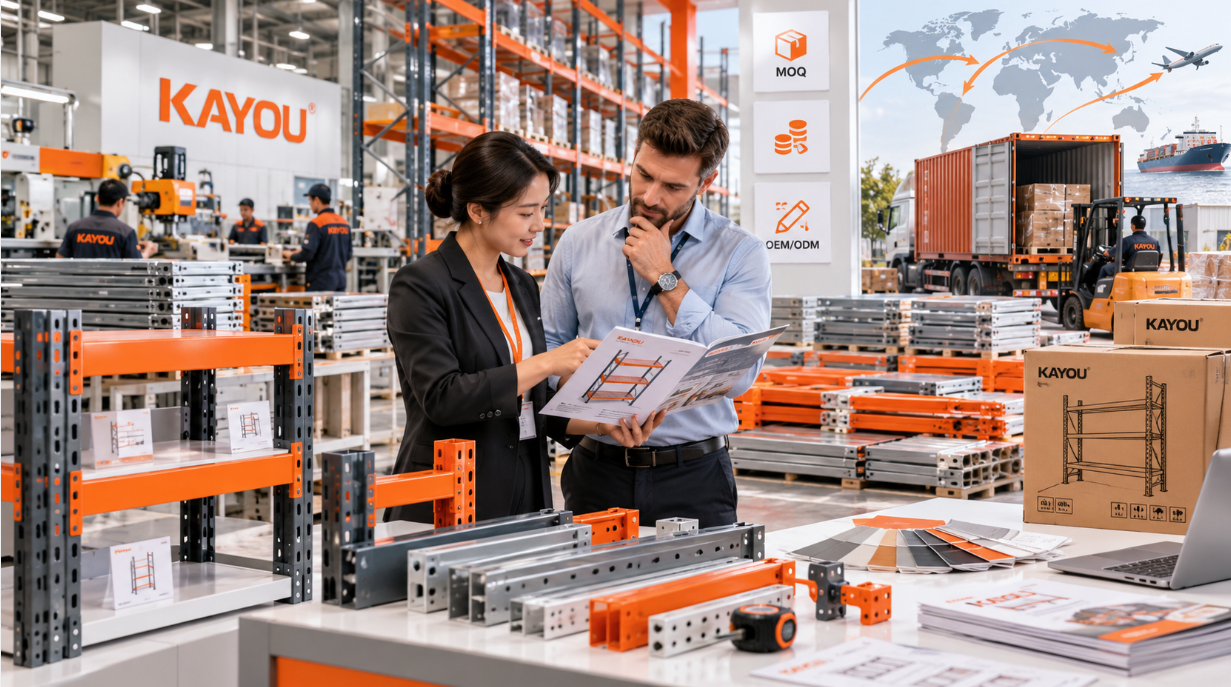

KAYOU · B2B Sourcing Guide
Steel Shelving Wholesale from China: MOQ, Pricing, Packaging and Container Loading
A practical procurement guide for distributors, importers and warehouse project buyers.
Buying steel shelving wholesale from China is very different from ordering a few shelves from a local retailer.
For distributors, warehouse contractors, importers and project buyers, the purchase decision involves much more than the unit price.
You need to know:
What is the real MOQ?
How is the price calculated?
Can dimensions and load capacity be customized?
Should you order a sample first?
How much space will the shelving occupy in a container?
Is knock-down packaging better than welded construction?
How long does production take?
How can you verify steel thickness and load capacity before shipment?
A good quotation should answer these questions before a purchase order is confirmed.
This guide explains how professional buyers can source steel shelving wholesale from China more efficiently and compare suppliers on total project cost rather than price alone.
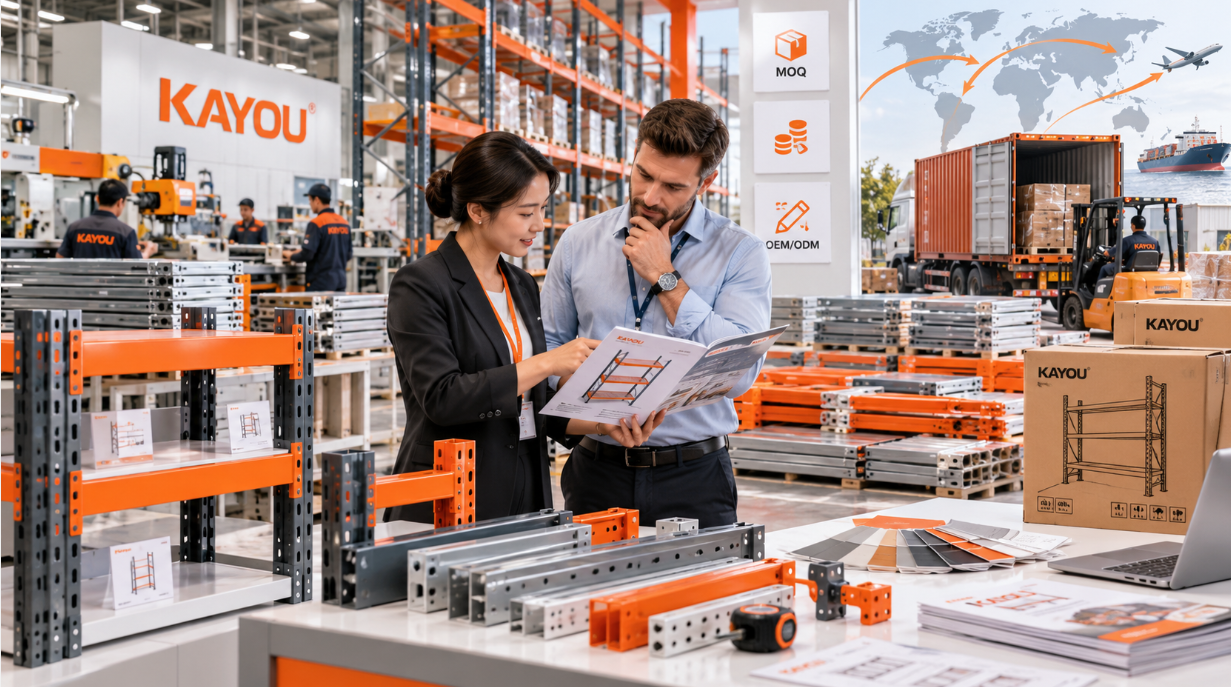
1. What Does “Steel Shelving Wholesale” Actually Mean?
Wholesale steel shelving usually refers to bulk purchasing directly from a manufacturer or large supplier rather than purchasing individual retail units.
Typical buyers include:
shelving distributors
warehouse equipment dealers
building contractors
logistics companies
e-commerce warehouse operators
industrial factories
retail chains
hardware wholesalers
storage equipment importers
The most common wholesale products include:
Light-duty shelving
Suitable for offices, retail stockrooms, household storage and lightweight cartons.
Medium-duty shelving
Commonly used for manual picking, cartons, plastic totes, spare parts and industrial storage.
Heavy-duty shelving
Designed for larger cartons, machinery parts, tools and higher shelf loads.
Boltless shelving
Popular with distributors because it is easy to assemble and can usually be packed efficiently.
Customized industrial shelving
Designed around specific dimensions, load requirements, shelf levels, colors, packaging or branding.
KAYOU supplies a range of steel shelving systems for industrial and commercial storage applications.
2. What Is the MOQ for Steel Shelving from China?
MOQ means Minimum Order Quantity.
There is no universal MOQ for steel shelving because it depends on the product and customization requirements.
For selected KAYOU standard medium-duty and heavy-duty shelving models, the current product specification lists an MOQ starting from 10 sets.
However, a customized wholesale project may require a different quantity.
Why Does MOQ Change?
MOQ can be influenced by:
| Factor | Effect on MOQ |
|---|---|
| Standard size | Usually lower MOQ |
| Custom dimensions | May increase MOQ |
| Custom steel thickness | May increase production requirements |
| Special powder-coating color | Depends on coating batch |
| Private logo | Usually requires packaging or printing setup |
| Custom carton | Printing MOQ may apply |
| Special structure | Tooling or production setup may be required |
| Sample order | Often handled separately |
For this reason, professional buyers should not ask only:
“What is your MOQ?”
A better question is:
“What is the MOQ for this exact size, load capacity, color, structure and packaging?”
That gives the supplier enough information to provide a meaningful answer.
3. How Is Wholesale Steel Shelving Price Calculated?
Steel shelving is not usually priced simply by external dimensions.
Two racks measuring:
2000 × 600 × 2000 mm
can have very different costs.
The major price factors include:
Steel Thickness
Thickness directly affects material consumption.
For example, increasing an upright or beam specification from a lighter section to a heavier section may significantly increase total steel weight.
Professional buyers should therefore request the actual component specification rather than comparing only rack dimensions.
Load Capacity
A rack designed for:
100 kg per shelf
is structurally different from a rack designed for:
500 kg per shelf.
Higher load requirements may require stronger uprights, beams, shelf panels or reinforcement.
Number of Shelf Levels
A five-level shelving unit uses more material than a four-level unit.
The quotation should clearly state whether the quoted number refers to:
shelves
beam levels
storage levels
or complete rack units
Shelf Material
Common options include:
steel shelf panels
wire decking
MDF or particleboard
plywood
galvanized panels
stainless steel shelves
Each affects both price and application.
Surface Treatment
Powder coating is widely used for steel shelving.
Cost can change depending on:
coating thickness
color
pretreatment
corrosion protection requirements
special finishes
Order Quantity
Larger production runs may reduce unit manufacturing and packaging costs.
However, buyers should compare total landed cost, not only factory unit price.
4. Ask for a Weight-Based Specification
One useful way to compare two steel shelving quotations is to examine the actual steel specification and approximate product weight.
A lower quotation may result from:
thinner uprights
lighter beams
fewer reinforcement ribs
thinner shelf panels
different steel grades
simplified connectors
This does not automatically mean the cheaper rack is unsuitable.
It means the two quotations may not represent the same product.
When comparing suppliers, request:
upright section + thickness
beam section + thickness
shelf panel thickness
reinforcement structure
number of levels
rated load
overall product weight
The goal is to compare equivalent specifications.
For more information, read:
5. Should You Order a Sample Before a Bulk Order?
For distributors and first-time buyers, a sample can be useful.
A sample allows you to inspect:
steel thickness
powder-coating quality
assembly method
hole positioning
shelf adjustment
packaging
accessories
dimensional accuracy
overall appearance
However, sample economics are very different from container-order economics.
International freight for one shelving unit can sometimes cost significantly more per unit than freight for a full container.
Therefore, buyers should separate:
sample cost
from:
mass-production unit cost
when evaluating a supplier.
For custom projects, the sample should ideally use the same confirmed material and structure planned for mass production.
Use the steel shelving manufacturer audit guide to compare the sample with the approved specification.
6. OEM vs. ODM Steel Shelving
Wholesale buyers often require customization.
There are two common approaches.
OEM Steel Shelving
The buyer already has a design or specification.
The manufacturer produces according to:
drawings
dimensions
steel thickness
load requirements
colors
branding
packaging specifications
OEM is particularly suitable for established distributors with their own product lines.
ODM Steel Shelving
The buyer describes the application and commercial requirements, while the supplier helps develop the product specification.
For example:
“We need a five-level rack for our European retail market. It should fit 600 × 400 mm plastic totes, support 250 kg per level, use knock-down packaging and carry our own brand.”
The supplier can then propose dimensions, structure and packaging.
KAYOU supports customized sizes, colors, shelf configurations, packaging and branding for appropriate shelving projects.
For a detailed explanation, see:
7. Packaging Can Change Your Total Import Cost
Packaging is one of the most underestimated factors when importing steel shelving.
A rack may have an attractive EXW price but become expensive after shipping if the packaging volume is unnecessarily large.
This is why wholesale buyers should request:
packing size + gross weight + net weight + CBM per set
before placing a bulk order.
Knock-Down Packaging
Knock-down, or KD, shelving is shipped disassembled.
Typical packages may contain:
uprights
beams
shelf panels
braces
fasteners
feet
accessories
The major advantage is reduced shipping volume.
For international wholesale orders, a well-designed knock-down structure can significantly improve container utilization.
Welded Structure
Welded uprights or frames can make installation easier.
However, pre-welded assemblies usually occupy more volume.
That may result in:
fewer units per container → higher freight cost per shelving unit
The best structure therefore depends on the buyer's priorities.
| Structure | Main Advantage | Main Limitation |
|---|---|---|
| Knock-down | Smaller packing volume | More assembly required |
| Pre-assembled | Faster installation | Larger shipping volume |
| Welded frame | Simple site assembly | Lower container utilization |
| Modular boltless | Easy assembly and adjustment | Structure must match load requirement |
8. How to Calculate Steel Shelving CBM
CBM means cubic meters.
The basic formula is:
Package Length × Package Width × Package Height × Quantity = Total CBM
All dimensions must be converted to meters.
For example, assume one packaged shelving set measures:
2.05 × 0.62 × 0.14 m
CBM per set:
2.05 × 0.62 × 0.14 = approximately 0.178 m³
For 300 sets:
0.178 × 300 = approximately 53.4 m³
This is only a theoretical packaging calculation.
Actual container loading can differ because of:
carton orientation
pallets
empty gaps
load distribution
packaging strength
mixed SKUs
maximum container weight
loading sequence
Therefore, container planning should use an actual packing list whenever possible.
9. How Many Steel Shelving Units Fit in a Container?
This is one of the most important questions for wholesale buyers.
The correct answer is:
It depends on the packed dimensions and weight of the specific shelving model.
Do not rely on a supplier saying:
“A 40HQ holds about X sets.”
without knowing the packaging specification.
A professional container-loading estimate should include:
Quantity per carton
Carton dimensions
Gross weight
Net weight
CBM
Total cartons
Total volume
Total weight
Theoretical container volume should not be treated as completely usable space.
Real loading efficiency depends on how cartons can actually be arranged.
Example
If the packaging plan indicates:
360 shelving sets
and total shipment volume is:
approximately 64 m³
the factory should still confirm whether carton dimensions allow those packages to be stacked and arranged efficiently inside the selected container.
For high-volume orders, a loading simulation can reduce the risk of discovering too late that the expected quantity does not physically fit.
10. 20GP or 40HQ: Which Is Better?
A 20GP can be suitable for smaller trial orders or heavy products where weight becomes the limiting factor before volume.
A 40HQ is often preferred for bulk shelving because steel shelving can occupy substantial volume, particularly when shelf panels, uprights and cartons are packaged separately.
However, the correct container depends on:
total CBM
gross weight
carton dimensions
order quantity
product mix
destination freight rates
The cheapest ocean freight quotation does not automatically result in the lowest logistics cost per rack.
Buyers should calculate:
Total logistics cost ÷ number of saleable shelving units
This gives a more useful comparison.
11. What Is the Typical Production Lead Time?
Lead time depends on product complexity and factory workload.
For selected KAYOU standard steel shelving models, current product information lists a typical production lead time of approximately:
10–20 days depending on order quantity.
Customized projects may take longer.
Lead time can increase when the order requires:
custom dimensions
custom steel sections
special coating colors
printed cartons
private labels
unusual accessories
pre-production samples
third-party inspection
Buyers should distinguish between:
production completion date
and:
shipment departure date
because container booking, trucking and port schedules may add additional time.
12. Quality Control Before Shipment
Price should never be the only supplier-selection criterion.
A professional bulk metal shelving supplier should be able to verify the confirmed specification.
Important checks may include:
Steel Thickness
Measure actual components rather than relying only on catalogue descriptions.
Material Documentation
Where required, buyers can request material documentation such as an MTC or related steel records.
Dimensions
Check:
height
width
depth
hole spacing
beam position
shelf spacing
Assembly
A pre-shipment assembly test can identify missing or incompatible components.
Surface Finish
Check powder coating for:
coverage
color
visible defects
scratches
inconsistent finish
Packaging
Confirm:
carton strength
component protection
labeling
quantities
accessory bags
pallet requirements
For a new supplier, third-party inspection may also be considered.
Related guide: Factory audit checks for materials, load evidence and export readiness.
13. Ask for a Complete BOM, Not Just “100 Racks”
Wholesale shelving orders should be defined by components.
For example, a modular project might include:
starter units
add-on units
upright frames
beams
shelf panels
braces
feet
bolts
anchors
back connectors
labels
guards
This becomes especially important when multiple bays share uprights.
A quotation for “100 shelving bays” does not necessarily mean 100 fully independent racks.
A clear BOM reduces misunderstandings during production and installation.
Review the quotation information checklist and KAYOU storage shelving range when defining starter and add-on bays.
14. EXW, FOB, CIF or DDP?
International buyers should confirm the trade term used in the quotation.
EXW
The buyer arranges transportation from the supplier's facility.
Useful when the buyer already has a freight forwarder in China.
FOB
The seller handles the goods up to the agreed port shipment stage under the relevant Incoterm responsibilities.
Frequently used by experienced importers.
CIF
The seller arranges ocean freight and insurance to the named destination port under the agreed Incoterm terms.
Buyers should still understand local destination charges.
DDP
The supplier or logistics provider arranges a broader door-to-door service under the agreed terms.
The availability and suitability of DDP depends on the destination and shipment.
Always compare quotations using the same trade term.
An EXW quotation and CIF quotation cannot be compared simply by unit price.
15. How to Choose a Steel Shelving Manufacturer in China
A professional supplier should be evaluated on more than website appearance.
Before placing a significant order, check:
Can the supplier clearly explain the structure it quoted?
Are steel thicknesses documented?
Can drawings be provided for customized projects?
Is the load rating linked to a specific structure?
Can packaging dimensions and CBM be confirmed before shipment?
Can the supplier support OEM or ODM requirements?
Is there a clear QC process?
Can the factory provide assembly or inspection evidence?
Are production and delivery responsibilities clearly defined?
Does the final quotation match the confirmed specification?
The lowest quotation may be attractive initially, but specification changes, poor packaging or incorrect quantities can create much larger costs after the goods arrive.
16. What Information Should You Send for a Fast Quotation?
If you want an accurate steel shelving wholesale quotation, prepare the following information:
| Information | Example |
|---|---|
| Shelving Type | Medium-duty steel shelving |
| Height | 2,000 mm |
| Width | 2,000 mm |
| Depth | 600 mm |
| Shelf Levels | 5 |
| Load Per Level | 300 kg UDL |
| Quantity | 300 sets |
| Color | Black / customized |
| Structure | Knock-down |
| Branding | Private logo |
| Packaging | Export carton |
| Destination | Los Angeles, USA |
| Trade Term | FOB / CIF |
| Special Requirements | Custom labels and cartons |
If you do not know the exact rack specification, provide:
product dimensions + product weight + warehouse dimensions + required quantity + application
and the supplier can recommend a preliminary configuration.
17. When Factory-Direct Purchasing Makes Sense
Buying directly from a steel shelving manufacturer in China can be attractive when you need:
bulk quantities
repeat orders
private-label products
custom sizes
custom load requirements
specific colors
optimized export packaging
container-load purchasing
warehouse project support
For a very small quantity, local purchasing may sometimes be more economical after freight, customs and handling costs are considered.
Factory-direct sourcing becomes more valuable when customization or purchasing scale justifies the international logistics process.
18. Why Work With KAYOU for Wholesale Steel Shelving?
KAYOU focuses on steel shelving, warehouse racking systems and customized storage equipment for global B2B applications.
Depending on the product and project, support can include:
light-, medium- and heavy-duty shelving
customizable dimensions
adjustable shelf levels
OEM/ODM support
customized colors
logo and packaging customization
knock-down structures
export packaging
warehouse layout support
project quotations
For selected standard shelving products, KAYOU currently lists MOQ starting from 10 sets and typical lead times around 10–20 days, while customized projects are quoted according to the actual specification and quantity.
FAQ: Steel Shelving Wholesale from China
What is the MOQ for wholesale steel shelving?
MOQ depends on the shelving model and customization. Standard products may support relatively small trial quantities, while custom colors, packaging, sizes or steel specifications may require a larger production batch.
Can I order a sample before mass production?
Yes, samples can be useful for checking structure, material, finish, assembly and packaging before a large order. Sample freight should be evaluated separately from bulk shipping economics.
Can steel shelving be customized with my brand?
For suitable OEM projects, branding can potentially be added through labels, cartons, instructions, colors and other packaging elements according to the confirmed project.
What information is needed to calculate container loading?
The supplier needs final packing dimensions, quantity per package, gross weight, total carton quantity and packaging method. Product dimensions alone are not sufficient.
Is knock-down shelving better for international shipping?
Often it provides better space utilization because components can be packed flat. However, the buyer must consider destination assembly labor and the structure required for the target load.
How do I compare two steel shelving quotations?
Compare the same dimensions, shelf levels, rated load, upright specification, beam specification, shelf thickness, reinforcement, surface finish, packaging and trade term. Do not compare only the final unit price.
Can KAYOU help calculate container quantity?
For a confirmed shelving specification and packaging plan, container-loading quantity can be estimated using packed dimensions, total CBM, weight and loading arrangement.