
An imported pallet may fit through your warehouse door yet fail to fit your existing racking safely. The problem can be its width, its underside construction, or simply the direction in which it enters the rack.
For importers, distributors and warehouse operators, pallet dimensions belong at the beginning of a racking specification.
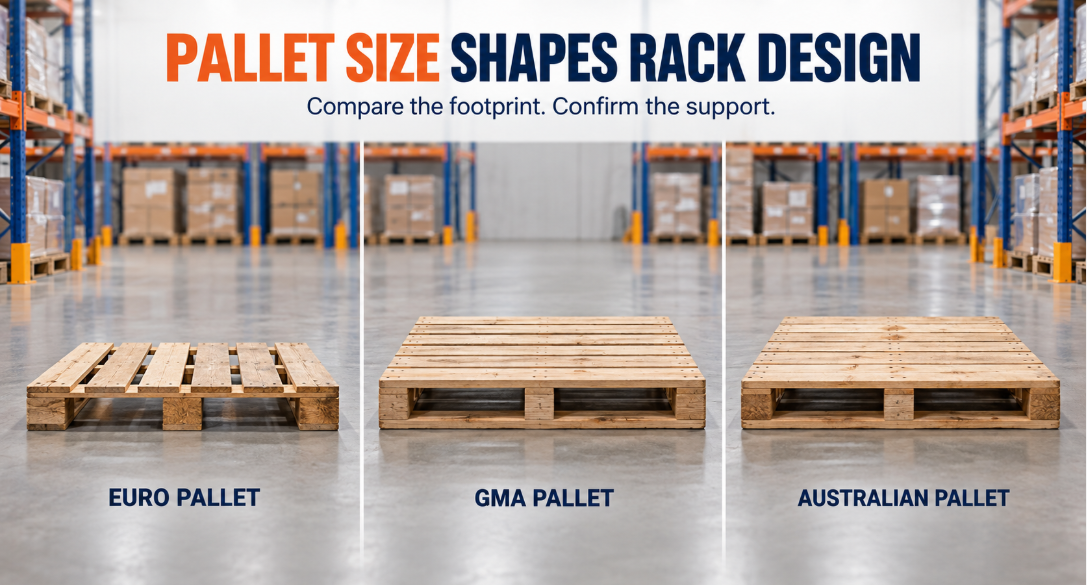
Euro pallets commonly measure 1200 × 800 mm, GMA pallets 48 × 40 inches (1219.2 × 1016 mm), and Australian standard pallets 1165 × 1165 mm. These differences affect the number of pallets per beam level, rack depth, support positions, aisle clearance and storage capacity.
The correct rack design starts with the complete loaded pallet: its dimensions, weight, orientation and support requirements.
1. Euro, GMA and Australian Pallet Dimensions Compared
| Pallet format | Nominal footprint | Approximate inches | Key purchasing distinction |
|---|---|---|---|
| Euro / EPAL 1 | 1200 × 800 mm | 47.24 × 31.50 in | Identify the specific Euro pallet format; “European pallet” does not always mean EPAL 1. |
| GMA-style | 1219.2 × 1016 mm | 48 × 40 in | The footprint alone does not establish construction, condition or racking capacity. |
| Australian standard | 1165 × 1165 mm | 45.87 × 45.87 in | A square footprint does not guarantee identical support performance in both directions. |
EPAL confirms the 1200 × 800 mm footprint of its Euro pallet. Kamps identifies 48 × 40 inches as a standard GMA size, while Loscam lists a 1165 × 1165 mm wooden pallet for Australia. EPAL Euro pallet specifications, Kamps pallet supply information, Loscam pallet range.
These are reference formats, not a complete list of pallets used in each market. International warehouses also receive export pallets, plastic pallets and custom skids.
Do not substitute a 1200 × 1000 mm pallet for a 48 × 40-inch GMA pallet in a drawing: their dimensions are close, but they are not identical.
2. Define Pallet Orientation Before Selecting Beam Length
For rack planning, use two clearly defined measurements:
Frontage: the loaded width along the beam, facing the aisle.
Depth: the loaded dimension running from the front beam toward the rear beam.
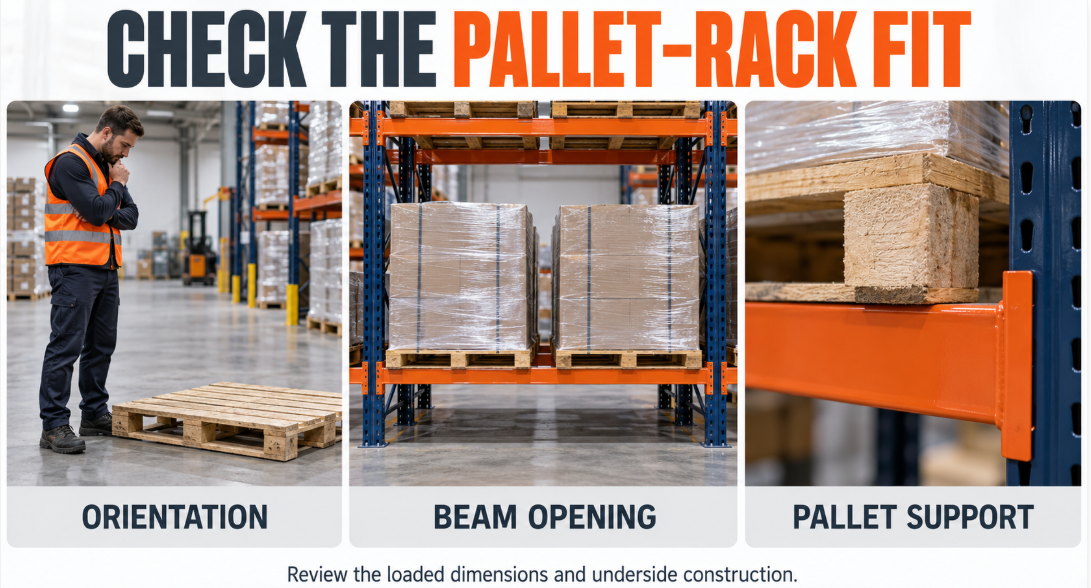
For example, a 1200 × 800 mm Euro pallet can have an 800 mm frontage and a 1200 mm depth. Rotating it creates a 1200 mm frontage and an 800 mm depth.
That rotation changes both the beam-space requirement and the relationship between the pallet underside and its supports. Confirm permitted fork entry and racking orientation before choosing the layout.
Always measure the loaded envelope. Cartons, wrapping or irregular products extending beyond the pallet can determine the clearance required between adjacent loads.
3. Calculate the Clear Opening for Each Beam Level
A useful preliminary formula is:
Required clear opening = total loaded frontages + gaps between loads + clearances at both ends.
Consider two pallets per level, with no goods extending beyond the pallets. For illustration only, assume a 100 mm gap between loads and 100 mm clearance at each end.
| Example orientation | Calculation | Preliminary clear opening |
|---|---|---|
| Two Euro pallets, 800 mm frontage | 2 × 800 + 100 + 2 × 100 | 1900 mm |
| Two GMA pallets, 1016 mm frontage | 2 × 10¹⁶ + 100 + 2 × 100 | 2332 mm |
| Two Australian pallets, 1165 mm frontage | 2 × 1165 + 100 + 2 × 100 | 2630 mm |
These are arithmetic examples, not prescribed clearances or approved beam sizes. Required clearances depend on the rack system, installation height, handling equipment, applicable design requirements and actual loads.
Clear opening is also different from overall beam length or bay pitch. Connector geometry and upright dimensions must be included in the supplier’s final layout.
For a project quotation, send the pallet orientation alongside the required number of pallets per level. Explore KAYOU’s warehouse pallet racking as a starting point for the specification.
4. Match Rack Depth to the Pallet’s Support Geometry
Pallet rack depth should position the supporting beams correctly beneath the pallet. It is not simply the pallet’s full front-to-back dimension.
For a conventional North American arrangement, a 48-inch-deep GMA pallet is commonly paired with a 42-inch-deep upright frame, giving approximately 3 inches of pallet overhang at the front and rear. WPRP describes this typical configuration in its pallet rack selection guide.
That example is not a universal rule for Euro, Australian, plastic or custom pallets. Confirm the actual bearing surfaces and rack geometry for each pallet type.
Ask the supplier to review underside photos or drawings showing bottom boards, runners, blocks and fork openings. A pallet that appears to fit can still bridge incorrectly, lack adequate bearing or require additional supports.
Distinguish pallet overhang beyond the beams from goods overhang beyond the pallet. The former concerns the approved support arrangement; the latter enlarges the stored load envelope.
5. Recheck Load Capacity When Pallet Size Changes
A footprint does not specify a pallet’s load rating. Pallet performance depends on construction, condition, load distribution and how it is supported.
Likewise, increasing the beam span to accommodate wider pallets can change the required beam section and its capacity.
Suppose two loaded pallets each weigh 1000 kg, including the pallet itself. The level must accommodate a 2000 kg payload in the specified positions. That arithmetic does not establish the capacity of an arbitrary beam pair.
The rack designer must check the complete configuration, including beam connections, uprights, bracing, beam elevations, anchorage and site conditions. Moving beam levels can affect frame capacity even when pallet weights stay unchanged.
Review KAYOU’s safe working load guide when preparing your load schedule. Request confirmation for the proposed arrangement, rather than relying on a generic “heavy-duty” description.
6. Recalculate Aisles, Row Spacing and Level Heights
Changing pallet size affects more than the space between uprights.
Aisle clearance: Check the forklift manufacturer’s right-angle stacking requirement for the actual load dimensions, lift height and operating arrangement. A truck suitable for one pallet orientation may need a different aisle with another.
Back-to-back rows: Account for the stored loads projecting behind the frames and the required separation between them. Coordinate fire-protection clearances with the project design; row spacers alone do not prove the required clear space is maintained.
Vertical spacing: Use the overall loaded height, including the pallet, plus the required handling clearance and beam depth. Pallet footprint alone says nothing about how many levels fit beneath the roof, services or sprinklers.
For smaller facilities, KAYOU’s warehouse space optimization guide offers complementary planning ideas. Preserve working access when evaluating additional storage positions.
7. Can One Rack Store All Three Pallet Formats?
Potentially, but compatibility must be designed and documented.
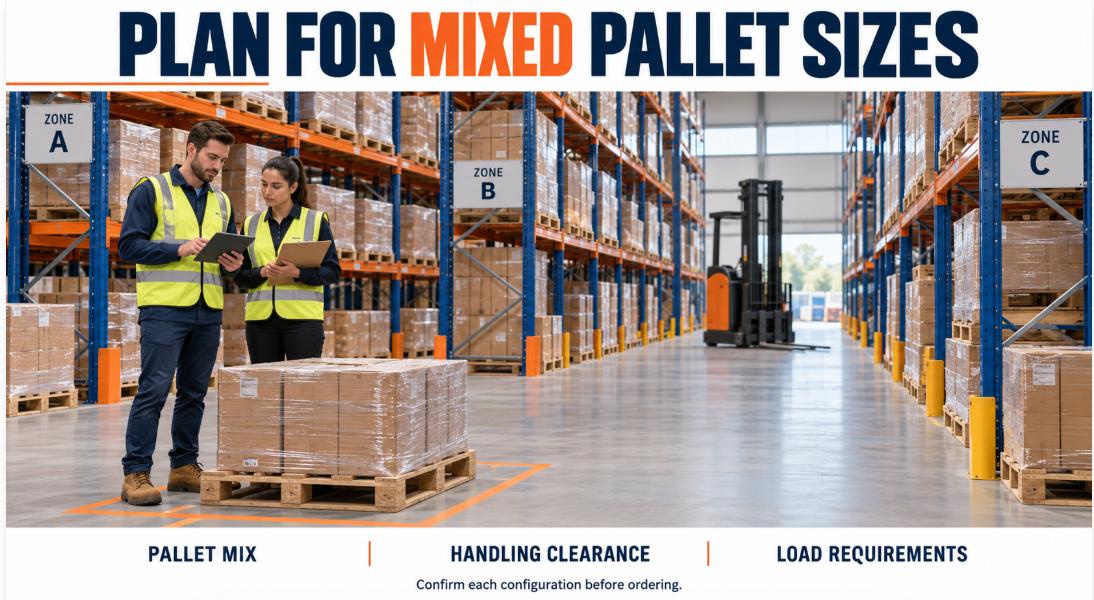
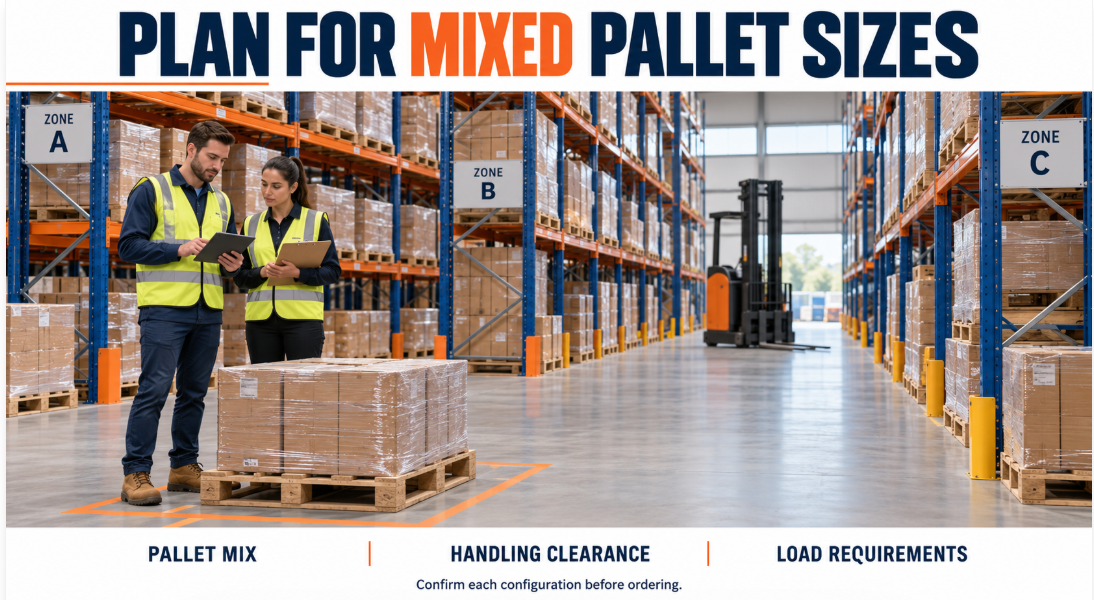
Selective racking provides direct access and can be configured with different bay widths, depths or support arrangements. Separate zones may be more practical than making every location accommodate the largest pallet.
For mixed pallets, consider:
Dedicated locations with permitted pallet types identified.
Engineered pallet support bars or decking where required.
A controlled repalletizing process when incoming pallets are unsuitable.
Inspection and quarantine of damaged or unapproved pallets.
Decking is not an automatic solution: its rating must match the actual load contact pattern, support arrangement and intended use.
Drive-in, pallet-flow, push-back and shuttle systems need particular attention because pallets interact with rails, rollers, carts or handling mechanisms. Similar outside dimensions do not guarantee compatibility.
Compare KAYOU’s warehouse racking systems against your pallet mix, stock rotation and access requirements before committing to a storage method.
8. What to Send with Your Racking RFQ
Provide the following information for a comparable, project-specific quotation:
Every pallet footprint, material and construction type.
Loaded width, depth, height and maximum total weight.
Goods overhang, uneven loading and unusual load shapes.
Pallet underside photos and intended fork-entry direction.
Pallets per level, storage positions and required stock rotation.
Forklift model, attachments, lift height and operating aisle requirements.
Warehouse drawing showing doors, columns, services and clear height.
Installation location, floor information and project design requirements.
Ask for drawings that identify allowed pallet orientations, support details and load limits. Review KAYOU’s quality control process and agree on the inspection records needed for your order.
For projects that also include hand-picked cartons, explore KAYOU’s industrial storage shelving. Review the manufacturing process when discussing production and inspection requirements.
Frequently Asked Questions
Is a Euro pallet the same size as a GMA pallet?
No. An EPAL 1 Euro pallet measures 1200 × 800 mm. A GMA-style pallet measures 48 × 40 inches, equivalent to 1219.2 × 1016 mm. Their different widths can change the required beam opening.
Can Australian pallets use racks designed for Euro pallets?
Only after compatibility is verified. Check beam opening, rack depth, underside bearing, load rating and handling clearance. The 1165 mm square footprint does not establish suitability for an existing Euro-pallet arrangement.
Can I rotate a pallet to fit an existing rack?
Do not assume so. Rotation changes the frontage, depth, fork entry and support relationship. Obtain confirmation for that orientation before use.
Does a larger pallet require a stronger rack?
Not automatically. Weight, span, load positions and the complete rack configuration determine the design. A wider pallet may require longer beams even if its weight is unchanged.
What rack depth should I specify?
Provide pallet dimensions and underside details first. The supplier should specify a depth and support arrangement compatible with the actual pallet, its orientation and loading conditions.
Plan Your Pallet Racking with KAYOU
Sourcing racking for European, North American or Australian pallet formats? Send KAYOU your pallet dimensions, loaded weights, underside photos, warehouse layout and delivery destination.
Our team can review your storage requirements and prepare a quotation based on the proposed configuration.