

How to Specify Cold Room Shelving for Coolers and Freezers
How to Specify Cold Room Shelving for Commercial Coolers and Freezers
By KAYOU
When requesting a cold room shelving quote, give the supplier the minimum operating temperature, condensation and cleaning conditions, stored goods, and maximum load per level. These inputs help the supplier propose a material, shelf deck and bay configuration for the way the room will be used.
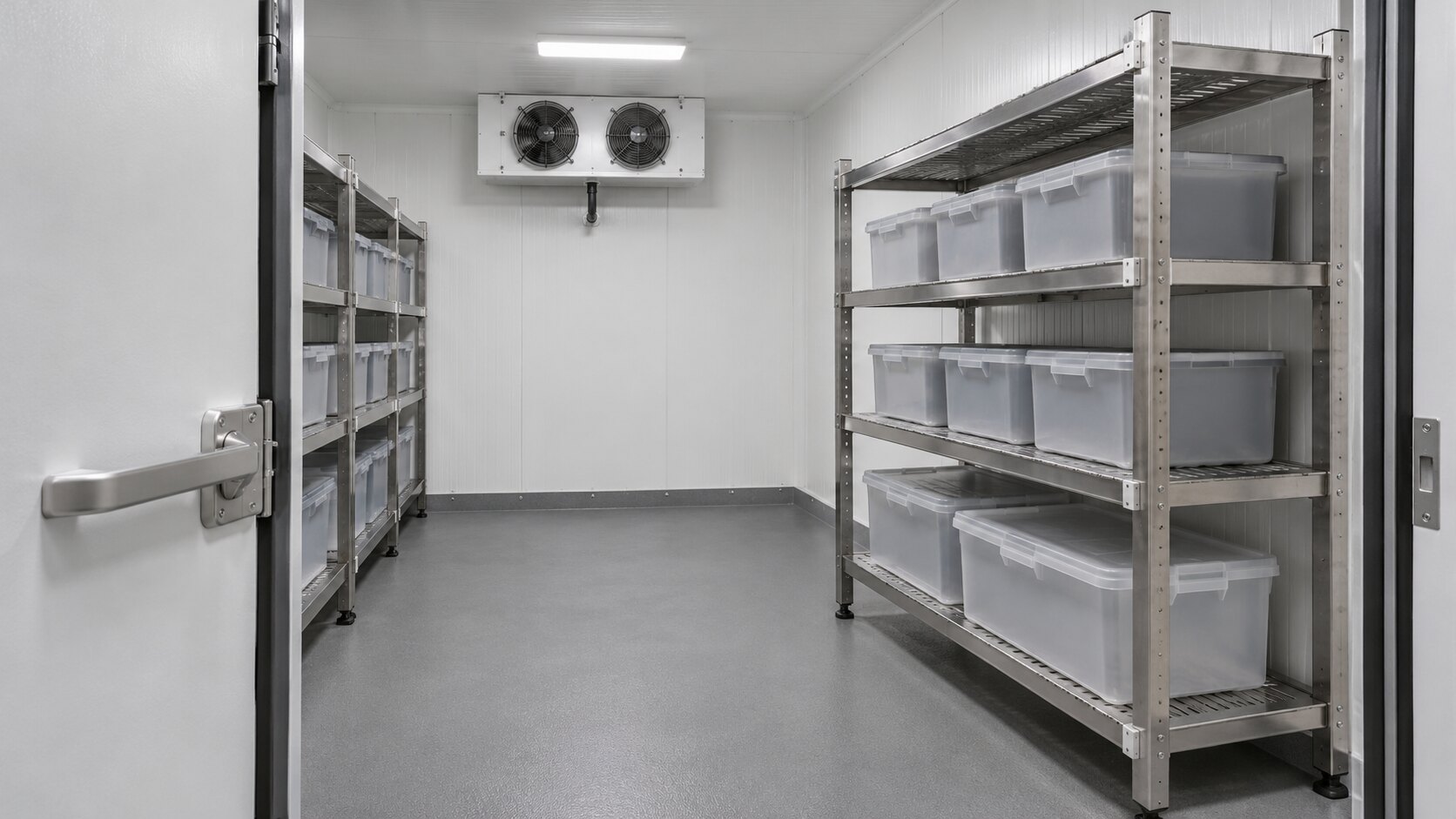
AI-generated illustration of shelving in a commercial walk-in cold room.
Record the room's temperature and moisture exposure
List the room's normal operating range and its lowest expected service temperature. Describe where condensation forms, how often doors open during restocking, and whether defrost or cleaning leaves parts of the rack wet. Tell the supplier whether the room is wiped down, rinsed or washed with chemicals. Include the cleaner names and concentrations if available.
Ask for written confirmation of the minimum service temperature and the approved cleaning methods for the proposed assembly, including shelves, frames, fasteners and feet. Share whether shelving will hold sealed cartons, closed totes or unpackaged products. Where a surface will directly contact food, identify the applicable project hygiene requirements in the inquiry.
Compare 304 stainless steel and hot-dip galvanized steel
| 304 stainless steel | Hot-dip galvanized steel |
|---|---|
| When to price it Start here when the room has recurring condensation or frequent wet cleaning. Confirm that the proposed finish and all hardware suit the cleaning routine. | When to price it Consider it for sealed goods in a room with controlled moisture and a cleaning regime the supplier confirms is compatible with the coating. |
| What to verify Ask which components are 304, what finish is supplied and whether your cleaner is compatible. For significant chloride exposure, ask the supplier to assess an appropriate grade and cleaning procedure. | What to verify Ask whether parts are made from galvanized sheet or dipped after fabrication, which surfaces are coated, and how cut edges and joints are treated. Confirm the applicable coating specification and maintenance instructions. |
For U.S. retail and foodservice projects, check the rules adopted locally. Section 4-101.15 of the FDA model Food Code restricts galvanized metal on utensils and equipment food-contact surfaces used with acidic foods.
Choose a shelf deck around the smallest item you store
Wire shelving has open space between wires for air movement. Measure the smallest tote or carton base and check that it sits securely across the wire spacing.
Perforated steel shelving offers a more continuous support surface with openings for airflow. Ask for the hole pattern, deck supports and cleaning access.
Solid shelving supports small items and can be paired with removable trays where spills may occur. Show the proposed deck and stocked shelf layout to your refrigeration installer for an airflow and clearance check.
On the room plan, mark the evaporator, drains, doors and cart routes. Ask the shelving and refrigeration suppliers to confirm the space needed for equipment service, stock handling and floor cleaning. If restraint or anchoring is required, have the cold-room installer confirm the fixing detail before work on insulated panels or floors.
What to verify when the RFQ calls for 250 kg per level
Example buyer requirement
A project calls for a 1,200 × 500 mm usable shelf deck, three loaded levels and 250 kg of uniformly distributed load (UDL) per level. Loading all three levels to the target would put 750 kg of stored goods in one bay. Ask the supplier to confirm both the per-level rating and the total allowable load for that bay in the proposed configuration.
Give the supplier the dimensions and gross weights of the actual cartons or totes and how they will be placed. A container on narrow runners or small feet applies its weight over smaller contact areas. Ask for a separate check of that load pattern and provide the runner or foot spacing, contact area and position on the deck.
Compare documentation for the quoted span, depth, deck supports and level spacing. Ask for a load table, a relevant test report or engineering documentation that identifies the configuration covered. For more detail, see KAYOU's guide to verifying shelving load capacity.
Cold room shelving RFQ checklist
Send the same information to each supplier and ask for any proposed deviations to be listed in the quote.
| Field | Information to send or request |
|---|---|
| Room conditions | Cooler or freezer, operating range, minimum service temperature, condensation, washdown frequency and chemicals. |
| Goods and loading | Package type, dimensions, gross weights, base contact pattern, target load per level and number of loaded levels. |
| Space and quantity | Marked floor plan, usable shelf width and depth, required openings, number of bays and delivery destination. |
| Materials and deck | Request the material and finish by component, shelf deck details, and separately priced options where more than one material is acceptable. |
| Quote documents | Dimensioned drawing, load information for the quoted design, minimum service temperature confirmation, and assembly and care instructions. |
Technical references
Metro guidance on selecting walk-in cooler and freezer shelving
Metro comparison of galvanized and stainless steel solid shelves
American Galvanizers Association guidance on galvanized steel and temperature
Request a KAYOU cold room shelving quote
Explore KAYOU stainless steel shelving, then send your room plan, operating temperature, cleaning routine and target load so we can review your requirements and quote the proposed configuration.
<!-- End of content for UEditor. --><!--!doctype-->