
Medium Duty Shelving vs Heavy Duty Shelving vs Pallet Racking: Which System Does Your Warehouse Need?
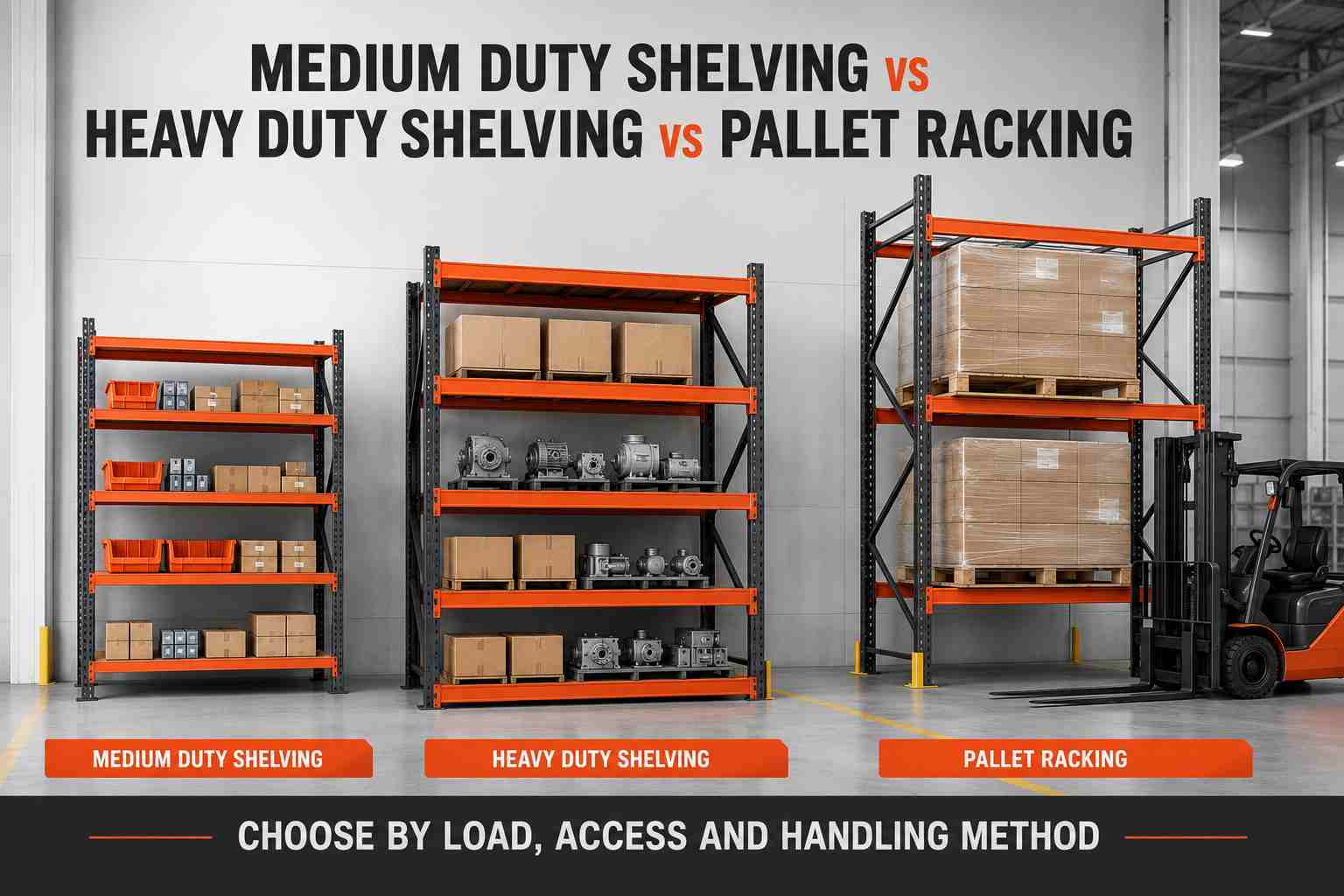
Medium duty shelving, heavy duty shelving and pallet racking can all improve warehouse capacity, but they are designed for different goods and handling methods. Medium duty shelving is generally suited to manually picked cartons, bins and components. Heavy duty shelving uses a more robust structure for heavier or bulkier non-palletized goods. Pallet racking stores complete pallet loads and is normally served by forklifts or other material-handling equipment.
The correct choice should not be based on the product name alone. Terms such as “medium duty” and “heavy duty” are not defined by one universal global load threshold. Shelf width, depth, beam span, upright profile, steel thickness, deck type, reinforcement, load distribution and installation conditions all affect the final capacity.
This guide explains the practical differences and helps B2B buyers identify the right system before requesting a quotation.
Quick Comparison
| Factor | Medium Duty Shelving | Heavy Duty Shelving | Pallet Racking |
|---|---|---|---|
| Primary load unit | Cartons, bins, tools and loose products | Heavier cartons, components, equipment and bulky loose goods | Complete pallets |
| Typical access | Direct manual picking | Direct picking, with suitable handling assistance when required | Forklift or other pallet-handling equipment |
| Structural concept | Adjustable upright frames, beams and shelf decks | Reinforced frames, stronger beams and heavier-duty decks | Upright frames and pallet-supporting load beams |
| Deck surface | Steel panels, wire mesh or engineered board | Reinforced steel, wire mesh or suitable board deck | Pallets normally rest on beams; decking may be added where specified |
| Typical span | Standard or moderate span | Often wider or structurally reinforced span | Designed around pallet positions |
| Best for | Frequently accessed medium-weight SKUs | Heavier or bulkier non-palletized inventory | High-volume palletized inventory |
| Picking style | Piece, carton or bin picking | Piece, carton or component picking | Pallet placement and retrieval |
| Aisle planning | Based mainly on people, carts and picking equipment | Based on goods and handling method | Based on forklift type, turning radius and pallet movement |
| Project complexity | Low to medium | Medium | Higher |
| Common users | E-commerce, retail stockrooms, workshops and parts stores | Industrial warehouses, maintenance stores and manufacturing facilities | Logistics centers, factories and distribution warehouses |
What Is Medium Duty Shelving?
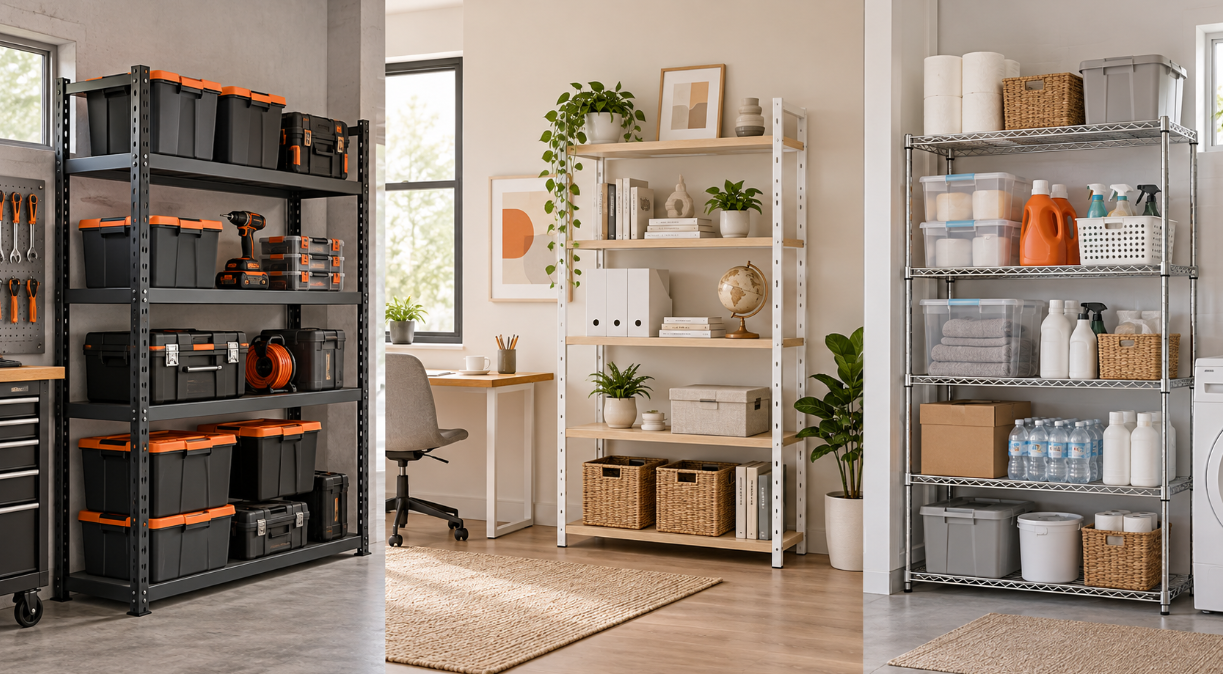
Medium duty steel shelving is an adjustable storage system designed mainly for goods that employees can identify and pick directly from the shelf. It occupies the space between light office-style shelving and higher-capacity industrial storage systems.
Typical stored goods include:
Cartons and packaged products
Plastic totes and storage bins
Tools and maintenance supplies
Automotive and machinery parts
Electrical components
E-commerce inventory
Retail reserve stock
Production consumables
The main components normally include perforated upright frames, horizontal and diagonal bracing, front and rear load beams, shelf decks, connectors, footplates and related accessories.
KAYOU can configure medium duty shelving for approximately 100–500 kg per level under uniformly distributed load conditions, depending on the approved dimensions and structure. This is a configurable product range, not a universal rating for every shelf.
When Medium Duty Shelving Is the Better Choice
Choose medium duty shelving when:
Goods are stored without pallets.
Employees need direct access to individual cartons, bins or SKUs.
Shelf levels need to be adjusted as product sizes change.
Storage rows must be expanded with starter and add-on bays.
The buyer needs a practical balance of strength, cost and flexibility.
A forklift is not required to place every load.
It is especially useful in warehouses with many different SKUs and frequent manual picking.
What Is Heavy Duty Shelving?
Heavy duty metal shelving is a reinforced shelving system for heavier or bulkier non-palletized goods. It may use larger upright profiles, stronger beams, additional deck supports, heavier shelf panels and more substantial bracing than a medium duty configuration.
Typical applications include:
Heavy boxed components
Automotive and machinery parts
Motors, pumps and industrial equipment
Metal components and production materials
Large containers and bulky inventory
Workshop tools and maintenance equipment
Commercial or industrial stock requiring frequent access
Heavy duty shelving can still be a direct-access picking system. However, “heavy duty” should not imply that employees are expected to lift unsafe loads manually. The weight and shape of each item must be considered together with suitable lifting methods, carts or handling equipment.
Why the Heavy Duty Label Can Be Misleading
There is no single international rule stating that every shelf above a particular kilogram value is automatically “heavy duty.” A wide shelf with a moderate load can require stronger beams than a narrow shelf carrying the same total weight. A concentrated motor or steel mould also creates a different loading condition from evenly distributed cartons.
Buyers should therefore confirm:
Rated load per level
Clear shelf span
Shelf depth
Upright and beam profiles
Material thickness
Deck type and reinforcement
Uniformly distributed or concentrated loading
Frame capacity and anchoring requirements
The approved technical specification is more important than the marketing category.
What Is Pallet Racking?
Warehouse pallet racking is designed to store goods assembled on pallets. Pallets are placed on the rack beams using forklifts, reach trucks or other suitable material-handling equipment.
A typical selective pallet rack includes:
Upright frames
Horizontal and diagonal frame bracing
Load beams
Beam connectors and safety locks
Footplates and floor anchors
Row spacers where required
Pallet supports or decking where specified
Column protectors and other safety accessories
Unlike shelving, the main storage unit is normally a complete pallet rather than an individual carton. Selective pallet racking provides direct access to each pallet position, making it suitable for warehouses with multiple palletized SKUs.
When Pallet Racking Is the Better Choice
Choose pallet racking when:
Most incoming and outgoing goods remain on pallets.
Forklifts are used for storage and retrieval.
Pallet weight, size and orientation are known.
The warehouse needs to use greater vertical height.
Inventory is managed by pallet position.
The layout can provide suitable forklift aisles and safe clearances.
Pallet racking is not simply “stronger shelving.” It is a different storage and operating system that must be planned around pallets, forklifts, aisles, building dimensions and warehouse workflow.
1. Goods and Unit Loads
The first question is not “How much does the rack hold?” It is “What exactly will be placed on it?”
Medium duty shelving is suitable for cartons, bins and components handled as individual units. Heavy duty shelving serves heavier or bulkier loose goods that still require direct shelf access. Pallet racking supports palletized unit loads.
For example:
A warehouse storing 15 kg cartons of electrical parts may need medium duty shelving.
A maintenance facility storing dense motors and boxed machine parts may need reinforced heavy duty shelving.
A distribution center receiving 800 kg pallets of packaged products may need pallet racking.
Product dimensions matter as much as weight. A long, shallow carton, a compact metal mould and a standard pallet apply loads in different ways.
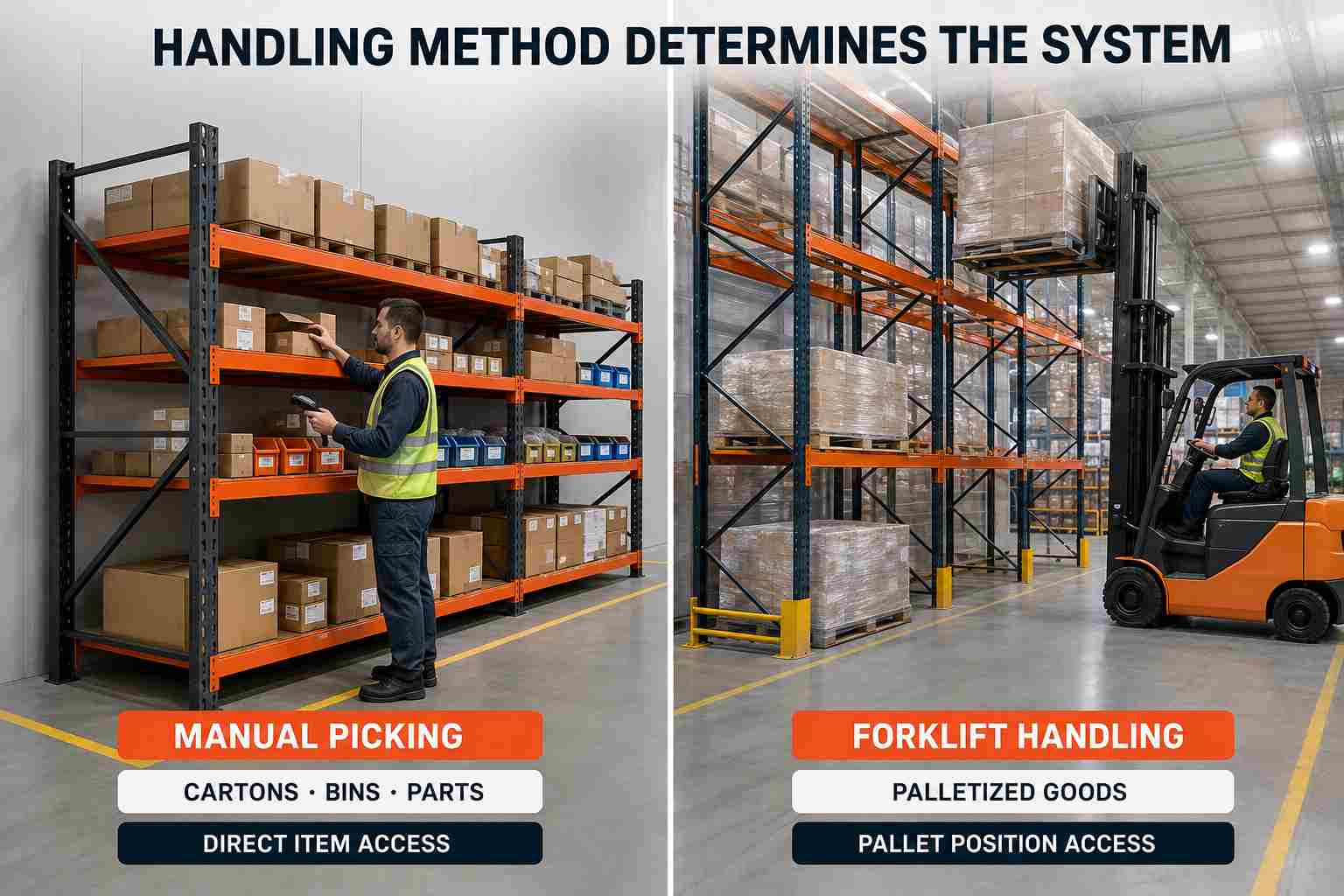
2. Manual Picking vs Forklift Handling
Medium and heavy duty shelving are normally selected for direct access to goods. Employees may pick individual units from the shelves, subject to safe working heights, item weights and handling procedures.
Pallet racking is designed around mechanical pallet handling. The rack layout must account for:
Forklift model and turning radius
Required aisle width
Maximum lift height
Pallet entry direction
Pallet overhang and clearances
Loading and unloading workflow
Upright protection in traffic areas
If a warehouse needs both pallet storage and carton picking, the most efficient solution may combine systems instead of forcing one product to perform both jobs.
3. Understanding Load Capacity
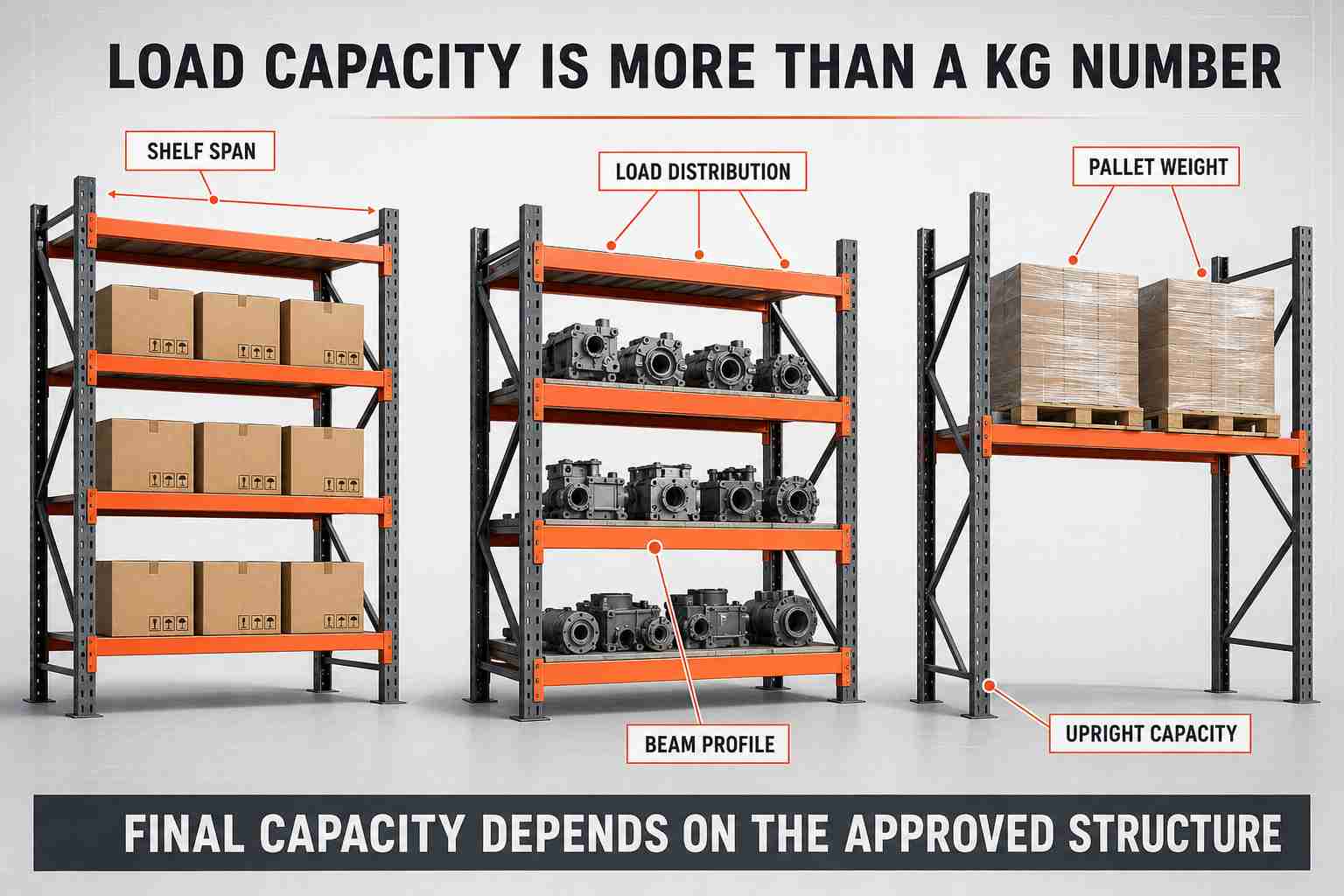
Load capacity should always be connected to a specific structure and loading condition.
Medium and Heavy Duty Shelving
Shelving capacity is usually stated per shelf level under uniformly distributed load (UDL) conditions. If a 300 kg load is spread evenly across a shelf, the structural effect differs from placing the same weight in one small central area.
Important values include:
Load per shelf level
Total merchandise load per bay
Upright frame capacity
Shelf or beam deflection limits
Concentrated load position
Number and spacing of shelf levels
Pallet Racking
Pallet rack capacity may be specified by pallet position, beam level, bay and upright frame. The design must consider individual pallet weight, number of pallets per level, beam span, rack height, level spacing and the cumulative load transferred to the frames and floor.
Never compare the capacity of a shelving level directly with the capacity of a pallet rack bay without first confirming what each number represents.
4. Shelf Decks and Load Support
Medium and heavy duty shelving normally requires a continuous or semi-continuous storage surface. Common choices include:
Steel shelf panels: durable and easy to clean for cartons, tools and components.
Wire mesh decking: improves visibility and airflow and supports many cartons or bins.
Engineered board or plywood: may be considered for certain dry indoor projects, depending on load and local requirements.
Pallet racking is normally designed for pallets to bridge between the front and rear beams. Wire decking, pallet supports or other accessories may be added according to the pallet type, stored product and applicable requirements.
Decking should never be treated as a substitute for correct structural design. Its size, support channels and capacity must match the rack or shelving system.
5. Space Utilization and Aisle Width
All three systems use vertical space, but they create different aisle requirements.
Medium duty shelving can often use relatively narrow pedestrian or picking-cart aisles because workers access the goods directly. Heavy duty shelving may need more handling space when items are bulky or mechanical assistance is used.
Pallet racking requires aisles based on the selected forklift. A conventional counterbalance forklift generally needs more turning space than a reach truck or very-narrow-aisle system. Choosing aisle width before confirming the handling equipment can create inefficient or unsafe layouts.
The correct calculation should consider:
Building length, width and clear height
Columns, walls, doors and emergency exits
Sprinklers, lights and overhead obstructions
Product and pallet dimensions
Picking and replenishment routes
Handling equipment
Required safety clearances
Future expansion
6. Cost and Project Complexity
Medium duty shelving is often the most economical option for manually picked medium-weight goods. Its modular design, adjustable levels and knock-down packaging can simplify transport and installation.
Heavy duty shelving may cost more because it uses larger sections, stronger beams, additional reinforcement or heavier decks. However, using a correctly reinforced shelf may be more economical than over-specifying a pallet racking system for goods that are never stored on pallets.
Pallet racking usually involves more project planning. The total investment may include:
Structural racks and accessories
Warehouse layout design
Anchoring and installation
Upright and end-of-row protection
Forklift or reach-truck operation
Safety signage and load notices
Pallets and pallet quality control
Inspection and maintenance procedures
The lowest unit price does not necessarily create the lowest total project cost. A system that does not match the goods or workflow can increase handling time, waste space and require later modification.
7. Safety, Inspection and Daily Operation
Whichever system is selected, the stored material must remain stable and the rated capacity must not be exceeded. The U.S. Occupational Safety and Health Administration’s warehousing guidance recommends inspecting and maintaining shelving and racking, isolating damaged areas, preventing hazardous storage and keeping loads within rated capacities.
Practical controls include:
Displaying the approved load capacity where appropriate
Distributing shelf loads as specified
Placing heavier manually picked goods at suitable lower levels
Keeping aisles clear
Anchoring the system when required by its design and site conditions
Protecting pallet rack uprights from forklift impact
Inspecting beams, uprights, connectors, bracing and anchors
Removing damaged components from service pending professional review
Training workers in the correct loading and picking method
Local regulations, building conditions and project-specific engineering requirements must also be reviewed before installation.
Which Storage System Should You Choose?
Use the following questions as a practical decision guide.
Choose Medium Duty Shelving If:
Most goods are cartons, bins or small components.
Workers need fast access to individual SKUs.
Loads are within the capacity of a confirmed medium duty configuration.
Shelf heights need frequent adjustment.
Cost-effective modular expansion is important.
Choose Heavy Duty Shelving If:
Goods are not palletized but are heavier, denser or bulkier.
Standard medium duty beams or decks are insufficient for the required span or load.
Direct access to parts or containers is still required.
Reinforced decks, beams and frames can match the actual loading condition.
Choose Pallet Racking If:
Goods are received, stored and shipped on pallets.
Forklifts handle the storage units.
The warehouse needs pallet-level inventory access.
Pallet size, weight and rack orientation are confirmed.
A layout can be designed around forklift aisles and building clearances.
Can One Warehouse Use All Three Systems?
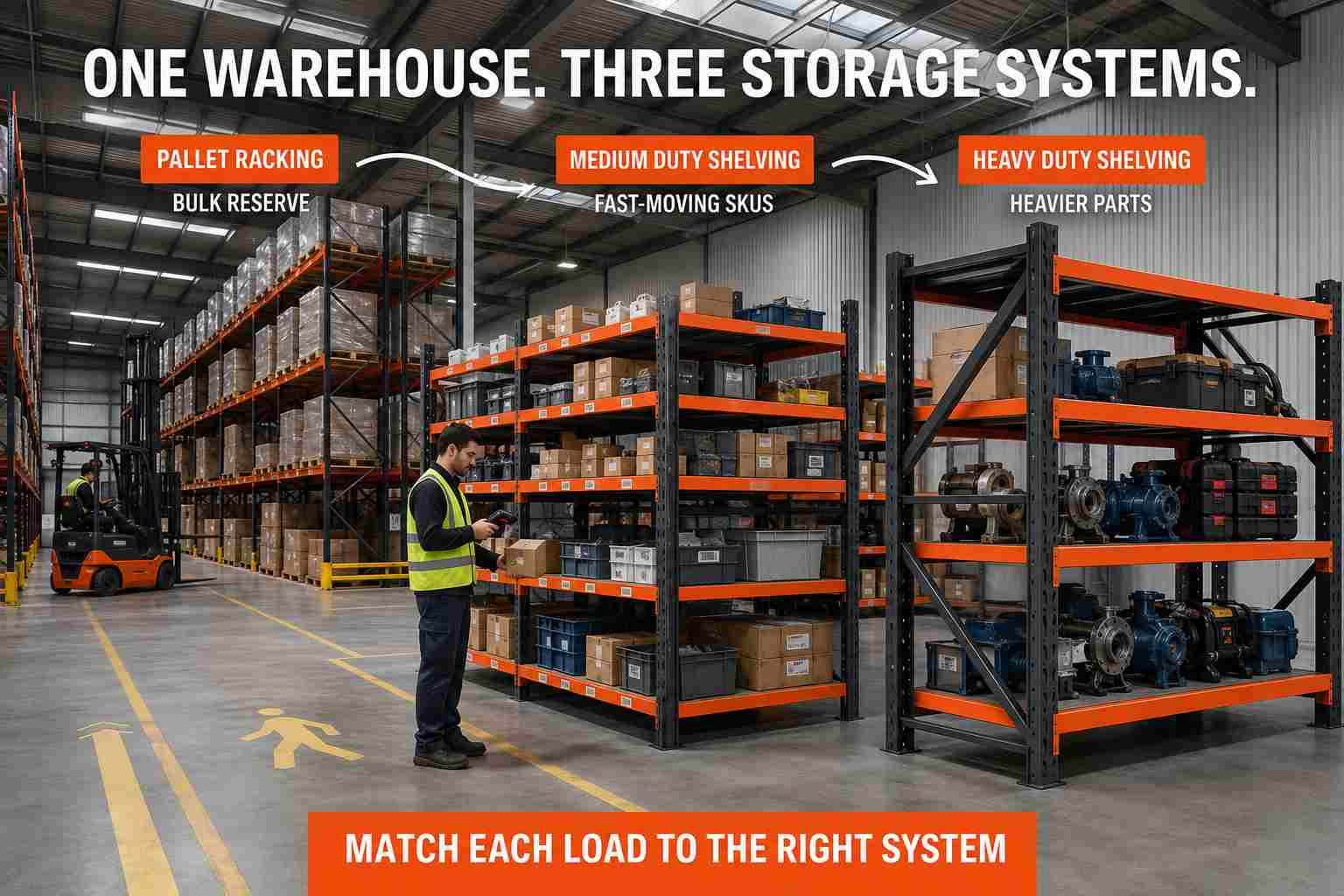
Yes. Many efficient warehouses use a hybrid layout.
For example, a distribution warehouse may use:
Pallet racking for bulk reserve inventory
Medium duty shelving for fast-moving carton picking
Heavy duty shelving for dense spare parts and maintenance equipment
Reserve pallets can be stored at higher or separate locations, while individual cartons are replenished into accessible shelving pick faces. This separates bulk storage from order picking and can improve both space utilization and workflow.
The layout should be planned according to product turnover, replenishment frequency, handling equipment and safe travel paths.
Three Example Selection Scenarios
Scenario 1: E-Commerce Parts Warehouse
The warehouse stores thousands of small boxed SKUs and plastic totes. Employees pick individual orders throughout the day. The goods are not normally handled on pallets after receiving.
Recommended starting point: Medium duty shelving with adjustable levels and clear SKU labels.
Scenario 2: Industrial Maintenance Store
The facility stores motors, pumps, metal components, large tool cases and heavy boxed spare parts. Direct access is required, but the goods are denser than ordinary cartons.
Recommended starting point: Heavy duty shelving engineered around the dimensions, support points and maximum load of the items.
Scenario 3: Regional Distribution Center
The facility receives full pallets, stores reserve inventory at height and dispatches pallet quantities. Forklifts manage inbound, storage and outbound movement.
Recommended starting point: Pallet racking designed around the pallet specification, forklift and warehouse layout.
Information Required for an Accurate Quotation
For Medium or Heavy Duty Shelving
Provide:
Overall height, width and depth
Clear shelf span and required levels
Maximum load per level
Dimensions and weight of stored goods
Uniform or concentrated loading information
Required quantity or total row length
Preferred deck type
Starter and add-on bay arrangement
Installation environment
Destination country or port
Colour, logo and packaging requirements
For Pallet Racking
Provide:
Warehouse floor plan and clear height
Pallet length, width and loaded height
Maximum pallet weight
Pallet entry direction and pallet type
Number of pallets per beam level
Required storage levels and pallet positions
Forklift model and required aisle width
Building columns, doors and obstructions
Sprinkler and fire-clearance requirements
Destination and installation requirements
Accurate input allows the manufacturer to select the correct components, prepare a useful layout and avoid assumptions that may affect safety, capacity or price.
Why Work with KAYOU?
KAYOU provides customizable storage shelving and warehouse racking systems for importers, distributors, warehouse operators, contractors and industrial buyers.
Project support can include:
Product selection based on goods and handling method
Custom dimensions and load configurations
Warehouse layout planning
Starter and add-on shelving layouts
Steel, wire mesh and other deck options
Pallet rack beam and frame configuration
Custom powder-coating colours
OEM and private-label production
Technical drawings
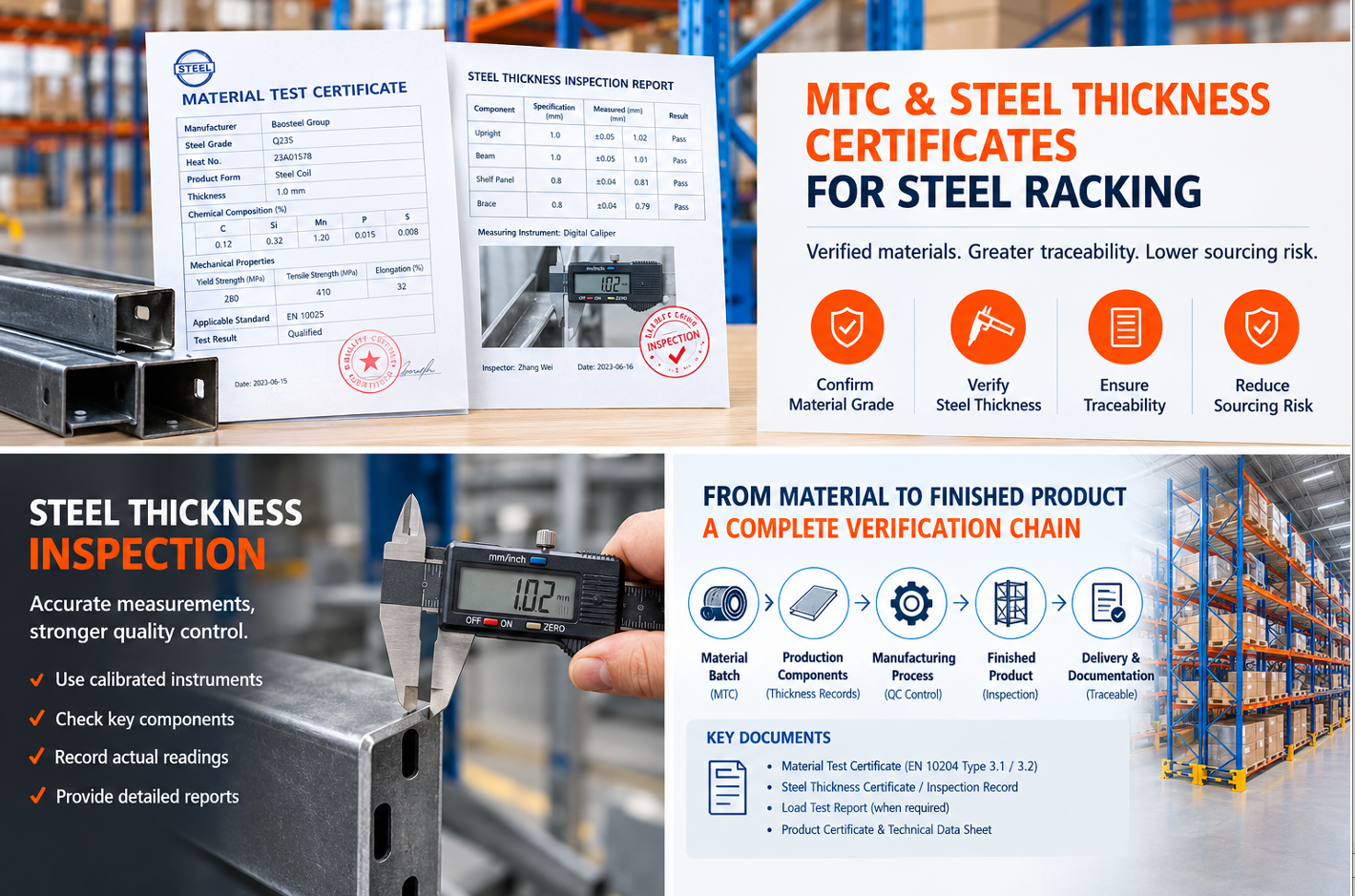
Pre-shipment inspection
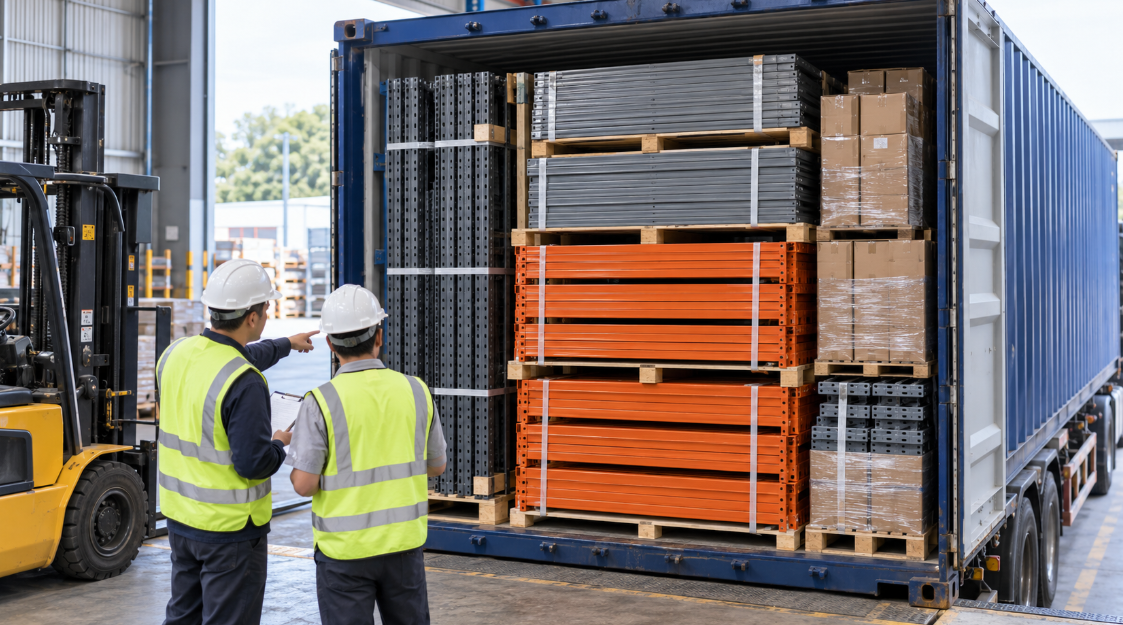
Export packaging and container-loading support
Installation instructions and technical guidance
The objective is not to sell the heaviest structure in every situation. It is to match the storage system to the products, space, workflow and budget.
Frequently Asked Questions
Is heavy duty shelving the same as pallet racking?
No. Heavy duty shelving normally provides a decked surface for direct access to non-palletized goods. Pallet racking is designed mainly for pallet loads placed and retrieved by forklifts.
Is medium duty shelving always limited to 500 kg per level?
No universal threshold applies to every manufacturer or configuration. KAYOU can configure certain medium duty shelving systems within an approximate 100–500 kg per-level range, subject to the confirmed dimensions, structure and uniformly distributed load conditions. Final capacity must follow the approved specification.
Can cartons be stored on pallet racking?
Yes, when the rack includes a suitable, correctly rated deck or support system. However, frequent carton picking may be more efficient on dedicated shelving at accessible heights.
Can pallets be placed on medium duty shelving?
Medium duty shelving should not be used for pallet storage unless the manufacturer has specifically designed and approved that exact configuration for the pallet loads and handling method. Standard medium duty shelving is primarily intended for manually accessed cartons, bins and components.
Which system uses warehouse space most efficiently?
The answer depends on the inventory and handling method. Shelving can create efficient carton-picking locations with smaller aisles, while pallet racking can use greater vertical height for palletized goods. A hybrid system is often the most efficient solution.
Does thicker steel always mean a higher rack capacity?
No. Steel thickness matters, but profile shape, dimensions, beam span, connectors, bracing, reinforcement, material properties and loading conditions also influence performance.
What is the difference between shelf capacity and bay capacity?
Shelf capacity refers to the rated load of one storage level. Bay capacity refers to the load supported by the complete bay or upright frames. Buyers should confirm which capacity a quotation states.
Do shelving and pallet racks need to be anchored?
Anchoring requirements depend on the system design, height, load, floor, operating environment and applicable local requirements. Pallet racking and many industrial shelving installations require suitable anchoring according to the approved design.
Request a Customized Warehouse Storage Recommendation
If you are deciding between medium duty shelving, heavy duty shelving and pallet racking, send KAYOU the dimensions and weight of your goods, warehouse layout, handling method, required quantity and destination.
Our team will review your storage requirements and recommend a suitable configuration for quotation.