
What Is Medium Duty Shelving? Components, Capacity and Applications
Medium duty shelving is an adjustable steel storage system designed mainly for cartons, bins, tools, spare parts and other goods handled manually rather than by forklift. It provides more strength and wider shelf spans than typical light-duty shelving while remaining more accessible and economical than pallet racking for non-palletized inventory.
For warehouses, workshops, distribution centres and retail stockrooms, medium duty shelving offers a practical balance of load capacity, flexibility, storage density and cost. However, the term “medium duty” does not represent one universal load rating. The actual capacity depends on the shelf dimensions, beam design, upright profile, steel thickness, deck type, reinforcement and loading method.
Medium Duty Shelving at a Glance
| Item | Typical Configuration |
|---|---|
| Storage method | Manual loading and picking |
| Common goods | Cartons, plastic bins, tools, components and spare parts |
| Main structure | Upright frames, beams, shelf decks and bracing |
| Shelf adjustment | Adjustable beam or shelf positions |
| Deck options | Steel panels, wire mesh or engineered board |
| Load capacity | Configured according to dimensions and structure |
| Expansion | Starter bays and add-on bays available |
| Surface finish | Powder-coated steel or other project-specific finish |
| Common applications | Warehouses, workshops, factories, stockrooms and fulfilment centres |
What Is Medium Duty Shelving?
Medium duty steel shelving is a modular storage system positioned between light-duty shelving and forklift-served pallet racking.
It is commonly selected when products are too heavy, bulky or frequently handled for ordinary office-style shelves, but do not need to be stored on pallets. Warehouse employees can see, identify and pick the goods directly from each shelf level.
Depending on the design, medium duty shelving may also be described as:
Medium duty steel shelving
Medium duty shelving rack
Industrial metal shelving
Warehouse picking shelving
Long span shelving
Wide span shelving
Adjustable steel shelving
These names can overlap, but they are not always technically identical. Long span shelving, for example, normally emphasizes a wider clear shelf opening and stronger beam construction. Buyers should therefore compare the confirmed component specifications rather than relying only on the product name.
What Are the Main Components of Medium Duty Shelving?
A stable shelving system depends on how all its parts work together. Steel thickness is important, but thickness alone cannot determine the final load capacity.
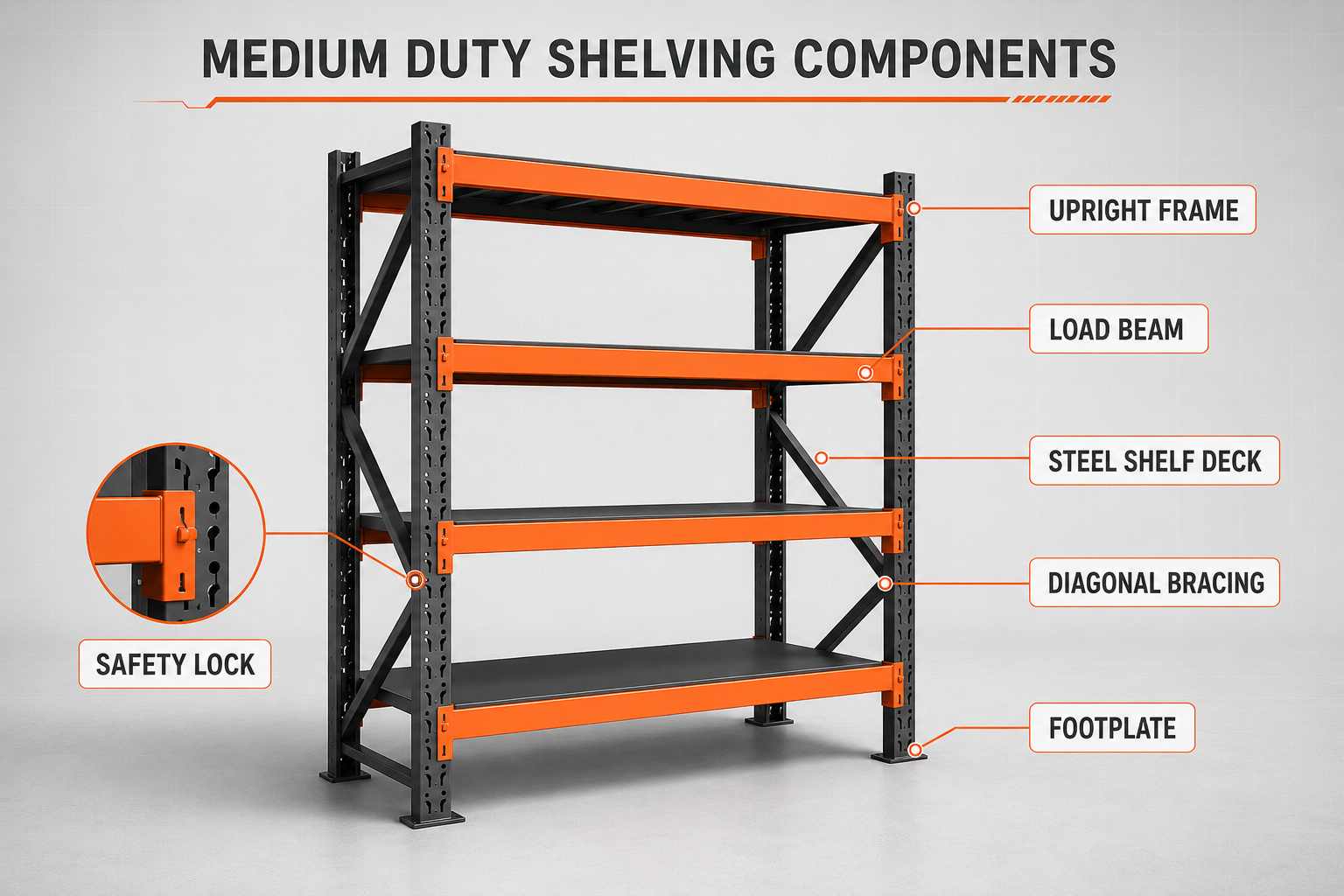
1. Upright Frames
The upright frames support the vertical load of the complete shelving system. A typical frame includes perforated steel uprights, horizontal braces, diagonal braces and footplates.
The upright holes allow the shelf levels to be repositioned at set intervals. The upright profile, section dimensions, material thickness, frame depth and bracing arrangement all affect the frame capacity and stability.
2. Load Beams
The front and rear beams support each storage level and transfer the shelf load to the upright frames. Their capacity is influenced by:
Clear beam span
Beam height and profile
Steel thickness
Connector design
Number and type of reinforcing members
Distribution of the stored load
As the clear span increases, the beam normally requires a stronger profile or additional reinforcement to control deflection.
3. Shelf Decks
The deck creates the surface on which goods are placed. Common options include:
Steel shelf panels: Durable, easy to clean and suitable for cartons, tools, components and packaged products.
Wire mesh decking: Provides visibility and airflow and can help prevent smaller cartons or containers from falling between the beams.
Engineered wood or plywood decking: May offer a cost-effective surface for dry indoor environments, subject to the required load, humidity and local fire-safety requirements.
The deck must be selected together with the beam structure and load requirement. Changing the deck material without reviewing the complete design may change the performance of the shelf level.
4. Bracing and Reinforcement
Horizontal and diagonal bracing helps the upright frame resist movement and maintain stability. Depending on the shelf width and load, additional support bars or formed reinforcements may be installed underneath the deck.
5. Connectors, Safety Locks and Footplates
Beam connectors attach the beams to the uprights. Safety locks help prevent accidental beam disengagement where the selected structure requires them. Footplates distribute the frame load at floor level and provide anchoring points when floor fixing is required.
6. Starter Bays and Add-On Bays
A starter bay can stand independently and normally uses two upright frames. An add-on bay shares one upright frame with the adjacent bay. This modular arrangement can reduce steel consumption and project cost while allowing a shelving row to be expanded.
How Much Weight Can Medium Duty Shelving Hold?
There is no single load capacity that applies to every medium duty shelving system.
KAYOU can configure shelving for approximately 100–500 kg per level, depending on the confirmed shelf dimensions, upright and beam structure, material thickness, deck design, reinforcement and uniformly distributed load conditions. The final rated capacity must always be based on the approved specification.
Shelf Load vs Total Unit Load
Buyers should distinguish between the capacity of one shelf level and the total merchandise capacity of the complete shelving bay.
For example, a shelving bay with four storage levels rated at 300 kg per level may provide a nominal merchandise capacity of:
4 levels × 300 kg = 1,200 kg per bay
This simple calculation does not replace structural confirmation. The upright frame, connectors, floor condition, anchoring arrangement and overall shelving height must still be suitable for the complete applied load.
Uniformly Distributed Load vs Point Load
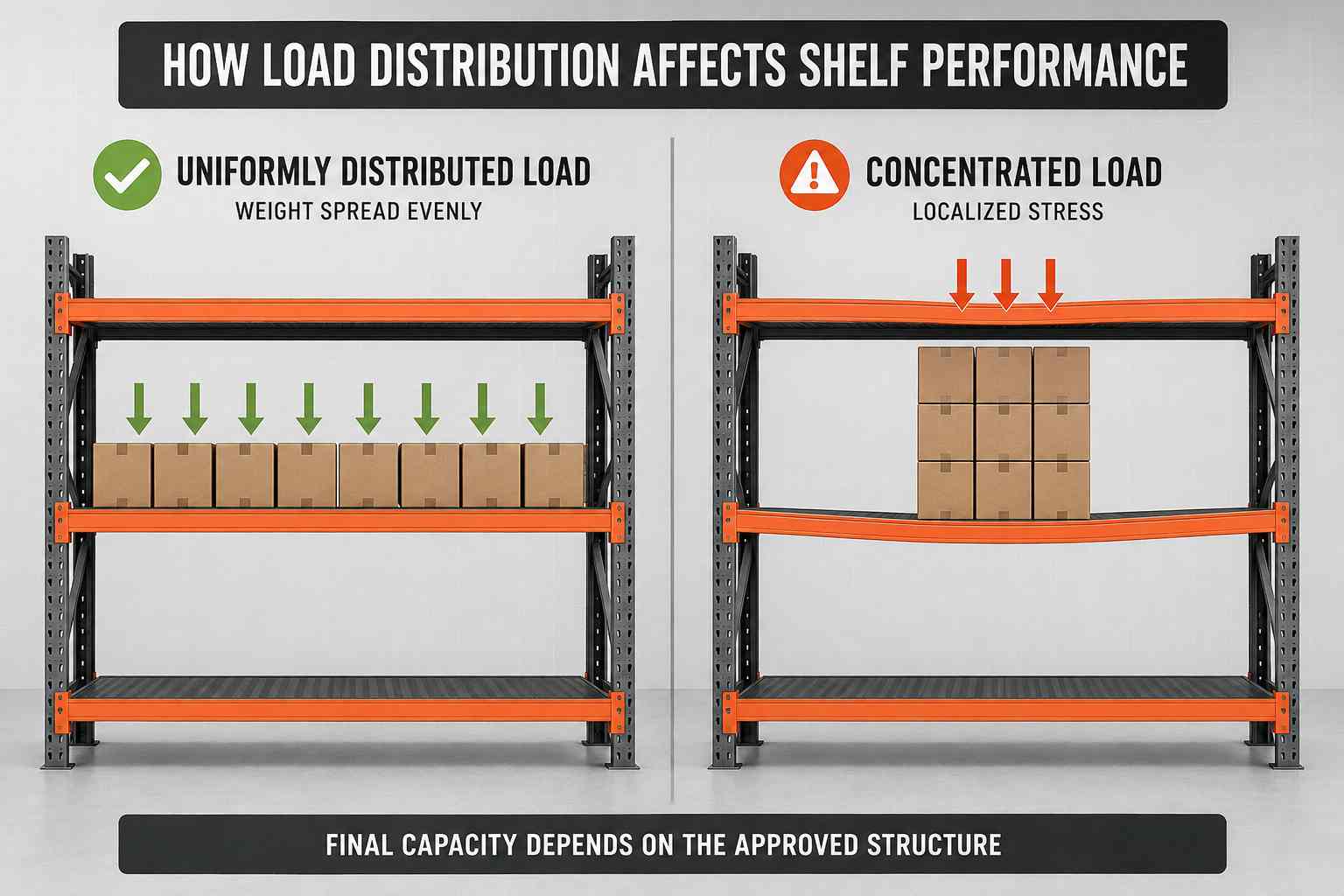
A published shelf capacity usually refers to a uniformly distributed load (UDL). This means the weight is spread reasonably evenly across the shelf surface.
Placing the same total weight in one small area creates a concentrated or point load. It can produce greater local stress and shelf deformation. Buyers storing machinery parts, metal moulds, motors or other dense items should provide the item dimensions, support points and loading position before the shelving is designed.
Factors That Affect Load Capacity
The final shelf rating can be affected by:
Shelf width and clear beam span
Shelf depth
Upright and beam profiles
Material grade and steel thickness
Number of shelf levels
Deck material and reinforcement
Even or concentrated loading
Shelving height-to-depth ratio
Bracing and anchoring
Floor condition and installation quality
Frequency and method of daily loading
A trustworthy quotation should connect the stated load capacity to a specific shelf size and confirmed structure, rather than presenting one capacity figure for every possible configuration.
Where Is Medium Duty Shelving Used?
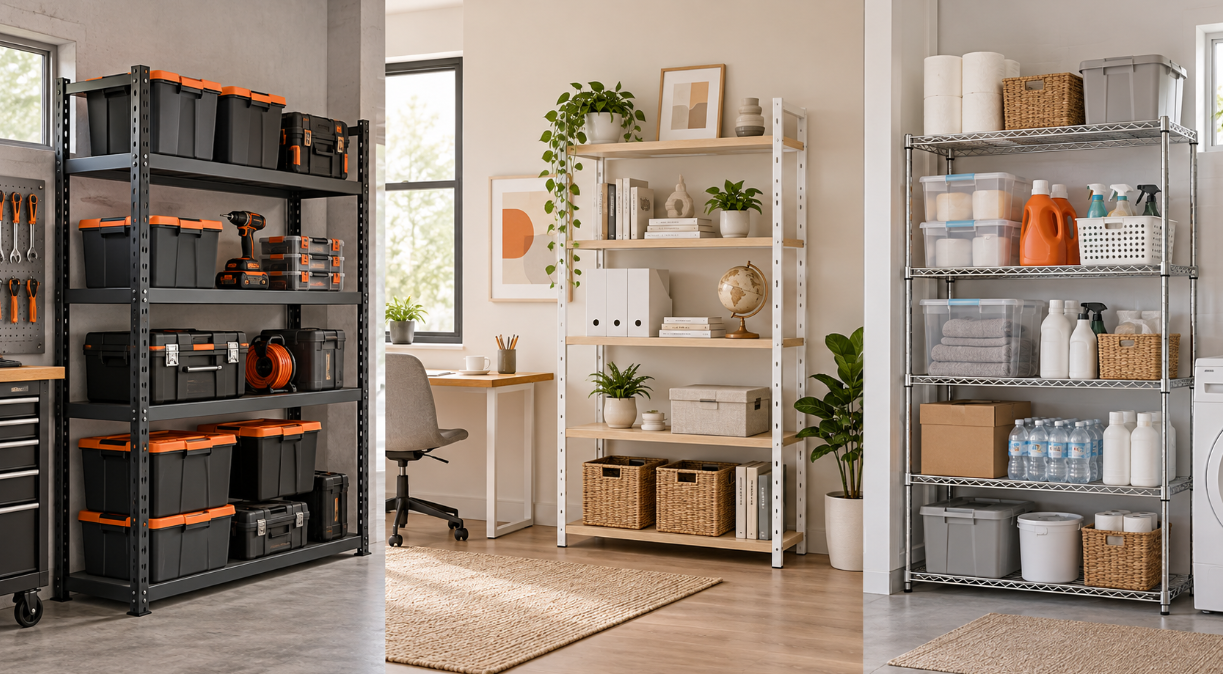
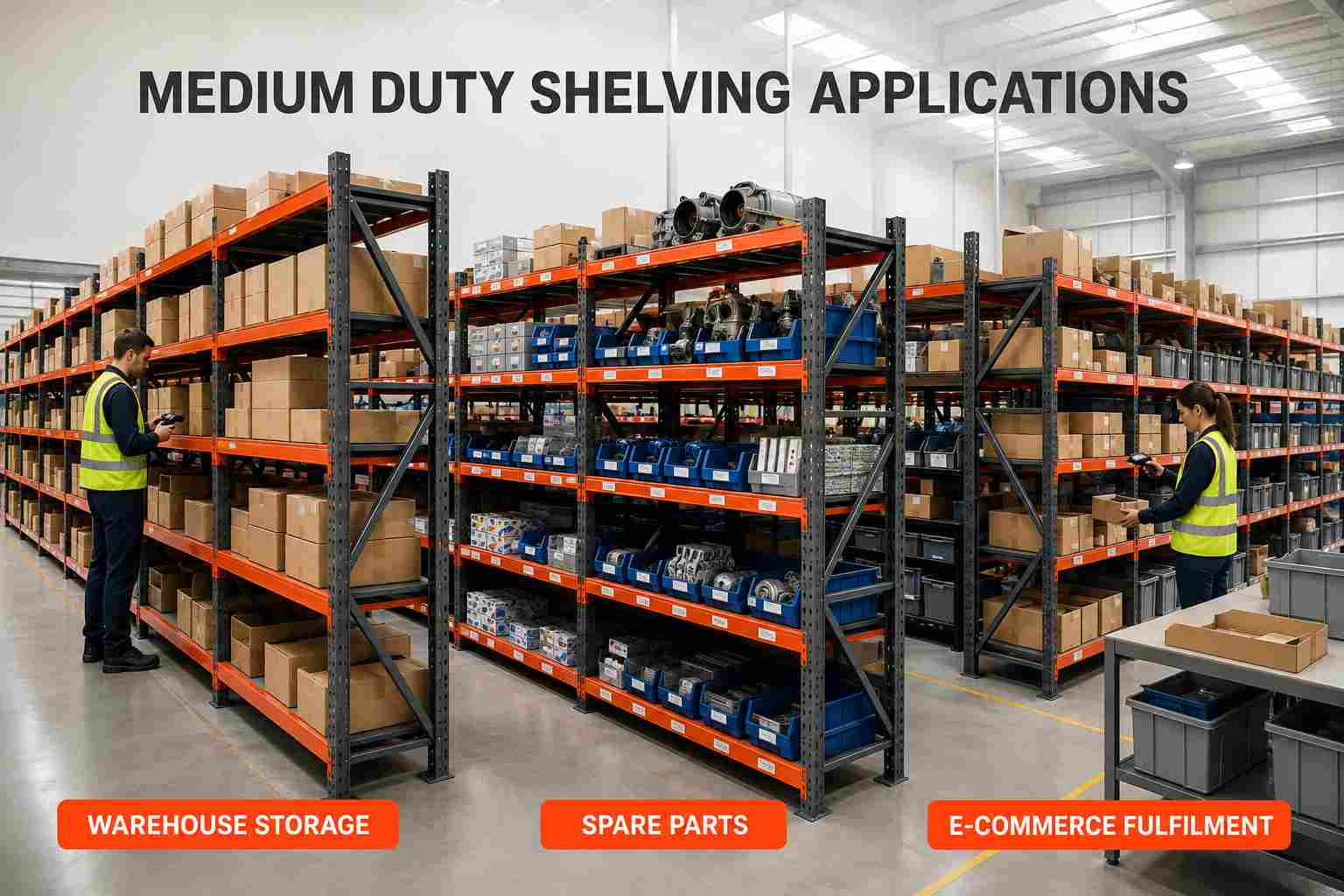
Warehouse Carton Storage
Adjustable shelf levels make it easier to organize cartons of different heights and reduce unused vertical space. Open access also supports direct manual picking and stock checks.
Spare-Parts Storage
Automotive, machinery and maintenance warehouses can use medium duty shelving for boxed components, replacement parts, plastic bins, tools and service supplies. Dividers and labelled storage locations can be added for better SKU control.
E-Commerce Fulfilment Centres
E-commerce warehouses often manage a large number of small and medium-sized SKUs. Multi-level shelving creates visible picking locations and can be arranged according to product turnover, carton size and order frequency.
Factory and Workshop Storage
Factories can store production materials, components, consumables, tooling and work-in-progress inventory near assembly or maintenance areas. Powder-coated steel surfaces are suitable for normal indoor industrial environments.
Retail Stockrooms
Medium duty shelving helps retailers organize reserve inventory, promotional materials and replenishment stock behind the sales area. Adjustable shelf spacing allows the layout to change with product packaging.
Distribution and Wholesale Warehouses
Importers, distributors and wholesalers can use long shelving rows to classify inventory by brand, product type, size or sales frequency. Starter and add-on bays make future expansion easier.
Medium Duty Shelving vs Light-Duty Shelving and Pallet Racking
| Feature | Light-Duty Shelving | Medium Duty Shelving | Pallet Racking |
| Main handling method | Manual | Manual | Forklift or handling equipment |
| Typical goods | Files, small boxes and light supplies | Cartons, bins, tools and spare parts | Palletized goods |
| Shelf span | Usually shorter | Standard or long span | Designed around pallet positions |
| Adjustability | Often adjustable | Adjustable | Adjustable beam levels |
| Storage access | Direct manual access | Direct manual access | Pallet access by forklift |
| Project complexity | Low | Medium | Higher, with layout and equipment planning |
| Best use | Offices and light storage | Warehouses, workshops and stockrooms | High-volume pallet storage |
Medium duty shelving is usually the better choice when employees need direct access to loose cartons or individual products. Pallet racking is more suitable when goods remain palletized and are handled by forklift.
How to Choose the Right Medium Duty Shelving
Confirm What Will Be Stored
List the type, dimensions and maximum weight of the cartons, bins, tools or components. If several SKUs will share one shelf, calculate the maximum combined load.
Confirm the Required Shelf Size
Provide the preferred overall height, width and depth, together with the required number of levels and clear vertical spacing. The shelf depth should support the goods without creating excessive unused space or making rear products difficult to reach.
Select the Appropriate Deck
Choose steel panels for a durable solid surface, wire mesh for airflow and visibility, or a suitable board deck for specific dry indoor projects. The selected deck must be evaluated with the load requirement.
Review the Operating Environment
Tell the manufacturer whether the shelving will be installed in a dry warehouse, humid stockroom, cold room, coastal location or workshop exposed to oil or chemicals. Standard powder coating should not automatically be treated as a permanent rustproof solution for every environment.
Plan the Layout and Future Expansion
For larger projects, provide a warehouse floor plan showing walls, columns, doors, fire equipment, working areas and aisle requirements. Also indicate whether more shelving bays may be added later.
Consider Packaging and Installation
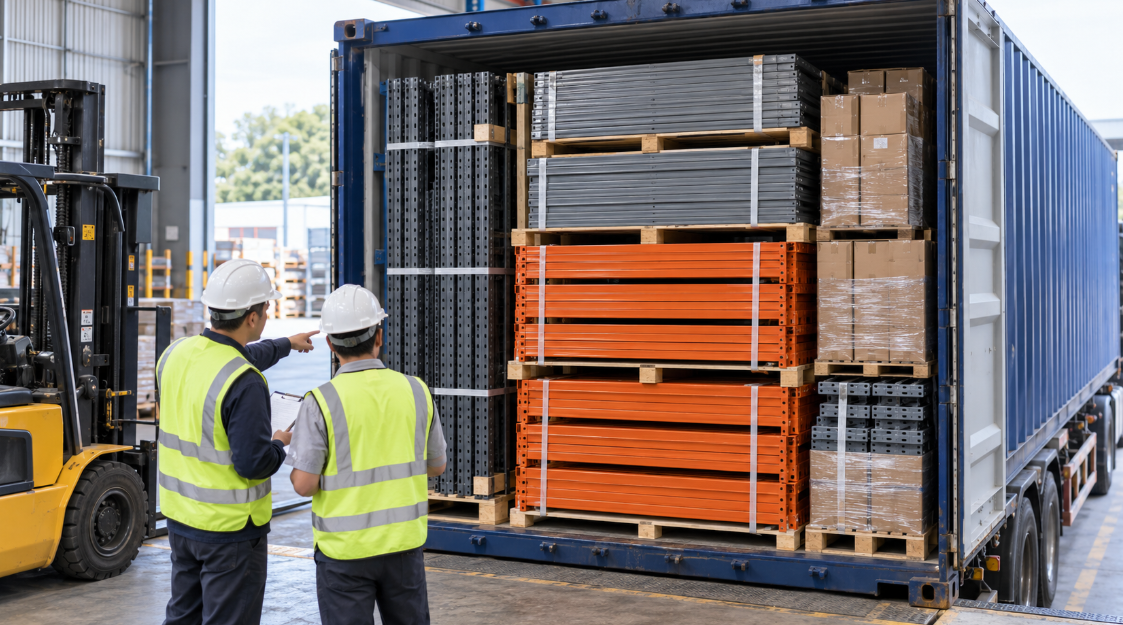
International buyers should confirm the knock-down structure, package dimensions, total CBM, component labels, assembly instructions, spare parts and container-loading plan before shipment.
Why Source Medium Duty Shelving from KAYOU?
KAYOU manufactures customizable steel shelving for warehouses, workshops, factories, stockrooms, distributors and project buyers.
Available project support includes:
Custom height, width, depth and shelf quantity
Load configuration based on the required dimensions
Steel, wire mesh and other deck options
Adjustable shelf levels
Starter and add-on bay layouts
Custom powder-coating colours
OEM and private-label production
Technical drawings before production
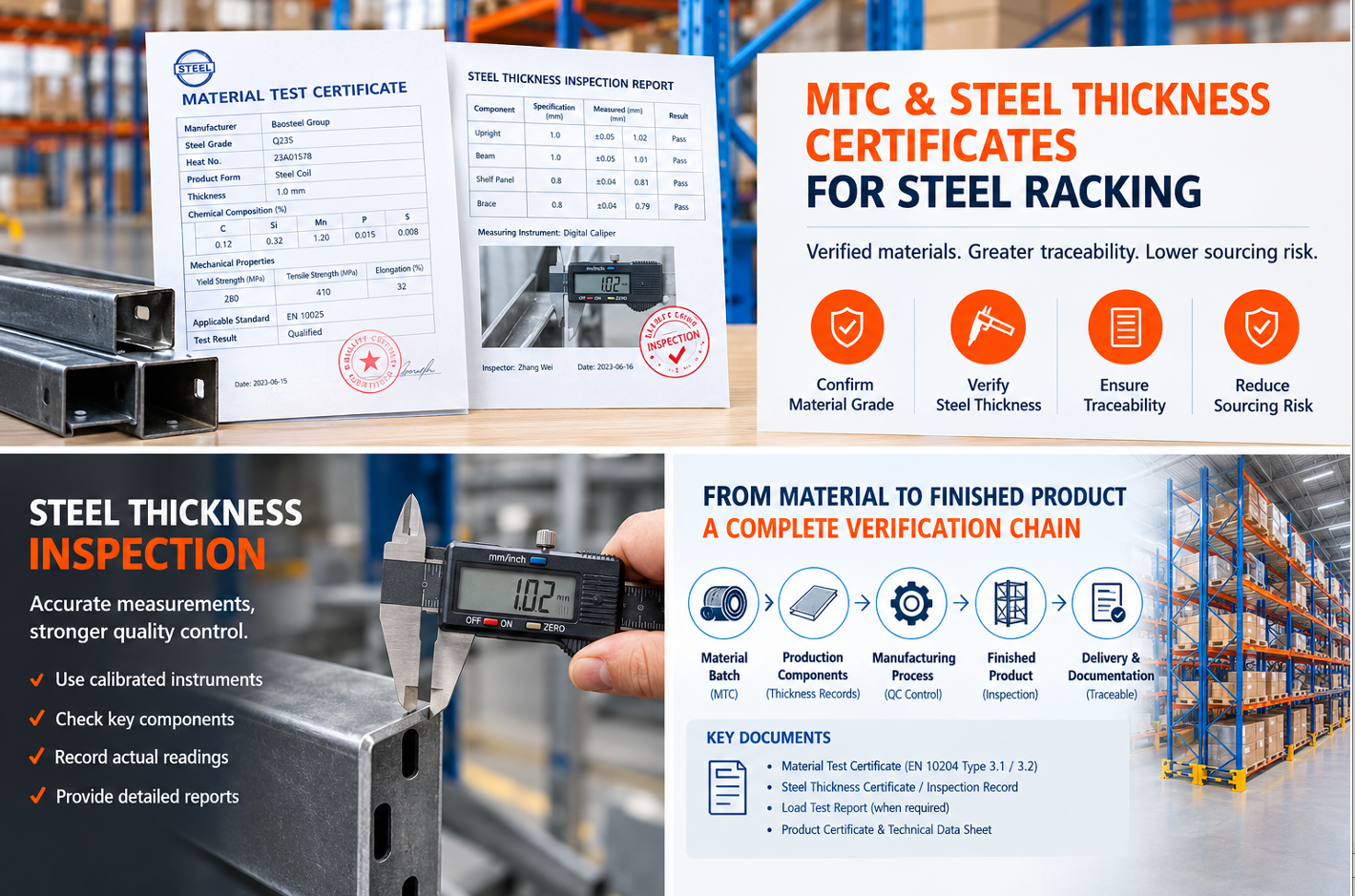
Material thickness and dimension inspection
Trial assembly and pre-shipment checking
Export packaging and container-loading support
Installation instructions and technical guidance
For an accurate proposal, the shelving structure should be selected around the goods and operating conditions—not only around a target price.
Information to Provide for a Medium Duty Shelving Quote
To receive a faster and more accurate quotation, prepare the following information:
Overall shelving height, width and depth
Number of shelf levels
Maximum load per level
Type and dimensions of stored goods
Required quantity or total shelving length
Starter bay and add-on bay requirements
Preferred deck material
Colour or RAL number
Installation environment
Destination country or port
Logo, packaging or private-label requirements
Warehouse drawing for layout-based projects
Frequently Asked Questions
Is medium duty shelving suitable for pallet storage?
Medium duty shelving is primarily designed for manually handled cartons, bins, tools and loose products. If goods will be stored and moved on pallets, a properly designed pallet racking system is normally more appropriate.
Is every medium duty shelf rated for 500 kg?
No. A 500 kg shelf rating requires a suitable combination of dimensions, upright and beam profiles, steel thickness, deck design and reinforcement. The final capacity must match the approved product specification.
Can the shelf height be adjusted?
Yes. Medium duty shelving normally uses perforated uprights that allow beam or shelf positions to be changed at defined increments.
What is the difference between medium duty shelving and long span shelving?
The terms sometimes overlap. Long span shelving generally emphasizes a wider shelf opening and stronger beams for bulky, manually handled goods. The actual component specifications should be compared before ordering.
Can a shelving row be expanded later?
Yes. A modular system can normally be extended with compatible add-on bays. Buyers should discuss future expansion during the initial design stage to maintain component compatibility.
Can the size, colour and packaging be customized?
Yes. KAYOU supports customized dimensions, shelf levels, load configurations, colours, logos, labels and export packaging for distributors, wholesalers and project buyers.
Does powder-coated steel shelving rust?
Powder coating improves surface durability and corrosion resistance in normal indoor conditions, but it should not be considered permanently rustproof. Humidity, chemicals, damaged coating and outdoor exposure can affect service life.
Request a Customized Medium Duty Shelving Solution
The right shelving system begins with accurate information about your products, shelf load, available space and daily operation.
Send KAYOU your required dimensions, number of levels, load per shelf, quantity and destination. Our team will recommend a suitable structure and prepare a customized quotation for your project.