
Selective vs Drive-In Pallet Racking: Which Is Better for Your Warehouse?
Choosing between selective pallet racking and drive-in pallet racking is not simply a question of which system stores more pallets.
The right choice depends on your SKU quantity, pallet volume per SKU, inventory rotation, forklift operation, warehouse dimensions and required storage density.
Quick Answer
Choose Selective Pallet Racking if:
You store many SKUs
Direct access to every pallet is important
Inventory changes frequently
Fast picking and replenishment matter
Warehouse flexibility is a priority
Choose Drive-In Pallet Racking if:
You store fewer SKUs
Each SKU has many pallets
High storage density is more important than direct access
Products are stored in batches
You want to reduce the number of forklift aisles
For many mixed-SKU warehouses, selective pallet racking offers greater flexibility. For bulk storage with large quantities of the same SKU, drive-in racking can significantly improve space utilization.
Before comparing selective and drive-in layouts, prepare the core project data with KAYOU's Pallet Racking RFQ Checklist so SKU quantity, pallet data, forklift information and warehouse dimensions can be reviewed together.
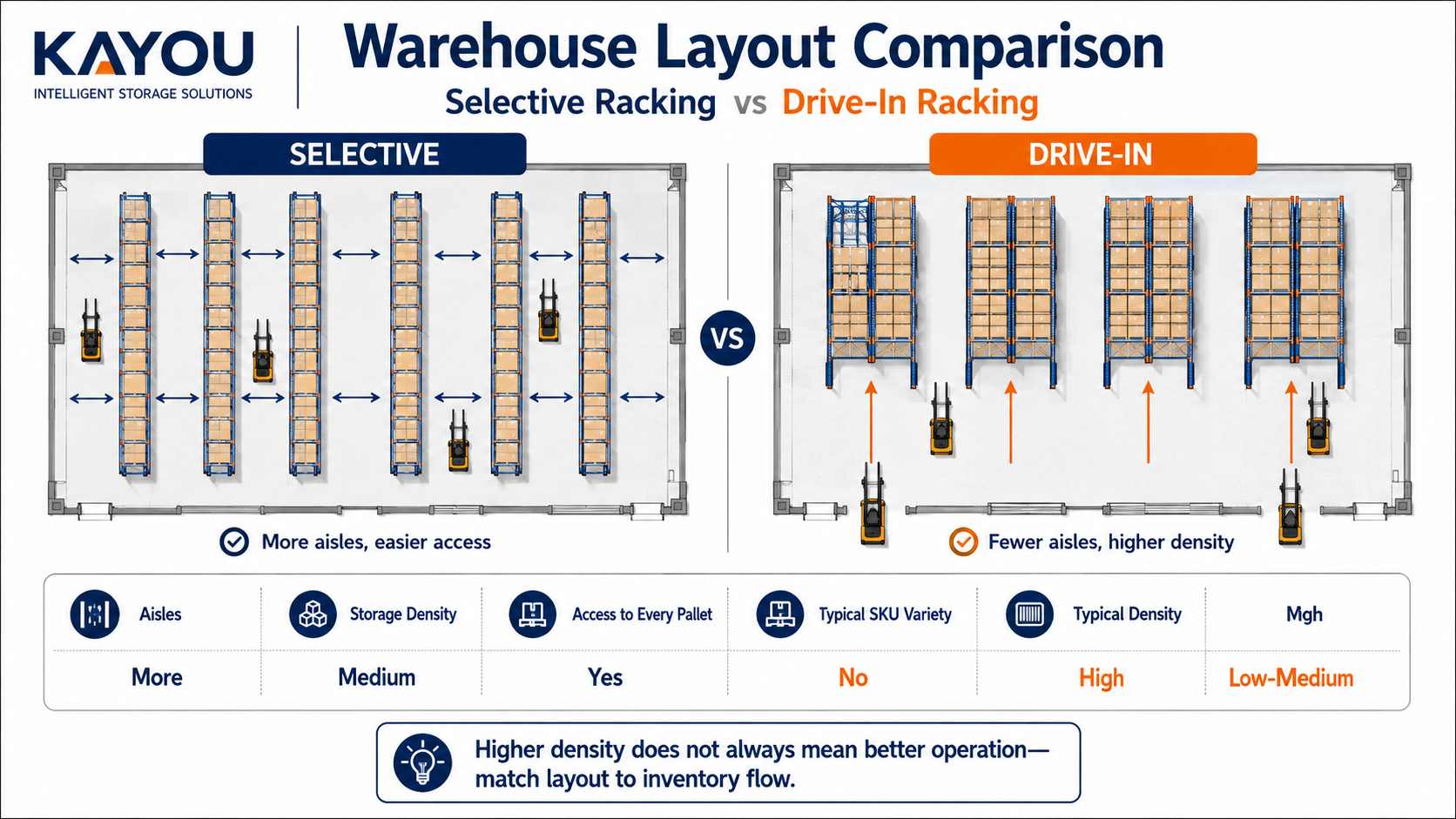
Recommended graphic:
Selective Pallet Racking vs Drive-In Pallet Racking
Show both systems side by side.
What Is Selective Pallet Racking?
Selective pallet racking is one of the most widely used warehouse racking systems.
Each pallet position is directly accessible from the aisle, allowing forklift operators to retrieve almost any pallet without moving other pallets first.
This makes selective racking suitable for:
Warehouses with many SKUs
Distribution centers
3PL facilities
Manufacturing warehouses
E-commerce and retail distribution
Fast-moving inventory
Its main advantage is selectivity.
The trade-off is that each rack face normally requires an operating aisle, so storage density is generally lower than high-density systems such as drive-in racking.
Load requirements should be checked together with the final rack configuration. Read the Pallet Racking Load Capacity Guide to understand how pallet weight, beam span, rack height and structural configuration affect the design.
What Is Drive-In Pallet Racking?
Drive-in racking is a high-density pallet storage system where forklifts enter storage lanes inside the rack structure.
Instead of storing only one pallet deep, drive-in lanes can hold multiple pallets in depth.
This reduces the number of aisles and increases storage density.
Drive-in racking is commonly used for:
Large quantities of the same SKU
Food and beverage storage
Cold storage
Raw materials
Batch inventory
Seasonal products
The main advantage is high storage density.
The trade-off is reduced direct pallet access.
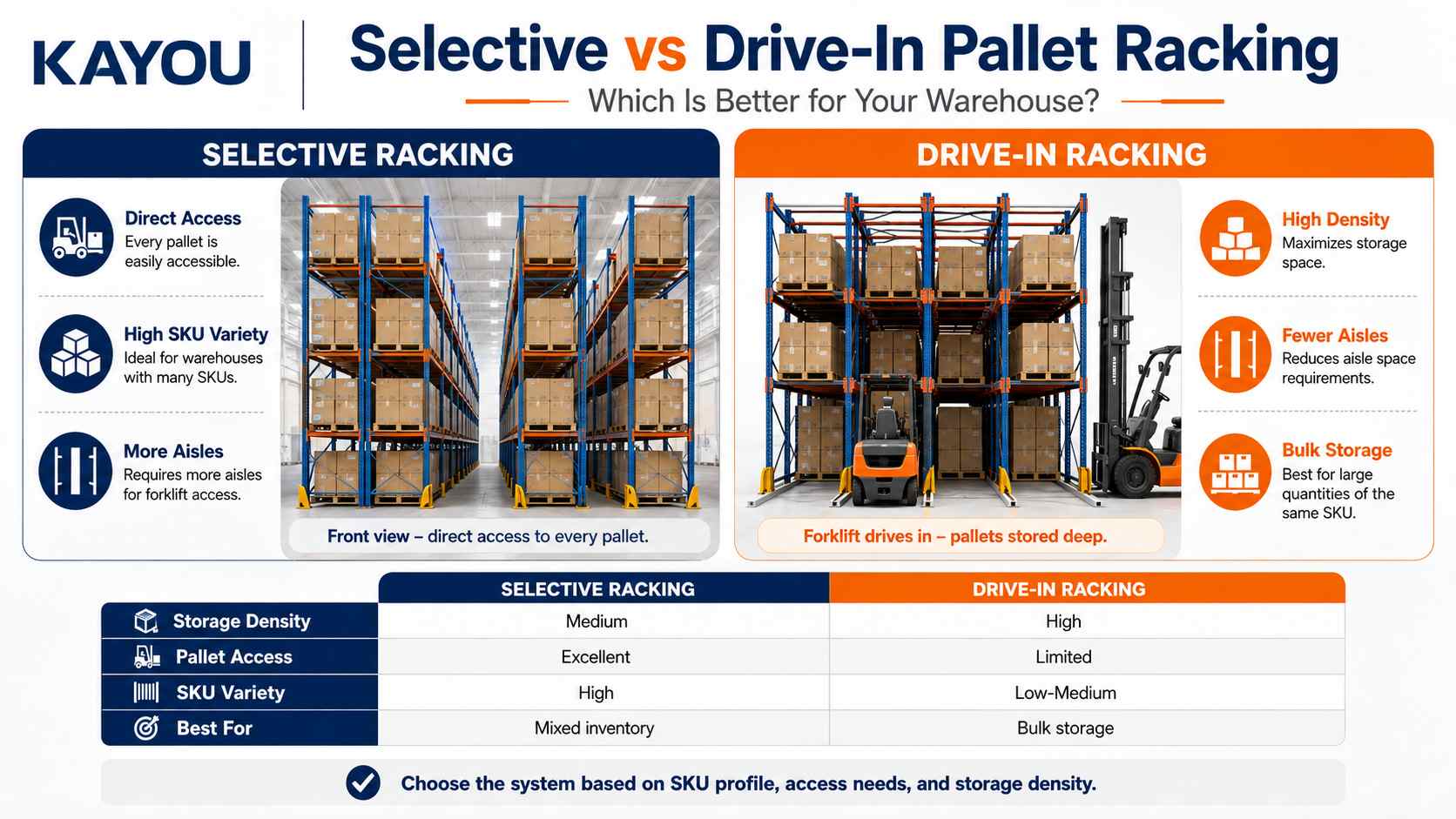
Recommended graphic:
Top-view comparison showing:
Selective → many aisles, direct access
Drive-In → fewer aisles, deeper pallet lanes
ALT:
selective racking vs drive in racking warehouse layout
Selective vs Drive-In Pallet Racking: Quick Comparison
| Factor | Selective Racking | Drive-In Racking |
|---|---|---|
| Direct Pallet Access | Excellent | Limited |
| Storage Density | Medium | High |
| SKU Variety | High | Low to Medium |
| Pallets per SKU | Flexible | Best with many |
| Forklift Operation | In front of racks | Enters rack lanes |
| Inventory Rotation | Flexible | Often LIFO |
| Aisle Requirement | More aisles | Fewer aisles |
| Expansion Flexibility | High | More layout-dependent |
| Best For | Mixed inventory | Bulk storage |
1. Which System Offers Higher Storage Density?
Drive-in pallet racking normally offers higher storage density because several conventional aisles can be eliminated.
Pallets are stored deep inside rack lanes, allowing more of the warehouse footprint to be used for storage.
Selective racking requires more operating aisles because each pallet face needs forklift access.
Therefore:
If maximum pallet positions per square meter are the main goal, drive-in may be more attractive.
However, warehouse efficiency should not be judged only by storage density.
More pallets do not automatically mean better operations.
2. Which System Is Better for Many SKUs?
Selective pallet racking is generally better for warehouses with a large number of SKUs.
Example:
Warehouse A
500 pallets
350 SKUs
Selective racking allows operators to reach almost every SKU directly.
Warehouse B
500 pallets
20 SKUs
Drive-in racking may be more efficient because many pallets belong to the same product group.
A useful rule is:
The more SKUs you have, the more valuable direct pallet access becomes.
3. FIFO vs LIFO
Inventory rotation is another major difference.
Selective Racking
Selective pallet racking can support flexible inventory management because each pallet is individually accessible.
It is therefore easier to organize:
FIFO
Batch picking
Lot control
Expiry-date management
Drive-In Racking
Traditional drive-in lanes are commonly operated using a LIFO-style workflow because pallets are loaded and retrieved from the same side.
The last pallet placed into the lane may be the first one removed.
For products with strict FIFO requirements, another high-density system may be more appropriate.
4. Forklift Operation
Selective racking is generally simpler to operate.
The forklift remains in the aisle and places pallets directly onto the beams.
Drive-in systems require the forklift to enter the rack lane.
This means drive-in projects require careful consideration of:
Forklift dimensions
Pallet clearance
Lane width
Upright protection
Driver accuracy
Rack depth
Guide rails where required
Load requirements should be checked together with the final rack configuration. Read the Pallet Racking Load Capacity Guide to understand how pallet weight, beam span, rack height and structural configuration affect the design.
Because forklifts operate inside the rack structure, drive-in systems may require more attention to rack protection and operator training.
5. What About Load Capacity?
Both systems can be designed for heavy pallet loads, but their structural configurations are different.
Load capacity should not be compared only by asking:
“How many kilograms per pallet?”
The final design also depends on:
Pallet weight
Rack height
Beam or rail configuration
Upright design
Lane depth
Number of levels
Load distribution
Before finalizing either system, confirm the required pallet and level loads in our pallet racking load capacity guide so the structural comparison is based on actual project conditions.
A 1,000 kg pallet can require very different structural solutions in selective and drive-in systems.
6. Which One Costs Less?
There is no universal answer.
Selective racking usually has a simpler structure, but it may require more aisles and therefore fewer pallet positions within the same building.
Drive-in racking can use more structural components per storage lane, but its higher density may reduce the cost per pallet position.
This means buyers should compare:
Total project price ÷ total pallet positions
rather than only:
Price per rack bay.
A higher project price can still produce a lower storage cost per pallet position.
7. Which System Is Better for Cold Storage?
Drive-in racking can be attractive in cold storage because refrigerated warehouse space is expensive.
Reducing aisles and increasing pallet density can improve utilization of the temperature-controlled area.
However, selective racking may still be better when:
SKU variety is high
Inventory turnover is frequent
Individual pallet access is important
The correct system depends on both storage cost and operating requirements.
8. Which System Is Better for 3PL Warehouses?
For many third-party logistics operations, selective pallet racking offers greater flexibility.
3PL warehouses often handle:
Multiple customers
Changing SKU profiles
Different pallet sizes
Frequent inbound and outbound movements
Direct access can therefore be more valuable than maximum density.
Drive-in racking may still be useful for dedicated bulk-storage zones within the same facility.
A hybrid layout can sometimes provide the best result.
Decision Checklist
Choose Selective Pallet Racking if most of these statements are true:
We have many SKUs
We need direct access to pallets
Inventory changes frequently
Picking speed is important
Flexibility matters
We operate a 3PL or mixed warehouse
Choose Drive-In Pallet Racking if most of these are true:
We have relatively few SKUs
We have many pallets per SKU
Bulk storage is important
High storage density is a priority
Batch inventory is acceptable
We want fewer aisles
[IMAGE 3]
Recommended graphic:
A simple decision-tree:
Many SKUs → Selective
Few SKUs + many pallets per SKU → Drive-In
Can You Use Both Systems in One Warehouse?
Yes.
Many warehouses do not need to choose only one system.
For example:
Fast-moving mixed SKUs
→ Selective Pallet Racking
High-volume reserve inventory
→ Drive-In Racking
This hybrid approach can balance:
Accessibility
Storage density
SKU management
Warehouse utilization
A proper warehouse layout should divide storage zones according to actual inventory characteristics.
How KAYOU Helps Choose the Right System
KAYOU can review project information including:
Warehouse drawing
Pallet size
Maximum pallet weight
SKU quantity
Pallets per SKU
Required pallet positions
Forklift model
Inventory rotation
Destination country
Based on these inputs, different layout options can be compared before finalizing the project.
Need a project-specific pallet racking configuration? Explore KAYOU Heavy-Duty Pallet Racking and send us your warehouse drawing, pallet data and storage requirements for layout review.
Not Sure Which Racking System Is Better?
Send KAYOU your:
Warehouse Drawing + Pallet Data + SKU Quantity + Forklift Model
We can help compare selective and drive-in layouts according to your storage requirements.
Frequently Asked Questions
Is drive-in racking better than selective pallet racking?
Not always. Drive-in is better when high storage density and large pallet quantities per SKU are priorities. Selective racking is usually better when direct pallet access and SKU flexibility are more important.
Which system stores more pallets?
Drive-in racking normally provides higher storage density because it reduces the number of forklift aisles.
Which system is better for many SKUs?
Selective pallet racking is generally better because almost every pallet position can be accessed directly.
Is drive-in racking FIFO or LIFO?
Traditional drive-in racking commonly operates using a LIFO-style workflow because pallets are loaded and retrieved from the same side.
Is selective pallet racking cheaper?
Its structure may be simpler, but total project economics depend on pallet positions, warehouse utilization and project requirements. Compare cost per pallet position rather than rack price alone.
Can drive-in racking hold heavy pallets?
Yes, when properly designed. The final capacity depends on pallet weight, rack height, lane depth, structural components and project conditions.
Can selective and drive-in racks be used together?
Yes. Hybrid warehouse layouts are common when different inventory groups require different storage strategies.
What information does KAYOU need to recommend a system?
Provide your warehouse dimensions, pallet size, pallet weight, SKU quantity, pallets per SKU, required storage capacity and forklift information.
Get a Custom Warehouse Racking Recommendation
The best pallet racking system is not necessarily the one with the highest storage density.
It is the system that best balances:
Storage Capacity
Pallet Accessibility
Inventory Rotation
Forklift Efficiency
Project Cost
If you are deciding between selective and drive-in pallet racking, send KAYOU your warehouse information.
Please Provide:
Warehouse drawing
Pallet dimensions
Maximum pallet weight
SKU quantity
Pallets per SKU
Required pallet positions
Forklift model
Destination country
WAREHOUSE RACKING SYSTEM SELECTION
Not Sure Whether Selective or Drive-In Racking Is Better?
Send KAYOU your warehouse drawing, pallet size, maximum pallet weight, SKU quantity, pallets per SKU and forklift model. Our team can compare layout options and help prepare a customized warehouse racking recommendation.