
How Much Weight Can Pallet Racking Hold? Pallet Rack Load Capacity Guide
How much weight can a pallet rack hold?
It sounds like a simple question, but there is no single load-capacity number that applies to every pallet racking system.
Pallet racking capacity depends on the complete rack configuration, including pallet weight, beam span, beam profile, upright specification, beam spacing, rack height, load distribution, base plates, anchors and project conditions.
A rack that safely supports a certain pallet load in one configuration may require different components if the beam span, number of levels or rack height changes.
For this reason, B2B buyers should never evaluate pallet racking only by a headline such as:
“3,000 kg capacity”
without confirming exactly what that rating means.
Quick Answer
Pallet racking load capacity is determined by the complete structural configuration, not by one component alone.
Buyers should normally confirm:
Maximum loaded pallet weight
Number of pallets per beam level
Beam length
Beam profile
Rack height
Number of storage levels
Vertical beam spacing
Upright specification
Load distribution
Pallet type
Base plate and anchoring requirements
Floor conditions
Applicable local project requirements
For an accurate quotation, always provide the maximum expected loaded pallet weight, not only an average pallet weight.
Need a more accurate load-capacity quotation? Use KAYOU's Pallet Racking RFQ Checklist to prepare pallet weight, dimensions, rack height, forklift and warehouse information before requesting a design.
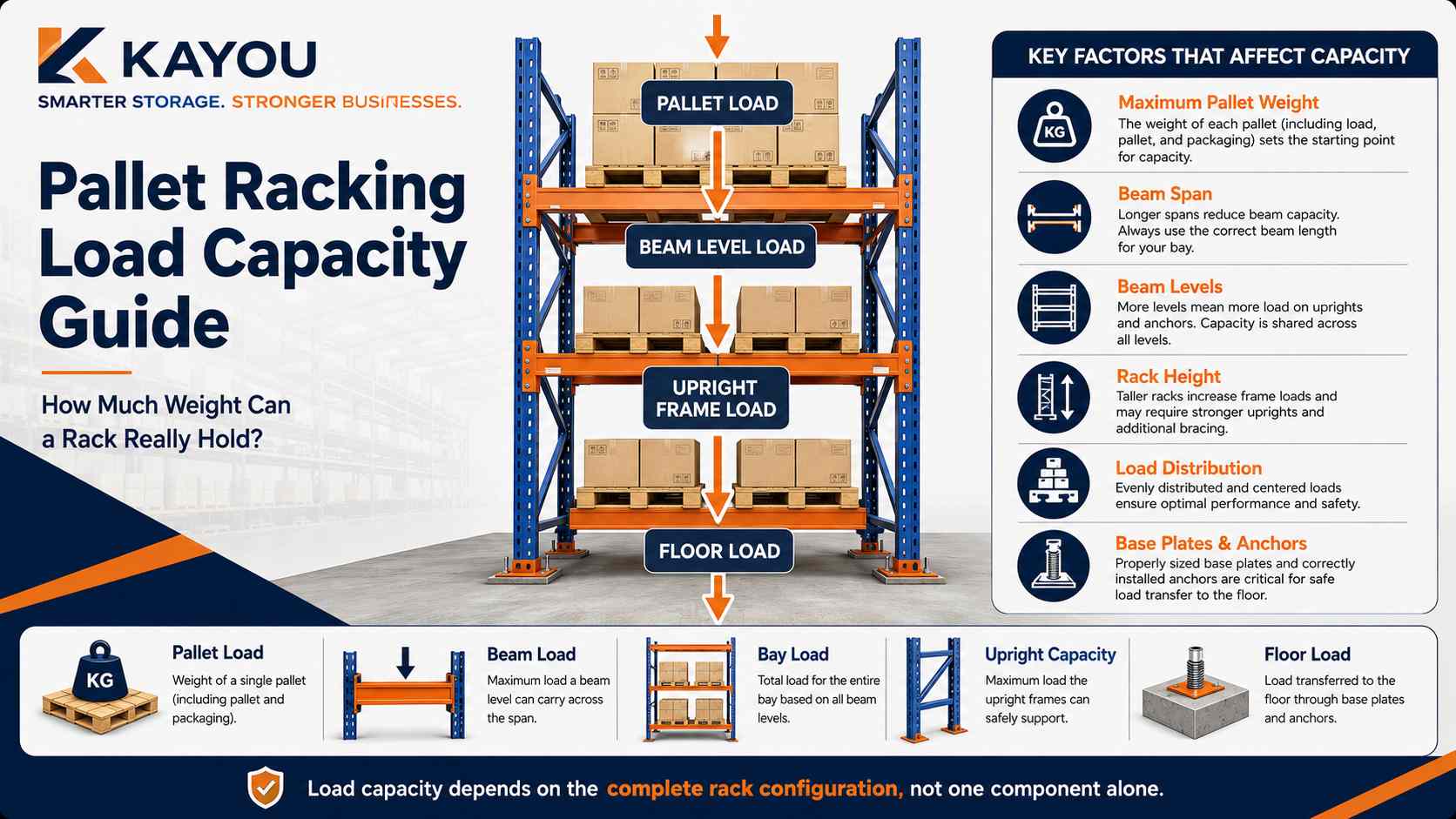
Recommended graphic:
Pallet Racking Load Capacity Guide
Show:
Pallet Load → Beam Level Load → Upright Frame Load → Floor Load
Recommended ALT:
pallet racking load capacity beam upright and pallet load guide
1. What Does Pallet Racking Load Capacity Actually Mean?
The term “load capacity” can refer to several different things.
This is one of the most common sources of confusion when buyers compare pallet racking quotations.
Pallet Load
The total weight of one loaded pallet.
This includes:
Goods + pallet
For example:
Pallet:
25 kg
Goods:
975 kg
Maximum loaded pallet:
1,000 kg
Beam Level Load
The total load supported at one beam level.
For example:
2 pallets × 1,000 kg each
= 2,000 kg loaded on the beam level
This does not automatically mean that every beam of the same visual size can carry 2,000 kg.
The beam profile, material, connector, span and loading condition still need to be suitable.
Bay Load
The combined storage load applied within one rack bay.
For example, if a bay has:
3 elevated beam levels
with:
2 × 1,000 kg pallets per level
the stored product load may be:
6,000 kg per bay
depending on whether floor-level pallets are included separately.
The complete rack frame must therefore be designed for the total configuration, not just one shelf level.
Upright Frame Capacity
Upright frames transfer loads from the beams down toward the floor.
Their capacity depends on more than simply:
upright thickness.
Important factors can include:
Upright section
Steel properties
Frame width
Bracing arrangement
Rack height
Beam elevations
Vertical beam spacing
Base plate configuration
System layout
Project design requirements
Floor Load
Ultimately, the rack loads are transferred through:
Upright → Base Plate → Anchor / Floor
Therefore the warehouse slab and project conditions must also be considered.
Quick Comparison
| Capacity Term | What It Describes |
|---|---|
| Pallet Load | Weight of one loaded pallet |
| Beam Level Load | Total load supported on one beam level |
| Bay Load | Total stored load within one rack bay |
| Upright Capacity | Load carried through the rack frame |
| Floor Load | Load transferred to the concrete floor |
Understanding these terms makes it much easier to compare quotations correctly.
2. Start With the Maximum Loaded Pallet Weight
The most important starting point is usually:
What is the heaviest pallet you expect to store?
Do not use only the average load.
Consider this warehouse:
Most pallets:
700 kg
Some pallets:
950 kg
Maximum pallet:
1,100 kg
If the rack is designed only around the 700 kg average, the heavier pallets may exceed the intended loading condition.
The quotation should therefore normally use the maximum expected loaded pallet weight.
Example
Maximum pallet weight:
1,000 kg
Pallets per beam level:
2
Initial required stored load at the beam level:
2 × 1,000 = 2,000 kg
This is only a starting design input.
The rack supplier still needs to confirm the correct beam and complete system configuration.
3. Beam Capacity Is Not the Same as Pallet Weight
Suppose a customer says:
“My pallet weighs 1,000 kg.”
That tells the supplier the unit load, but not the complete beam requirement.
The supplier also needs to know:
How many pallets are stored per level?
What is the beam span?
How is the load supported?
Is the load evenly distributed?
What type of pallet is being used?
Are pallet support bars required?
For example:
Configuration A
2 pallets × 1,000 kg
Beam level load:
2,000 kg
Configuration B
3 pallets × 1,000 kg
Beam level load:
3,000 kg
Even though the pallet weight is identical, the beam requirement is different.
This is why quotations should clearly state:
Capacity per pallet
and/or
Capacity per beam level
rather than simply:
“Load capacity: 3 tons.”
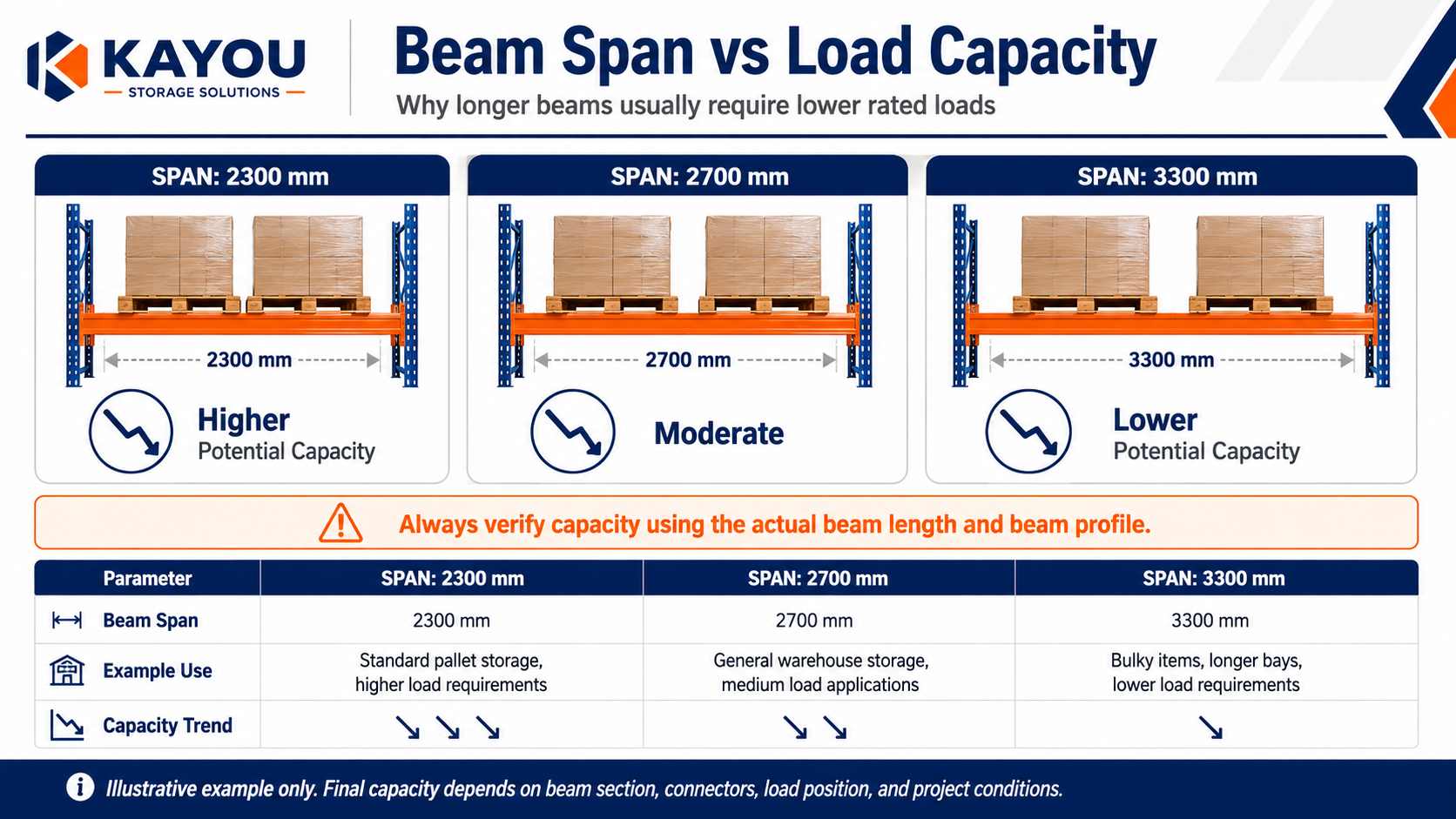
4. Why Beam Span Changes Load Capacity
Beam length is one of the most important variables affecting rack capacity.
In general:
A longer beam span creates a greater structural demand than a shorter span using the same beam profile.
Consider two racks using visually similar beams.
Rack A
Beam length:
2,300 mm
Rack B
Beam length:
3,300 mm
The longer beam cannot automatically be assumed to have the same allowable load as the shorter beam.
This is why buyers should not compare beam thickness alone.
Beam design can depend on:
Beam height
Beam width
Steel thickness
Section shape
Beam length
Connector design
Load position
Load distribution
Buyer Tip
If a supplier provides a capacity chart, always check that the capacity corresponds to the actual beam span used in your quotation.
Recommended graphic:
Same beam profile shown at:
2300 mm
2700 mm
3300 mm
with decreasing conceptual capacity arrows.
Recommended ALT:
pallet rack beam span and load capacity comparison
5. Load Distribution Matters
Published rack-beam capacities often assume a specific loading condition.
A typical pallet rack level may be designed around pallet loads positioned at expected locations across the beam pair.
But different storage conditions can change how the load is transferred.
Examples include:
Standard pallets
Skids
Metal bins
Machinery
Point loads
Uneven pallets
Damaged pallets
Loads with runners
Non-standard containers
A concentrated load can create a different beam demand compared with a properly distributed pallet load.
Therefore, if you are storing something other than normal palletized goods, tell the rack supplier before production.
Do Not Simply Say
2,000 kg per level.
Instead explain:
Two 1,000 kg pallets positioned side-by-side.
or:
One 2,000 kg machine supported at four contact points.
These are not necessarily equivalent loading conditions.
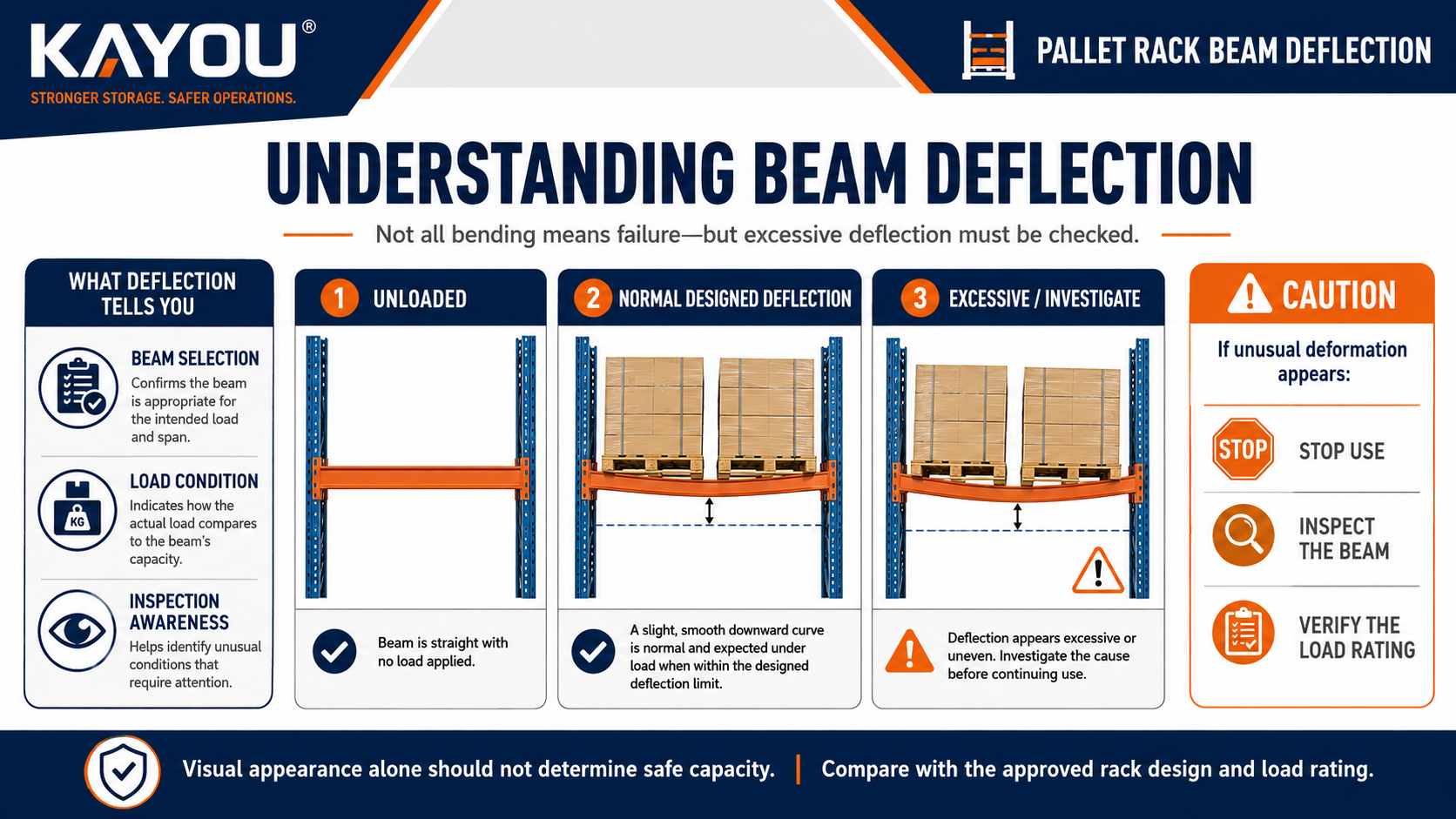
6. What Is Pallet Rack Beam Deflection?
When a beam carries load, it can bend slightly.
This bending is called:
deflection.
A small amount of designed deflection does not automatically mean that the beam has failed.
However, excessive deformation can indicate:
Overloading
Incorrect beam specification
Damaged components
Unexpected loading
Improper load distribution
Beam selection therefore considers both structural strength and acceptable deformation.
Important Buyer Point
Do not judge rack capacity only by visually checking:
“The beam still looks straight.”
and do not assume:
“A little bending means the rack is unsafe.”
The correct assessment needs to be based on the approved rack design, load rating and inspection criteria.
If a beam shows unusual deformation under normal loads, stop using the affected level and have it checked by qualified personnel.
Recommended graphic:
Three beams:
Unloaded
Normal Designed Deflection
Excessive / Investigate
Do not exaggerate the curvature.
Recommended ALT:
pallet rack beam deflection under load illustration
7. Upright Frame Capacity Depends on Beam Spacing
This is one of the most important technical points in pallet rack design.
Upright capacity is not simply a fixed number that stays the same regardless of rack configuration.
The vertical distance between beam levels affects how the rack column behaves.
This distance is often described as:
vertical beam spacing
or
unsupported column length between beam levels.
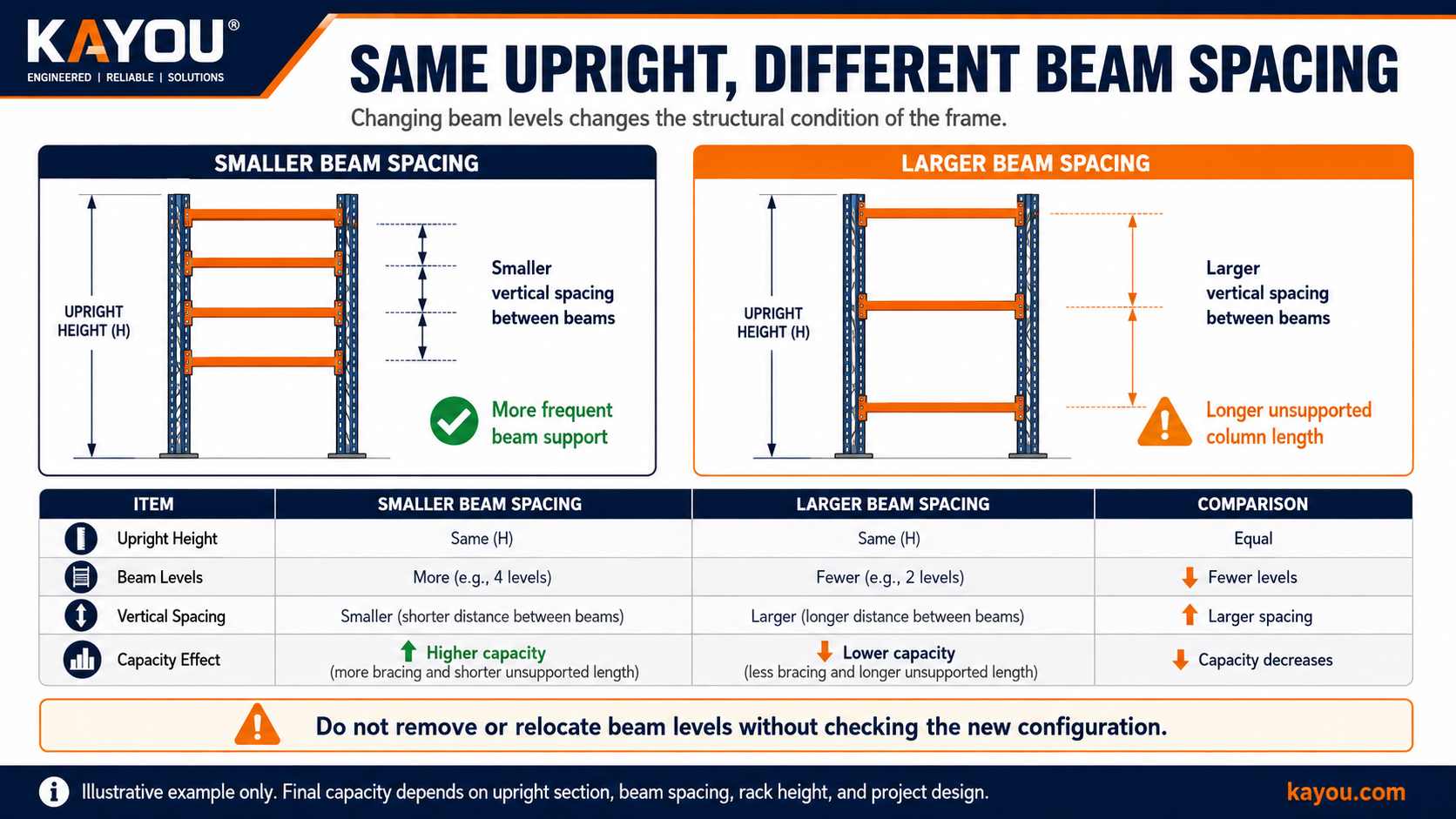
Imagine the same upright frame.
Layout A
Beam levels positioned relatively close together.
Layout B
One beam level is removed, creating a much larger vertical spacing.
Even though the upright itself has not changed, the structural condition has changed.
Therefore:
Moving beam levels after installation can affect rack capacity.
This is why users should not remove beams, raise storage levels or significantly change rack configuration without checking whether the new arrangement remains suitable.
Buyer Tip
If you expect future beam-level changes, tell the supplier during design.
The project can then be reviewed with future flexibility in mind.
Recommended graphic:
Same upright frame shown twice:
Smaller Beam Spacing
vs
Larger Beam Spacing
with vertical dimension arrows.
Recommended ALT:
vertical beam spacing effect on pallet rack upright capacity
8. Rack Height Also Affects the Structural Design
A 3-meter-high pallet rack and a 10-meter-high pallet rack should not automatically use the same assumptions simply because they store pallets of the same weight.
Higher racks introduce additional considerations such as:
Upright stability
Beam elevations
Frame bracing
Anchorage
Installation tolerances
Forklift interaction
Building conditions
Seismic requirements where applicable
Therefore:
Maximum pallet weight + total rack height
should both be provided during quotation.
This is another reason that copying a small rack specification and simply making the uprights taller is not good engineering practice.
Rack height and capacity also need to be coordinated with forklift operation and aisle planning. Explore pallet racking aisle and layout planning within KAYOU's warehouse racking solutions.
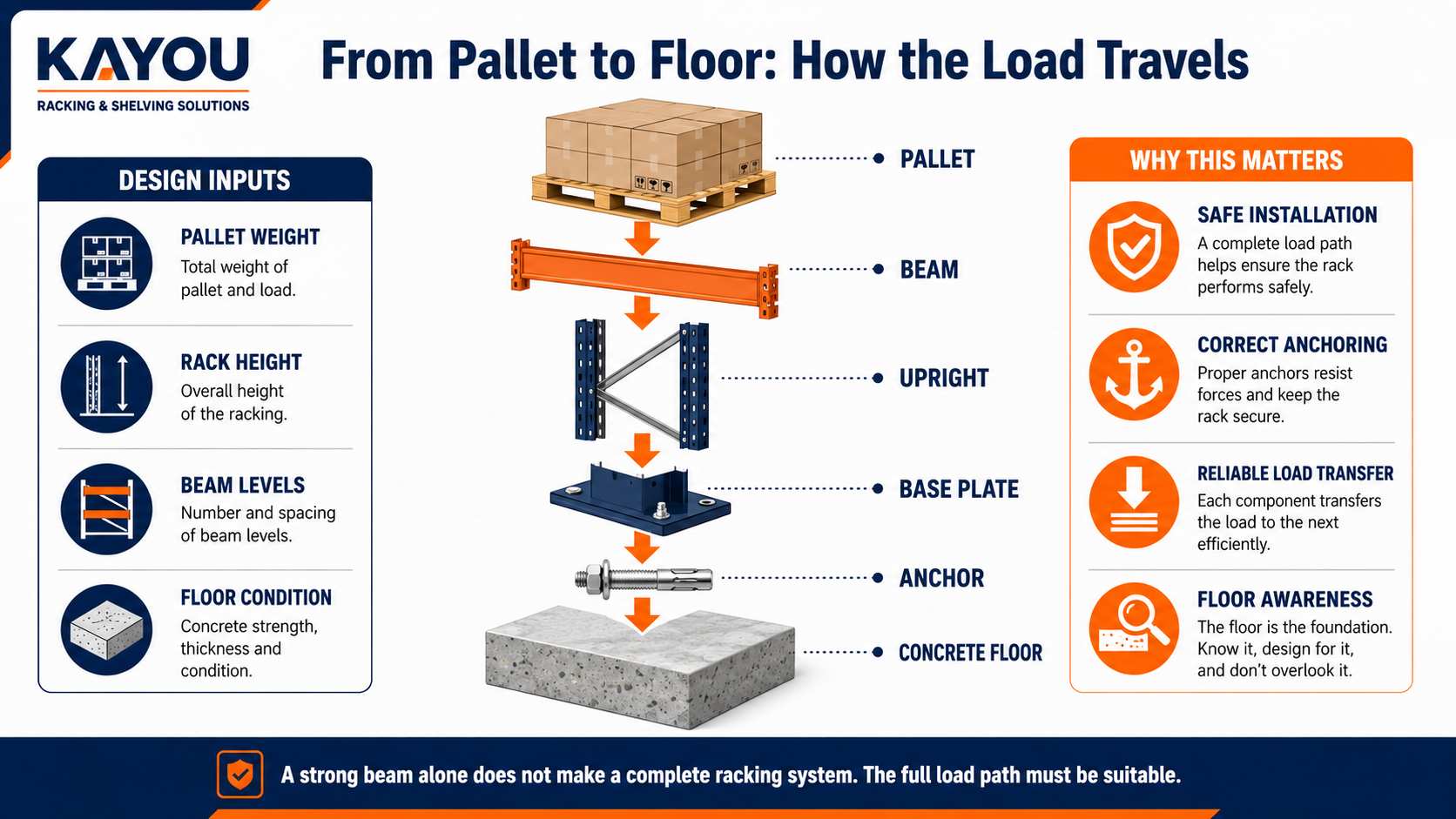
9. Base Plates and Anchors Are Part of the Load Path
A pallet rack does not stop at the upright.
Loads eventually need to be transferred to the warehouse floor.
The basic load path is:
Pallet
↓
Beam
↓
Upright
↓
Base Plate
↓
Concrete Floor
For this reason, the rack design may also need to consider:
Base plate size
Anchor type
Anchor quantity
Concrete condition
Slab thickness
Concrete strength
Floor joints
Local engineering requirements
A heavy-duty rack with strong beams and uprights is not a complete storage system if the load transfer at the floor has not been considered correctly.
Important
Do not change anchor specifications or install the rack without anchors simply to save installation time unless the approved engineering requirements explicitly allow the intended arrangement.
Recommended graphic:
Exploded load path:
Pallet → Beam → Upright → Base Plate → Anchor → Concrete Floor
Recommended ALT:
pallet racking load path base plate anchor concrete floor
10. Can Wire Mesh Decking Increase Rack Capacity?
This is a common misunderstanding.
Wire mesh decking, steel panels and pallet support bars can support stored goods and improve the storage surface.
However:
Adding decking does not automatically increase the rated capacity of the entire pallet rack.
Decking has its own design capacity.
The beams have their own capacity.
The uprights have their own structural role.
The complete rack configuration still needs to be suitable for the intended load.
For standard pallet storage, wire decking may provide:
Additional support
Better visibility
Reduced risk of small items falling
Improved storage flexibility
but it should not be used as a shortcut for increasing rack load capacity.
Decking selection should match the pallet and load-support requirement. Explore KAYOU warehouse racking solutions and accessories when discussing wire mesh decking, pallet supports and other rack components.
11. Can You Add Heavier Pallets Later?
Sometimes a customer initially stores:
800 kg pallets
but later changes products and wants to store:
1,200 kg pallets.
Can the existing rack be used?
The correct answer is:
Not without verification.
The rack needs to be checked against the new loading condition.
Possible changes may be required to:
Beam profile
Beam quantity
Uprights
Bracing
Pallet supports
Base plates
Anchors
Rack configuration
Similarly, changing from:
2 pallets per beam level
to
3 pallets per level
can substantially change the required beam load.
Never assume unused-looking structural capacity is available.
12. Can You Move the Beam Levels?
Adjustable pallet racking allows beam elevations to be changed.
That does not mean every possible beam position has the same rack capacity.
Changing beam positions changes:
Vertical spacing
Pallet clearance
Upright loading
Rack configuration
Therefore, before significantly changing the beam arrangement, confirm that the modified system remains suitable.
This is especially important when:
Removing a complete beam level
Increasing the vertical distance between levels
Adding heavier pallets
Increasing the top beam elevation
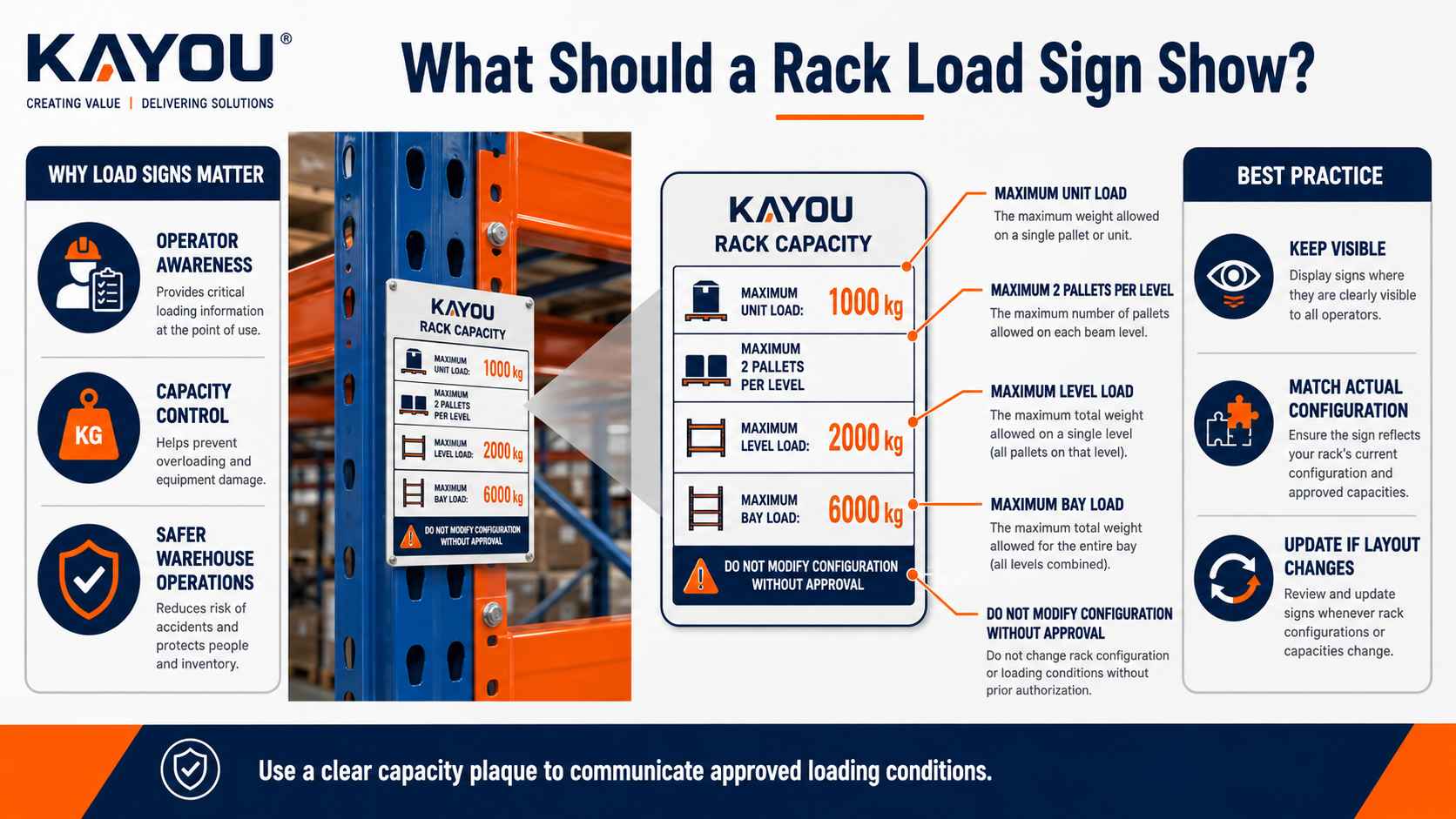
13. What Is a Rack Load Capacity Plaque?
A professional pallet rack installation should clearly communicate the approved loading conditions.
A capacity plaque or load sign can identify information such as:
Maximum permissible unit load
Maximum level load
Maximum bay load
Rack configuration
Important operating restrictions
This helps warehouse operators avoid relying on memory or assumptions.
Example
A load sign may state:
Maximum pallet load: 1,000 kg
Maximum 2 pallets per level
Maximum beam level load: 2,000 kg
Rack configuration must not be modified without approval
The exact format should follow the applicable project requirements.
Recommended graphic:
Professional KAYOU rack capacity sign attached to an upright.
Recommended ALT:
pallet racking load capacity plaque and maximum load sign
14. Pallet Rack Capacity vs Safety Factor
Buyers sometimes ask:
“If the rack is rated for 2,000 kg, how much can it actually hold before it fails?”
This is the wrong way to use a storage rack.
A rack's rated capacity already represents the maximum permissible design loading under the specified conditions.
It should not be intentionally exceeded to test the theoretical reserve.
Do not treat engineering safety factors as:
extra usable capacity.
The operating rule should remain:
Never exceed the approved rated capacity.
15. Five Common Pallet Rack Overloading Mistakes
Mistake 1: Using Average Pallet Weight
Example:
Average = 700 kg
Maximum = 1,100 kg
Better Approach
Design around the maximum expected pallet load.
Mistake 2: Confusing Pallet Load With Level Load
A 1,000 kg pallet does not mean:
1,000 kg per beam level
if two or three pallets are stored at the same level.
Better Approach
Calculate:
Maximum pallet weight × pallets per level
as an initial input.
Mistake 3: Changing Beam Positions Without Checking
Removing or repositioning beams may change upright-frame behavior.
Better Approach
Confirm significant layout changes before reuse.
Mistake 4: Assuming All Loads Are Uniform
Machinery, bins and point-loaded products can behave differently from standard pallets.
Better Approach
Tell the supplier exactly what is being stored.
Mistake 5: Ignoring Damaged Rack Components
A rack may originally have been correctly designed but later suffer:
Forklift impact
Bent uprights
Damaged beams
Loose anchors
Missing beam locks
Damage can reduce the reliability of the installed system.
Better Approach
Inspect damaged areas and replace or repair components according to qualified guidance before continued use.
16. What Information Does KAYOU Need to Confirm Rack Capacity?
When requesting a pallet racking quotation, provide the following information whenever possible.
Pallet Racking Load Capacity Checklist
| Information | Example |
| Maximum Loaded Pallet Weight | 1,000 kg |
| Pallet Size | 1200 × 1000 mm |
| Loaded Pallet Height | 1,500 mm |
| Pallets Per Level | 2 |
| Required Beam Levels | 4 |
| Target Rack Height | 7,000 mm |
| Beam Span | Supplier to design |
| Required Pallet Positions | 500 |
| Forklift Model | Reach Truck |
| Warehouse Clear Height | 8,000 mm |
| Floor Information | If available |
| Project Country | Australia |
| Warehouse Drawing | CAD / PDF |
The more accurate the information, the more accurately the rack configuration can be reviewed.
Need a project-specific rack capacity review? Send KAYOU your pallet size, maximum pallet weight, target rack height and warehouse drawing.Start Your Racking Design
Need a Pallet Rack Load Calculation and Layout?
Send KAYOU:
Pallet Size + Maximum Pallet Weight + Rack Height + Warehouse Drawing
Our team can review the project requirements and prepare a customized pallet racking proposal.
17. Example Pallet Racking Capacity Calculation
Consider the following simplified project.
Pallet
1200 × 1000 mm
Maximum Loaded Pallet Weight
1,000 kg
Pallets Per Beam Level
2
Elevated Beam Levels
3
The stored load per beam level is:
1,000 kg × 2 pallets = 2,000 kg
The elevated pallet product load within the bay is:
2,000 kg × 3 levels = 6,000 kg
This information helps define the starting design requirement.
However, this does not mean:
any 2,300–2,700 mm beam automatically supports 2,000 kg;
any upright automatically supports 6,000 kg;
the floor and anchors are automatically suitable.
The final system still depends on beam span, component sections, beam spacing, rack height and project-specific engineering.
That distinction is extremely important when comparing supplier quotations.
18. Selective vs Drive-In Racking: Does Capacity Work the Same Way?
Different pallet racking systems transfer loads through different structural arrangements.
For example:
Selective Pallet Racking
typically uses front-access beam levels with each pallet position directly accessible from the aisle.
Drive-In Pallet Racking
uses deeper storage lanes where forklifts enter the rack structure, creating a different structural and operational configuration.
Therefore, buyers should not assume that:
“1,000 kg per pallet”
creates exactly the same rack design for both systems.
Storage density, lane depth, structural layout and forklift operation all need to be considered.
19. Why Two Pallet Rack Quotations Can Have Different Prices
Suppose Supplier A and Supplier B both quote:
1,000 kg per pallet
but their prices are very different.
Before assuming one supplier is simply more expensive, compare:
Beam Span
Are the beam lengths the same?
Beam Profile
Are the sections and thicknesses equivalent?
Upright Specification
Are upright sizes and material specifications comparable?
Rack Height
Same total height?
Beam Levels
Same number and elevations?
Load Definition
Is capacity quoted:
per pallet,
per level,
or per bay?
Accessories
Are these included?
Anchors
Safety locks
Pallet supports
Upright protectors
Mesh decking
Load signs
Engineering Scope
Does the quotation include:
Layout design
Technical drawings
Structural verification
Installation drawings
Comparing these items gives buyers a much better picture than comparing:
USD per rack bay
alone.
20. How KAYOU Approaches Pallet Racking Load Requirements
For project-based pallet racking, KAYOU reviews the intended application before finalizing the rack specification.
Project inputs can include:
Pallet dimensions
Maximum pallet load
Pallets per level
Number of beam levels
Warehouse dimensions
Rack height
Forklift model
Required storage capacity
Destination country
Special project conditions
Depending on the project, supporting information may include:
2D layout drawings
3D warehouse layouts
Rack configuration drawings
Material specifications
Load information
Installation drawings
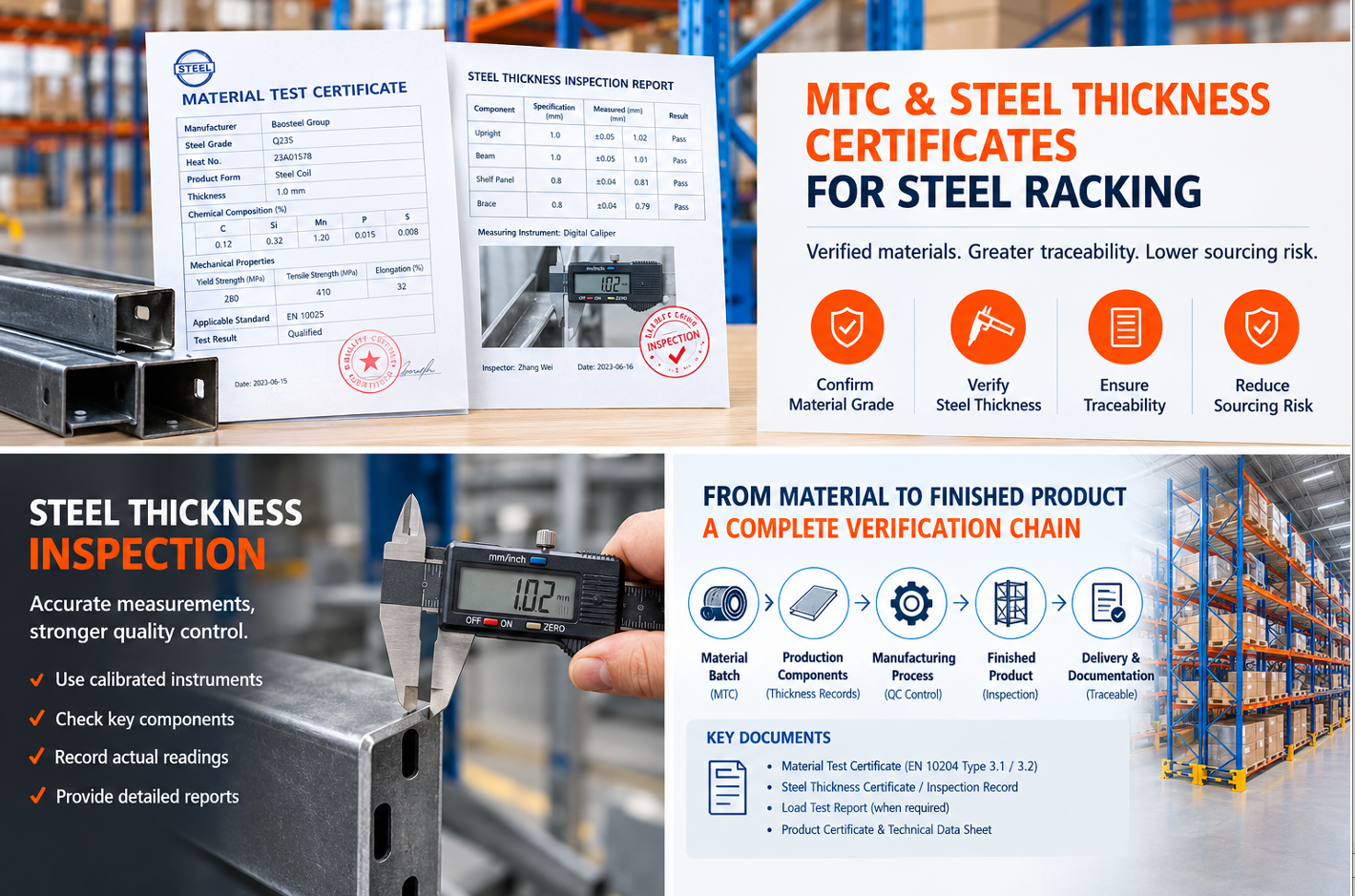
Quality inspection records
Material documentation
Pre-shipment inspection
The objective is to provide a rack configuration based on actual project requirements rather than simply applying one generic “heavy-duty” rating to every customer.
For a project-specific configuration based on actual pallet loads and warehouse conditions, explore KAYOU Heavy-Duty Pallet Racking and send your project data for layout and specification review.
Want to understand how rack specifications and finished products are checked? Review KAYOU Quality Control for more information about material, dimension, production and pre-shipment inspection.
Frequently Asked Questions About Pallet Racking Load Capacity
How much weight can pallet racking hold?
There is no single universal pallet rack capacity. Capacity depends on beam span, beam section, upright specification, rack height, beam spacing, pallet weight, load distribution and the complete structural configuration.
What does 2,000 kg per level mean?
It normally means that the approved beam level can support a total specified load of 2,000 kg under the intended loading condition. Buyers should confirm whether the rating applies to a pair of beams, shelf level or another configuration.
Is pallet rack capacity calculated per beam or per bay?
Both values may be important. Beam-level capacity refers to the load supported at an individual storage level, while bay load describes the total load associated with a rack bay.
How do I calculate the required beam capacity?
As an initial input:
Maximum loaded pallet weight × number of pallets stored on the beam level
For example:
1,000 kg × 2 pallets = 2,000 kg.
The final beam specification still needs to be selected according to span, beam profile, connectors and loading conditions.
Does a longer beam reduce pallet rack capacity?
For the same beam section and loading condition, increasing the span generally increases structural demand and can reduce allowable load capacity. Always use capacity data that corresponds to the actual beam length.
Does pallet rack height affect capacity?
Yes. Upright and system design depend partly on total rack height, beam positions, vertical beam spacing and other project conditions.
Can I remove one beam level from my pallet rack?
You should not assume that removing or repositioning a beam has no effect. Increasing the vertical distance between beam levels can change the structural behavior of the upright frame.
Can I increase the pallet weight after the rack is installed?
Only after confirming that the existing beams, uprights, base plates, anchors and complete rack configuration remain suitable for the heavier load.
Does wire decking increase pallet rack capacity?
Wire decking can support stored goods and improve shelf functionality, but it does not automatically increase the rated capacity of the entire rack system.
Should pallet racks be anchored to the floor?
Anchoring is commonly part of engineered pallet rack installations because loads must be transferred through the rack base to the floor. Final anchoring requirements should follow the approved design and applicable local requirements.
What is a pallet rack capacity plaque?
A rack capacity plaque or load sign communicates approved loading information to warehouse users, such as maximum pallet, level or bay loads and relevant restrictions.
Can a damaged rack still hold its original rated capacity?
Damage to beams, uprights, bracing, anchors or connectors can affect rack performance. Damaged areas should be inspected and appropriately repaired or replaced before continued operation.
Does KAYOU provide customized load-capacity designs?
KAYOU can develop pallet racking configurations according to pallet size, maximum pallet load, rack height, beam levels, warehouse dimensions and other project requirements.
What should I send KAYOU for a load-capacity quotation?
Send:
Warehouse drawing
Pallet size
Maximum loaded pallet weight
Loaded pallet height
Pallet quantity
Required rack height
Forklift information
Destination country
This gives the engineering and quotation team a much clearer starting point.
Ready to Confirm Your Pallet Racking Load Requirements?
Pallet racking capacity should never be reduced to one marketing number.
A reliable rack configuration should match:
Your Pallet
Your Load
Your Warehouse
Your Forklift
Your Rack Height
and
Your Project Requirements
If you are planning a new warehouse or upgrading an existing storage system, send KAYOU your project information.
Get Your Customized Pallet Racking Design & Quote
Please provide:
Warehouse drawing
Pallet size
Maximum pallet weight
Loaded pallet height
Required pallet positions
Forklift model
Destination country
Primary CTA Button
GET MY LOAD DESIGN & QUOTE
Secondary CTA Button
UPLOAD WAREHOUSE DRAWING
PALLET RACKING ENGINEERING SUPPORT
Need a Pallet Rack Load Capacity Review & Quote?
Send KAYOU your pallet size, maximum loaded pallet weight, pallets per level, rack height and warehouse drawing. Our team can review the project requirements and help prepare a customized pallet racking layout and quotation.