


Shelving on Wheels: Static vs Dynamic Load Ratings and Caster Selection
KAYOU INSIGHTS / ROLLING STORAGE
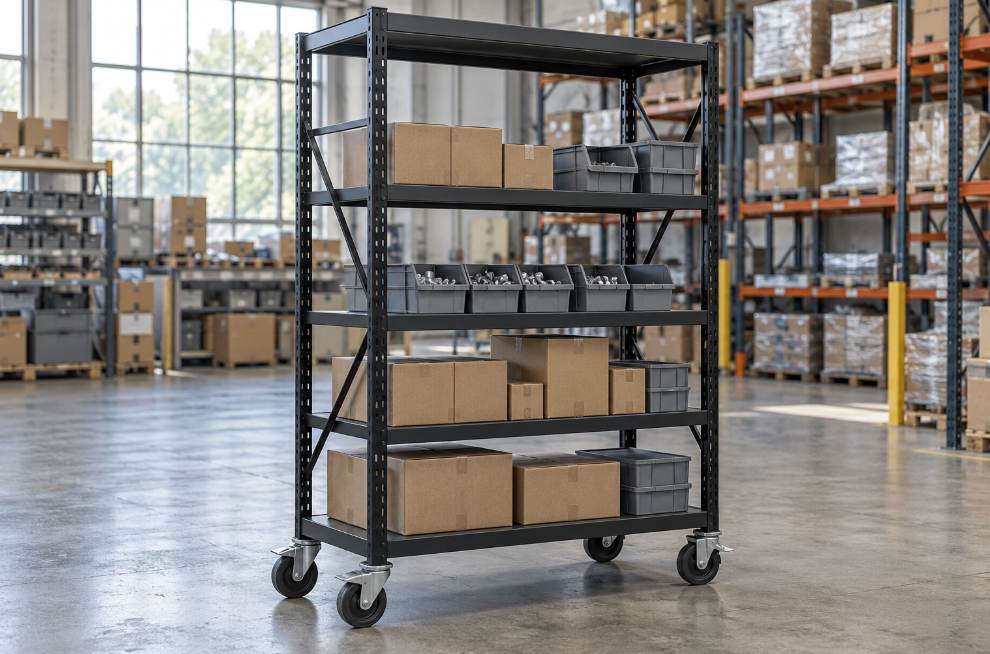
A shelving unit described as “100 kg per shelf” does not automatically have permission to move with that load on every level. Once wheels are added, the caster package, mounting connections and complete rack configuration become part of the load assessment.
For importers, distributors and warehouse buyers, a useful quotation should identify both what the rack can store and how it may be moved. This guide explains the ratings to request when specifying manually moved, caster-mounted steel shelving.
Quick answer: Confirm the per-shelf load, total rack payload, caster dynamic rating and any permitted payload while moving. Wheel diameter and the sum of individual caster ratings cannot establish the complete shelving unit’s capacity.
1. Understand the Different Load Ratings
“Static” and “dynamic” describe different operating conditions. A caster’s static capacity concerns stationary loading; its dynamic capacity applies under specified rolling conditions. Published ratings need to be read with their test and application conditions. Blickle’s guidance identifies speed, floor condition, obstacles and temperature as relevant selection factors. Blickle: load-capacity guidance
For a shelving purchase, distinguish the following:
| Specification | What the buyer needs to confirm |
|---|---|
| Per-shelf load | Permitted goods weight on one level, with the specified load distribution |
| Total rack payload | Maximum goods weight on the complete unit in its approved configuration |
| Empty rack weight | Mass of the frame, shelves, casters and fitted accessories |
| Caster static/dynamic ratings | Per-caster limits and the conditions to which each applies |
| Permitted moving payload | Goods weight, if any, allowed during movement of the complete assembled rack |
Gross operating weight is the empty equipment weight plus its payload. A caster calculation must account for both.
There is no universal percentage for converting a static rating into a dynamic rating. Request the selected caster’s data and the rack supplier’s written operating limits.
2. Calculate a Preliminary Caster Requirement
Simply dividing the loaded weight by four assumes equal support at every wheel. Colson Group Canada describes a preliminary rule of thumb for standard four-caster layouts: calculate using three supporting casters, allowing for uneven contact. Other wheel arrangements require different assessment. Colson: caster-load calculation
For that specific screening approach:
Preliminary capacity per caster = (empty rack weight + maximum payload) ÷ 3
Consider this illustrative example:
| Input | Assumed value |
|---|---|
| Empty rack, including accessories | 60 kg |
| Goods | 300 kg |
| Gross operating weight | 360 kg |
| Supporting casters used for screening | 3 |
| Preliminary requirement per caster | 120 kg |
The 120 kg result is a starting point before application-specific allowances. It does not approve the rack for movement with 300 kg of goods. The caster manufacturer must confirm suitability and any additional margin; the rack supplier must confirm the assembled unit’s limits.
This is a calculation example, not a KAYOU test result or product rating. Avoid stacking several manufacturers’ safety-factor methods without checking their assumptions.
3. Choose Wheel Diameter Around the Actual Route
Wheel size affects handling, but “larger” is not a complete specification. Colson’s selection guidance connects wheel choice with load, rolling ease, floor protection and obstructions. Colson: caster selection
Before ordering metal shelving with wheels, record:
Floor material and surface condition.
Joints, cracks, thresholds and route restrictions.
Travel distance, movement frequency and turning space.
Doorway clearance and required shelf height.
A 150 mm wheel does not add exactly 150 mm to the rack height. Caster overall height includes the mounting assembly and differs from wheel diameter. Confirm the final floor-to-top dimension on the assembled drawing. Colson: caster dimensions
If the route includes ramps or significant thresholds, describe them before quotation. Their suitability requires confirmation for the complete rack and movement method.
4. Match Wheel Material to the Environment
Wheel tread, bearing and housing should be selected together. Blickle’s selection guide highlights tread characteristics and resistance to corrosion, temperature changes and chemical exposure. Blickle: selection criteria
| Operating condition | Information to request |
|---|---|
| Smooth warehouse or workshop floor | Rolling effort, floor marking and rated load |
| Noise-sensitive work area | Tread characteristics and a representative movement trial |
| Wet or frequently cleaned area | Wheel, bearing and housing compatibility with moisture and cleaning agents |
| Cold or hot environment | Documented temperature range for the complete caster |
| Floor joints or irregular surfaces | Suitable diameter, tread and operating restrictions |
Names such as “rubber wheel” or “polyurethane wheel” leave important details unspecified. Request the actual wheel specification rather than relying on appearance or a general material description.
For repeat wholesale orders, retain the approved caster reference so substitutions can be reviewed before production.
5. Specify Steering and Brakes Separately
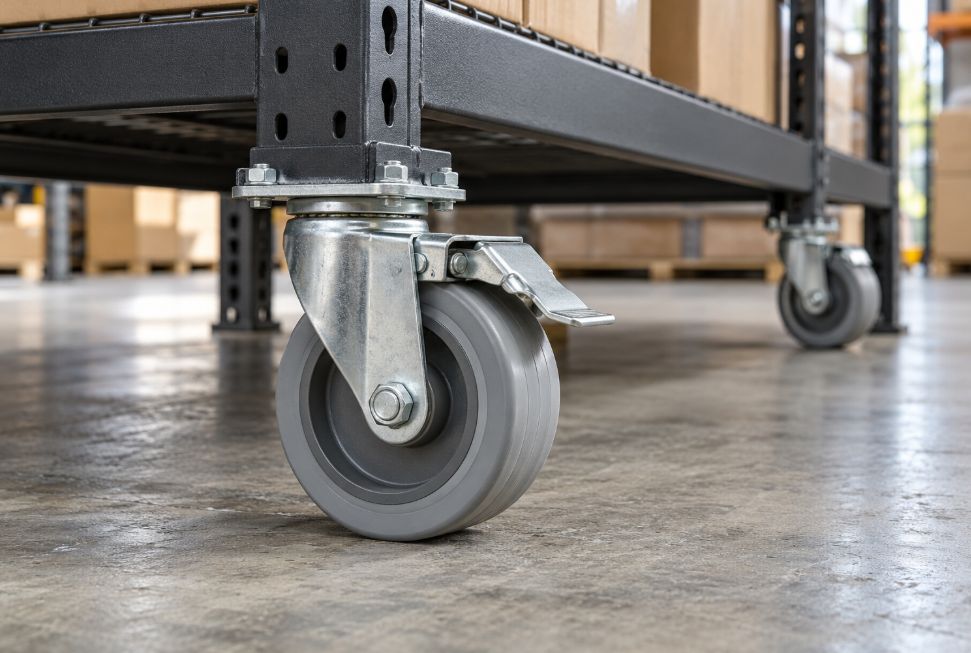
Caster layout changes how a rack handles. Colson describes two rigid and two swivel casters as a common arrangement for straight or longer travel, while four swivel casters support sideways positioning. The appropriate layout depends on the task. Colson: caster layouts
Brake terminology also matters:
| Function | What it controls |
|---|---|
| Wheel brake | Wheel rotation |
| Directional lock | Swivel direction, to assist guided travel |
| Total lock | Wheel rotation and swivel movement |
TENTE distinguishes total locking from other locking functions. Therefore, “two wheels with brakes” should be expanded into a clear specification: brake type, quantity, position and accessibility. TENTE: locking functions
A brake does not increase the rack’s load capacity or establish that parking on a slope is acceptable. Confirm the approved parking conditions and operating instructions.
6. Check the Complete Rack, Including Caster Mountings
A high-capacity caster cannot compensate for an unsuitable mounting plate, stem connection or shelving frame. Check the load path from the goods through the shelves, beams, uprights and caster connections.
The lowest applicable component or system limit governs, with each shelf and the complete unit remaining within their respective approved limits. Metro’s shelving guidance also explains that caster-mounted units can have a different overall capacity from stationary units. Metro: shelving load ratings
Ask the rack supplier to confirm:
The exact frame, shelf and caster configuration covered by the rating.
Whether concentrated loads need separate assessment from uniformly distributed loads.
Permitted shelf positions and any required bracing.
Load placement, retention and movement instructions.
Keep heavier items low, consistent with the supplied configuration and instructions. Metro also recommends placing heavier items toward the lower part of shelving. Load capacity and resistance to tipping are separate checks. Metro: shelving selection
For a broader explanation of loading conditions, read KAYOU’s steel shelving load-capacity guide.
7. Request Evidence That Matches the Quoted Configuration
Useful purchasing evidence connects a rating to an identifiable product. Request the caster data sheet, mounting drawing, applicable rack ratings and assembly instructions with the quotation.
If testing is specified, agree the method and acceptance criteria before the order. A useful record identifies the model, configuration, applied loads, operating conditions, date and results. A caster-only test does not establish the performance of the complete rack.
Likewise, photographs of steel thickness do not establish a moving-load rating. KAYOU’s steel thickness verification guide explains how component measurements can support specification checks.
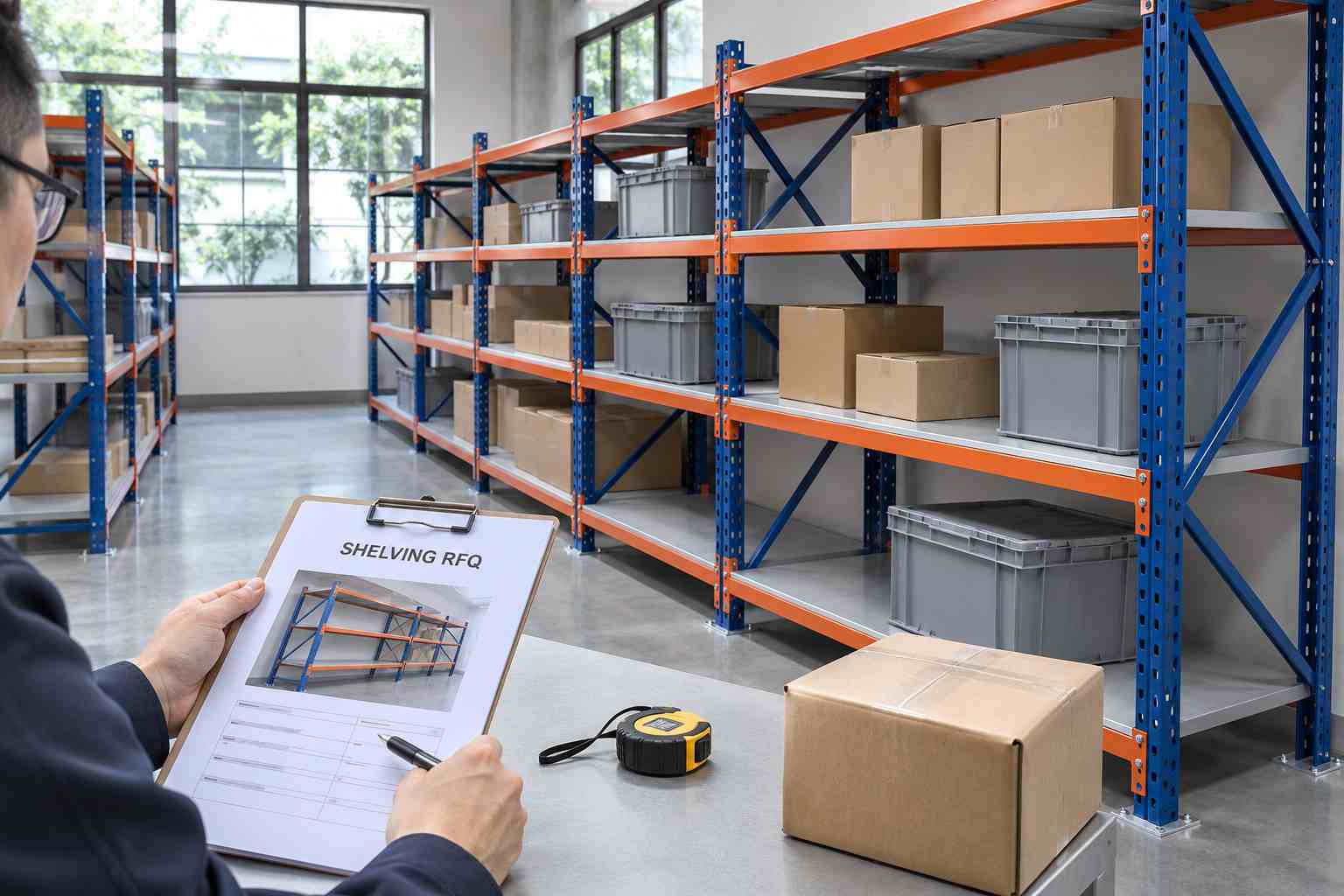
8. Prepare a Clear RFQ for Shelving on Wheels
Send these details to obtain a more comparable proposal:
Overall width, depth and finished height, including casters.
Shelf quantity, spacing and stored-item dimensions.
Maximum weight per item, per shelf and across the unit.
Whether movement will be empty, partly loaded or fully loaded.
Floor photographs, route length, joints, thresholds and slopes.
Steering, brake, noise and cleaning requirements.
Order quantity, packing requirements and destination.
Ask suppliers to state any assumptions beside the proposed ratings. This helps prevent a quotation for stationary storage being mistaken for approval for loaded transport.
Frequently Asked Questions
Can I multiply shelf capacity by the number of levels?
That arithmetic gives the sum of shelf ratings, not automatically the permitted total rack payload. The frame, connections, caster package and operating conditions also govern.
Is a caster’s static rating suitable for loaded movement?
Use the applicable dynamic rating for rolling selection, together with the complete rack’s approved moving-load conditions. A static rating alone is insufficient.
Are larger wheels always better?
Diameter is one selection factor. Capacity, tread, bearings, mounting height, steering, clearances and the actual route also matter.
Can KAYOU customize shelving with wheels?
KAYOU offers customization of dimensions, shelf levels, colors, wheel options and packaging. Confirm the selected rack, caster and brake configuration in the quotation. See our metal shelving rack with wheels for product options.
PLAN YOUR NEXT BULK ORDER
Discuss Your Rolling Shelving Requirements with KAYOU
Planning a bulk purchase for a warehouse, workshop, retail stockroom or distribution project? Send KAYOU your dimensions, stored-item weights, movement requirements, floor photographs, quantity and destination.
Request a proposal identifying the per-shelf limit, total rack payload, permitted moving conditions, caster specification and brake arrangement for your selected configuration.