
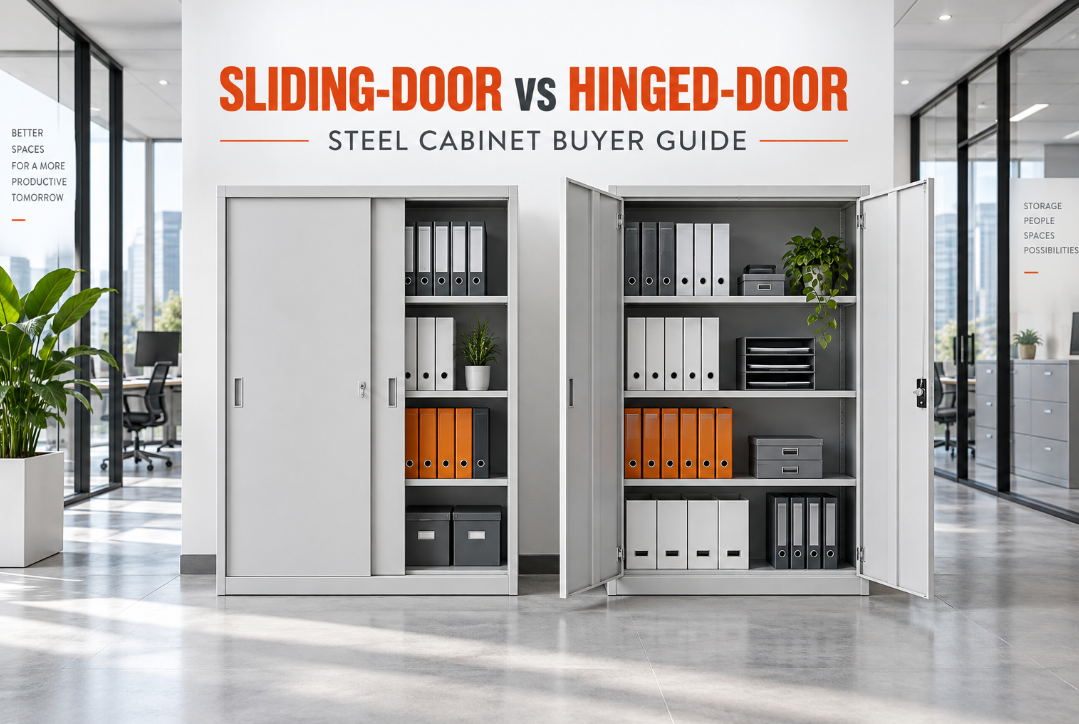
When specifying steel cabinets for an office project, door style affects much more than appearance. It changes the clearance needed in front of the cabinet, how much of the interior can be reached at once, how users share the storage area and which components require maintenance.
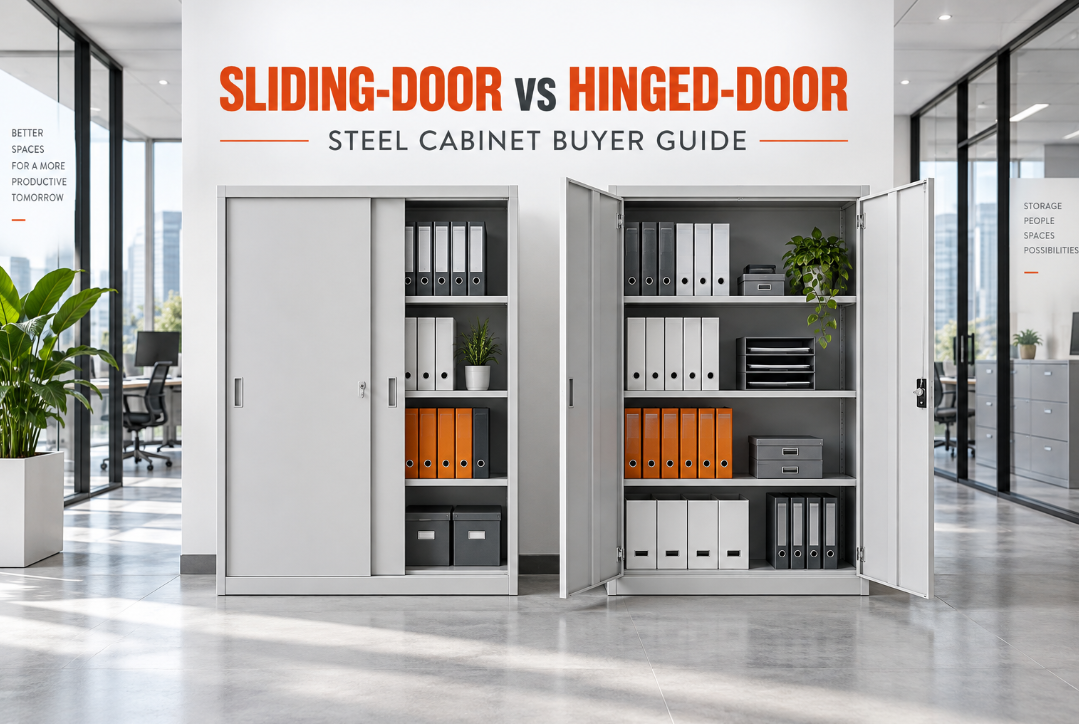
The short answer is:
Choose sliding doors where floor space and aisle clearance are limited, or where users must pass close to the cabinet.
Choose hinged doors where users need a wide, unobstructed opening and there is enough space for the doors to swing safely.
Neither design is universally better. The correct choice depends on the room layout, stored items, access frequency, security plan and total project specification.
Technical note: This article provides general procurement guidance. Dimensions, loads, locks, glass type, stability, test evidence and compliance must be confirmed for the exact cabinet and destination market.
Quick Comparison
| Decision factor | Sliding-door steel cabinet | Hinged-door steel cabinet |
|---|---|---|
| Front clearance | Doors stay within the cabinet footprint | Requires space for door swing |
| Interior access | Normally exposes one section at a time | Can provide access across the full cabinet opening |
| Narrow corridors | Usually the more practical option | Door leaves may obstruct circulation |
| Large folders or equipment | Check overlap and clear opening carefully | Wide opening can make bulky items easier to handle |
| Shared office use | Useful where people frequently pass the cabinet | Suitable where users can stand clear of open doors |
| Main hardware | Tracks, guides, rollers and stops | Hinges, door stops and latching points |
| Maintenance focus | Track cleanliness, alignment and smooth travel | Hinge alignment, sagging and door closure |
| Locking | Model-specific sliding-door lock | Model-specific cam, rod or multipoint arrangement |
1. Space Planning: The Main Reason to Choose Sliding Doors
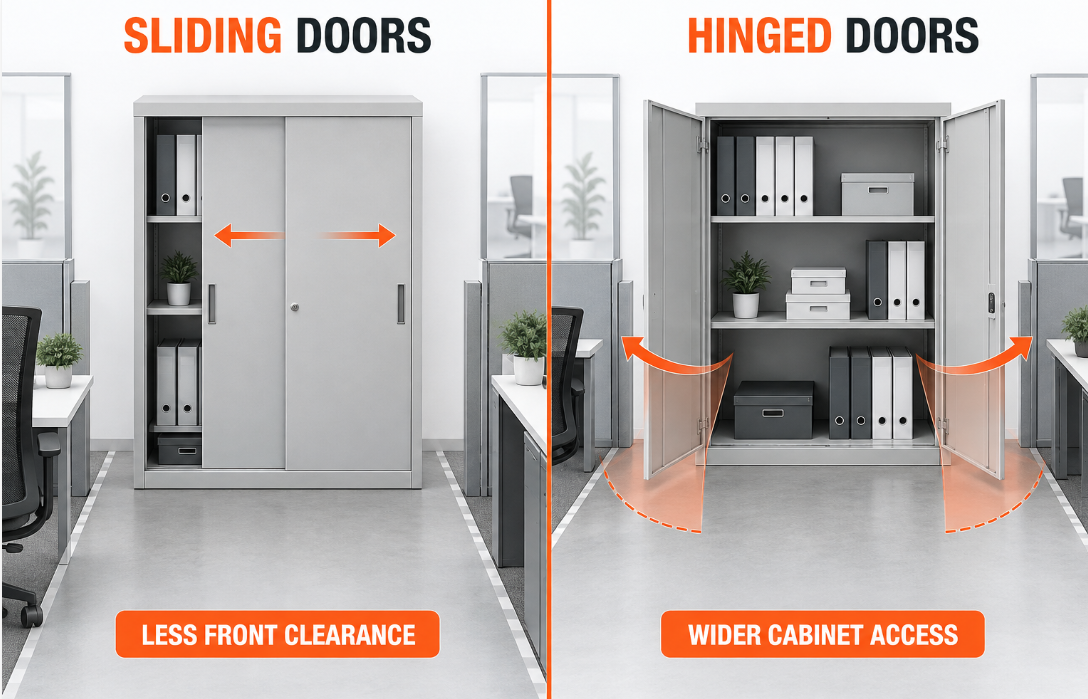
A sliding door moves sideways instead of projecting into the room. This makes it useful behind workstations, beside shared walkways and in compact filing rooms where an open door could interfere with chairs or pedestrian movement.
However, “space-saving” does not mean the cabinet can be placed anywhere. Buyers still need to check:
room and aisle dimensions;
nearby desks, switches, sockets and skirting;
handle projection and lock position;
whether the door can travel fully without obstruction;
user standing space while files are removed;
local circulation and accessibility requirements.
Sliding doors overlap, so users normally access one side of the cabinet at a time. The usable opening may also be smaller than half the external cabinet width because of frames, handles, stops and overlap. Ask for the clear opening width, not only the overall cabinet dimensions.
2. Access: Why Hinged Doors Can Be Better
Hinged doors swing outward and can usually expose most or all of the cabinet interior. This is valuable when staff need to compare several folders, load archive boxes or move larger office supplies.
Hinged cabinets are often suitable for records rooms, private offices, meeting-room storage and back-office areas with adequate clearance. They can also make shelf adjustment and interior cleaning easier because the central opening is not blocked by overlapping door panels.
The disadvantage is the swing zone. A door left open can conflict with people, furniture or an escape route. The project layout should show the cabinet with its doors open—not just as a closed rectangle. Confirm opening angle, handle location and whether adjacent cabinets can open at the same time.
3. Which Door Is Better for Different Office Projects?
Open-Plan Office or Narrow Shared Aisle
Preferred starting point: sliding doors. They avoid projecting door leaves into busy circulation space. If documents are accessed continuously, confirm that one-side-at-a-time access will not slow the workflow.
Dedicated Filing or Records Room
Preferred starting point: hinged doors. A wider opening can help users retrieve and return multiple files. Sliding cabinets may still be preferable if the room uses closely spaced rows.
School, Clinic or Public Administration Office
Either style can work. Focus on supervision, key control, sharp-edge treatment, glass specification if applicable, cleaning routines and anchoring or stability requirements. The project owner should confirm any local institutional rules.
Executive Office or Client-Facing Area
Choose according to layout and visual requirements. Glass doors can help users identify contents without opening the cabinet, while solid doors conceal files and visual clutter. Glass type and retention method must be specified rather than assumed from a photograph.
Distributor or Multi-Site Rollout
Consider a coordinated range instead of one universal model. Sliding cabinets may suit compact branches, while hinged cabinets serve larger administrative rooms. Standardising colors, locks, shelf spacing and replacement parts can simplify repeat orders.
4. Security: Compare the Locking System, Not Just the Door Style
Both sliding and hinged steel cabinets can be lockable, but a visible key lock does not explain the complete security arrangement.
For each quoted model, confirm:
Which doors the lock secures.
Whether the mechanism uses a cam, rods or several locking points.
Whether cabinets are keyed alike, keyed differently or supplied under a master-key plan.
How many keys are included and how replacements are controlled.
Whether the lock and handle can be replaced without damaging the door.
Whether the cabinet has any tested security rating.
A standard office lock is mainly an access-control feature; it should not be described as a safe or high-security system without supporting evidence. For confidential records, the buyer should combine the cabinet specification with workplace access procedures.
5. Durability and Maintenance
Door performance depends on the complete construction—not simply whether the cabinet is steel.
For sliding cabinets, inspect the upper and lower tracks, guides, rollers, travel stops and anti-lift details. Tracks should remain free of paper clips, dust and other debris. Poor alignment can cause resistance, noise or incomplete locking.
For hinged cabinets, inspect hinge fixing, door alignment, opening stops and the gap between paired doors. A heavily loaded door, unsuitable hinge or uneven cabinet can lead to sagging and poor latch engagement.
For either type, specify:
cabinet and door steel thickness;
shelf dimensions and rated load;
adjustable-shelf pitch and retaining method;
powder-coating requirements and agreed color reference;
handles, locks and replaceable parts;
assembled or knock-down construction;
installation, levelling and anchoring instructions;
warranty scope and spare-parts availability.
Material thickness alone does not prove cabinet performance. Door reinforcement, folds, joints, shelf design and workmanship also affect stiffness and service life.
6. Safety and Test Documents
Office storage furniture should be evaluated as a complete, assembled product. ISO 7170:2021 specifies test methods for the strength, durability and stability of storage units, including movable and non-movable parts. The ISO page also notes that the document provides test methods rather than universal acceptance criteria.
For North American office projects, ANSI/BIFMA X5.9-2019 provides a common basis for evaluating freestanding, mobile and wall-mounted storage units.
These references should not be treated as automatic proof that a particular cabinet complies. State the required standard and acceptance criteria in the purchase specification, then request model-specific test evidence. Also confirm local rules for furniture stability, anchoring, accessibility, glass and fire safety.
7. Total Project Cost
Do not assume one door style is always cheaper. Compare the complete delivered and installed cost:
cabinet price and quantity;
lock, glass and shelf options;
export packaging and container utilisation;
assembly and installation labor;
wall or floor fixing where required;
replacement locks, tracks, rollers or hinges;
maintenance over the expected service period;
damage and spare-parts support for multi-site projects.
A knock-down cabinet may reduce shipping volume, but it also transfers more assembly and alignment work to the destination. Request packing dimensions, gross weight, assembly instructions and a sample-approval process before comparing suppliers.
8. RFQ Checklist for Office Cabinet Buyers
Send the same information to every supplier:
room layout and cabinet location;
required external dimensions and quantity;
clear opening requirement;
stored item and file dimensions;
number, spacing and load requirement of shelves;
sliding or hinged door preference;
solid-steel or glass-door configuration;
steel thickness and surface-finish specification;
lock and key-management plan;
stability, anchoring and test-document requirements;
assembled or knock-down delivery;
color, logo, labels and packaging;
delivery country, trade term and target schedule.
Ask the supplier to return an approved specification sheet or drawing. This makes it easier to compare quotations and prevents a cabinet with the same external dimensions—but a different opening, shelf capacity or lock—from being treated as equivalent.
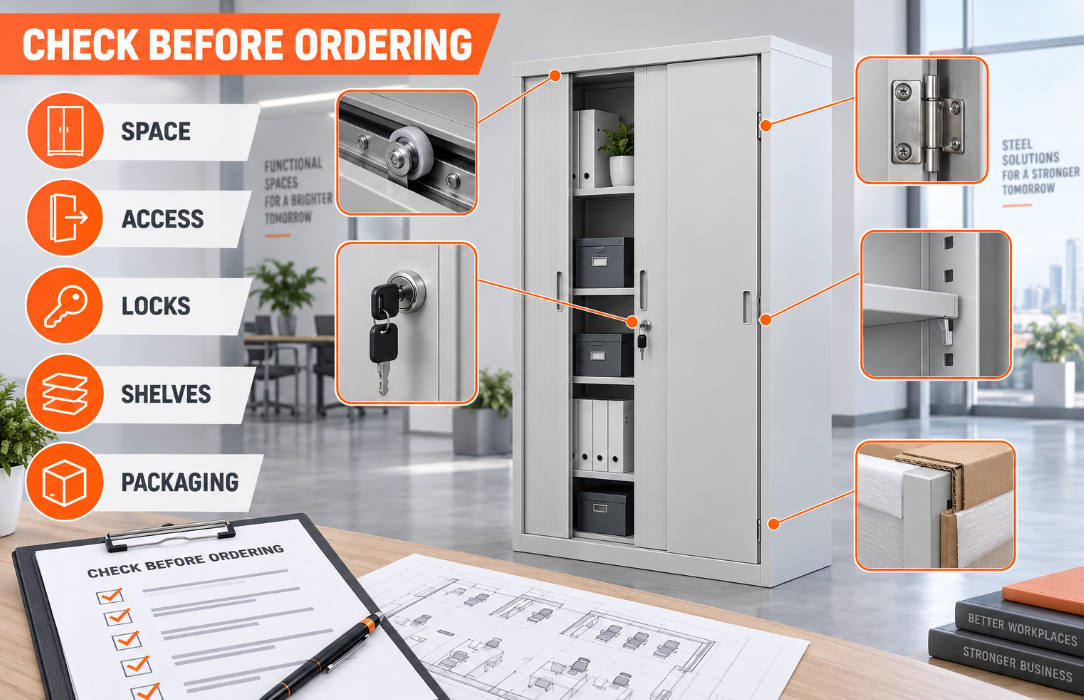
Final Recommendation
For most compact offices and narrow shared aisles, a sliding-door steel cabinet is the better starting point because it does not need a door-swing zone. For filing rooms and work areas where users need the widest possible access, a hinged-door steel cabinet is usually more practical.
The final decision should be based on a scaled layout and an agreed technical specification. Door style is only one part of the cabinet: usable internal space, shelf loading, locks, stability, finish, packaging and after-sales parts can have a greater effect on project success.
KAYOU has more than 15 years of storage-industry experience and supports custom steel furniture for global B2B projects. Buyers can discuss cabinet dimensions, door configurations, locks, colors, internal layouts, branding and export packaging. Explore the KAYOU steel furniture range, review our metal filing cabinet options and see our quality-control process.
Frequently Asked Questions
Do sliding-door cabinets really save office space?
They eliminate the outward door-swing zone, which can improve circulation in compact layouts. They do not reduce the cabinet footprint, and users still need standing and working space in front.
Can both cabinet types use glass doors?
Yes, depending on the model. Specify the glass type, thickness, frame, edge protection and retention method. Do not infer safety performance from an image.
Which type gives access to more of the cabinet at once?
Hinged doors normally provide the wider simultaneous opening. Sliding doors usually expose one section while the other remains behind an overlapping panel.
Which type is more secure?
Security depends on the lock, door engagement, cabinet construction and access procedures—not the opening method alone. Request a written lock specification and any required test evidence.
What should buyers inspect before shipment?
Check dimensions, door alignment, smooth operation, locks and keys, shelf quantity, load labels if specified, surface finish, accessories, assembly fit and packaging. Record the approved sample and inspection criteria before mass production.
References and Further Reading
Need Steel Cabinets for an Office Project?
Send KAYOU your room layout, preferred door style, cabinet dimensions, stored-item details, quantity, lock requirements and delivery destination. Our team can review the requirements and prepare a project-based quotation.