


Steel Shelving Export Packaging: A Documentation Checklist for EU Importers
KAYOU · B2B BUYER’S GUIDE
Prepare the packaging file before you place the order.
A practical documentation checklist for steel shelving and steel furniture importers in Germany, Spain and Poland.
By KAYOU | Updated October 29, 2026
A quotation for steel shelving may include carton dimensions, gross weight and a container-loading estimate. Before an EU importer approves the order, the purchasing team also needs to understand what the packaging contains, which records support it and who will maintain those records.
For distributors buying steel shelving or steel furniture for Germany, Spain or Poland, this review should begin before the packaging design is approved.
This guide focuses on the documentation behind the packaging. For packed-volume calculations and physical protection, see our separate guide to export packaging for knock-down steel furniture: CBM, protection and container loading.
Quick Answer: What Should an EU Buyer Request?
Ask the supplier for an order-specific packaging file covering:
A packaging specification and component-level materials list.
Packaging weights by material, with a clear measurement basis.
Supplier identities and supporting material records.
Applicable conformity documentation and the party responsible for it.
Wooden packaging details where pallets, crates or dunnage are used.
Approved packing photographs, labels and revision history.
A written allocation of documentation and destination-country responsibilities.
These are purchasing recommendations. The legal requirements depend on the packaging, the economic operators involved and the provisions applicable when it enters the EU market.
1. Check the PPWR Timeline Before Setting Document Requirements
Regulation (EU) 2025/40, the Packaging and Packaging Waste Regulation, entered into force on February 11, 2025 and generally applies from August 12, 2026. Its requirements have different implementation dates. European Commission
| Topic | Timing and scope to check |
|---|---|
| General application | August 12, 2026; assess which obligations apply to the packaging and transaction. |
| Harmonised material-composition labels | Article 12(1) specifies August 12, 2028 or 24 months after the relevant implementing acts enter into force, whichever is later. Transport packaging, except e-commerce packaging, is excluded from this particular obligation. |
| New design-for-recycling criteria | Article 6(2)(a) applies from January 1, 2030 or 24 months after the relevant delegated acts enter into force, whichever is later. Existing recyclability requirements remain relevant during the transition. |
| New packaging-minimisation requirements | Article 10 requirements apply from January 1, 2030; existing minimisation requirements continue through 2029. |
The Commission also clarifies that the PPWR conformity assessment for recyclability is not required until the relevant Article 6(4) delegated acts enter into force. eur-lex.europa.eu
For each requested document, record the applicable requirement, implementation date and packaging type. This makes a supplier’s response easier to assess.
2. Start with a Packaging Bill of Materials
A description such as “standard export carton with foam protection” leaves too much unspecified for a purchasing review.
Request a packaging bill of materials, or BOM, linked to the quoted shelving model and packaging revision.
| Packaging component | Information to request | Purchasing purpose |
|---|---|---|
| Outer carton | Board specification, dimensions, supplier reference and unit weight | Identify the carton included in the quotation. |
| Inner separators and corner protectors | Material, quantity, dimensions and weight | Check protection and material composition. |
| Foam, sleeves or protective film | Material specification, quantity and weight | Identify materials hidden inside the carton. |
| Hardware bags | Bag material and weight, recorded separately from the hardware | Keep product parts separate from packaging data. |
| Tape, straps and stretch wrap | Material, usage basis and estimated or measured weight | Include closure and load-securing materials. |
| Pallets, crates and dunnage | Material, construction, weight and number per shipment | Capture shared transport packaging. |
Identify mixed-material components, coatings and adhesives where relevant. If a supplier cannot confirm a material, record the gap and agree how it will be resolved.
Also distinguish packaging from the product. A steel shelf panel or an MDF shelf board belongs to the shelving specification; the bag or separator protecting it belongs to the packaging review.
3. Request Packaging Weights with a Clear Measurement Basis
Gross shipment weight alone does not provide a reliable material-by-material packaging breakdown.
Ask the supplier to state:
Whether each weight is measured, calculated or estimated.
Whether it applies per carton, per complete shelving unit or per pallet.
The sample, measurement date and packaging revision used.
How shared pallets, wrap, straps and dunnage are allocated.
Whether the final production packaging differs from the quotation sample.
For internal purchasing checks, a useful reconciliation is:
Shipment packaging weight = packaging used for all sale units + shared transport packaging.
Count shared items once. For products shipped in several cartons, include every carton associated with the complete product.
This is a reconciliation method for procurement records. Destination-country reporting categories and calculation rules must be checked separately.
A buyer should also compare the component total with the packed sample. An unexplained difference is a reason to review the data before using it for reporting or cost comparisons.
Related purchasing guide: see what changes your steel shelving factory quote when comparing packaging, testing and documentation costs.
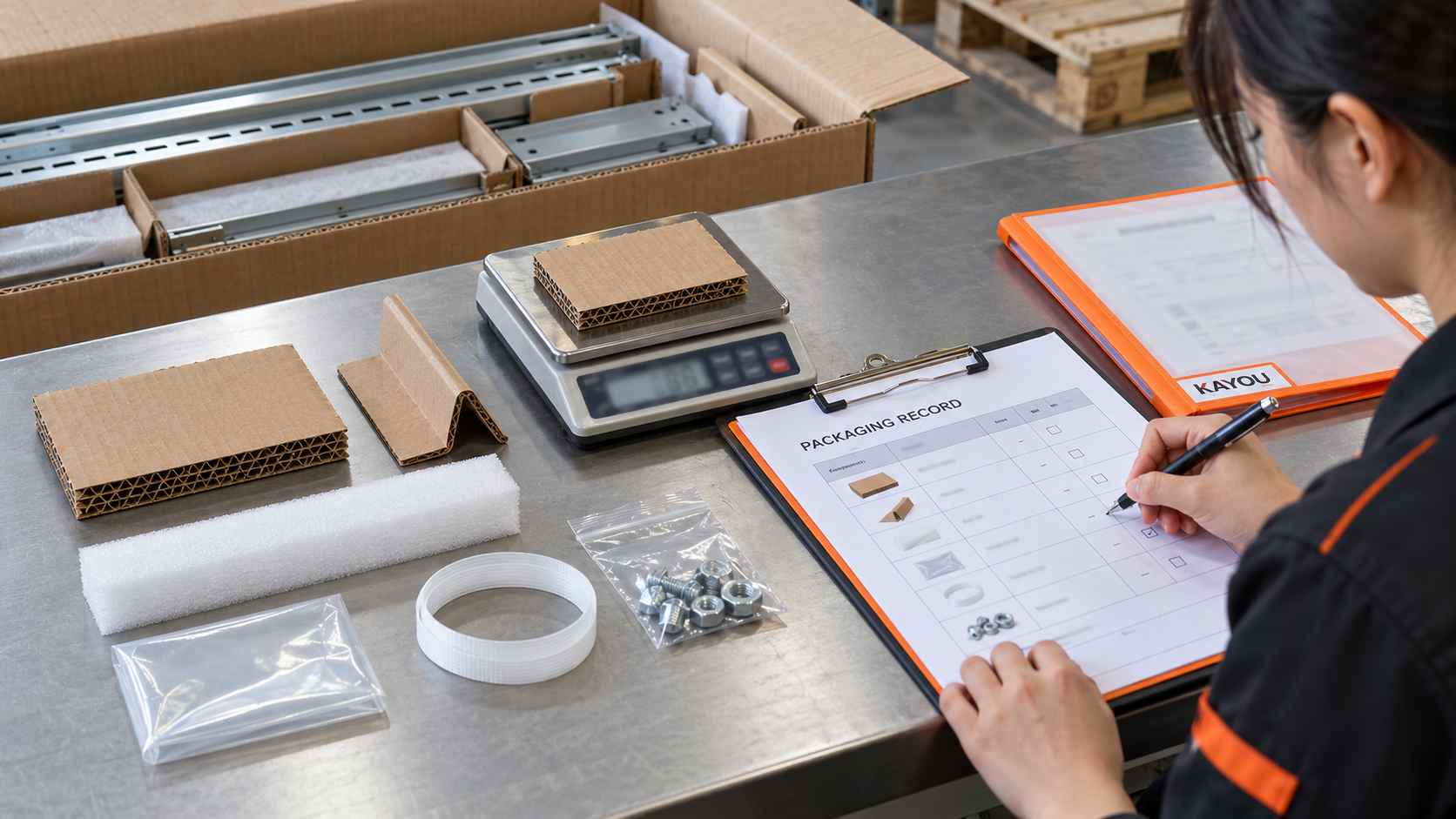
Illustration: review packaging materials, measured weights and order-specific records together.
4. Separate Supporting Supplier Records from Conformity Documentation
Where applicable, Article 18 requires importers to verify the manufacturer’s conformity assessment, technical documentation, required accompanying documents, labelling and identification. Annex VII provides for internal production control and the supporting technical file; Annex VIII sets the EU declaration of conformity structure.
Importers must keep a copy of the declaration for five years for single-use packaging or ten years for reusable packaging and ensure the technical documentation can be made available to authorities. EUR-Lex
For the purchasing file, request:
| Record | What the buyer should check |
|---|---|
| Packaging specification | It identifies the packaging type and revision used for the order. |
| Material specifications and supplier declarations | They identify the relevant materials and the scope of each statement. |
| Test or assessment reports, where used | Sample identity, method, date and conclusions match the packaging being assessed. |
| Applicable EU declaration of conformity | It identifies the packaging, responsible manufacturer and signed declaration. |
| Technical-documentation access arrangement | A named contact can retrieve the supporting records when required. |
Ask which requirements each record addresses. A report covering one film material should not be treated as evidence for an entire carton-and-pallet system.
Confirm legal roles before assigning sign-off. The Commission explains that the PPWR manufacturer is not always the company physically making the packaging; branding and control over its design can affect the role. EUR-Lex
5. Check Wooden Packaging Separately
For wood packaging and dunnage entering the EU from non-EU countries, the European Commission specifies ISPM 15 treatment, official marking and debarking requirements. Its stated exemptions include wood 6 mm thick or less and packaging made entirely from processed wood such as plywood. Food Safety
Where wooden packaging is proposed, request:
Construction details identifying solid wood and processed wood.
Photographs of the relevant marks on the actual packaging.
A link between the wooden packaging and the shipment.
Supporting treatment or supplier records where available and relevant.
Check the complete construction. A plywood platform may still include solid-wood supports or additional dunnage.
Keep these plant-health checks as a separate part of the packaging file so that they are reviewed alongside the materials and conformity records.
6. Keep the Approved Sample and Production Packaging Traceable
A useful packaging file should allow the buyer to connect the approved sample with the goods received.
As an illustrative filing convention, a buyer might use PACK-SHELF-A-REV02. The exact code matters less than consistent use across the specification, photographs, material records and purchase order.
| Review stage | Record to retain |
|---|---|
| Quotation | Proposed materials, weights and packaging assumptions |
| Sample approval | Complete packing photographs, measured data and agreed changes |
| Production release | Approved revision and confirmation of the production materials |
| Before shipment | Final quantities, packaging references, labels and loading evidence |
| After a change | Revised specification, reason, affected orders and buyer approval |
A different foam insert, tape, carton supplier or pallet construction should trigger a review of the affected records.
For repeat orders, ask the supplier to confirm whether the packaging revision remains the same. Reusing a product model number does not establish that its packaging is unchanged.
7. Agree Who Maintains the Records
Use the purchase agreement to allocate routine work and identify the people responsible for supplying information. Confirm the statutory roles separately.
| Task | Suggested working arrangement |
|---|---|
| Prepare the proposed packaging BOM and weights | Product supplier coordinates the information with packaging suppliers. |
| Review applicable requirements and legal roles | EU buyer and relevant compliance specialists confirm the transaction. |
| Prepare and maintain applicable conformity documentation | The responsible manufacturer is identified and the access process agreed. |
| Approve artwork and commercial carton labels | Buyer supplies destination/customer instructions; supplier submits proofs. |
| Confirm wooden packaging requirements | Supplier provides construction and mark evidence; buyer checks destination applicability. |
| Maintain shipment and revision records | Both parties retain an agreed, consistent order file. |
| Check national EPR registration and reporting | The responsible operator confirms obligations in each destination country. |
The Commission advises businesses to continue complying with existing national extended producer responsibility registration rules and to check the countries where they sell. European Commission
For Germany, Spain and Poland, confirm the relevant national requirements and reporting arrangements. A supplier’s materials spreadsheet can support that work, but it does not complete the buyer’s registration or reporting tasks.
8. Send This Packaging Request with Your RFQ
Include the following request when asking for a quotation:
Please quote steel shelving model [model/specification], quantity [quantity], for delivery to [EU country and destination].
Please provide the proposed packaging specification, component materials list and packaging weights by material. Identify the weight basis, carton configuration, shared pallet or load-securing materials, and packaging revision.
Please identify the parties responsible for applicable packaging conformity documentation and explain how supporting records can be accessed.
Where wooden packaging is proposed, provide construction details and relevant ISPM 15 mark information.
Please state which documents are available now, which require sample approval, and any additional cost or lead time for agreed testing, documentation or packaging changes.
Review the response before confirming the order. Resolve missing material identities, unclear measurement bases and unsigned or unrelated documents while changes are still practical.
Frequently Asked Questions
Is a commercial packing list enough?
A commercial packing list normally supports shipment identification and quantities. Request a separate packaging specification and materials breakdown when those details are absent.
Can one packaging file cover different shelving models?
Ask the supplier to identify exactly which models, carton configurations and revisions the file covers. Review any differences in protection materials, carton sizes, weights or pallets before relying on shared records.
Can the same documents be used for repeat orders?
They may remain useful if the packaging and applicable requirements remain unchanged. Confirm the revision, material sources, document scope and destination instructions for each order.
Official sources & scope
General purchasing guidance based on official EU sources reviewed on October 29, 2026. Confirm the requirements applicable to the specific packaging, economic operators, destination and market-placement date.
PLAN YOUR NEXT BULK ORDER
Request a Packaging Review for Your KAYOU Order
Send your shelving or steel furniture specifications, quantity, destination country and port, branding requirements, and packaging-documentation checklist.
Ask for a quotation identifying the proposed packaging, available supporting information, outstanding items and any agreed testing or documentation costs.
WhatsApp: +86 158 3799 8881