

Waterfall Wire Mesh Decking for Warehouse Racks: What Buyers Should Verify
Wire mesh decking looks simple: a welded steel grid placed between the beams of a warehouse rack. In practice, its performance depends on a complete specification that includes the rack dimensions, beam profile, deck construction, stored goods and actual load pattern.
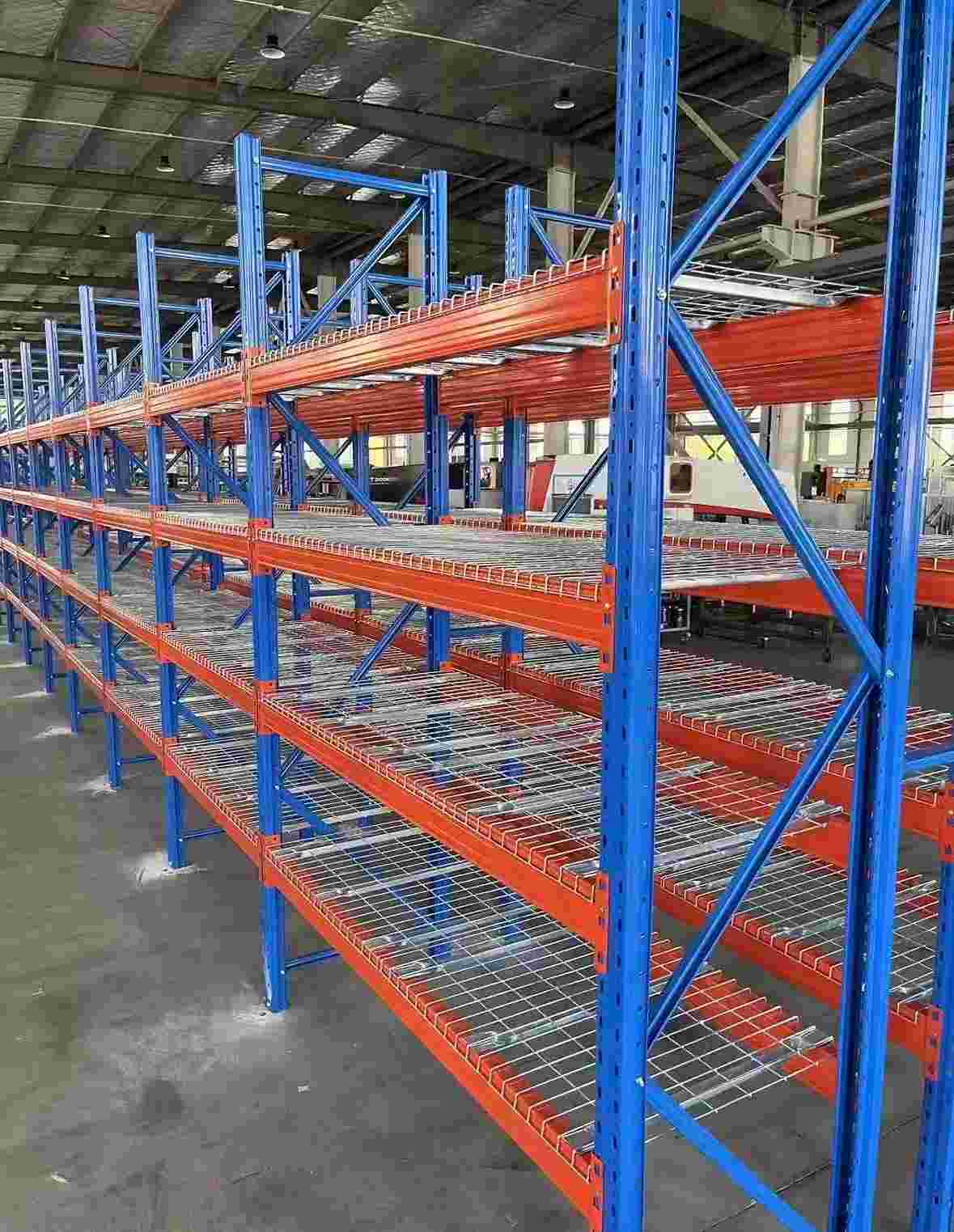
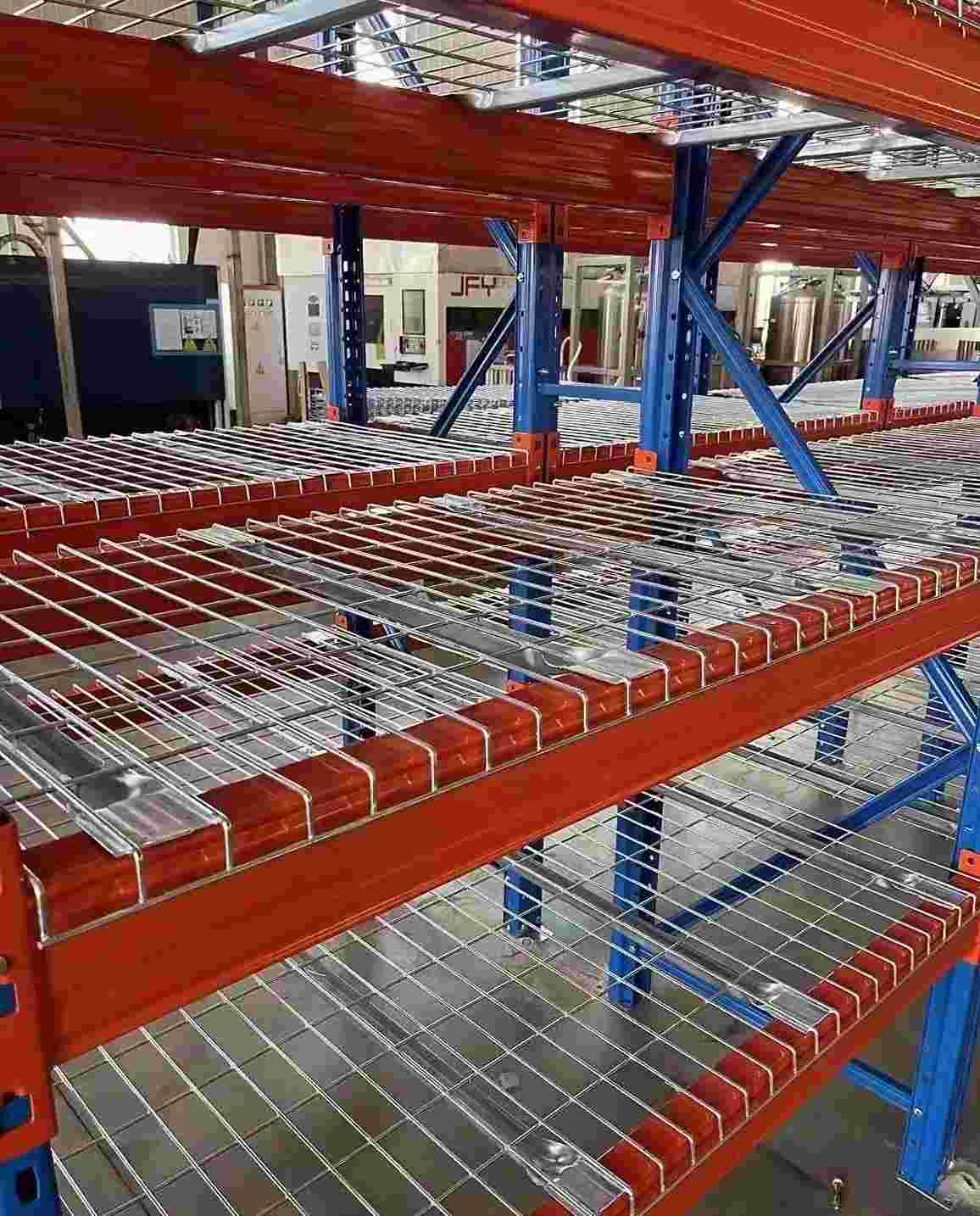
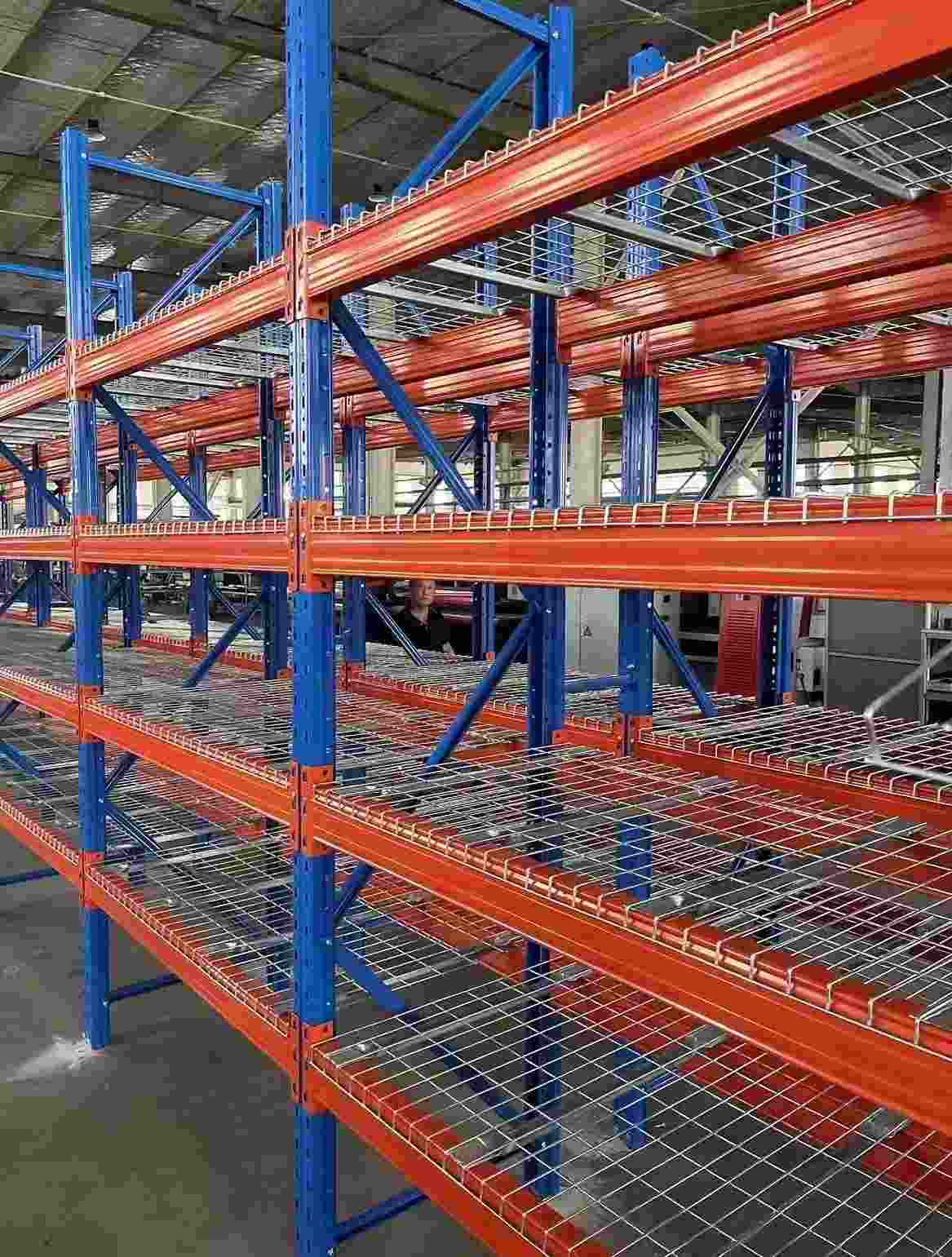
The KAYOU product photos accompanying this article show multi-level warehouse racking with blue upright frames, orange beams and galvanized wire mesh panels. The deck edges wrap over the front and rear beams, creating the recognizable “waterfall” profile. Reinforcing channels are also visible beneath the mesh. This configuration creates an open storage surface for pallets, cartons, totes and other warehouse goods when it is properly matched to the application.
However, a photograph cannot prove the wire diameter, mesh aperture, deck capacity, finish thickness, weld quality or compliance with a particular standard. Those details must be confirmed through drawings, specifications, test evidence and inspection. This guide explains what B2B buyers should check before approving waterfall wire mesh decking for a new or existing racking project.
Technical note: Wire decking is an accessory to the rack system. Its rating does not increase the capacity of the beams, uprights, frames, anchors or complete rack. The lowest applicable capacity in the load path controls the installation.
What Is Waterfall Wire Mesh Decking?
Waterfall wire mesh decking is made from welded longitudinal and transverse steel wires, usually combined with permanently attached support channels. The front and rear edges bend downward over the beams. This “waterfall” helps locate the panel on the rack and reduces movement during normal use.
The deck creates more support than an open pair of beams, but it is not automatically a solid shelf. Waterfall, inside-waterfall and flush/drop-in panels use different interfaces and are not interchangeable. Grid openings, support channels and beam contact points determine how goods transfer weight into the rack.
What the Product Photos Confirm—and What They Do Not
From the supplied KAYOU images, a buyer can reasonably observe:
Upright frames with horizontal and diagonal bracing
Multiple adjustable beam levels
Several wire deck panels used across each rack bay
Waterfall edges extending over the beams
Reinforcing channels installed beneath the welded mesh
An open-grid surface with visibility through the rack levels
The images do not establish a safe working load, coating process, mesh spacing, wire diameter, steel grade, channel thickness, weld strength or compliance. A photograph is a configuration reference—not the final specification.
Why Warehouses Choose Wire Mesh Decking
Mixed storage support: A deck can support cartons, totes and irregular packages that cannot sit on beams alone. The supplier must still know whether the unit is beam-supported, deck-supported or supported by both.
Visibility and housekeeping: The open grid permits light, air and sightlines through the levels and generally collects less broad-surface dust than an opaque panel. The aperture must retain the smallest package support point.
Modular replacement: Several panels can cover one bay, allowing individual sections to be handled, inspected or replaced. Panel quantity and joint locations belong on the approved drawing.
Fire-protection coordination: Open mesh may permit more vertical passage of water, heat and smoke than solid shelving, but it does not by itself prove compliance. Commodity, storage height, flue spaces, layout and sprinklers all matter. Final review belongs to the fire designer, insurer and local authority. Current NFPA research on multiple-row racks shows why one rule cannot cover every warehouse.
12 Specification Checks Before You Order
1. Identify the Exact Rack System
State whether the deck is for pallet racking, long-span shelving, carton picking or another system. For retrofits, provide the rack manufacturer, model and beam profile; “standard pallet rack” is insufficient.
2. Measure the Clear Bay and Rack Depth
Confirm inside bay width, rack depth and beam contact points. Note components that could interfere with the deck, and measure several bays in a used installation.
3. Confirm the Beam Profile
Step, box and structural beams support decks differently. Send a dimensioned beam section; waterfall length, channel ends and deck depth must suit the actual beams.
4. Define the Load, Not Just the Weight
Give the maximum load per panel and level, plus its contact pattern. A UDL, pallet runners, tote perimeter or four machine feet create different stresses.
The current ANSI MH26.2-2023 scope covers uniformly distributed, concentrated and partially distributed loads. Capacity must identify the tested or engineered load case.
5. Specify the Stored Unit’s Footprint
List pallet or container size, base and orientation. For loose goods, provide the smallest contact area, heavy-item position and any foreseeable off-center loading.
6. Match the Mesh Aperture to the Goods
The grid must retain the smallest product or support point. Smaller cartons may need tighter mesh; select aperture from the goods, not price or appearance alone.
7. Verify Wire and Weld Construction
Request wire diameters, spacing and welding method, then compare production with the approved sample. Inspect for broken welds, loose wires, sharp projections and irregular spacing.
8. Review the Reinforcing Channels
Record the number, profile, thickness and position of support channels. Require an underside drawing showing their beam bearing. More channels alone do not prove higher capacity.
9. Confirm Deck Width, Panel Count and Fit
Agree on panel dimensions, tolerances, quantity per bay and clearances. A narrow deck may have inadequate bearing; a wide one may interfere. Trial-fit a sample on an equivalent rack.
10. Select the Finish for the Environment
The bright metallic appearance does not identify the coating process. Specify the required finish and disclose humidity, condensation, chemicals and exposure. Ask for a defined inspection method, not a blanket “rust-proof” claim.
11. Separate Deck Capacity from Rack Capacity
Decks, beams, uprights, connectors, frames and anchors form one load path. A deck rating cannot override a lower rack rating or repair a damaged system.
Load signage should identify the approved configuration. OSHA 1910.176 requires stored materials to remain stable and secure against sliding or collapse.
12. Ask for Model-Specific Evidence
Require evidence for the ordered configuration:
Approved deck drawing and revision number
Rack and beam interface dimensions
Wire, mesh and support-channel specifications
Defined load pattern and rated static load
Applicable test report or engineering basis
Finish description and inspection criteria
Sample approval and trial-fit record
Production inspection and packaging plan
A report for another size, span, channel arrangement or load footprint needs documented technical justification.
Wire Mesh, Steel Panel or Engineered Board?
| Decking option | Practical strengths | Questions to resolve |
|---|---|---|
| Wire mesh decking | Open visibility, airflow, removable panels and compatibility with many pallet/carton applications | Grid size, point loads, channel design, beam fit, finish and fire review |
| Steel shelf panels | Continuous surface for small items and easier containment of some packages | Added dead load, drainage, corrosion, deflection and sprinkler implications |
| Engineered board | Smooth surface and economical for some indoor hand-loaded storage | Moisture, fire performance, edge support, grading and replacement cycle |
There is no universally best deck. The correct choice follows the load, handling method, environment and compliance requirements.
Installation and Inspection Guidance
Before loading, verify that every panel sits evenly, the waterfall edges contact the intended beams and support channels are correctly oriented. Check for rocking, excessive gaps, bent edges, damaged welds or interference with rack components. Do not force an incompatible panel into position.
During use, inspect decks after forklift contact, dropped loads or any visible change. Remove goods and isolate the affected level if a panel is permanently bent, displaced, cut, heavily corroded or has broken welds or channels. Do not weld extra steel, cut the waterfall edge or drill structural components without written approval from the responsible manufacturer or engineer.
Wire decking is not a work platform. ANSI MH26.2 specifically excludes decking intended to support moving or live loads created by walking or stepping. Workers should never stand or climb on rack decks unless the system was separately designed and approved for that purpose.
Common Buying Mistakes
Comparing quotations by panel dimensions and price while ignoring load pattern
Assuming a high UDL rating also covers a small concentrated load
Ordering replacement decks without identifying the existing beam profile
Treating a galvanized-looking surface as proof of a specific coating
Believing the wire deck increases the structural capacity of the rack
Using large mesh openings for small cartons or loose components
Accepting a generic test report that does not match the supplied model
Assuming an open deck alone determines sprinkler compliance
Allowing workers to step on decking during picking or maintenance
Avoiding these errors usually begins with a better request for quotation.
RFQ Checklist for B2B Buyers
Send the following information to KAYOU for a project-specific proposal:
Warehouse location and operating environment
New rack or retrofit project
Rack type, beam profile and manufacturer if known
Bay width, rack depth and level spacing
Number of bays, levels and deck panels required
Maximum load per level and per panel
UDL, pallet, line, point or other concentrated loading
Pallet, carton or tote dimensions and base footprint
Required mesh opening, finish and corrosion protection
Applicable destination-market standard or customer specification
Fire-protection or insurer requirements
Drawings, samples, testing and inspection documents required before shipment
Frequently Asked Questions
Can wire mesh decking carry pallets?
It can be specified for pallet applications, but the pallet type, orientation, condition and load path must be defined. Some pallets are intended to bear directly on the rack beams, while others place more load on the deck. Confirm the approved condition with the rack and decking supplier.
Is waterfall wire decking compatible with every pallet rack?
No. Beam width, step depth, rack depth and other interface dimensions vary. A trial fit or controlled drawing is especially important for retrofit orders.
Does a smaller mesh opening mean a stronger deck?
Not necessarily. Capacity depends on the entire construction: wire sizes, welds, reinforcement channels, span, steel properties and loading pattern. Mesh aperture should first be matched to product retention and support needs.
Is galvanized wire decking suitable for cold storage?
Galvanized finishes are commonly considered for humid environments, but suitability depends on the coating process, exposure, temperature cycles, condensation and cleaning chemicals. Define the environment and request the appropriate finish specification.
Can workers walk on wire mesh decks?
Not unless a system has been specifically engineered and approved for personnel loads. Standard rack decking is intended for product loads, not as a walkway or maintenance platform.
What should be checked during pre-shipment inspection?
Verify dimensions, panel count, wire and channel specifications, finish, weld condition, edge formation, fit on a reference beam and packaging. Any load evidence should match the same ordered construction and load case.
Conclusion
Waterfall wire mesh decking can provide a practical, visible and adaptable storage surface, but reliable performance comes from specification discipline. Buyers should connect every capacity claim to the actual rack, beam interface, panel construction and load footprint. The supplied KAYOU photos show the configuration clearly; drawings, testing and inspection must establish the technical details that a photograph cannot.
KAYOU supplies customized warehouse racking systems and warehouse pallet racking for industrial storage projects. Buyers can also review our quality-control approach when preparing an inspection plan.
To discuss wire mesh decking for a new rack or retrofit project, send KAYOU your beam profile, rack dimensions, stored-product footprint, load pattern, quantity and destination requirements. Contact KAYOU or message us on WhatsApp at +86 158 3799 8881 for a project-specific configuration and quotation.
Need a Custom Wire Mesh Decking Solution?
Send us your rack dimensions, beam profile, load pattern, stored-product footprint and required quantity. KAYOU will help you develop a project-specific configuration and quotation.