


How to Choose Steel Shelving Systems for Industrial Storage
KAYOU INSIGHTS / STEEL SHELVING PROCUREMENT
Make every shelving quote comparable.
A practical buying checklist for warehouse teams, importers and distributors: define the goods, verify the configuration and agree the supply scope.
Choose steel shelving systems by matching the goods, maximum loads, usable shelf dimensions and installation conditions to a documented configuration. Then compare suppliers using the same specification. A product photograph or the description “heavy duty” does not give a buyer enough information to approve an order.
This guide focuses on fixed shelving for manually stored cartons, bins, tools and parts. It helps warehouse buyers, importers and distributors select an industrial shelving unit or plan connected rows, then prepare a clear purchasing specification.
IN THIS GUIDE
Goods & handlingSystem optionsLoad ratingsUsable dimensionsInstallationQuote comparisonRFQ checklist

AI-generated illustration. Warehouse storage context; the actual specification must match your goods and layout.
Explore KAYOU steel shelving options alongside this checklist to identify configurations worth discussing.
01 Start with the Goods and How They Are Handled
Record Item Dimensions, Maximum Weight and Contact Points
Prepare a short inventory of the goods you intend to store. Record the loaded dimensions and maximum weight of cartons, containers and individual heavy items. Include how each item contacts the shelf: a flat base, narrow runners, small feet or another arrangement.
Give the supplier your expected maximum loading pattern rather than only an average inventory weight. Also identify awkward items, protruding handles and containers that must be tilted or lifted during removal.
For mixed stock, group items by dimensions, weight and picking frequency. This gives suppliers a more useful brief than a request for the strongest available shelving.
Confirm Manual Picking or Pallet Handling
Describe whether workers will place goods by hand, replenish them from a trolley or use handling equipment. If loaded pallets will be placed directly onto the structure, request a system specifically designed for that operation. A wide shelf opening alone does not establish suitability for pallet storage.
List the handling equipment used near the shelving, even when it does not load the shelves directly. Its operating space should be considered in the proposed layout.
02 Compare Steel Shelving Configurations
Compact Units and Beam-Based Longspan Shelving
Compact units are one option to investigate where smaller openings fit the stock and available space. Beam-based longspan shelving is worth considering where wider openings would accommodate bulky cartons or several containers side by side.
“Boltless” describes a connection method; “longspan” describes a shelving format. One system can have both characteristics. Dexion's longspan product information, for example, describes bolt-free beam connections.[1]
Compare the actual drawings and ratings. For a more detailed comparison, read boltless and longspan shelving.
Standalone Units, Starter Bays and Add-On Bays
Some systems use a starter bay with add-on bays that share structural components. The component arrangement varies by system, so request a drawing and bill of materials for the complete row.
Confirm which quoted items are standalone units and which require connection to another bay. Lyon's bulk storage add-on, for example, explicitly requires connection to a starter.[2] Do not assume every item priced as a “set” includes the same components or can stand independently.
For a continuous run, compare the complete row price, component quantities and overall installed dimensions.
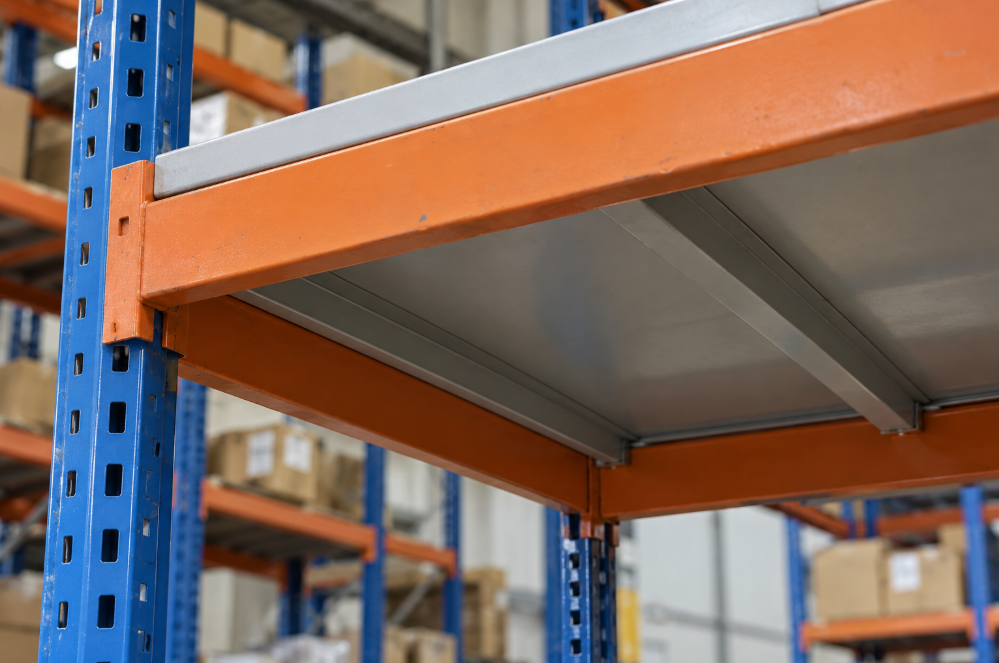
AI-generated illustration. Shelf supports and reinforcement must match the quoted configuration.
03 Verify Load Ratings Before Comparing “Heavy Duty” Claims
Check Per-Shelf and Total Bay Limits
For a heavy duty metal shelving unit, ask for both the permitted load per shelf level and the total bay limit. Record the size, number of levels and shelf positions to which those ratings apply.
Multiplying a shelf rating by the number of shelves does not establish the allowable bay load. Manufacturer capacity guidance can consider loaded shelf count, shelf loads and spacing separately when determining post requirements.[3]
Distinguish UDL from Concentrated Loads
A uniformly distributed load, or UDL, is treated as spread evenly over a defined area. A concentrated load acts over a relatively small area. The SMA identifies equipment feet as an example of concentrated loading.[4]
Tell the supplier how the goods contact the shelf. Do not assume a UDL rating covers the same total weight supported on small feet or narrow runners.
Match Load Evidence to the Quoted Configuration
When reviewing a calculation or test report, check the model, dimensions, component specification, supports, loading arrangement and conclusion. Ask the supplier to explain any differences between the documented configuration and the goods being quoted.
If a standard is referenced, verify its scope. ANSI MH28.2-2022 addresses industrial steel boltless shelving; its published scope does not establish that a particular supplier's product complies.[5]
Use the steel shelving load capacity guide for a fuller discussion of ratings and supporting evidence.
04 Check Usable Dimensions and Shelf Design
Overall Dimensions, Clear Openings and Vertical Clearance
Ask for a drawing that distinguishes the overall footprint from the space available for goods. Request clear width between obstructions, usable shelf depth and clear height above the stored item.
For example, three cartons each measuring 400 mm across need 1,200 mm of combined width before picking clearance is considered. A unit described as 1,200 mm wide externally should not be assumed to provide that opening. This is a dimensional planning example, not a recommended configuration.
Check how a container will be removed. Include hand access, lids, handles and any lifting movement in your review. Agree the necessary clearances for your goods rather than applying one generic allowance.
Shelf Panels, Supports and Reinforcement
Request a view of the shelf underside and its support arrangement. Include the panel type, intermediate supports and reinforcement in the agreed specification.
Ask the supplier to confirm suitability for the contact points identified in your inventory. A general material description such as “steel shelf” is too broad to define the assembly being purchased.
Where thickness is specified, identify each component and clarify whether the value describes base steel or the finished coated part. Agree the tolerance and inspection method. See how to verify steel thickness for the measurement checklist.
05 Confirm the Site and Installation Requirements
Floors, Fixings and Aisle Access
Send the supplier a layout showing the proposed rows, doors, columns and operating routes. Identify floor irregularities, restrictions on drilling and any site information requested by the responsible designer.
Obtain installation instructions for the exact configuration. If attachment to a wall or building column is proposed, consult the equipment provider and building designer; SMA guidance calls for consideration of the forces transferred between the structures.[4]
Review anchoring and restraint requirements before agreeing the installation scope. Confirm access routes and working clearances for the actual users and equipment.
Environment and Future Reconfiguration
Describe indoor or outdoor use, moisture, condensation, wash-down routines, cleaning chemicals and other relevant exposure. Ask the supplier to identify a suitable material and finish for those conditions and document any limitations.
If you expect to move shelf levels later, request the permitted configurations. SMA warns that reconfiguration outside the original design assumptions may affect rated capacity.[4] Include expected future changes in the purchasing brief so they can be assessed before ordering.
06 Compare Supplier Quotations on the Same Basis
Match Components, Materials and Documentation
Use a common comparison sheet for every quotation. Record unresolved differences instead of treating similarly worded offers as equivalent.
If a quotation leaves the panel supports or connection details unspecified, ask for clarification before comparing its price with a fully defined offer.
Include Packing, Delivery Terms and Installation Scope
Record packaging, shipment quantities, package dimensions, weights and the agreed delivery term with its named place or port. Identify which transport, destination and unloading costs are included.
Clarify whether assembly, fixings, site installation and installation checks are included or arranged separately. For distributors, also confirm labelling, spare components and the information supplied to the end user.
Compare the cost of supplying the same usable storage arrangement to the same scope. A lower price per set may reflect different components, packing or responsibilities.
07 Prepare Your Steel Shelving RFQ
Information to Send Before Requesting a Quote
Use the following request-for-quotation checklist. Mark unresolved items as “supplier recommendation requested” so they remain visible during review.
If your specification is incomplete, start with photographs of the goods, their dimensions and weights, and a simple room layout. Ask the supplier to list the assumptions used in its proposal.
References
Dexion — Longspan Shelving. Manufacturer example of longspan shelving with bolt-free beam connections.
Lyon — Bulk Storage Rack Add-On with Solid Decking. Manufacturer example of a dependent add-on configuration.
Lyon — 8000 Series Shelf Loading Capacities. Manufacturer guidance illustrating configuration-dependent post loading.
MHI / Storage Manufacturers Association — FAQs. Public guidance on load definitions, reconfiguration and building attachments.
ANSI — ANSI MH28.2-2022. Public scope description for industrial steel boltless shelving.
Manufacturer examples explain purchasing considerations. Their ratings and approvals do not apply to KAYOU products. Project requirements must be checked for the actual system and installation location.
Explore KAYOU shelving options
Review our steel storage shelving range or discuss an adjustable metal shelving configuration for your cartons, bins and parts.
Need to clarify technical details first? Start with load ratings, steel thickness and installation requirements.
PLAN YOUR NEXT SHELVING ORDER
Get a shelving configuration and quotation
Send KAYOU your goods dimensions, maximum shelf loads, layout, quantity and destination. Include the drawings and inspection documents you need for purchasing approval.
Not sure where to start? Send photos of the goods and a simple room sketch, and tell us which specifications you would like us to recommend.
WhatsApp: +86 158 3799 8881 · B2B supply · OEM / ODM enquiries