

KAYOU / WAREHOUSE PROCUREMENT / POLAND
Two warehouse shelving quotations arrive with the same headline: 300 kg per shelf. One uses steel panels; the other uses MDF or HDF boards. The dimensions look similar, but the price, supporting structure and maintenance requirements may differ.
Which should a Polish warehouse buyer choose?
Start with the goods, operating environment and complete shelving configuration. A material name and a capacity label are not enough to establish suitability.
This guide covers fixed shelving for manually handled cartons, bins and parts. It does not establish a design for forklift-loaded pallets or mezzanine floors.
By KAYOU · Updated October 27, 2026 · For warehouse buyers & distributors
Quick answer: Both steel and properly specified MDF/HDF shelf systems can be candidates for warehouse storage. Compare the exact panel construction, supports, documented loading conditions, moisture exposure, cleaning requirements and delivered cost before ordering.
1. Compare the Shelf Surface Separately from the Frame
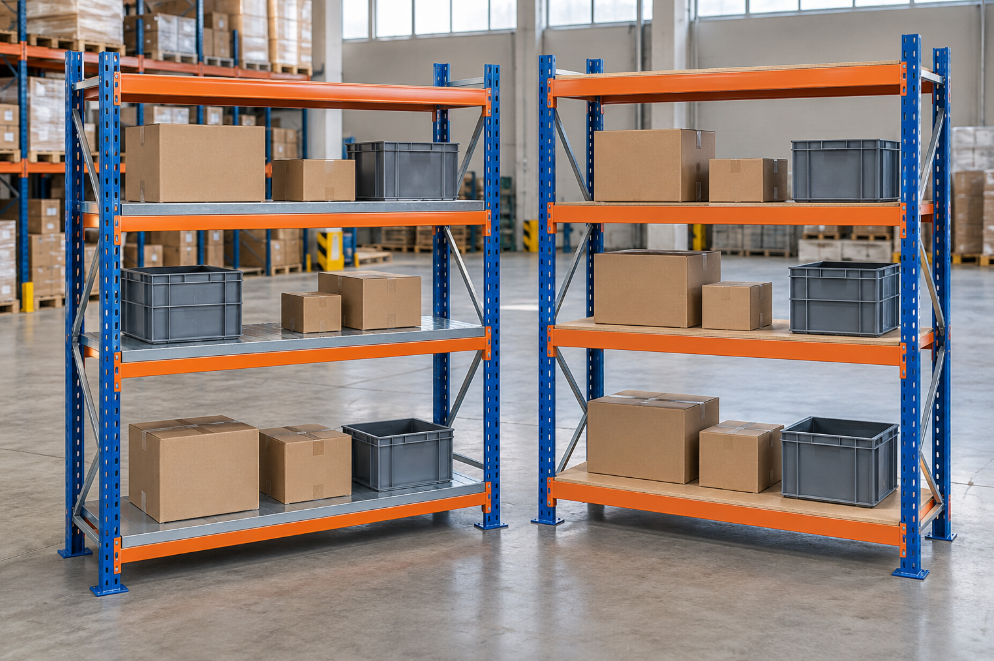
In Poland, a product described as regał metalowy may have a metal frame and wood-based shelf boards. The description does not necessarily mean all-steel construction.
For example, Metalkas organizes its shelving catalogue by MDF/HDF panels, metal shelves, grid shelves, finish and load category. These are visible purchasing distinctions—not evidence of national market shares. Metalkas shelving categories
Identify the frame and decking separately:
Steel decking: Specify solid panels, perforated panels or mesh/grid construction. These are different products.
MDF: Medium-density fibreboard; identify the actual product grade, thickness and finish.
HDF: High-density fibreboard; request its product data rather than treating the name as a load rating.
Supporting structure: Identify beams, shelf supports, braces, connectors and panel retention.
Higher density alone does not establish the capacity of a finished shelf. Nor does steel thickness alone establish the performance of a formed, reinforced panel.
For a broader material overview, see Metal vs Wood vs Plastic Shelving: Which Should You Choose?. This article focuses specifically on steel versus fibreboard decking for bulk warehouse procurement.
2. Start with Moisture Exposure and Cleaning
Describe the actual storage area rather than assuming every indoor warehouse is dry.
Tell suppliers about condensation, loading-bay exposure, roof leaks, wet cartons, cleaning methods and seasonal operating conditions. These factors can affect both panels and frames.
Steel shelves
Specify the steel and protective finish for the intended exposure. Powder-coated carbon steel, galvanized steel and stainless steel should not be treated as interchangeable.
Ask how the proposed finish should be cleaned and how damaged areas should be handled. A smooth metal surface may support a practical cleaning routine, but joints, folded edges and access underneath also matter.
Avoid assuming that a powder-coated shelf is suitable for outdoor exposure, aggressive chemicals or washdown.
MDF/HDF shelves
Request the panel manufacturer’s identification, grade, surface treatment and edge requirements.
Moisture resistance is a product-specific property. MEDITE SMARTPLY, for example, explains that its MEDITE MR product is intended for humid interiors, is not waterproof and should be protected from wetting. That guidance concerns the named product; it does not establish the properties of every MDF or HDF shelf board. MEDITE MR technical FAQs
A laminated face also leaves questions about cut edges, openings and the underside. Ask which cleaning methods the complete panel permits.
For dry carton storage, a suitably specified fibreboard shelf may be a reasonable option. For repeated wet cleaning or persistent condensation, request a specific material and finish assessment.
3. Match the Surface and Supports to the Goods
A shelf carrying flat-bottomed cartons has a different contact arrangement from one carrying bins with narrow runners or equipment on small feet.
Before requesting a quotation, record:
Maximum item weight, including its container.
Base dimensions and actual contact points.
Number of items per level.
Likely positions during normal use.
Whether items are placed, dragged or dropped.
How long stock normally remains loaded.
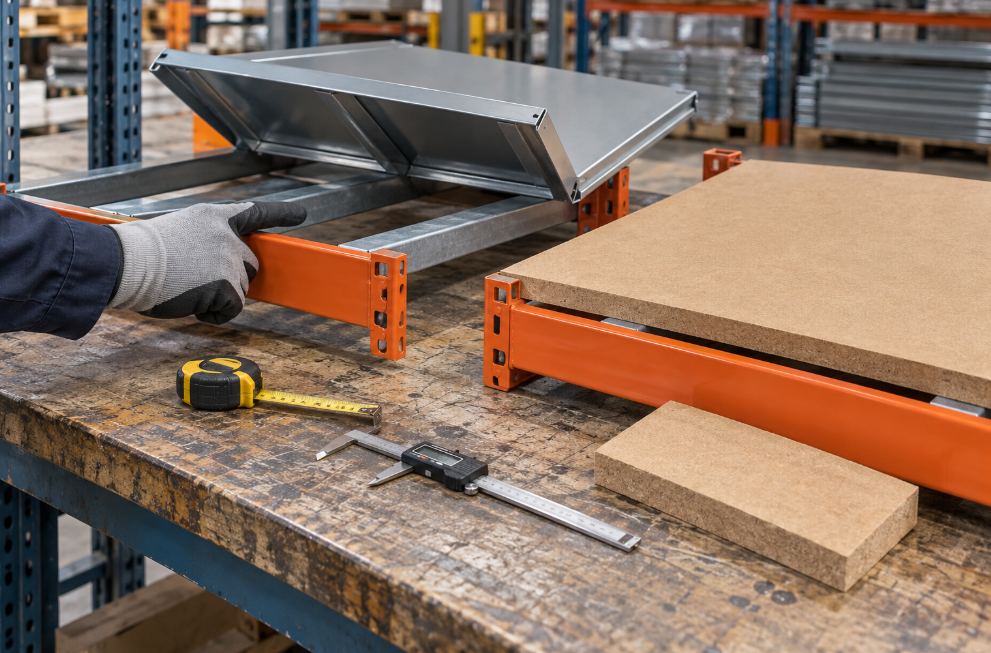
For steel panels, ask about panel widths, folded profiles, reinforcement and gaps between sections.
For MDF/HDF boards, ask about thickness, unsupported spans, bearing edges and intermediate supports. Request suitability for the intended loading duration and environment.
The support layout belongs in the quotation. An underside photograph or drawing can show details that a front-view catalogue image misses.
If a bin rests on two narrow runners, provide a bottom-view photograph. Its outside dimensions alone do not describe how its weight reaches the shelf.
4. Why Two “300 kg per Shelf” Claims May Differ
A rating needs to identify the panel, supporting members, dimensions and loading arrangement it covers.
Consider two storage patterns:
Ten cartons distributed across a level.
One compact item of the same total weight resting near the centre.
The total mass may match, while the forces in the panel and supports differ.
RMI guidance distinguishes uniformly distributed loads from point loads and explains why the actual contact arrangement matters. Its discussion concerns industrial racking; it supports the loading principle, not automatic application of a particular rack standard to every shelving product. RMI guidance on load distribution
Before accepting either offer, confirm:
Whether 300 kg means a uniformly distributed load or another defined pattern.
The shelf dimensions and support arrangement covered.
The permitted load for the complete bay.
The number and positions of shelf levels.
Installation, bracing and fixing requirements.
The applicable assessment or test basis.
Four levels rated at 300 kg do not, by themselves, establish a 1,200 kg bay rating.
Ask for identifiable evidence covering the quoted configuration. A useful report should describe the specimen, supports, loading method, deflection observations, acceptance criteria and results.
A short demonstration video cannot supply all that information. Likewise, replacing fibreboard with steel—or changing board thickness—requires confirmation that the revised configuration remains suitable.
Read KAYOU’s Guide to UDL, Load Testing and Structural Design when preparing your technical questions.
5. Use One RFQ to Compare Both Options
The following is an illustrative enquiry specification, not a KAYOU quotation, tested model or approved design. Both proposals must be assessed against the same storage requirement.
| Comparison item | Option A: Steel decking | Option B: MDF/HDF decking |
|---|---|---|
| Order quantity | 100 complete standalone bays | 100 complete standalone bays |
| Overall size | W 2,000 × D 600 × H 2,000 mm | W 2,000 × D 600 × H 2,000 mm |
| Shelf levels | Four | Four |
| Goods | Manually handled cartons; buyer supplies sizes and maximum weights | Same cartons and loading arrangement |
| Required capacity | Target 300 kg per level, subject to confirmed loading conditions | Same target and conditions |
| Bay requirement | Assess simultaneous loading of all four levels | Assess the same simultaneous loading |
| Deck specification | Declare steel grade, thickness, panel sections and reinforcement | Declare MDF or HDF product, grade, thickness and treatment |
| Supports and frame | Provide the proposed drawing and component list | Provide the proposed drawing and component list |
| Environment | Dry indoor storage; buyer identifies any exceptions | Same environment and exceptions |
| Commercial price | Quote complete bay price, currency, validity and delivery scope | Quote on the same commercial basis |
| Packing | State packed dimensions, net/gross weights and protection | State the same data for this option |
| Replacements | Quote panel/support prices, minimum quantities and lead times | Quote board/support prices, minimum quantities and lead times |
On mobile, swipe the table horizontally to compare both options.
The two proposals may need different structural details to satisfy the same requirement. Ask the supplier to identify those differences rather than forcing a panel substitution into an unchanged frame.
Compare usable openings as well as overall dimensions. Different beam profiles and panel supports can change available storage space.
For more quotation checks, see Steel Shelving Cost Breakdown: What Changes Your Factory Quote?.
6. Compare Delivered Cost, Packing and Maintenance
Do not assume MDF/HDF is always cheaper or steel always reduces transport costs.
Price depends on the actual panel, reinforcement, finish, quantity and manufacturing scope. Shipping weight depends on component dimensions and material quantities—not the material label alone.
Request:
Net and gross weight per complete bay.
Dimensions and quantities of every package type.
Protection against panel damage and moisture during transit.
A loading plan for the actual order.
Assembly requirements and included hardware.
Replacement-part costs and availability.
Steel components may require protection against dents, scratches and coating damage. Fibreboard panels need suitable edge, corner and moisture protection.
For imports into Poland, compare transport quotations using the same destination, delivery scope, currency assumptions and quotation date. For order planning, see our wholesale shelving guide to MOQ, packaging and container loading.
Then consider the cost of service. Can a damaged panel be replaced without changing the whole bay? Can staff identify the correct model? Are support bars and retention parts available?
Purchase price + delivery + assembly + maintenance + replacements provides a more useful comparison than unit price alone. Use your own operating assumptions; there is no universal lifespan or saving percentage for either option.
7. Check a Representative Sample Before Bulk Approval
Review the complete shelf assembly, including its underside.
Check panel seating, fit, edges, connections, support engagement and the instructions supplied for installation. Compare the components with the quotation and drawing revision.
Where technical evidence is required, agree its scope separately from visual inspection. A panel that looks satisfactory is not automatically suitable for the proposed load.
For fibreboard, record the product identification and treatment requirements. For steel, record the component specifications and finish.
Keep the approved sample record connected to the production order. Agree how changes will be reviewed and what evidence will accompany the shipment.
Do not replace boards locally by matching thickness alone. Panel grade, dimensions, supports and retention must remain consistent with the approved configuration.
Frequently Asked Questions
Is HDF automatically stronger than MDF shelving?
No universal shelf rating follows from the name. Compare product properties, thickness, unsupported span, supports and evidence for the completed assembly.
Are steel shelves always better in a damp warehouse?
They may be appropriate when the material, finish and construction suit the exposure. Ordinary coated carbon steel still needs suitable protection and maintenance. Provide the supplier with the actual moisture and cleaning conditions.
Can I put 300 kg anywhere on a shelf marked “300 kg”?
Only if the documented rating covers that arrangement. A uniformly distributed load rating should not be assumed to permit a concentrated load.
Can KAYOU compare both decking options for my order?
Send your requirements and ask which configurations are available and technically suitable. Any proposed steel or MDF/HDF option, supporting evidence and commercial terms should be confirmed in the written quotation.
Request a Shelving Proposal for Your Polish Warehouse
The right choice begins with the goods you store and the conditions in which the shelving will work.
Explore the KAYOU storage shelving range, then send:
Stored-item dimensions, weights and bottom-view photographs where relevant.
Warehouse conditions and cleaning methods.
Required bay dimensions, shelf levels and quantity.
Maximum load per level and expected loading pattern.
Preferred finish and any panel requirements.
Delivery destination in Poland and required schedule.
Ask for a complete specification, support arrangement, applicable capacity information, packing details and itemized quotation.
Sources reviewed October 27, 2026. Product listings show available categories, not market shares. The comparison RFQ is illustrative; confirm specifications and capacity evidence for your actual order.
DISCUSS YOUR WAREHOUSE REQUIREMENTS
Get Shelving Matched to Your Goods and Storage Conditions
Send KAYOU your stored-item details, warehouse conditions, bay dimensions, loading requirements and order quantity. Discuss suitable decking options, supporting specifications and an itemized quotation.
WhatsApp: +86 158 3799 8881